Best Dust Mask Respirators for Clean Breathing Anywhere
You need a mask that seals well and filters reliably, since even a small gap cuts protection drastically. The 3M P100 Reusable (65021H1-DC) delivers 99.97% filtration for both oil and non-oil particles, while the N95 8511 offers 95% efficiency with a valve to reduce breath resistance. BASE CAMP M PRO and M Plus provide strong filtration with washable shells and good comfort. Reusable models save money over time but require maintenance. Each has trade-offs in weight, fit, and filter life. Practical choices depend on your environment, facial shape, and how long you wear them. Your best pick hinges on matching specs to your real-world conditions - the details ahead clarify which performs where.
We are supported by our audience. When you purchase through links on our site, we may earn an affiliate commission, at no extra cost for you. Learn more. Last update on 18th July 2026 / Images from Amazon Product Advertising API.
Notable Insights
- N95, P95, and P100 filters offer 95% to 99.97% efficiency against dust, mold, and oil-based particles for reliable clean breathing.
- Reusable P100 respirators like the 3M 65021H1-DC provide long-term protection with high filtration and organic vapor cartridges.
- A proper seal is critical-adjustable straps and nose clips ensure fit, while facial hair can compromise protection.
- Lightweight designs under 10 ounces with exhalation valves reduce fatigue and heat buildup during extended wear.
- Models like BASE CAMP M Plus and Klein Tools P100 offer comfort, odor reduction, and compatibility with eyewear for versatile use.
3M P100 Reusable Respirator (65021H1-DC)

The 3M P100 Reusable Respirator (65021H1-DC) is best for workers regularly exposed to both hazardous particulates and organic vapors, like those sanding sealed wood or applying stains and coatings. I use it because it filters 99.97% of aerosols and resists oil-based particles. The NIOSH-approved OV cartridge reduces odors from varnishes and sealants, which helps during long jobs. Its lightweight design and adjustable straps mean it fits securely without pressure points. The swept-back cartridges give me a wider view, and the bayonet system lets me swap filters fast. It’s latex-free, made in the USA, and built to last-though filters need replacing over time.
Best For: Workers regularly exposed to hazardous particulates and organic vapors, such as those sanding sealed wood or applying stains, varnishes, and coatings.
Pros:
- Filters 99.97% of solid and liquid aerosols with P100 and NIOSH-approved organic vapor protection
- Lightweight design with adjustable straps and swept-back cartridges for comfort and improved field of view
- Reusable, durable construction with bayonet-style filter compatibility and no latex components
Cons:
- Organic vapor cartridge has limited service life and requires timely replacement
- Not effective against formaldehyde, ammonia, or methane hazards
- Higher initial cost compared to disposable respirators
3M N95 Respirator 8511 (10 Pack)
You’re covered if you work long hours on gritty construction jobs like drywall or floor sanding-this 3M N95 8511 respirator cuts breathing resistance by up to 50% compared to non-valved models thanks to its Cool Flow Exhalation Valve. I rely on its lightweight design and stretchable braided headbands for comfort during extended wear. The adjustable M-noseclip seals well without pressure points. It filters at least 95% of non-oil-based particles, including dust, pollen, and mold spores. I use it for sanding and pre-paint prep-it works. Each 10-pack gives me replacements that feel consistent. It’s disposable, so I don’t reuse it, but that keeps filtration reliable.
Best For: Professionals working long hours on dusty construction tasks like drywall hanging and floor sanding who need reliable, comfortable respiratory protection.
Pros:
- Up to 50% easier breathing compared to non-valved models thanks to the Cool Flow Exhalation Valve
- Lightweight design with stretchable braided headbands for secure, comfortable fit during extended wear
- Filters at least 95% of non-oil-based particles, including dust, pollen, and mold spores
Cons:
- Not effective against oil-based aerosols or fumes
- Disposable design means frequent replacement is necessary
- May not fit smaller face sizes securely despite adjustable noseclip
BASE CAMP M PRO Reusable Dust Mask
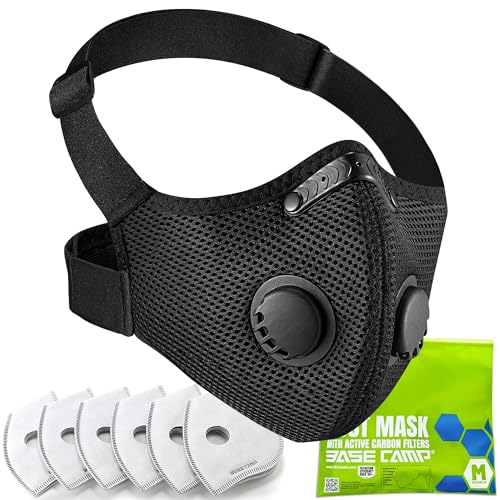
When long hours on the job demand reliable respiratory protection without sacrificing comfort, the BASE CAMP M PRO Reusable Dust Mask stands out for professionals tackling tasks like woodworking, sanding, or landscaping. I’ve worn it for 8+ hours straight, and the L-shaped head strap really does distribute weight evenly. The adjustable Velcro neck strap makes it easy to take on and off. It filters 99.6% of dust, pollen, and pollutants with six layers, including activated charcoal for odors. Dual valves keep airflow steady, cutting humidity. I can clean the shell with soap and water, and the six included filters guarantee long-term use. It’s lightweight, at just over 3 ounces, and stores neatly in the included resealable bag.
Best For: Professionals and DIY enthusiasts who need reliable, long-wearing respiratory protection during extended tasks like woodworking, sanding, grinding, or landscaping.
Pros:
- Six-layer filtration with activated charcoal effectively captures 99.6% of dust, pollen, pollutants, and odors
- L-shaped head strap and adjustable Velcro neck strap provide all-day comfort and secure, customizable fit
- Dual-valve design enhances breathability and reduces internal humidity during strenuous work
Cons:
- Replacement filters may need frequent changing in high-dust environments, increasing long-term cost
- Fit may vary slightly for users with very small or very large face sizes despite adjustable straps
- Cleaning required between uses to maintain performance, which may be inconvenient for some users
BASE CAMP M Plus Reusable Dust Mask

Built for workers who need reliable protection across heavy-duty tasks, the BASE CAMP M Plus Reusable Dust Mask stands out with its 6-layer EAPI nanofilter that blocks 99.6% of dust, pollen, and airborne contaminants. I’ve used it for sanding and mowing, and it cuts odors effectively thanks to the activated carbon layer. The mesh material boosts breathability by 11.3%, and the one-way valve keeps heat and moisture under control. It fits snug with an adjustable nose clip and hook-and-loop straps, reducing fog on glasses. The shell’s washable, filters are replaceable, and it’s light at just 2.89 ounces.
Best For: DIY enthusiasts and professionals handling dusty or odorous tasks like sanding, mowing, or painting who want a reusable, breathable, and well-fitting dust mask.
Pros:
- Blocks 99.6% of dust, pollen, and airborne particles with 6-layer EAPI nanofilter and activated carbon for odor reduction
- Enhanced breathability (11.3% increase) and moisture control via one-way valve and mesh material
- Washable shell, replaceable filters, and adjustable fit with nose clip and hook-and-loop straps for long-term use and comfort
Cons:
- Not suitable for protection against hazardous chemicals or fumes beyond particulates and odors
- One-size-fits-all design may not seal perfectly on all face shapes despite adjustability
- Replacement filters may add ongoing cost over time
AirGearPro G-500 Reusable Respirator Mask

Though not the lightest on the market, the AirGearPro G-500 Reusable Respirator Mask suits workers who need reliable protection from both airborne particles and organic vapors during extended tasks like painting or sanding. I’ve used it for hours without irritation thanks to the soft, skin-friendly materials and adjustable straps. It weighs just 3.25 ounces and uses A1P2 dual filters, blocking 95% of particles and filtering organic vapors from substances boiling above 65°C. The reusable design cuts waste-I swap in new filters when needed. CE certified and sold since April 2021, it’s built for real jobs, not just quick fixes.
Best For: Workers who need reliable, long-wearing protection from both airborne particles and organic vapors during extended tasks like painting, sanding, or construction.
Pros:
- Dual A1P2 filtration effectively captures 95% of particles and organic vapors from substances with boiling points above 65°C
- Reusable design with replaceable filters reduces environmental waste
- Lightweight at 3.25 ounces with soft, skin-friendly materials and adjustable straps for extended comfort
Cons:
- Not the lightest respirator available, which may affect comfort during very long shifts
- CE certification does not guarantee NIOSH approval for use in the United States
- Dual filtration may increase breathing resistance compared to basic particle-only masks
3M 8210 N95 Respirator (Pack of 20)

I rely on the 3M 8210 N95 Respirator when I need dependable protection in industrial settings where dust from grinding, sanding, or sweeping is present. It’s NIOSH-approved to filter at least 95% of non-oil-based particles, thanks to electrostatically charged microfibers that make breathing easier without sacrificing filtration. The cup-style design holds its shape, and the cushioned nose foam with an adjustable noseclip helps seal tightly while reducing fog on safety glasses. Dual steel straps stay securely attached and keep the fit consistent. It’s lightweight, so I can wear it for hours without fatigue, and it works well with goggles and ear protection. Each pack gives me 20 units-enough for a workweek or team use. Just remember: it’s meant for occupational, not consumer, use.
Best For: Industrial workers who need reliable, NIOSH-approved respiratory protection against non-oil-based particles during dusty operations like grinding, sanding, and sweeping.
Pros:
- NIOSH-approved with 95% filtration efficiency for non-oil-based particulates, ensuring trusted protection
- Lightweight, cup-style design with cushioned nose foam and adjustable noseclip for comfort and secure fit
- Compatible with safety goggles and hearing protection, ideal for use in occupational environments
Cons:
- Not intended for consumer use, limiting its applicability for personal or home projects
- Dual steel straps, while secure, may feel stiff or less comfortable for some users
- May not fit properly on all face shapes without careful adjustment, risking seal leakage
3M P95 Reusable Respirator (6311P1-DC)

If you work with solvents, pesticides, or spray paints regularly, the 3M P95 Reusable Respirator (6311P1-DC) is a dependable shield when reliable protection matters most. It’s NIOSH-approved with a 6001 organic vapor cartridge and 5P71 P95 filter, so it handles both fumes and fine particles. The P95 rating means it’s oil-proof, which matters when dealing with spray paints or adhesives. I find the lightweight design comfortable, and the swept-back cartridges don’t block my view. The bayonet system makes filter changes fast. It’s built for pros, not casual use, and while the upfront cost is higher, reusing the facepiece saves money over time. Replacement parts are easy to find. It’s made in the USA, weighs less than 10 ounces, and carries a limited warranty. For routine, heavy-duty jobs, it delivers consistent performance without surprises.
Best For: Professionals regularly exposed to organic vapors and oil-based particulates during tasks like paint spraying, solvent use, or pesticide application.
Pros:
- NIOSH-approved with P95 oil-proof filtration and organic vapor cartridge for reliable, dual-hazard protection
- Lightweight, comfortable design with swept-back cartridges for wide field of view and easy filter replacement
- Reusable facepiece with readily available replacement parts, offering long-term cost savings
Cons:
- Higher initial cost compared to disposable respirators
- Intended for occupational use only, not ideal for occasional or casual DIY projects
- Limited warranty requires contacting manufacturer for service and potential replacement
3M P95 Reusable Respirator (6211P1-DC)

The 3M P95 Reusable Respirator (6211P1-DC) is a solid choice for professionals working with oil-based paints, solvents, or pesticides, especially if you need reliable, dual-level protection and have a smaller face. It uses a NIOSH-approved P95 filter and 6001 organic vapor cartridge, blocking 95% of oil-based and solid aerosols while reducing exposure to vapors from paints, stains, and pesticides. The swept-back design improves visibility, and the soft faceseal fits snugly without leaking. At 15.8 ounces, it’s lightweight for long wear. I replace the filter regularly when paint spraying, as prefiltered use is required. It’s reusable and compatible with other 3M parts, but don’t use it in low-oxygen or IDLH environments.
Best For: Professionals with smaller faces who need dual-level protection against oil-based particulates and organic vapors during spray painting, pesticide application, or solvent-heavy tasks.
Pros:
- Provides reliable P95 filtration and organic vapor protection for hazardous environments
- Lightweight and comfortable with a soft faceseal and wide field of view
- Reusable design with bayonet compatibility for easy replacement of 3M cartridges and filters
Cons:
- Requires prefilter during paint spraying, adding to maintenance and cost
- Not suitable for use in low-oxygen or immediately dangerous to life or health (IDLH) environments
- Limited oil resistance with time-use restrictions when exposed to oil-based aerosols
3M P100 Mold & Lead Respirator (6297P1-DC)

You want this respirator when you’re up against mold spores, lead dust, or fine particulates that demand serious filtration-3M’s 6297P1-DC delivers with NIOSH-approved P100 filters that block 99.97% of airborne threats, including oil-based aerosols. It’s built for tough jobs like lead abatement, mold removal, or insulation work, and meets OSHA’s standards for respiratory protection. The built-in carbon layer helps reduce nuisance odors from solvents or resins, but don’t rely on it for chemical exposure. It’s lightweight, reusable, and fits comfortably with adjustable straps. I use it with 3M’s bayonet-style cartridges, which swap easily. Just remember-it’s for workplace use only and requires a proper respiratory program.
Best For: Professionals handling mold remediation, lead abatement, or fine particulates in industrial settings who need reliable, OSHA-compliant respiratory protection.
Pros:
- NIOSH-approved P100 filters provide 99.97% filtration efficiency against oil and non-oil-based particulates
- Integrated carbon layer helps reduce nuisance odors from solvents, degreasers, and resins
- Lightweight, reusable design with adjustable straps and 3M bayonet compatibility for secure, comfortable fit
Cons:
- Not suitable for environments with organic vapor concentrations above OSHA Permissible Exposure Limits
- Requires a full respiratory protection program, including fit testing and training, per OSHA regulations
- Not intended for chemical exposure protection-limited to nuisance odor reduction only
Klein Tools Reusable P100 Half-Mask Respirator

A reliable choice for professionals needing durable respiratory protection, the Klein Tools P100 Half-Mask Respirator delivers NIOSH-certified P100 filtration, blocking 99.97% of oil-based and non-oil-based particulates like dust, fumes, and mists. I’ve used it in gritty job sites, and the seal holds. The TPE body is lightweight at 6.4 ounces, and the low-profile design doesn’t clash with my safety glasses. Its downward exhalation valve keeps goggles fog-free. I can adjust the straps and nose clip for a secure fit, and the push-in seal check works fast. It uses replaceable P100 filters (sold separately), so I reuse the mask. The fit test port helps verify protection without guesswork.
Best For: Professionals in construction, metalworking, and industrial environments needing durable, reusable respiratory protection against dust, fumes, and oil-based particulates.
Pros:
- NIOSH P100-rated filtration blocks 99.97% of oil and non-oil-based particles, ensuring high-level respiratory protection
- Lightweight TPE design with a low-profile shape and downward exhalation valve prevents fogging of safety glasses
- Features a push-in fit check and built-in fit test port for reliable, verified face seal performance
Cons:
- Filters sold separately (model 60554), increasing total cost of ownership
- One-size-fits-most design may not seal properly on smaller or larger face shapes despite adjustability
- Reusable nature requires regular cleaning and maintenance to ensure continued effectiveness
Factors to Consider When Choosing a Dust Mask Respirator
You need a dust mask that fits snugly and seals well to keep particles out-otherwise, even the highest filtration won’t help. Look for models that balance comfort during long use with easy breathing, especially if you’re wearing safety glasses or working for hours. Not all masks handle these factors the same, so check how each one performs in real conditions.
Fit and Seal Quality
Proper fit and seal determine how effectively a dust mask respirator delivers its rated filtration. If the mask doesn’t seal tightly, gaps can let in unfiltered air, cutting protection by over 50%. Facial hair like beards or stubble breaks the seal, so you’ll get far less protection even with a high-rated filter. You need adjustable straps and a nose clip to mold the mask snugly to your face-this customization reduces leaks across different facial shapes. In workplaces, fit testing (qualitative or quantitative) is required to confirm the seal works for you. Look for low-profile designs and downward-facing exhalation valves-they maintain seal integrity by reducing pressure and prevent fogging on glasses. These features don’t just add comfort; they keep contaminants out. A good seal isn’t optional-it’s essential for real-world performance. Test the fit every time you wear it.
Filtration Efficiency Level
When choosing a dust mask respirator, the filtration efficiency level directly determines how well it blocks airborne particles, and that depends on the filter’s NIOSH rating. You’ll need an N95 if you’re filtering non-oil-based particles like dust or pollen-it blocks at least 95% but fails around oil. If oil-based aerosols are present, go with a P-series. P95s offer 95% efficiency and resist oil, while P100s capture 99.97% of both solid and liquid particles, including oil. That makes them ideal for high-risk tasks like lead or mold removal. R-series filters also work with oil, but only for up to eight hours. P100 is your best bet when maximum protection matters, even if it costs more. Match the filter to your environment-using the wrong type cuts efficiency fast. Don’t guess; check the rating. Your lungs depend on getting this right.
Comfort for Extended Wear
A high filtration rating means little if the mask forces you to take it off every hour due to discomfort. You need a respirator that stays comfortable over long shifts. Look for models under 10 ounces-they reduce neck strain during full-day use. Adjustable head straps and flexible faceseals let you customize the fit, cutting pressure points that cause fatigue. Sweat-resistant thermoplastic materials stay soft against your skin and prevent irritation. Headbands with L-shaped or braided designs spread pressure evenly, so you won’t keep readjusting. Exhalation valves help too-they lower heat and moisture buildup, making each breath easier when you’re working continuously. Without one, you’ll feel stuffy and distracted. Comfort isn’t just about softness; it’s about smart engineering that supports endurance. Choose a mask that balances fit, weight, and breathability, so you can stay protected without constant breaks.
Compatibility With Eyewear
You’ll want a respirator that works with your safety glasses without compromising the seal or fogging up the lenses. Look for models with an adjustable nose clip-it helps create a secure seal and reduces air leakage that causes fogging. Downward-facing exhalation valves direct warm breath away from your lenses, keeping them clear during long tasks. Choose low-profile designs with swept-back filters; they improve your field of view and reduce interference with goggles or glasses. Head straps with adjustable tension let you fine-tune the fit, maintaining a tight seal while keeping eyewear stable. Cushioning along the nose bridge cuts pressure points without sacrificing a leak-proof fit, even when wearing specs. These features work together to guarantee visibility and protection, so you’re not constantly readjusting gear. A compatible mask means clearer vision and consistent performance-no guesswork, just reliable function.
Ease of Breathing
Clear vision matters, but so does being able to breathe without effort during long jobs. You’ll want a mask that doesn’t make every breath feel like work. Look for models with exhalation valves-they cut breathing resistance by up to 50% and let hot, moist air escape fast. That means less fog, less fatigue. Valved designs keep you cooler during extended use, especially in warm settings. Electrostatic filter media help too, offering strong particle capture with lower initial airflow resistance than many mechanical filters. Just don’t assume more layers mean better performance-multi-layer systems can restrict breathing if not well designed. Opt for low-profile or swept-back filters that align with your natural air path. They reduce blockage and keep airflow smooth. Balance filtration needs with how easily you can inhale and exhale. Your lungs will notice the difference over hours of use.
Reusability and Maintenance
Don’t assume all respirators are disposable-some are built to last. Reusable models save money and reduce waste, with washable shells and valves you can clean with warm water and mild soap. You’ll replace only the filters, swapping them when they near end-of-life, which keeps your protection reliable and cuts environmental impact. Look for designs with fit check systems or sample ports so you can confirm a proper seal-no guesswork. Maintenance is simple but non-negotiable: clean the facepiece regularly, inspect for cracks or wear, and change filters based on exposure, not a calendar. Store your respirator in a sealed bag or case to prevent contamination and extend component life. Reusables cost more upfront, but their long-term value wins if you use them often. They’re practical for daily jobs, especially in dusty or high-exposure environments. Just stay consistent with care, or you’ll compromise safety.
Frequently Asked Questions
How Long Can I Reuse a Disposable N95 Mask?
You can reuse a disposable N95 mask up to five times if it’s dry, clean, and undamaged. Don’t reuse it if it’s soiled, wet, or crushed-those reduce seal and filtration. Store it in a paper bag between uses to prevent moisture buildup. Each reuse slightly degrades the fit and electrostatic charge, lowering protection. It’s a practical trade-off when supply’s short, but don’t push it beyond safety limits.
Can I Wear a Dust Mask With Facial Hair?
You can’t wear a dust mask effectively with facial hair. It breaks the seal, letting unfiltered air leak in. Even stubble reduces protection. For a proper fit, shave first. If you can’t, use a powered air-purifying respirator (PAPR) with a hood. Those don’t rely on face seals. Facial hair’s a real flaw in protection-skip it if air quality or safety’s a concern. Test fit matters more than comfort.
Are P100 Filters Effective Against Viruses?
Yes, you can stop most viruses with P100 filters-they capture 99.97% of particles as small as 0.3 microns. You’ll block viral droplets and airborne pathogens effectively, but only if the mask seals tightly to your face. Gaps leak unfiltered air, making even the best filter useless. You’ll need a full respirator, not just a dust mask, and you must maintain a snug fit. Facial hair often breaks that seal, so you’ll likely need to shave for real protection.
Do Respirators Protect Against Paint Fumes?
Yes, respirators protect against paint fumes-if they have organic vapor cartridges. Standard particulate filters like N95 or P100 won’t stop fumes. You need an NIOSH-approved respirator with activated carbon layers that absorb solvent vapors. For oil-based paints, go with a P100-rated cartridge with vapor protection. Always check the cartridge’s rated service life and replace it when you start to smell odors. Reusable models save money over time, but fit and seal matter just as much as the filter type.
Can Children Safely Use Adult-Sized Respirators?
No, children can’t safely use adult-sized respirators because they won’t seal properly due to smaller face sizes. A poor seal means contaminated air leaks in, reducing protection. Most adult models aren’t adjustable enough for a child’s facial structure. You need a proper fit to filter harmful particles effectively. Instead, use respirators specifically designed for kids. They’re sized right and tested to fit younger users safely and securely.