Best Backpacks for Bushcraft Adventures (And Why They Last)
You need a durable, weather-resistant pack that handles heavy loads over rough terrain. The ONETIGRIS WILD ROCKET 45L lasts with 500D Cordura nylon and 500mm waterproof rating, while the 70L Mardingtop offers full MOLLE and an integrated raincover. Waxed canvas models shed water but require maintenance. Tactical designs with reinforced stitching and YKK zippers hold up under strain. Look for padded hips, ventilation, and secure closures. Each choice balances weight, capacity, and resilience-knowing the trade-offs helps you pick what works where it matters most.
We are supported by our audience. When you purchase through links on our site, we may earn an affiliate commission, at no extra cost for you. Learn more. Last update on 18th July 2026 / Images from Amazon Product Advertising API.
Notable Insights
- Durable materials like 500D–1000D Cordura or polyester ensure long-term resistance to abrasion and tears in rugged environments.
- Reinforced stitching and high-quality hardware (YKK zippers, UTX-Duraflex buckles) enhance structural integrity under heavy use.
- Waterproof or water-resistant fabrics with coatings or integrated rain covers protect gear during extended bushcraft trips.
- Spacious, well-organized compartments and external attachment points improve gear access and load customization.
- Ergonomic features like padded harnesses, load lifters, and internal frames distribute weight for comfort on multi-day adventures.
ONETIGRIS WILD ROCKET 45L Backpack

If you’re someone who counts gear weight but won’t cut corners on durability, the ONETIGRIS WILD RACKET 45L hits a sweet spot between toughness and practicality. I carry it for multi-day bushcraft trips, and the 500D Cordura nylon resists abrasion like military packs do. It weighs 4.6lbs-light enough to move fast, tough enough to drag through brush. The roll-top closure seals against rain, and the 400–500mm waterproof rating keeps my gear dry in downpours. MOLLE webbing lets me clip tools where I need them, and side axe loops hold my hatchet securely. YKK zippers don’t snag, even when I’m tired.
Best For: Outdoor enthusiasts who prioritize durable, lightweight backpacks for bushcraft, backpacking, and survival adventures.
Pros:
- Made with rugged 500D Cordura nylon and features YKK zippers and UTX-Duraflex buckles for superior durability
- 45L roll-top design with MOLLE webbing, axe loops, and hydration compatibility offers excellent organization and customization
- Waterproof rating of 400–500mm and water-repelling finish keep gear dry in harsh weather
Cons:
- At 4.6lbs, it may be heavier than ultralight backpacking preferences
- Recommended for users over 5’7″, limiting fit for shorter individuals
- Water bladder not included despite hydration compatibility
Waterproof Waxed Canvas Backpack for Men

The TOPWOLFS Waterproof Waxed Canvas Backpack stands out for bushcraft adventurers who prioritize durability and weather resistance in a compact, reliable pack. I’ve used it in steady rain and heavy brush, and the waxed canvas sheds water without soaking through. At 18 liters, it’s small but fits essentials like a knife, fire starter, and a light jacket. It weighs just 1.72 pounds, so it won’t drag you down. The leather trim adds structure, and the build feels tough without being stiff. It’s ranked #326 in daypacks, with a solid 4.5-star rating from 784 reviews. I noticed it fits adults and older kids, despite the “children” age tag. There’s a warranty, and you can submit lower prices if you find one. It won’t carry a week’s gear, but for short trips and rugged use, it’s dependable.
Best For: Bushcraft adventurers and outdoor enthusiasts who need a durable, weather-resistant backpack for short trips and rugged use.
Pros:
- Waterproof waxed canvas construction effectively sheds rain and withstands heavy brush
- Lightweight at only 1.72 pounds while offering 18 liters of practical storage
- High customer satisfaction with a 4.5-star rating from 784 reviews and added value through warranty and price match options
Cons:
- Limited 18-liter capacity makes it unsuitable for extended trips or carrying bulky gear
- Listed with an inaccurate “children” age range despite being designed for adults
- May require re-waxing over time to maintain full waterproof performance
GOOTIUM High-Density Canvas Backpack (Large)
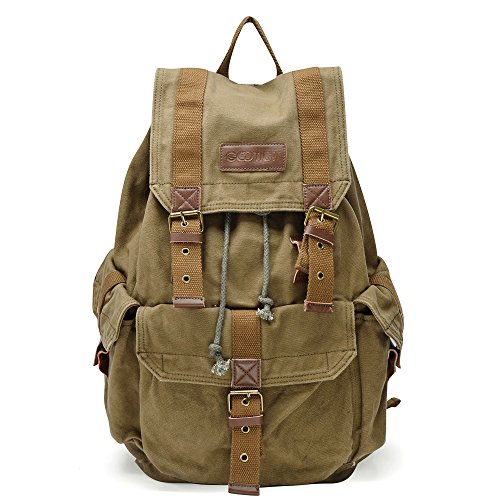
I rely on gear that balances durability and practicality when heading into the backcountry, and the GOOTIUM High-Density Canvas Backpack (Large) fits anyone needing a rugged, no-frills pack for bushcraft use. Made from thick, garment-washed canvas, it feels soft yet resists wear, and the metal fastenings won’t fail under stress. At 13.5 x 8 x 17.7 inches, it holds a 17-inch laptop plus gear, while the front, side, and internal zippered pockets keep essentials organized. The structured design supports daily carry or short trips, though it lacks frame support for heavy loads. It’s not waterproof, but the dense fabric sheds light rain. I use it when I need simplicity and reliability.
Best For: Outdoor enthusiasts and daily commuters seeking a durable, low-profile canvas backpack for light to moderate loads and organized carry.
Pros:
- Constructed with high-density, garment-washed canvas for a soft feel and rugged durability
- Features multiple organized storage options including a laptop sleeve and secure zippered pocket
- Stylish vintage look with reliable metal fastenings and clean, reinforced stitching
Cons:
- Lacks internal frame or padding for support during heavy or extended backcountry use
- Not fully waterproof; only sheds light rain due to fabric density
- Limited size options; large model may be oversized for minimalist packers
REEBOW GEAR Tactical Backpack 3-Day Assault Pack

You’ll find the REEBOW GEAR Tactical Backpack 3-Day Assault Pack works best if your bushcraft trips demand reliable carry for multi-day outings without extra weight. I’ve used it on 48-hour treks, and it holds up thanks to its 600×600 high-density fabric and double-stitched seams. At 40 liters and just 2.62 pounds, it’s light but spacious enough for essentials. The MOLLE system lets me attach extra pouches, and the compression straps keep the load stable. Ventilated padding cuts sweat during long hikes, and the hydration sleeve fits a standard bladder. Heavy-duty zippers and cord pulls haven’t failed, even in wet, rough use.
Best For: Outdoor enthusiasts and tactical users seeking a durable, lightweight 40-liter backpack for 3-day adventures, hiking, camping, or bushcraft.
Pros:
- Constructed with 600×600 high-density fabric and double-stitched seams for superior durability
- Full MOLLE webbing system and compression straps allow for customizable gear attachment and load stability
- Ventilated mesh padding and hydration bladder compatibility enhance comfort and convenience during extended use
Cons:
- No included hydration bladder, requiring a separate purchase
- Limited internal organization compartments for finer gear categorization
- Some users may find the unisex fit less optimal for very petite or tall frames
Fjallraven F23350662 Skule Top 26 Deep Forest

Lightweight durability defines the Fjallraven F23350662 Skule Top 26 Deep Forest, making it a solid pick for hikers who prioritize function without excess bulk. I use it on short hikes and daily trips where gear load stays under 20 pounds. The Oxford fabric resists abrasions, and the recycled polyester liner adds structure without weight. Its 26-liter capacity fits essentials, and the zippered front compartment keeps smaller items organized with mesh pockets. Padded straps distribute weight well, and the air-mesh back panel reduces sweat during movement. It won’t handle multi-day loads, but for day use, it balances comfort and resilience efficiently.
Best For: Hikers and commuters seeking a lightweight, durable daypack for short trips and daily use under 20 pounds.
Pros:
- Durable Oxford fabric and recycled polyester lining offer long-lasting performance with eco-conscious materials
- Well-organized storage with a zippered front compartment and internal mesh pockets for easy access
- Comfortable carry thanks to padded shoulder straps and a ventilated air-mesh back panel
Cons:
- Limited 26-liter capacity isn’t suitable for multi-day hikes or heavy loads
- Minimal padding on back panel may reduce comfort on extended wear
- Lack of side compression straps limits adaptability for bulky gear
Helikon-Tex Matilda Backpack

The Helikon-Tex Matilda Backpack suits those who prioritize organized storage and structural support in rugged conditions. I rely on its 35 L capacity for multi-day bushcraft trips, and it fits a hydration system. The double main chamber with drawstring adjustment keeps gear secure, while two zippered flap pockets-one external, one mesh inside-add smart organization. Three external buckled pockets with drawstring sleeves hold tools I need fast. MOLLE/PALS panels let me attach pouches; the loop-velcro flap panel lets me add identification. Reinforced stitching at key points, stiffened back support, and a detachable hip belt distribute weight well. The carry and transport handles work when I’m moving quickly. Accessories aren’t included, but they’re not needed-this pack’s ready as-is.
Best For: Outdoor enthusiasts and bushcrafters who need a durable, well-organized backpack with customization options and solid load support for multi-day adventures.
Pros:
- Spacious 35 L capacity with smart compartment layout for efficient gear organization
- MOLLE/PALS and loop-velcro panels allow for personalization and gear expansion
- Reinforced construction, stiffened back, and detachable hip belt ensure comfort and durability under load
Cons:
- No included accessories, so hydration bladder and other add-ons must be purchased separately
- External pockets, while functional, may lack quick-access design for frequent use
- Drawstring closures may be less secure than zippers in high-movement scenarios
Mardingtop 75L Molle Hiking Backpack with Rain Cover

Hauling gear through backcountry trails demands a pack built for endurance, and the Mardingtop 75L Molle Hiking Backpack fits those who prioritize capacity and durability without stepping into expedition-grade bulk. I’ve used it on multi-day bushcraft trips, and its 75-liter volume handles all my essentials, from shelter to fire-making tools. The 600D polyester resists abrasion, and YKK zippers run smooth under stress. MOLLE webbing lets me attach extras securely, while the internal frame supports heavy loads without sagging. It includes a rain cover, which actually works-my gear stayed dry in a two-hour downpour. The front zipper opens like luggage, making packing easier, and the hydration sleeve fits a 3L bladder. Side pockets hold water bottles, and trekking poles clip externally without bouncing. At 4.49 pounds, it’s light enough for long hikes but tough enough for rugged use. It’s not expedition-level refined, but for regular backcountry use, it balances function, price, and resilience.
Best For: Outdoor enthusiasts who need a durable, high-capacity backpack for multi-day hiking, camping, and bushcraft adventures without the weight of expedition-grade packs.
Pros:
- Spacious 75-liter capacity with luggage-style front access for easy organization
- Durable 600D polyester construction, YKK zippers, and functional rain cover keep gear protected
- MOLLE webbing and external attachment points provide excellent customization for tactical and outdoor gear
Cons:
- Bulkier design may be overkill for day hikes or minimalist backpackers
- Chest and hip straps, while supportive, could use more padding for ultra-long treks
- Limited color options and utilitarian aesthetic may not appeal to all users
Mardingtop Tactical Molle Backpack 25L
You want a pack that keeps up when the trail turns rough, and this 25-liter tactical backpack fits anyone serious about staying prepared without excess weight. I’ve used it on hikes and short bug-out drills, and its 600D polyester holds up, weighing just 1.2kg. The YKK zippers and buckle don’t snag. It has a main compartment with front zip access, dedicated pockets for a power bank, wallet, and clothes, plus a hydration sleeve for a 2L bladder-tube exits near the top handle. MOLLE webbing lets me attach pouches; four straps secure a bedroll or tent. Chest straps help balance the load. It’s compact enough for day use but tough enough for survival scenarios, working as a trekking pack, bug-out bag, or travel carry-on.
Best For: Outdoor enthusiasts, preppers, and tactical users who need a durable, lightweight 25L backpack for hiking, bug-out scenarios, or daily carry.
Pros:
- Durable 600D polyester construction with YKK zippers ensures long-term reliability
- MOLLE webbing and external attachment straps allow for customizable gear setup
- Hydration-compatible with dedicated sleeve and easy tube routing for on-the-go use
Cons:
- No included hydration bladder, requiring a separate purchase
- Limited capacity for multi-day trips beyond 2 days
- Chest strap may feel restrictive for some users during prolonged wear
Large Tactical MOLLE Backpack 70L

If you’re tackling extended bushcraft trips that demand gear versatility and durability, the Large Tactical MOLLE Backpack 70L stands out with its full-coverage MOLLE webbing, letting me attach pouches and tools exactly where I need them. Made from 1000D polyester, it handles rough use without added bulk. Its 70L capacity fits multi-day gear, with top and front access to the main compartment. I use the hydration-compatible design with tube ports on both sides for easy sipping. The adjustable harness, lumbar pad, and load lifters keep heavy loads stable. Integrated raincover protects contents when storms hit. Compression straps and external lash points let me secure extra gear. While it’s heavier than ultralight packs, the trade-off is unmatched durability and organization for serious missions.
Best For: Outdoor enthusiasts and tactical users needing a durable, highly configurable 70L backpack for extended missions, bushcraft, or rugged adventures.
Pros:
- Full-coverage MOLLE webbing allows customizable gear attachment for mission-specific setups
- Durable 1000D polyester construction and integrated raincover ensure reliability in harsh conditions
- Multiple access points, ample storage, and ergonomic suspension enhance comfort and organization
Cons:
- Heavier than ultralight backpacking packs, making it less ideal for weight-conscious users
- Complex feature set may overwhelm casual hikers or beginners
- Narrow design, while enhancing mobility, may limit bulkier gear packing options
Helikon-Tex Bergen Earth Brown/Clay Backpack

The Helikon-Tex Bergen Earth Brown/Clay Backpack suits bushcrafters who prioritize durability and modularity in rugged terrain. I’ve used it on long treks, and its 18-liter capacity holds essentials without bulk. Weighing 1380 g, it’s light enough for day hikes but tough thanks to 500D Cordura nylon. The main compartment has a zip pocket and sleeve, plus a snow collar with drawstrings to keep gear dry. YKK zippers with metal sliders last, and Woojin buckles secure well. MOLLE/PALS webbing lets me attach extra pouches. Padded straps, a chest clip, and waist belt make carrying comfortable, even with a hydration bladder.
Best For: Bushcrafters and outdoor enthusiasts who need a durable, modular backpack for day hikes and rugged terrain.
Pros:
- Durable 500D Cordura nylon construction with YKK zippers and Woojin buckles for long-lasting performance
- MOLLE/PALS webbing throughout allows for customizable gear attachment
- Comfortable padded straps with adjustable chest and waist belts, plus hydration bladder compatibility
Cons:
- 1380 g weight may be heavy compared to other 18-liter packs
- 18-liter capacity may be too small for extended trips
- Limited color options within the Bushcraft line
Factors to Consider When Choosing a Backpack for Bushcraft
You need a backpack that won’t fall apart in the field, so check the material durability-ripstop nylon or Cordura fabrics handle abrasion better. Make sure the storage capacity matches your trip length; 40–60 liters is usually enough for multi-day bushcraft without overloading. Weather resistance, ergonomic design, and modular compatibility aren’t just nice-to-haves-they keep gear dry, reduce fatigue, and let you adapt the pack as needed.
Material Durability
Though not all backpacks handle rough terrain equally, choosing one built with high-density 500D to 1000D nylon or polyester guarantees it withstands abrasion and tearing during extended bushcraft trips. You’ll need double or triple stitching at stress points-like the shoulder straps and bottom panel-to maintain structural integrity under heavy loads. Reinforced fabrics with PU or silicone coatings resist water without sacrificing strength, keeping your gear dry and the material from degrading in wet conditions. Opt for packs with military-grade components: UTX-Duraflex buckles and YKK zippers won’t fail when constantly adjusted or exposed to dirt and moisture. MOLLE webbing made from durable woven straps lets you attach tools securely without tearing the base fabric. These features aren’t just extras-they’re essentials that determine how long your pack lasts when pushed hard in the wild.
Storage Capacity
When sizing up storage capacity for bushcraft, start by matching the pack’s volume to your trip length, since a 20L pack won’t carry enough for more than a day or two while a 75L model may be overkill for short outings. You’ll want 30–45L for weekend trips-enough space for essentials without excess bulk. Packs sized 50L and up make sense when you’re out for several days and need room for shelter, food, and tools. Look for multiple compartments and external attachment points so you can organize gear like fire starters, knives, and cordage for quick access. Roll-top closures and drawstring collars let you compress the load or expand it as needed, improving flexibility. Hydration-compatible designs often trade a bit of storage space, but the convenience of on-the-go drinking usually outweighs the slight loss in volume.
Weather Resistance
A backpack’s ability to keep your gear dry and intact in harsh conditions matters just as much as how much it holds. You need high-denier fabrics-look for 500D to 1000D-paired with durable water-repellent coatings to resist abrasion and moisture. A waterproof rating of at least 400–500mm hydrostatic head keeps your gear dry through light to moderate rain. Seams should be taped or double-stitched and sealed, especially in high-stress areas where leaks often start. Always check for integrated rain covers stored in external pockets-they’re essential for sudden downpours and keep your pack functional when weather hits fast. Use backpacks with YKK zippers protected by storm flaps or fabric overlays, as these block water from seeping through zipper tracks during heavy rain. Don’t assume all “water-resistant” packs are equal-real protection comes from combined materials, construction, and design tested beyond specs.
Ergonomic Design
SinceYou’ll move more efficiently on rugged terrain if your backpack transfers weight properly and fits your body. You’ll want padded shoulder straps and a ventilated back panel-they cut fatigue and let air flow during long hikes. An adjustable load lifter strap pulls the pack closer to your center of gravity, boosting balance and cutting shoulder strain. A padded hip belt is essential; it shifts most of the load to your hips, making loads above 20 lbs feel manageable. Look for a customizable suspension system so you can dial in the fit to your torso length-this keeps the pack stable on uneven ground. Side and front compression straps let you secure the load tight, maintaining balance in thick brush. A well-tuned fit means less sway, better control, and fewer pressure points over time.
Modular Compatibility
With modular compatibility, you get precise control over gear placement through MOLLE (Modular Lightweight Load-carrying Equipment) webbing, typically made of 30mm nylon strips spaced at 1-inch intervals and stitched at high-stress points for durability. You can attach mission-specific pouches, medical kits, or tool holders directly to full- or partial-coverage panels, customizing your loadout for bushcraft demands. The standardized grid guarantees compatibility with most tactical accessories, so you’re not locked into proprietary systems. Reinforced stitching at each junction supports real weight, tested to endure constant strain from attached gear over long treks. You’ll also find utility straps, lash points, or compression webbing layered under or between MOLLE fields, letting you secure sleeping pads, axes, or trekking poles externally without compromising stability. While added attachment points increase versatility, they can add bulk if overused. Choose panels positioned where you’ll actually use them-side, front, or top-to balance access and streamlining.
Frequently Asked Questions
How Do I Season a Waxed Canvas Backpack?
You don’t season a waxed canvas backpack like cast iron. The manufacturer already applied wax. If it looks dry or water stops beading, you re-wax it. Rub a paraffin-based wax bar evenly over the fabric in a warm room. Use a hair dryer to gently heat and absorb the wax. Wipe off excess. This restores water resistance without damaging fibers. Over-waxing causes stiffness, so apply only when needed.
Can I Use a Bushcraft Backpack for Urban Commuting?
Yes, you can use a bushcraft backpack for urban commuting, but you’ll trade comfort for durability. These packs are built to handle rough terrain and heavy loads, so they’re often heavier and less padded than urban-focused models. You’ll get tough materials and simple designs that last, but minimal back support and fewer organizational pockets. If you value ruggedness over convenience and don’t mind the weight, it’ll work. Just expect less comfort during daily commutes.
Are These Backpacks Bear-Resistant or Bear-Proof?
No, these backpacks aren’t bear-resistant or bear-proof. They’re built for durability and load support, not animal attacks. While the tough fabrics might slow a bear, they won’t stop one from tearing through. If you’re hiking in bear country, you need a certified bear-resistant food container-not your backpack-to store food and scented items. Relying on any standard pack for protection is unsafe and untested. Use proper bear bags or canisters instead.
Do Any of These Models Have a Built-In Hydration Bladder?
No, none of these models have a built-in hydration bladder. You’ll need to add one separately, as they’re designed with hydration sleeves instead. That gives you flexibility to choose your preferred bladder size and brand. Just slide it into the dedicated compartment and route the tube through the shoulder strap port. It’s a practical setup-you save weight and avoid built-in bladders that can leak or degrade over time.
Is It Safe to Store My Bushcraft Backpack in a Garage?
You shouldn’t store your bushcraft backpack in a garage unless it’s clean, dry, and sealed. Garages expose gear to temperature swings, humidity, and pests-mold, rodents, and UV damage can degrade fabric and stitching over time. Hang it off the floor, away from concrete moisture. Use a breathable cotton sack, not plastic. Cleaning it first prevents mildew. You’re better off storing it indoors where conditions are stable and predictable.