Best Backpacking Power Banks for Off-Grid Adventures
You need a power bank that’s durable, efficient, and light enough for long trails. Models like the INIU 45W and Anker 10K deliver fast charging in compact sizes, while rugged options like the ELECOM NESTOUT (IP67, 15,000mAh) and BLAVOR solar models handle drops, rain, and dust. Solar charging works in emergencies but isn’t reliable alone. High-capacity banks (50,000mAh) offer multiple charges but may exceed airline limits. Choose based on capacity, portability, and real-world durability. There’s more to take into account for your specific adventure.
We are supported by our audience. When you purchase through links on our site, we may earn an affiliate commission, at no extra cost for you. Learn more. Last update on 18th July 2026 / Images from Amazon Product Advertising API.
Notable Insights
- Choose rugged, high-capacity power banks like 20,000mAh models with IP68 ratings for durability in harsh conditions.
- Opt for solar-charging models such as the 49800mAh unit with foldable panels for sustained off-grid power.
- Prioritize fast charging with 32W–45W USB-C PD to maximize battery top-ups during short breaks.
- Select compact, lightweight designs under 1 lb with high energy density for easier backpack integration.
- Ensure multi-port functionality with USB-C, USB-A, and built-in cables to charge several devices simultaneously.
Anker Power Bank 10K (PowerCore 10,000mAh)

If you’re a minimalist backpacker who demands reliability without bulk, the Anker Power Bank 10K (PowerCore 10,000mAh, model A1229) fits the role. I carry it because it weighs just 8.5 ounces and slips into tight pack pockets at 6 inches long. It’s survived drops during my trips-thanks to its 3.2 ft drop test rating-and charges my iPhone 15 twice or my Galaxy S23 nearly twice. The two-way USB-C runs input and output at 5V/3A, so I recharge it fast between hikes. Scratch-resistant materials hold up after months in my bag. An 18-month warranty gives me confidence. It’s not flashy, just dependable.
Best For: Minimalist travelers and on-the-go users who need a lightweight, durable, and high-capacity portable charger without excess bulk.
Pros:
- Compact and lightweight at just 8.5 ounces, ideal for backpackers and daily carry
- Two-way USB-C charging with 5V/3A support enables fast input and output
- Durable design with scratch-resistant materials and 3.2 ft drop test certification
Cons:
- 10,000mAh capacity may not be sufficient for extended trips without access to power
- No built-in cable or AC adapter included beyond the USB-C to USB-C cable
- Slightly higher price compared to basic models with similar capacity
BLAVOR 10,000mAh Solar Power Bank
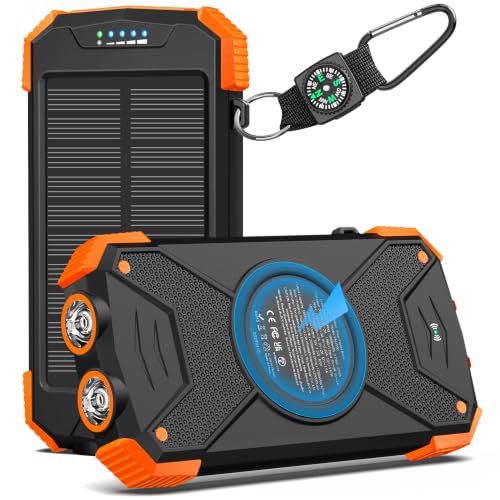
I rely on the BLAVOR 10,000mAh Solar Power Bank when weight and reliability matter most, because it’s the lightest and most compact solar charger I’ve used without sacrificing real capacity. At just 9.3 ounces and 5.9 x 3.1 x 0.8 inches, it’s easy to pack, yet it delivers a full 10,000mAh with lithium-metal cells that last 50% longer than standard batteries. It charges my iPhone 15 to 65% in 30 minutes via 20W USB-C and can power three devices at once. Solar charging is slow but functional, and the IPX5-rated build survives rain, drops, and dust. It includes a compass carabiner and dual flashlights, which help at campsites.
Best For: Outdoor enthusiasts and travelers who need a lightweight, durable, and high-capacity portable charger with emergency features like flashlights and a compass.
Pros:
- Ultra-compact and lightweight at 9.3 ounces with a 10,000mAh lithium-metal battery that lasts 50% longer than standard Li-polymer batteries
- Charges iPhone 15 to 65% in 30 minutes via 20W USB-C and supports simultaneous charging of three devices with wireless, USB-C, and solar options
- Rugged IPX5 waterproof, dustproof, and shockproof design with added utility from dual flashlights and a compass carabiner for camping and adventures
Cons:
- Solar charging is slow and better suited for emergency top-ups rather than full recharges
- Wireless charging may be less efficient compared to wired options
- Limited capacity for multiple full charges of newer high-drain devices like iPad Pro or large Android phones
ELECOM NESTOUT Rugged Power Bank 15000mAh

The ELECOM NESTOUT Rugged Power Bank 15000mAh stands out as a reliable choice for backpackers who need durable, high-capacity power in harsh conditions. I’ve used it on extended trips, and its 32W USB-C PD fast charging keeps my phone and tablet running efficiently. It’s IP67 rated, so I didn’t worry when it got submerged in a river crossing. The MIL-STD 810G drop protection held up after multiple falls on rocky terrain. At 12.8 ounces, it’s heavier than some, but the trade-off is resilience. The tripod mount adds versatility, and the 15000mAh capacity consistently charges my devices. It’s practical, no-frills power when failure isn’t an option.
Best For: Backpackers and outdoor enthusiasts who need a durable, high-capacity power bank capable of withstanding extreme environmental conditions.
Pros:
- 32W USB-C Power Delivery enables fast charging for phones, tablets, and other USB devices
- IP67 waterproof and dustproof rating with MIL-STD 810G drop protection for extreme durability
- Built-in 1/4-20″ tripod mount adds compatibility with NESTOUT and third-party accessories
Cons:
- At 12.8 ounces, it’s heavier than many competing power banks
- 15000mAh capacity is good but not exceptional for the weight
- Limited color options and a bulkier design may not appeal to minimalist travelers
INIU 45W Portable Charger 10000mAh PD

Need a compact, reliable charge for your devices on the trail? I carry the INIU 45W Portable Charger because it’s small-30% smaller and 15% lighter than most-and still delivers 10,000mAh. It fits in my pocket, weighs 6.4 ounces, and has a lanyard. Two USB-C ports and one USB-A let me charge three devices at once. I’ve charged my iPhone 15 to 60% in 25 minutes using 45W PD. It’s flight-safe, backed by a 3-year warranty, and ships with a short USB-C cable. Dual-direction USB-C input is rare and useful. Black, no-frills, and built to last.
Best For: Travelers and outdoor enthusiasts who need a compact, high-capacity power bank with fast charging and multi-device support.
Pros:
- 30% smaller and 15% lighter than comparable models, making it highly portable
- 45W PD fast charging delivers 60% charge to iPhone 15 in just 25 minutes
- Dual USB-C input/output and USB-A port allow simultaneous charging of three devices
Cons:
- Includes only a short 0.4ft USB-C cable, limiting charging flexibility
- No wall charger included, requiring separate purchase for full setup
- Limited color options-only available in black
Portable Solar Charger 20000mAh Waterproof

You’ll want this 20000mAh power bank if your backpacking takes you deep into the backcountry where outlets don’t exist and weather turns fast. I rely on its 15W fast charging and dual USB ports to power my iPhone 15 and GPS at once-getting nearly five full iPhone charges. It’s heavy at 10.5 ounces, but the military-grade shell survives drops and rain. Solar charging works in emergencies, though it’s slow. I use the built-in flashlight’s SOS mode when needed. It supports 1000+ cycles, so it’ll last years. Just don’t expect wall-speed recharging from the sun. My model S1008D stays ready in my pack-durable, simple, and waterproof.
Best For: Outdoor enthusiasts and backpackers who need a durable, waterproof power bank with emergency solar charging for off-grid adventures.
Pros:
- High 20000mAh capacity delivers up to 4.5 full charges for an iPhone 15 and supports fast 15W charging via dual USB ports
- Rugged, military-grade, waterproof, dustproof, and shockproof design built to withstand harsh outdoor conditions
- Includes versatile LED flashlight with SOS mode and supports over 1000 charge cycles for long-term reliability
Cons:
- Solar charging is slow and impractical for daily use-better suited for emergency top-ups
- Heavier than average at 10.5 ounces, which may be a drawback for ultralight backpackers
- No AC outlet or USB-C input, limiting charging options compared to higher-end models
20,000mAh Rugged Power Bank with Lantern

I rely on this 20,000mAh rugged power bank with lantern when I need dependable energy and lighting in tough conditions-campers, hikers, and emergency preppers who demand durability and function will find it fits. It charges my phone up to five times and supports fast charging via USB-C PD, with dual ports for powering multiple devices at once. Its IP68-rated body survives 2m drops, submersion, and extreme terrain. The 420-lumen lantern covers 50㎡ with five modes, including SOS and strobe. A digital display shows exact charge levels and current flow. I’ve used it with tripods for hands-free camp lighting and it’s survived vehicle compression and heavy rain. Weighing 1.03 pounds, it’s compact but tough. Includes a 6-month warranty.
Best For: Outdoor enthusiasts, emergency preppers, and adventurers who need a durable, high-capacity power source with built-in lighting for rugged environments.
Pros:
- 20,000mAh capacity provides up to five full smartphone charges with fast charging via USB-C PD and simultaneous multi-device support
- IP68-rated and shockproof design withstands submersion, drops, extreme terrain, and harsh weather conditions
- Integrated 420-lumen lantern with five lighting modes and digital display for real-time power and current monitoring
Cons:
- Limited 6-month warranty compared to longer coverage offered by some competitors
- Lantern brightness, while adequate, may not suffice for large-area illumination in pitch-dark environments
- Weight of 1.03 pounds may feel heavy for ultralight backpackers prioritizing minimal load
50000mAh Portable Charger with Built-in Cable

A 50,000mAh portable charger with built-in cables stands out for backpackers who need reliable, high-capacity power across multiple devices over extended trips. I rely on it because it charges my iPhone 17, iPad, and GPS simultaneously using its four integrated cables-Type-C, iOS, Micro USB, and USB-A-plus three extra ports. It delivers 22.5W PD fast charging, filling my phone to 55% in 30 minutes. Dual inputs let me recharge it flexibly, while safety chips prevent overcharging. Weighing 503g, it’s compact enough to fit in my pack, and the LED screen shows exact battery levels, so I know exactly how much juice I’ve got left.
Best For: Backpackers and travelers needing reliable, high-capacity charging for multiple devices over extended trips.
Pros:
- High 50000mAh capacity supports multiple full charges for smartphones, tablets, and GPS devices
- Equipped with 4 built-in cables and 3 additional ports, enabling simultaneous charging of up to 6 devices
- Features 22.5W PD fast charging and advanced safety protections with real-time battery monitoring via LED display
Cons:
- 503g weight may feel heavy for ultra-lightweight pack setups
- Built-in cables, while convenient, limit cable management customization
- High capacity and multiple ports may lead to faster wear if used continuously under heavy load
50000mAh Portable Charger with Built-in Cables

This 50000mAh portable charger with built-in cables suits backpackers who need reliable, multi-device charging over long stretches without power access. I’ve used it to charge my iPhone 15 twice and still had power for four other devices. The 22.5W PD and QC4.0 deliver 55% in 30 minutes-fast, but not magic. Four built-in cables plus three ports let six devices charge at once, which is practical for groups. It’s compact, fits in my daypack, and weighs just over a pound. A digital display shows exact charge levels, and the 10-layer safety system keeps temps stable. Cables survived 10,000 bends in testing-durable, not disposable.
Best For: Backpackers and travelers who need reliable, high-capacity charging for multiple devices over extended periods without access to power outlets.
Pros:
- 50000mAh capacity provides up to 10 full charges for smartphones and supports simultaneous charging of up to 6 devices
- Equipped with 4 built-in cables and 3 additional ports for broad device compatibility and maximum convenience
- Features 22.5W PD fast charging, a digital power display, and a 10-layer safety system with durable, 10,000-bend-tested cables
Cons:
- 1.07 lb weight, while portable, may be bulky for minimalist or ultralight packers
- Built-in cables limit flexibility if a cable is damaged or if different connector types are needed
- High capacity may require extended recharge times, especially via single USB-C input
BLAVOR Solar Power Bank 10,000mAh (20W)
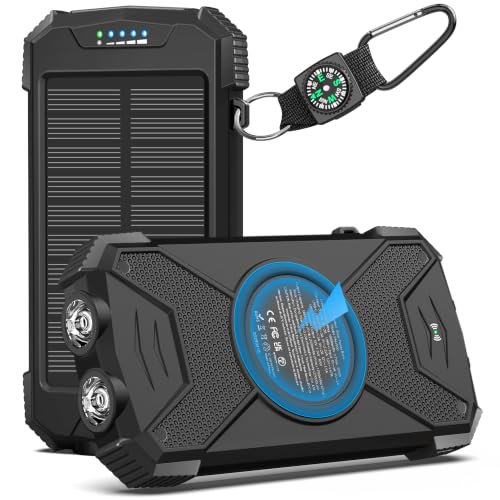
When you’re miles from the nearest outlet and weather turns unpredictable, the BLAVOR Solar Power Bank 10,000mAh (20W) keeps your devices running without adding bulk to your pack. I’ve used it on backcountry trips where its 10,000mAh capacity charged my iPhone 14 Pro twice and still had juice left. The 20W USB-C port charges fast-65% in 30 minutes for an iPhone 15. It’s IPX5-rated, so rain or splashes won’t kill it, and the rubberized finish holds up to drops. Weighing just 9.3 ounces, it’s light, rugged, and charges three devices at once, including wirelessly. Flashlight and carabiner add real utility.
Best For: Outdoor enthusiasts and travelers who need a durable, portable power solution for charging multiple devices in remote or harsh environments.
Pros:
- High 10,000mAh capacity with 20W fast charging efficiently powers iPhones and other devices, delivering up to 65% charge in 30 minutes
- Rugged IPX5-rated, dustproof, and shockproof design with rubberized finish ensures reliability in extreme outdoor conditions
- Supports simultaneous charging of three devices via USB-C, wireless charging, and includes practical extras like flashlight and carabiner
Cons:
- Solar charging is supplemental only and not efficient for primary recharging, requiring long exposure to sunlight
- Lithium-cobalt battery, while long-lasting, may raise safety concerns in extreme temperatures compared to newer chemistries
- No AC outlet or USB-C input, limiting fast recharging options from wall sources
Solar Charger Power Bank 49800mAh
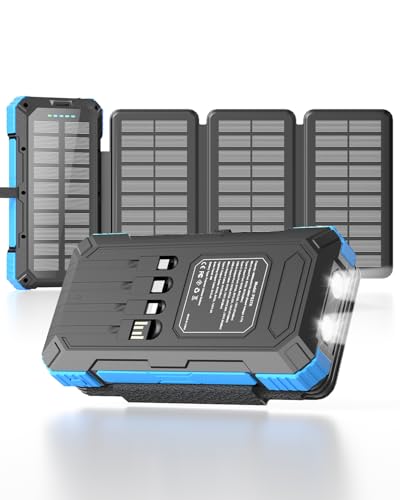
You’ll want this 49800mAh solar charger power bank if you’re heading deep into the backcountry for days without grid access and need to keep multiple devices running. I rely on its four built-in cables and three ports to charge up to five gadgets at once, including phones, tablets, and GPS units. The 3 foldable solar panels recharge the unit slowly but effectively-8X faster than basic models-though direct sun is key. It’s built tough: waterproof, shockproof, and dustproof, with silicone-sealed ports and a carabiner for clipping to my pack. The 22.5W PD charging works fast, and the flashlight has SOS mode for emergencies. Just check airline rules-this battery might exceed limits.
Best For: Outdoor enthusiasts and adventurers who need to power multiple devices for extended periods in remote locations without access to electricity.
Pros:
- Ultra-large 49800mAh capacity with support for charging up to five devices simultaneously via multiple built-in cables and ports
- Durable, rugged design with waterproof, shockproof, and dustproof construction ideal for harsh outdoor environments
- 3 foldable solar panels provide 8X faster solar charging compared to standard models, with a bright flashlight featuring SOS mode for emergencies
Cons:
- Solar charging is slow and highly dependent on direct sunlight, making it impractical as a sole recharge method
- High-capacity lithium battery may exceed airline carry-on limits, requiring verification before air travel
- Bulky size and weight (1.63 pounds) may add noticeable load to lightweight backpacking setups
Factors to Consider When Choosing a Backpacking Power Bank
You need a power bank that balances capacity and portability-too small, and it won’t last your trip; too big, and it adds unnecessary weight. Look for rugged, weather-resistant builds that can handle drops, rain, and dust without failing when you need them most. Fast charging, solar compatibility, and efficient power delivery make a real difference in the backcountry, where every watt counts.
Capacity And Runtime
A 10,000mAh power bank gives you about two full smartphone charges, while a 20,000mAh unit can manage up to five-enough to keep most phones running for several days. You’ll need even more if you’re charging tablets, which often take 10,000mAh or more per full cycle. Keep in mind, though, you won’t get every joule of rated capacity; expect only 60–70% in real use due to energy lost in voltage conversion. A 50,000mAh power bank offers serious endurance, but check its watt-hours-many exceed the 100Wh airline limit and could get flagged at security. Higher Wh means longer runtime, but also stricter travel rules. Match capacity to your trip length and device needs. Bringing extra power? Make sure it’s allowed on your flight.
Portability And Size
Small size and low weight matter when every ounce counts on the trail. You’ll want a power bank under 5.3 x 2.7 x 0.5 inches and as light as 6.4 ounces-it fits easily in a pocket or small bag. Larger models with higher capacity often weigh over 12 ounces and stretch past 8 inches, adding bulk that wears on you over miles. Units with built-in cables are convenient but usually thicker, reducing packability. Look for lightweight designs using high-density cells; they cut weight by up to 15% versus standard versions with the same output. Avoid overbuilt models if size is a priority-rugged cases add 0.2 to 0.8 inches in thickness and extra weight. You’ll trade compactness for toughness, which might not suit ultralight setups. Prioritize what fits your load strategy: high capacity means more weight, and added features often mean less portability.
Durability And Weather Resistance
Built to endure the realities of trail life, a reliable power bank must handle more than just the weight in your pack. You need one rated IP67 or higher-it’s fully dustproof and survives 30 minutes under a meter of water. Pick models tested to military-grade drop standards, able to survive falls over 3 feet onto concrete. They’re built tough, with rugged ABS+PC plastic that resists impacts, heat, cold, and rough terrain. Silicone-covered ports seal out water and dust, so charging stays reliable in storms or sandy deserts. Rubberized coatings or cushioned shells improve grip and absorb shock when you drop it on rocks. These materials don’t just add protection-they make the unit easier to hold when wearing gloves or moving fast. Don’t assume all tough-looking banks are equal; check independent test ratings. A durable build means less worry when weather turns or trails get rough.
Charging Speed And Technology
How much power can you actually get during a short break on the trail? With a power bank that supports Power Delivery (PD) or PowerIQ, you can charge your devices fast by matching their ideal input rate. Look for at least 18W PD output-20W or higher charges modern smartphones to 50–60% in about 30 minutes. Fast charging at 22.5W or more makes a real difference when you’ve got limited downtime. Two-way USB-C ports let you recharge the power bank quickly, too, cutting wait times versus older USB-A models. If you’re powering multiple devices, pick a model with dual or multi-ports that maintains high combined wattage without slowing down. Don’t assume more ports mean better performance-check specs to avoid drop-offs. Fast charging isn’t just about speed; it’s about maximizing every break.
Solar Charging Capability
You’ve seen how fast charging can keep your devices powered during short breaks, but when you’re deep on the trail with no outlet in sight, solar charging becomes a practical lifeline. You’ll rely on sunlight to recharge your power bank, which works well off-grid but charges slower than wall outlets. The panel needs direct sun-clouds or shade cut efficiency fast. Most models include USB charging too, so you’re not stuck waiting on sunlight alone. Think of solar as backup or supplemental power, not your main source. It keeps your phone alive in emergencies or adds a trickle charge over a long day. You’ll get better results with high-efficiency panels, but even then, patience is key. Choose a dual-charge model so you can top up at home before heading out. Solar won’t replace grid charging, but it’s smart insurance when you’re far from plugs.
Multiple Device Compatibility
When you’re managing a phone, GPS, and headlamp on a multi-day trek, your power bank must handle multiple devices without slowing down. Choose a model with multiple output ports-USB-C, USB-A, and wireless-so you can charge different devices at once. Look for at least 5V/3A total output current to maintain speed across all connected gear. Make sure it supports common charging protocols like PD, QC, and PowerIQ, so both Android and iOS devices charge efficiently. Units with built-in cables (Type-C, Lightning, Micro USB) cut clutter and spare you from packing extras. Check that input and output combinations allow simultaneous charging without interference-some port pairs can’t work together. Bidirectional charging lets you recharge the power bank while powering a device, which helps in a pinch. No single port should hog performance. Prioritize balanced, real-world function over peak specs alone.
Safety And Certification
While exploring remote trails, your power bank’s safety features become as critical as its capacity. You need models with UL, CE, FCC, and RoHS certifications-these confirm it meets international safety and environmental standards. Always check for UN38.3 certification, which means the lithium battery passed strict tests for thermal stability and safe transport. Look for built-in protection against overcharge, overcurrent, short circuits, and overheating; these safeguards prevent damage to your gear and reduce fire risk. Some units use multi-layer circuits with temperature control, cutting overheating chances by up to 97%. If flying to your trailhead, make sure the power bank is flight-safe, with a capacity at or below 100Wh to meet airline carry-on rules. Don’t assume all brands comply-verify labels and specs. A certified, protected power bank isn’t just reliable-it’s essential for safe, uninterrupted off-grid power.
Frequently Asked Questions
Can I Charge Multiple Devices at Once With These Power Banks?
Yes, you can charge multiple devices at once if the power bank has more than one USB port. Most models support dual output, letting you power a phone and headlamp simultaneously. Charging speed splits between devices, so total output drops. High-capacity banks handle multiple draws better, but runtime decreases faster. Check total output specs-banks with 30W or more manage multiple devices more efficiently. Always verify port compatibility with your gear to avoid slow charging or incompatibility issues.
Are These Power Banks Allowed on Airplanes?
Yes, you can bring these power banks on airplanes, but they must be in your carry-on, not checked luggage. Airlines limit lithium batteries to 100 watt-hours or less-most portable models fall under that. If yours exceeds 100Wh, you’ll need approval and can carry only one. Always check your airline’s policy. Labeling matters too-untagged or damaged units raise red flags. Keep receipts to prove specs if questioned.
Do Solar Power Banks Work in Cloudy Conditions?
Yes, solar power banks work in cloudy conditions, but you’ll get less power. Expect 10–25% of their rated output, depending on cloud thickness and panel quality. You’ll need more time to charge them compared to full sun. Don’t rely solely on weak light. Pair solar with a high-capacity battery so you’re not stranded. Use them as a backup, not your only source. Bring extra stored power for reliability.
How Long Do These Power Banks Last Before Needing Replacement?
You typically get 300 to 500 charge cycles before your power bank loses significant capacity. After that, you’ll notice slower charging and shorter run times. Most last 2 to 4 years with regular use. Exposure to extreme temps or constant full discharges shortens lifespan. Cheaper models degrade faster. You can extend life by storing at 50% charge and avoiding moisture. Replacement is inevitable-plan for it.
Can I Use Third-Party Cables With These Power Banks Safely?
Yes, you can use third-party cables safely if they meet USB-IF standards and show no physical damage. Poor-quality cables risk slower charging, data errors, or port damage over time. Stick to certified cables with proper insulation and reinforced connectors-especially in rugged conditions. While original cables often offer better durability, reputable third-party options perform just as well. Always inspect connections before use. You’re trading minor risks for greater packing flexibility.