Best Bug Out Bag Radios for Emergency Communication
You need a radio that powers up when the grid fails, and models with hand crank, solar, and USB charging offer the most reliable access. Look for NOAA weather alerts, AM/FM, and shortwave bands to stay informed. Flashlights, power banks, and durable builds add practical value. Some radios charge phones or use AAA batteries for backup. Solar and crank charging work but require time and effort-bigger batteries last longer. The right one fits your bug-out plan and keeps you connected when it matters most. You’ll find clear trade-offs between power, size, and features as you compare options.
We are supported by our audience. When you purchase through links on our site, we may earn an affiliate commission, at no extra cost for you. Learn more. Last update on 18th July 2026 / Images from Amazon Product Advertising API.
Notable Insights
- Choose radios with multiple power sources like solar, hand crank, USB, and AAA batteries for reliable off-grid charging.
- Prioritize models with NOAA Weather Alerts and AM/FM/SW bands for comprehensive emergency broadcasts and global communication.
- Opt for radios with digital tuning, DSP chips, and telescopic antennas to ensure clear signal reception in remote areas.
- Select rugged, water-resistant (IPX3 or higher) models with shockproof builds to withstand harsh conditions during evacuations.
- Look for built-in power banks with 5000mAh or higher capacity to charge phones and operate the radio for extended periods.
FosPower NOAA Emergency Weather Radio & Power Bank

If you’re someone who prioritizes reliability and multifunctionality in a compact emergency tool, the FosPower NOAA Emergency Weather Radio & Power Bank makes a practical addition to your bug out bag. I rely on its 7400mWh battery to charge my smartphone at least once when grid power fails. It offers three charging methods-solar, hand crank, and AAA batteries-so I’m never left without options. The built-in flashlight and 4-LED reading light help me see during blackouts. It picks up NOAA, AM, and FM broadcasts clearly, keeping me informed. FosPower backs it with a limited lifetime warranty, which tells me it’s built to last.
Best For: Outdoor enthusiasts, emergency preppers, and anyone seeking a reliable, multi-powered radio and portable charger for use during power outages or off-grid adventures.
Pros:
- Combines a NOAA weather radio with AM/FM reception, flashlight, reading light, and 7400mWh power bank in one compact device
- Offers three charging methods (solar, hand crank, AAA batteries) for uninterrupted operation during emergencies
- Backed by a limited lifetime warranty, reflecting strong build quality and long-term reliability
Cons:
- 7400mWh capacity provides only about one full smartphone charge, which may not suffice for extended outages
- Solar charging is slow and inefficient in low-light conditions, limiting its practicality as a primary recharge method
- Requires manual cranking for extended periods to generate meaningful power, which can be tiring during prolonged use
086S Hand Crank Emergency Radio

The 086S Hand Crank Emergency Radio is one of the few emergency radios that combines a built-in 2000mAh battery, solar charging, and a reliable hand crank into a package light enough for nearly every bug out bag. I’ve used it on hikes and during power outages, and it’s held up well. It powers AM/FM and NOAA weather bands, so I stay informed. The 3W LED flashlight gives 140 lumens-enough for tasks-and the SOS mode emits an 80+ decibel siren. At 8.1 ounces and under 5.2 inches, it fits in tight spaces. Charging via Type-C, solar, or hand crank means I’m not stranded without power.
Best For: Outdoor enthusiasts, preppers, and emergency responders who need a compact, multi-power-source radio with reliable communication and lighting during power outages or remote adventures.
Pros:
- Combines three charging methods (hand crank, solar, and Type-C) for reliable power in emergencies
- Includes AM/FM and NOAA weather bands for critical information and alerts
- Features a bright 140-lumen flashlight and loud 80+ decibel SOS siren for safety and signaling
Cons:
- 2000mAh battery may provide limited device charging for modern smartphones
- Solar charging is slow and dependent on direct sunlight
- Plastic build, while lightweight, may lack durability under heavy impact or prolonged field use
Emergency Crank Weather Radio with Solar Charger

I rely on the Emergency Crank Weather Radio with Solar Charger when power’s not an option, and staying informed could mean the difference between reacting in time or being caught off guard. I’ve used the MD-090P model with its 14800mWh battery, which fully charges my smartphone twice. It pulls in AM/FM and NOAA alerts from 7 stations clearly, even during storms. The hand crank and solar panel keep it running when the grid’s down, and the flashlight throws light over 10 meters. Its motion-sensor lamp helps me move at night without waking others. Over 10 million people have used it in real disasters like Hurricane Harvey, and with 18 months of warranty and 24/7 support, I know it won’t leave me stranded.
Best For: Outdoor enthusiasts, emergency preppers, and anyone needing a reliable communication and power source during power outages or natural disasters.
Pros:
- High-capacity 14800mWh battery charges smartphones multiple times and supports extended use
- Multiple charging options including hand crank, solar, Micro USB, and wall charging ensure reliability during prolonged outages
- Clear reception of AM/FM and NOAA weather alerts from 7 stations, providing critical real-time updates during emergencies
Cons:
- Larger size and weight due to high-capacity battery may reduce portability for some users
- Solar charging is slow and dependent on direct sunlight, limiting effectiveness in cloudy conditions
- Motion-sensor lamp may activate unintentionally if placed near movement, draining battery over time
Hand Crank Emergency Radio with Solar Charging
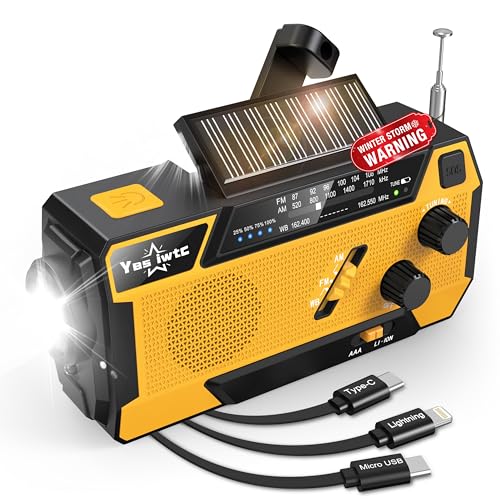
You’ll want this hand crank emergency radio with solar charging when grid power fails and cell networks go down, especially if you’re preparing for hurricane season or remote off-grid trips. I rely on its 7400mWh battery and four power sources-USB-C, hand crank, solar, and AAA-so it keeps working during extended outages. The AM/FM/NOAA bands with DSP chip deliver clear weather alerts, more reliably than phones. It doubles as a power bank, charging devices via built-in 3-in-1 cables. I use the flashlight’s three modes and SOS alarm regularly. At 13.4 ounces, it’s compact, durable, and backed by lifetime support.
Best For: Outdoor enthusiasts, emergency preppers, and anyone seeking a reliable, multi-power-source communication and charging device during power outages or severe weather events.
Pros:
- Powered by four sources (USB-C, hand crank, solar, AAA) with a 7400mWh battery for extended reliability during blackouts
- Features AM/FM/NOAA weather bands with DSP chip for clear, real-time emergency alerts, outperforming cellphones in disasters
- Doubles as a power bank with built-in 3-in-1 cables and includes multiple lighting modes plus an SOS alarm for safety
Cons:
- Solar charging is slow and ineffective in low-light conditions, limiting reliability as a primary recharge method
- Built-in cables, while convenient, are short and may not suit all device types simultaneously
- Heavier than standard radios at 13.4 ounces, which could be a drawback for ultra-light backpacking
Solar Hand Crank NOAA Weather Radio
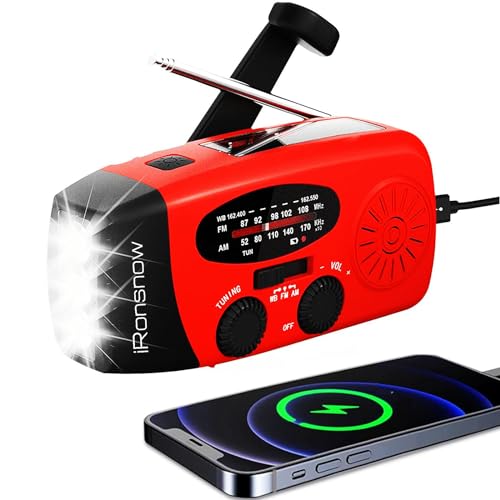
This compact solar hand crank NOAA weather radio suits backpackers, preppers, and anyone needing reliable emergency updates without depending on grid power. I rely on it for real-time alerts during storms, floods, or hurricanes thanks to its NOAA channel access. It’s small-just 5 inches long-but packs a 2000mAh battery that charges via USB C, solar panel, or hand crank. The battery indicator shows charge levels clearly with four LEDs. I’ve used it to charge my phone in a blackout. The LED flashlight has steady and SOS modes, and while solar charging is slow, the hand crank works when sunlight isn’t available.
Best For: Outdoor enthusiasts, emergency preppers, and travelers needing reliable weather alerts and off-grid power.
Pros:
- Receives real-time NOAA weather alerts for storms, floods, hurricanes, and other emergencies
- Multi-power options including USB C, hand crank, and solar for reliable use anywhere
- Functions as a power bank to charge phones and includes a bright LED flashlight with SOS mode
Cons:
- Solar charging is slow and less effective in low sunlight conditions
- 2000mAh battery has limited capacity for multiple device charges
- Compact size may make it harder to grip when using the hand crank
Raynic Emergency Radio with Solar Crank

A solar-powered radio like the Raynic Emergency Radio with Solar Crank is a solid choice for anyone who relies on off-grid communication and weather monitoring during extended power outages or outdoor trips. I use its NOAA Weather Alert function to get automatic warnings for tornadoes, floods, or hurricanes without constantly monitoring the broadcast. The 5000mAh battery powers the AM/FM/SW/WB bands, and I can charge it via USB, solar, crank, or AAA batteries. Its IPX3 rating holds up in light rain, and the 3W flashlight plus SOS siren help in emergencies. I appreciate the backlit LCD for nighttime use, though I dim it to save power. I’ve charged my phone mid-hike when outlets weren’t an option. At 1.2 pounds, it’s light enough to pack without hesitation and tough enough to last through real-world use.
Best For: Outdoor enthusiasts, preppers, and anyone needing reliable off-grid communication and emergency weather alerts during power outages or remote adventures.
Pros:
- Multiple charging options including solar, hand crank, and USB ensure continuous power in emergencies
- NOAA Weather Alert functionality provides automatic severe weather warnings for enhanced safety
- Compact, lightweight, and IPX3 water-resistant design makes it durable and portable for outdoor use
Cons:
- Backlight cannot be fully adjusted-only turned on or off, limiting customization
- AAA batteries not included, which are needed for one of the power options
- Solar charging is slow and dependent on direct sunlight, limiting effectiveness in low-light conditions
Hand Crank Emergency Radio with Solar & Charger

When I need dependable communication and power during prolonged outages or remote trips, the Hand Crank Emergency Radio with Solar & Charger stands out as the best choice for anyone prioritizing reliability and versatility. It has a 10,000 mAh battery and charges via USB Type-C, hand crank, or solar panel-giving me options when outlets aren’t available. I get NOAA, AM, and FM radio with a tuning knob that works smoothly, even in the dark. The 20-LED flashlight and 48-LED reading light are useful, and the SOS siren is loud enough to be effective. It’s lightweight at 1.1 lbs, IPX6-rated, and grips well in wet conditions. While the solar charging is slow, the hand crank reliably generates power when needed. I can navigate with the built-in compass, and the clear labels help under stress. This radio fits snugly in my bug out bag, measures 6.3 x 3.5 x 3.1 inches, and weighs slightly less than average-making it practical for long-term use.
Best For: Outdoor enthusiasts, emergency preppers, and anyone needing reliable off-grid communication and power during outages or disasters.
Pros:
- Offers multiple charging options (USB Type-C, hand crank, solar) with a high-capacity 10,000 mAh battery
- Features NOAA, AM/FM radio with accurate weather alerts and easy tuning, ideal for emergency updates
- Includes bright LED lighting, a loud SOS siren, built-in compass, and IPX6 waterproof rating for rugged reliability
Cons:
- Solar charging is slow and inefficient in low-light conditions
- Slightly bulky design may not fit comfortably in smaller emergency kits
- Button responsiveness can diminish over time with heavy use
Emergency NOAA Weather Radio with Solar Crank
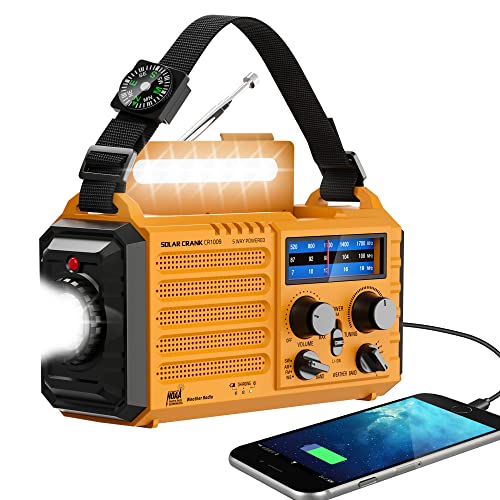
Who needs a reliable lifeline during sudden storms or grid-down scenarios? I do - and this NOAA radio delivers. It monitors 7 weather channels and sounds a 9-second alarm with flashing light when severe weather hits, so I stay alerted even while sleeping. The AM/FM and shortwave bands pick up global broadcasts clearly, thanks to the telescopic antenna. I can power it via solar, hand crank, USB, or AAA batteries. Its 5000mAh battery runs FM for 13 hours and charges my phone. The dual LED lights - 3W flashlight and 2.5W reading lamp - help me see in darkness. It’s compact, rugged, and field-tested for real emergencies.
Best For: Outdoor enthusiasts, emergency preppers, and frequent travelers who need a reliable, multi-powered communication and lighting device during severe weather or power outages.
Pros:
- Monitors 7 NOAA weather channels with audible and visual alerts for real-time severe weather warnings
- Offers multiple power options including solar, hand crank, USB, and AAA batteries for extended usability off-grid
- Combines a 5000mAh power bank, dual LED lighting, and AM/FM/shortwave radio in a compact, portable design
Cons:
- AAA batteries not included, which are needed for backup power operation
- Shortwave reception may require precise antenna positioning for optimal clarity
- Hand-cranking to charge is labor-intensive and generates limited power
Emergency NOAA Weather Radio with Solar & Hand Crank

If you’re building a bug-out bag for reliable communication during extended power outages or remote outdoor trips, this Emergency NOAA Weather Radio stands out as a practical core component. I rely on its 4000mAh battery, charged via USB, solar panel, or hand crank, to keep me powered when the grid fails. It delivers real-time alerts across 7 NOAA weather bands and pulls in AM/FM stations clearly. The LED flashlight, reading lamp, and SOS alarm add utility. It’s compact, waterproof, and drop-proof-ideal for camping or emergencies. I can charge my phone, and the dual included batteries guarantee longer runtime.
Best For: Outdoor enthusiasts, preppers, and emergency responders needing a durable, multi-power-source weather radio with communication and lighting tools for off-grid or disaster scenarios.
Pros:
- Offers three charging methods (USB, solar, hand crank) plus a 4000mAh battery for reliable power during outages
- NOAA-certified with 7 weather bands, real-time alerts, and clear AM/FM reception for critical updates
- Combines flashlight, reading lamp, SOS alarm, and phone charging in a compact, waterproof, drop-proof design
Cons:
- Hand-crank charging requires sustained effort for minimal power generation
- Analog tuning may be less convenient than digital presets for some users
- Limited battery capacity may not fully charge modern smartphones multiple times
Baofeng AR-5RM Ham Radio 2-Pack

The Baofeng AR-5RM Ham Radio 2-Pack belongs in the bug-out bag of any serious prepper who demands reliable, long-range communication without depending on cell networks. I rely on its 144–148 MHz and 420–450 MHz transmit ranges for clear, interference-resistant signal delivery. With 999 memory channels and NOAA weather alerts, it handles diverse scenarios. The 2500 mAh batteries last through extended operations, and USB-C charging means I can power them from a power bank or car. It’s heavy at over three pounds for the set, but the color screen, CHIRP compatibility, and cloning feature save time during setup. This radio works when infrastructure fails.
Best For: Preppers and outdoor enthusiasts who need reliable, long-range two-way communication in remote or emergency situations without relying on cell networks.
Pros:
- Supports 999 memory channels, NOAA weather alerts, and frequency cloning for versatile, efficient setup and emergency readiness
- Long-lasting 2500 mAh batteries with USB-C charging offer flexible power options including power banks, car adapters, and laptops
- Wide receiving range and dual transmit bands (144–148 MHz, 420–450 MHz) with CHIRP programming compatibility for enhanced communication flexibility
Cons:
- Heavy at 3.16 pounds for the 2-pack, which may be cumbersome for lightweight bug-out bags or extended carry
- Transmits only on limited amateur radio bands, limiting use for non-ham licensed operators
- Complex programming for beginners, despite CHIRP support, requiring time and technical familiarity to fully utilize features
Factors to Consider When Choosing a Bug Out Bag Radio
You need a radio that won’t quit when things get rough, so check the power source options-hand cranks, solar panels, and battery compatibility all affect how long you can stay powered in the field. Look closely at signal reception quality and durability, since a clear signal and rugged build make the difference between getting help and being left in the dark. Don’t overlook emergency features, portability, and size-they directly impact how useful the radio will be when every ounce and function counts.
Power Source Options
While no single power source guarantees uninterrupted operation, opting for a radio with multiple charging methods-like hand crank, solar, USB, and standard battery compatibility-keeps you informed when the grid’s down. You’ll rely on the hand crank in a pinch, but don’t expect miracles-it takes minutes of cranking for just a few minutes of runtime. Solar charging works well in direct sun, but clouds or storms cut efficiency fast. Pair it with a built-in 2000mAh to 5000mAh rechargeable battery to store power and extend use. When those options fail, popping in AAA batteries gets you back online fast. You need that flexibility when help’s far off and conditions shift. Relying on one method risks silence when you need info most. Choose a radio that gives you backup options, not just promises.
Signal Reception Quality
Having multiple ways to power your radio means nothing if the device can’t pull in clear signals when you need them most. You want digital tuning and DSP chips-they cut static and boost clarity on AM, FM, and NOAA bands. Make sure it covers AM (520–1710 kHz), FM (87–108 MHz), and NOAA weather frequencies (162.400–162.550 MHz) so you don’t miss critical alerts. A telescopic or external antenna helps grab weak signals, especially in valleys or dense woods. If you’re off-grid long-term, shortwave (SW) reception (like 7–19 MHz) gives you international broadcasts and distant stations during major disasters. Look for auto-tuning and signal scanning-they lock onto the strongest stations fast, so you spend less time twisting dials and more time getting info. Clear reception isn’t luxury-it’s necessity when every update counts.
Durability And Build
When every mile counts and conditions turn rough, a radio’s build quality becomes just as critical as its circuitry. You need a device that can handle heavy rain or accidental drops, so look for an IPX6 waterproof rating-it withstands powerful water jets from any direction. A drop-resistant design, tested to survive falls up to 6 feet, guarantees reliability on rocky trails or during frantic use. High-impact ABS plastic housings resist crushing and remain stable in extreme heat or cold. Non-slip rubberized grips and recessed controls let you operate the radio with wet hands or gloves without damaging buttons. A reinforced antenna, whether telescopic or external, maintains signal strength and resists snapping during transport. These features don’t just add toughness-they guarantee your radio works when you can’t afford for it to fail.
Emergency Features Included
If you’re caught in a sudden storm or cut off after a disaster, a radio with NOAA weather band reception keeps you informed with real-time alerts for tornadoes, floods, and hurricanes-critical for making fast, life-saving decisions. You’ll also want an SOS function with a flashing light and an 80+ dB alarm to signal rescuers when visibility or noise is low. Many models include multi-mode flashlights that reach over 80 meters, giving you reliable light in blackouts or at night. Built-in power banks range from 2000mAh to over 10,000mAh, letting you charge phones or GPS devices when the grid’s down. Higher-end units add digital tuning for clearer signals, retractable reading lamps for close tasks, and internal compasses for basic navigation. These features aren’t just extras-they’re functional tools that work together to keep you informed, visible, and connected when help isn’t nearby.
Portability And Size
A radio that fits in the palm of your hand can make the difference when every ounce matters. You need a compact unit under 7 inches long and weighing less than 1.5 pounds so it slips easily into your bug out bag without weighing you down. Models under 14 ounces are ideal for long evacuations, letting you move faster with less fatigue. Look for rugged builds with drop resistance and non-slip grips-they add durability without bulk. A compact design doesn’t mean sacrificing access; integrated lanyard loops or carrying straps keep the radio secure and ready. Many top options are water-resistant up to IPX6, so rain or splashes won’t stop them, all while staying small enough to stow in tight spaces. Size and portability directly affect usability in real emergencies, so choose a radio that balances compactness with reliable build and easy handling when you’re on the move.
Battery Life Performance
You’ll often rely on battery life as the deciding factor during extended outages, so choosing a radio with a 5000mAh capacity makes sense for multi-day use. That size keeps the radio running, powers your phone once or twice, and supports built-in lights and alerts without quitting. Smaller 2000mAh units run out faster, especially if you’re charging devices daily. Models with LED charge indicators let you track remaining power at a glance-25%, 50%, up to 100%-so you can ration wisely. Dual-function radios act as both power banks and emergency receivers, but they drain quicker when multitasking. You’ll get more runtime by turning off the backlight, dimming the display, or switching to manual power mode. These energy-saving features noticeably stretch your charge. High-capacity batteries with smart power management give you reliable communication and device support when outlets aren’t an option.
Frequently Asked Questions
Can These Radios Pick up International Emergency Broadcasts?
No, most bug out bag radios can’t reliably pick up international emergency broadcasts. They’re designed for local emergency bands, NOAA weather, and AM/FM. International signals require shortwave capability, which only some include. Even then, reception depends on antenna quality, atmospheric conditions, and interference. You’d need a dedicated shortwave receiver for consistent global reach. Don’t count on compact emergency radios for distant broadcasts-use them for local alerts and basic comms where signal strength and range are limited but dependable.
Do Any Require Special Licenses to Operate Legally?
Yes, some radios require licenses to transmit legally. You can use FRS channels without one, but if you plan to use GMRS, you need a FCC license-though it’s cheap and easy to get. Ham radios need licensing too, with exams required. Receiving signals? No license needed. Most bug-out bag radios are receive-only or use FRS, so you’re fine. Just don’t transmit on restricted bands unless you’re licensed. Know the rules to stay legal.
Are Replacement Parts Available for Solar Panels or Hand Cranks?
You can find replacement parts for solar panels and hand cranks, but availability depends on the model and manufacturer. Common brands like Eton and Midland offer limited serviceability, though generic repair kits exist. Plastic gears in hand cranks often fail and rarely come with replacements. Solar panels usually aren’t user-replaceable; you’d replace the whole unit. You’re better off choosing radios with proven durability and modular designs to extend field usability when parts break.
Can They Be Used While Charging Other Devices?
You can use most emergency radios while charging devices, but it slows down the charging process. Simultaneous use splits the power output, so charging takes longer. Some models handle multitasking better thanks to higher-capacity batteries or efficient circuitry. Check specs: units with 5,000 mAh or more manage dual tasks more effectively. Prioritize models with separate input/output ports to avoid interference. Real-world tests show that hand-crank models generate just enough power to maintain function while trickle-charging small devices.
How Do I Store Them Long-Term Without Damage?
You store them long-term by keeping batteries removed to prevent corrosion. Place the radio in a sealed, waterproof container with a desiccant pack to control moisture. Store in a cool, dry, and dark place-avoid temperature swings or direct sunlight. Check every few months for damage or condensation. If it has rubber gaskets, inspect them for brittleness. Keep user manuals and cables nearby but separate to avoid strain. This routine maintains functionality without relying on hype or assumptions.