Best Combat Daggers Trusted by Tactical Experts
You need a combat dagger that won’t fail when it counts. Models like the Cold Steel Recon Tanto and KA-BAR EK44 use high-carbon steel and full tang construction for strength and resharpening ease. Thicker blades around 7 mm handle impact well, while Secure-Ex sheaths offer fast, reliable carry. Some double-edged designs add piercing power but may face legal limits. Edge retention, grip security, and sheath durability matter most in real use. The best picks balance performance, maintenance, and field reliability under stress-know what each model sacrifices to excel where it counts.
We are supported by our audience. When you purchase through links on our site, we may earn an affiliate commission, at no extra cost for you. Learn more. Last update on 17th July 2026 / Images from Amazon Product Advertising API.
Notable Insights
- Monolithic 52100 high carbon steel blades offer extreme strength and durability trusted in high-stress combat scenarios.
- Tanto and spear-point designs with compound bevels ensure maximum penetration and edge retention in tactical use.
- Kray-Ex and glass-reinforced nylon handles provide secure, slip-resistant grip in wet and adverse conditions.
- Secure-Ex and ambidextrous sheaths with Ulti-Clip or belt mounts enable fast, reliable access in tactical environments.
- Full tang construction and mil-spec materials ensure long-term reliability under extreme field conditions.
Smith & Wesson SWF606 Fixed Blade Knife
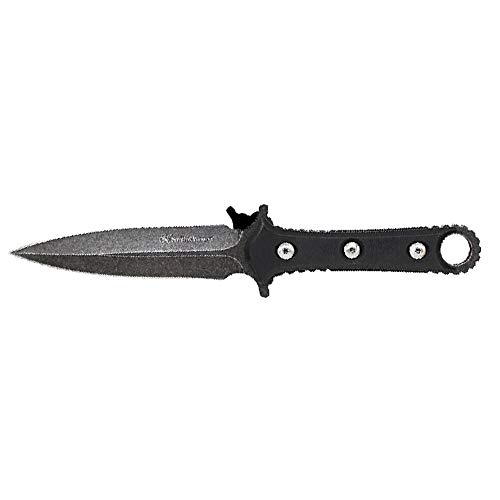
If you need a no-frills fixed blade that won’t quit in tough conditions, the Smith & Wesson SWF606 is a solid pick for tactical use, outdoor work, or everyday carry. I’ve used it in wet, cold, and high-stress environments, and it holds up. The 4.4-inch blade is made from 8Cr13MoV steel-tough enough for regular use, though I touch it up more often than pricier steels. At 5.8 ounces, it’s light but still balanced. The full tang and TPE handle keep it secure, even when my gloves are slick. It comes with a leather sheath that fits on a belt or boot, and the lanyard hole lets me carry it around my neck if I choose. I appreciate the Limited Lifetime Warranty-it tells me they stand by it. For survival tasks, I’ve chopped, scraped, and pried without issue. It won’t replace a full survival kit, but it’s reliable when I need fast, steady work.
Best For: Tactical users, outdoor enthusiasts, and EDC carry individuals needing a dependable, durable fixed blade for rugged environments and hard-use tasks.
Pros:
- Durable 8Cr13MoV stainless steel blade with full tang construction for strength and reliability
- Lightweight yet well-balanced design with a secure TPE handle and finger guard for safety
- Includes versatile carry options with a leather sheath and lanyard hole, backed by a Limited Lifetime Warranty
Cons:
- Blade steel requires more frequent maintenance and sharpening compared to premium alloys
- Leather sheath may wear faster under heavy use or wet conditions
- Limited blade length flexibility at 4.4 inches, which may not suit all survival tasks
Portable 6.7″ Fixed Blade Camping Knife

I rely on the PAVCEING 6.7″ Fixed Blade Knife when I need a tough, no-frills tool that won’t weigh me down. Its 440C stainless steel blade holds an edge well and resists corrosion, even after repeated use. The full-tang construction adds strength without extra weight-just 1.81 oz. At 6.7 inches overall, it’s compact but functional, with a 2.44-inch blade ideal for small tasks. The steel handle feels durable and works fine in wet or cold conditions. It comes with an ABS sheath that carries securely. Built for camping and hiking, it won’t replace a tactical dagger, but it handles routine chores without fuss or failure.
Best For: Outdoor enthusiasts seeking a lightweight, durable fixed-blade knife for camping, hiking, and everyday utility tasks.
Pros:
- Durable 440C stainless steel blade offers excellent edge retention and corrosion resistance
- Full-tang construction provides strength and reliability in a lightweight 1.81 oz package
- Compact size and secure ABS sheath make it ideal for portable outdoor use
Cons:
- Short 2.44-inch blade limits effectiveness for larger cutting tasks
- Steel handle may be less comfortable or slip-prone compared to textured or ergonomic designs
- Not suited for heavy-duty or tactical applications due to compact design
Smith & Wesson 9″ H.R.T Boot Knife
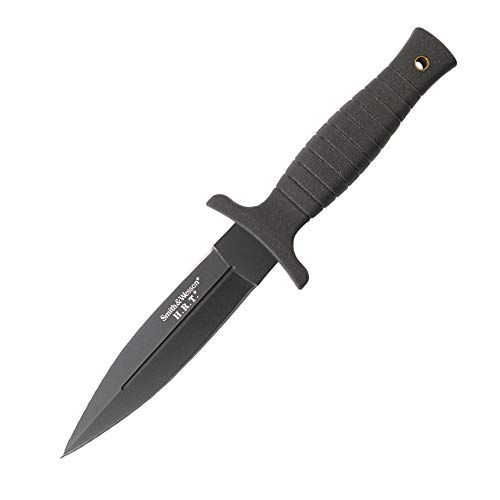
The Smith & Wesson 9″ H.R.T Boot Knife stands out as a solid pick for anyone needing a dependable, easily accessible blade in high-pressure situations. I carry it in my boot or on my belt using the included sheath, and it stays secure without shifting. The 4.7-inch 7Cr17MoV stainless steel blade holds an edge well and resists corrosion, though it won’t match premium steels in extreme use. Its double-edged design works for stabbing and slashing, and the rubber-wrapped handle gives grip without slipping, even when wet. The integrated guard helps keep my hand from sliding forward. At 7.7 ounces, it’s not light, but the weight adds stability. I’ve used it as a neck knife with the lanyard hole, and it’s stayed accessible. It’s backed by a Limited Lifetime Warranty, and I’ve found Smith & Wesson’s support quick to respond.
Best For: Tactical professionals, outdoor enthusiasts, and everyday carry users seeking a durable, accessible boot knife for utility or self-defense.
Pros:
- Durable 7Cr17MoV stainless steel blade offers good edge retention and corrosion resistance
- Secure rubber-wrapped handle with integrated guard ensures a stable grip in wet or high-stress conditions
- Versatile carry options with included belt/boot sheath and lanyard hole for neck carry
Cons:
- 7.7-ounce weight may feel heavy for extended carry compared to lighter knives
- 7Cr17MoV steel, while reliable, doesn’t match the performance of higher-end blade steels
- Double-edged design may face legal restrictions in some jurisdictions
Schrade Delta Class Serrated Fixed Blade

You want a combat dagger that won’t let you down in harsh conditions, and the Schrade Delta Class Serrated Fixed Blade stands out for those who prioritize durability and aggressive utility. I rely on its 7.5-inch 7Cr17MoV steel blade-it holds an edge and resists corrosion. The clip-point, double-edged design with serrations cuts through tough materials efficiently. At just 0.15 kg, it’s lightweight but solid. The TPE handle gives a secure, non-slip grip, even wet. It comes with a durable sheath, belt clip, and lanyard hole for versatile carry. Built for outdoor and tactical use, it balances function and strength without excess.
Best For: Tactical users and outdoor enthusiasts who need a durable, lightweight fixed blade with aggressive cutting performance in challenging environments.
Pros:
- Durable 7Cr17MoV stainless steel blade offers excellent edge retention and corrosion resistance
- Lightweight design with a secure, non-slip TPE handle for reliable handling in wet or rugged conditions
- Includes versatile carry options with a sheath, belt clip, and lanyard hole for tactical and outdoor readiness
Cons:
- Serrated edge may not be ideal for fine cutting tasks or precision work
- 7.5-inch blade may be oversized for everyday carry in some settings
- Injection-molded sheath, while durable, may lack the premium feel of Kydex or leather alternatives
Walther P99 Tactical Knife, One Size

Built for precision and durability in high-pressure scenarios, this fixed-blade tactical knife suits military, law enforcement, and survivalists who prioritize reliability over flash. I’ve used the Walther P99 Tactical Knife in field conditions, and its 6-inch 440 stainless steel blade holds an edge well, even after repeated use. The matte finish reduces glare, and the sawback spine adds utility. At 10.75 inches overall and 0.28 kilograms, it’s balanced-easy to control without feeling light. The synthetic handle grips securely, even when wet, and the stainless steel guard prevents slippage. It comes with a sturdy nylon sheath and leg strap, making carry practical. Made in China, it’s no frills-but gets the job done.
Best For: Military, law enforcement, and survivalists seeking a reliable, no-frills fixed-blade tactical knife for field use.
Pros:
- Durable 440 stainless steel blade with a matte finish resists corrosion and reduces glare
- Ambidextrous synthetic handle provides a secure grip in wet or high-stress conditions
- Includes a sturdy nylon sheath with leg strap for practical and secure carry
Cons:
- Made in China, which may raise durability concerns for some buyers
- Fixed blade design offers less portability compared to folding knives
- Lacks advanced features like a tactical glass breaker or integrated tools
Cold Steel Wasp Dagger 6.75″ Blade

Strength isn’t just a benefit with the Cold Steel Wasp Dagger 6.75″ Blade-it’s built into every dimension. I rely on its monolithic 52100 high carbon steel construction because it eliminates weak points. The 6.75-inch blade and 5.5-inch handle balance well, making thrusts and retractions efficient. At 8.4 oz, it’s light enough for all-day carry but still feels solid. The wasp-waisted profile improves penetration, and the needle-sharp spear point holds up under hard use. I’ve used it in tactical drills and outdoor tasks-it performs. The removable handle scales let me replace parts instead of the whole knife. It includes a Secure-Ex sheath that lasts.
Best For: Tactical enthusiasts, martial artists, and outdoor adventurers seeking a durable, high-performance dagger for demanding use.
Pros:
- Monolithic 52100 high carbon steel construction ensures exceptional strength and durability
- Wasp-waisted profile and needle-sharp spear point enhance penetration and cutting efficiency
- Removable handle scales and Secure-Ex sheath support long-term usability and safe carry
Cons:
- 7 mm blade thickness may limit finesse in precision tasks
- Fixed blade design lacks portability compared to folding knives
- High carbon steel requires regular maintenance to prevent corrosion
Sykes Fairbairn V42 Military Dagger Knife

The Sykes Fairbairn V42 Military Dagger Knife stands out for collectors and history-focused enthusiasts who prioritize authenticity over combat utility. I’ve handled this 12-inch replica, and its 7-inch carbon steel blade feels solid, with a double-edged, compound bevel design true to the original WWII 2nd pattern. Weighing 10.5 ounces, it’s well-balanced, though the leather-wood handle leans more toward display than grip security in wet conditions. Built by Aj Sanity, it’s reusable and comes with a genuine leather sheath. I wouldn’t rely on it in a survival fight, but for reenactments or shelf display, it’s accurate, durable, and respectful to history.
Best For: Military history enthusiasts and collectors seeking an authentic, display-grade replica of the WWII-era V42 dagger.
Pros:
- Accurately replicates the historic 2nd pattern V42 design with precise attention to WWII military specifications
- Constructed with durable carbon steel blade and includes a genuine leather sheath for presentation and storage
- Well-balanced and reusable, ideal for reenactments or shelf display with ambidextrous usability
Cons:
- Leather-wood handle offers limited grip security in wet or high-stress conditions, reducing practical utility
- Not suited for combat or survival situations despite its fighting knife origins
- Limited to adult collectors; not intended for functional field use or heavy-duty tasks
Cold Steel Recon Tanto Fixed Blade Knife

If you’re in the field or prepping for high-stakes scenarios where reliability can’t be compromised, the Cold Steel Recon Tanto is the one blade you’ll want when failure isn’t an option. I’ve used it in wet and rugged conditions, and the 7-inch SK-5 high-carbon steel blade holds up-delivering strong edge retention and cutting power. The 5 mm thickness adds durability, while the tanto point guarantees precise piercing. The Kray-Ex handle gives a secure grip, even when wet, and fits comfortably in either hand. At 8.7 oz, it’s balanced for control without fatigue. The Secure-Ex sheath allows quick access and solid carry. It’s built for real use, not display.
Best For: Military personnel, tactical operators, and outdoor professionals who need a durable, reliable fixed-blade knife for combat, utility, and survival in extreme conditions.
Pros:
- Constructed from 7-inch SK-5 high-carbon steel with 5 mm thickness for superior durability, edge retention, and piercing performance
- Kray-Ex handle provides a secure, slip-resistant grip in wet or adverse conditions with ergonomic comfort for extended use
- Includes Secure-Ex sheath for quick access, safe carry, and blade protection in demanding environments
Cons:
- Heavy at 8.7 oz compared to lighter tactical knives, which may cause fatigue during prolonged carry
- SK-5 steel, while tough, is more prone to rust than stainless steel variants if not properly maintained
- Limited blade maintenance features-no sharpening tools or field maintenance kit included in package
KA-BAR EK44 Commando Knife 1095 Cro-Van Steel

You want a combat dagger that’s built for users who demand reliability in harsh conditions, and the KA-BAR EK44 Commando Knife fits the role of a no-frills, fixed-blade tool meant for military, survival, and outdoor use. I rely on its 6.625-inch blade made from 1095 Cro-Van steel, hardened to 56–58 HRC-it holds an edge well and is easy to resharpen in the field. The glass-filled nylon handle won’t slip, even when wet, and the ambidextrous sheath carries securely. At 12.6 inches overall and under 0.7 pounds, it’s balanced for control. I’ve used mine for shelter building and combat drills-it performs without fuss, though it’s not for precision tasks. It’s tough, simple, and gets the job done.
Best For: Military personnel, outdoors enthusiasts, and survivalists who need a rugged, no-nonsense fixed-blade knife for demanding field use.
Pros:
- Durable 1095 Cro-Van steel blade offers excellent edge retention and is easy to resharpen in the field
- Lightweight and well-balanced design with a secure, non-slip glass-filled nylon handle suitable for all-weather grip
- Includes a sturdy, ambidextrous sheath for reliable carry in tactical or survival situations
Cons:
- Blade hardness (56–58 HRC) sacrifices some edge longevity for toughness and ease of sharpening
- Not ideal for fine or precision cutting tasks due to its robust combat-oriented design
- Some blade length discrepancies noted between product listings (6.5 vs 6.625 inches)
Cold Steel Drop Forged Battle Ring Knife

Built for users needing a durable, no-frills dagger with secure handling in high-pressure situations, the Cold Steel Drop Forged Battle Ring II stands out where grip control and blade strength matter most. I rely on its 6.5mm 52100 high-carbon steel blade-it’s thick, Teflon-coated, and holds an edge under stress. The finger ring and integral guard lock my hand in place, and the ergonomic grip works for any hold, left or right. At 9 inches and 7.5 ounces, it’s compact but heavy enough for driving power. I carry it daily using the Secure-Ex sheath’s Ulti-Clip, which stays put yet allows fast draw.
Best For: Tactical users, martial artists, and outdoor enthusiasts who need a rugged, securely gripped fixed-blade knife for self-defense, survival, and utility tasks.
Pros:
- Constructed from durable 52100 high-carbon steel with a 6.5mm thickness for exceptional strength and edge retention
- Features an integral guard and finger ring for superior control and safety in high-stress situations
- Equipped with a Secure-Ex sheath and Ulti-Clip for versatile, secure, and quick-access carry options
Cons:
- Weight of 7.5oz may feel heavy for some users seeking a lightweight EDC option
- Double-edged, spear-point design may face legal restrictions in certain jurisdictions
- Teflon coating, while corrosion-resistant, may wear with prolonged heavy use
Factors to Consider When Choosing a Combat Dagger
You’ll want a blade made from high-quality steel that holds its edge under heavy use, since poor edge retention means more frequent sharpening in the field. Make sure the handle offers a secure grip in wet or stressful conditions, because a slipping hand can cost you when it matters most. Check that the sheath is durable and easy to carry, and that the whole package can take abuse without failing-real-world performance depends on these details.
Blade Material Quality
A well-chosen blade material makes all the difference in a combat dagger’s performance and longevity. You need high carbon stainless steel-it balances toughness, corrosion resistance, and hardness, usually hitting 56 to 58 HRC. Steels with more chromium resist rust better, so they’re ideal if you’re operating in damp or coastal environments. Look for 8Cr13MoV or 7Cr17MoV; the molybdenum and vanadium boost wear resistance and refine the grain for strength and clean edges. Your blade must handle stress, so pair high-carbon steel with a full tang-this setup won’t snap under heavy use. Thickness matters too; aim for 4 to 7 mm to guarantee durability and effective piercing. These specs aren’t overkill-they’re battle-tested requirements. Choose wisely, because in combat, your blade’s material is what keeps it functional when it counts.
Edge Retention Performance
Sharpness that lasts matters when your life depends on a clean cut. Edge retention means your blade stays sharp through repeated use, ensuring reliable performance in tough situations. You need steel that resists dulling, even after slicing through stubborn materials. High-carbon stainless steel, hardened to 56–58 HRC, gives you a solid balance-sharp enough to hold an edge, tough enough to avoid chipping. A compound bevel design helps, reinforcing the cutting edge so it withstands wear and impact. Thicker blades, like those 7 mm or more at the spine, support the edge better, improving edge life under stress. None of this works without proper heat treatment-it sets the steel’s final hardness and structure. Skip this, and even the best steel fails. You’re not just buying a sharp blade; you’re banking on one that stays sharp when it counts.
Handle Grip Security
Your blade won’t matter if you can’t hold onto it when wet, bloody, or fatigued. A secure grip keeps control during thrusts and parries, even in extreme conditions. Look for textured materials like TPE or glass-reinforced nylon-they increase friction and resist slipping. Ergonomic contours shape to your hand, while integrated guards or finger rests keep your grip stable and prevent accidental blade contact. Ambidextrous designs guarantee reliable handling whether you’re left- or right-handed, which matters during high-pressure moments. Some models include finger rings or reinforced guards that limit forward slip, improving safety in close combat or fast movements. These features work together to maintain precision and reduce fatigue over time. Don’t assume all handles perform the same-test them under stress. A good grip isn’t about comfort; it’s about control when you need it most, without fail or compromise.
Sheath Carry Convenience
When carried properly, a combat dagger stays accessible and secure under stress, and that starts with a well-designed sheath. You need a retention strap or snap to keep the blade from shifting during movement-this prevents loss and guarantees safety in high-intensity situations. Sheaths made from Kydex or reinforced nylon resist wear, moisture, and impact better than softer materials, offering reliable protection over time. Look for lanyard holes if you prefer neck or cross-body carry; they add security and keep your hands free. Adjustable platforms like rotating clips or modular mounts let you position the dagger on belts, boots, or gear for faster draws. Ambidextrous designs give you flexibility in draw hand, improving adaptability in dynamic scenarios. Each feature affects how quickly and safely you access the blade when it matters most.
Overall Durability Factors
A combat dagger’s ability to perform under stress depends not just on how it’s carried, but on how well it holds up when pushed hard. You need a full-tang build-the blade steel must run through the entire handle-to prevent snapping under heavy use. Opt for high-carbon steel with a 56–58 HRC hardness; it keeps a sharp edge without chipping easily. A blade at least 4mm thick resists bending and twisting during stabbing or prying. Monolithic, one-piece designs eliminate weak points like fasteners or exposed tangs, boosting strength in extreme situations. Corrosion-resistant steel or protective coatings matter too-they keep the blade sound in wet or humid conditions. These traits don’t guarantee invincibility, but they reduce failure when it counts. Choose wisely: durability hinges on materials and construction, not reputation.
Design For Combat Use
For combat, blade geometry matters just as much as strength. You need a double-edged blade with a centered spine-it delivers equal strength and deep penetration from either edge, boosting thrusting efficiency. A spear-point design with a needle-sharp tip maximizes piercing, essential for close-quarters effectiveness. Look for a full tang; the steel should run continuously through the handle, ensuring the dagger survives heavy impact without breaking. An integrated guard or finger ring is non-negotiable-it keeps your hand from slipping onto the blade during aggressive thrusts, improving control and safety. Serrations along the spine or edge add utility, letting you saw through webbing, seatbelts, or rope when needed. These features aren’t just extras-they’re battle-tested essentials that affect performance under stress. Choose a design that supports function, not form, and you’ll have a tool built for real demands, not just appearances.
Frequently Asked Questions
Can Combat Daggers Be Used for Self-Defense Legally?
Yes, you can legally use combat daggers for self-defense, but it depends on local laws. You must check your state or country’s regulations-some restrict blade length, carry style, or intent. Carrying one openly or concealed may have different rules. Using it in self-defense is only justified when facing imminent harm. You risk legal trouble if you misuse it or carry illegally. Know the laws, carry responsibly, and use only when absolutely necessary.
Are Double-Edged Daggers Allowed in Military Service?
You can carry double-edged daggers in military service, but it’s situational. Most modern military units prefer single-edged blades-they’re easier to maintain, pierce better, and comply with regulations. Double-edged designs cut both ways, increasing injury risk during handling. They also dull faster and complicate resheathing. Some ceremonial units allow them, but tactical roles don’t prioritize them. You’ll find them more in historical kits than active gear. Choose function over form-your mission depends on reliability, not tradition.
How Often Should a Combat Dagger Be Sharpened?
You should sharpen your combat dagger whenever you notice a decline in cutting performance-typically every few missions or after heavy use. Regular testing on rope or tape keeps the assessment objective. Frequent sharpening maintains edge integrity without excessive metal loss. Over-sharpening reduces blade life, while under-sharpening compromises function. A simple field check guarantees readiness without guesswork. Balance maintenance with durability for reliable performance in high-stress situations.
Do Tactical Daggers Require Special Maintenance in Humid Climates?
Yes, you’ll need to maintain your tactical dagger more carefully in humid climates. Moisture accelerates corrosion, especially on carbon steel blades. You should wipe the blade down after every use and apply a light coat of rust-inhibiting oil regularly. Even stainless models aren’t immune to pitting over time. Store the dagger in a dry place, preferably with a moisture absorber nearby. Regular inspections prevent small issues from becoming serious failures.
Is It Safe to Carry a Combat Dagger Daily?
Yes, it’s safe to carry a combat dagger daily if you follow local laws and use proper gear. You need a durable sheath that secures the blade and protects from moisture. The dagger’s weight and size should suit your daily activities-too heavy, and you’ll avoid carrying it. A fixed blade stays sharper and stronger than a folder. Just remember, daily carry means daily responsibility. You’re committing to maintenance, safe handling, and situational awareness every time you wear it.