Best Geiger Counters: GQ GMC-800 vs GMC-300S Compared
You get reliable detection with models like the GQ GMC-800 and Radiacode-102, featuring energy-compensated sensors and wide ranges from 0.01 μSv/h. The GMC-800 logs 10 years of data and uses a NIST-traceable sensor, while the pocket-sized Radiacode-102 offers fast spectral analysis and app-connected mapping. Some skip alpha detection for durability, and battery life varies with connectivity use. Wi-Fi and cloud features add convenience but drain power faster. Each model balances accuracy, range, and field readiness differently, making it worth checking how features match your needs.
We are supported by our audience. When you purchase through links on our site, we may earn an affiliate commission, at no extra cost for you. Learn more. Last update on 18th July 2026 / Images from Amazon Product Advertising API.
Notable Insights
- Top models detect alpha, beta, gamma, and X-ray radiation using sensitive GM tubes like the LND 7317.
- High-sensitivity sensors achieve over 80 CPM/μSv for accurate low-dose detection.
- Devices like the GQ GMC-800 offer NIST-calibrated sensors for reliable, ±30% accuracy.
- Long battery life up to 8 days and USB-C charging support continuous field use.
- Advanced data logging, WiFi, and cloud integration allow real-time monitoring and trend analysis.
GQ GMC-800 Geiger Counter Portable Radiation Detector

If you need reliable, continuous radiation monitoring with minimal setup, the GQ GMC-800 is built for people who value accuracy and ease of use-whether you’re a prepper, a concerned parent, or someone working in environments where radiation exposure is a real consideration. I rely on its instant readings for real-time dose and accumulated exposure, and its NIST-calibrated sensor gives me confidence in the data. It’s lightweight and rugged, with a sunlight-readable display and multi-mode alerts. I can set custom alarms and store over a decade of data. Charging and data transfer are simple with USB-C.
Best For: Individuals who need accurate, long-term radiation monitoring with easy data access and reliable alerts, including preppers, safety-conscious parents, and professionals in radiation-prone environments.
Pros:
- NIST-calibrated sensor ensures high measurement accuracy and reliability
- Stores up to 10 years of data with USB-C connectivity for easy transfer and updates
- Multi-mode alarms (audio, visual, vibration, voice) enhance accessibility and user safety
Cons:
- No mention of external probe support for detecting Alpha radiation
- Limited battery life details provided for extended field use
- Higher price point compared to basic Geiger counter models
GQ GMC-300S Digital Radiation Detector

I rely on the GQ GMC-300S when I need a compact, reliable geiger counter that logs radiation data every second without requiring constant attention. It’s small-just 4.75 inches long-and light at under 8 ounces, so I carry it easily in a pocket or pack. The rechargeable lithium-ion battery lasts long and eliminates disposable replacements. I use it in dosimeter or CPM mode, and it stores readings internally for later download to my computer using the free Data Viewer software. It’s ranked #2 in lab geiger counters, which reflects its precision. While it lacks Wi-Fi, the trade-off is simplicity and reliability in the field.
Best For: Professionals, hobbyists, and emergency responders who need a compact, reliable radiation detector with continuous data logging and long battery life.
Pros:
- Compact and lightweight design (4.75 x 2.75 x 0.75 in, 7.8 oz) for easy portability
- Real-time data logging every second with free PC software for analysis
- Rechargeable lithium-ion battery eliminates the need for frequent replacements
Cons:
- No Wi-Fi connectivity, limiting real-time remote monitoring capabilities
- Requires manual data transfer via computer instead of cloud syncing
- Limited display functionality compared to larger, more advanced models
Geiger Counter Radiation Detector with LCD Display
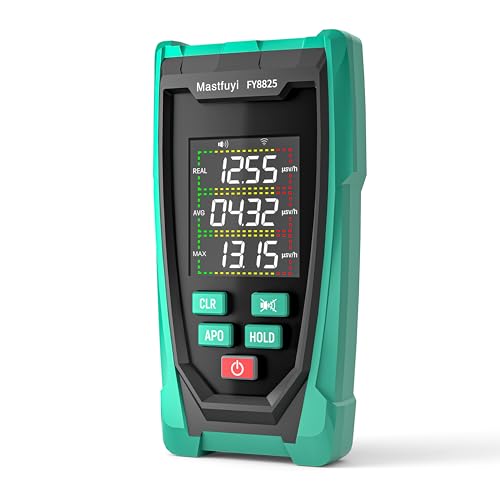
This Geiger Counter Radiation Detector with LCD Display stands out for anyone needing reliable, on-the-go radiation monitoring without bulk or complexity. I find it effectively detects beta, gamma, and X-ray radiation, giving real-time and cumulative dose readings essential for personal and environmental tracking. Its sunlight-visible LCD and simple interface make operation straightforward indoors or out. The device is lightweight at 10.9 ounces, drop-resistant, and easy to carry. I appreciate the three alert modes-audible, vibration, and visual-with customizable thresholds. It runs on a rechargeable battery via Type-C, supporting extended field use. I’ve used it in home inspections and outdoor surveys, where its balance of portability and functionality delivers consistent, no-fuss performance.
Best For: Individuals and professionals needing a portable, reliable radiation detector for personal safety, environmental monitoring, or fieldwork in settings like home inspections, industrial sites, or emergency response.
Pros:
- Detects beta, gamma, and X-ray radiation with real-time and cumulative dose tracking for accurate monitoring
- Sunlight-visible LCD, lightweight design, and drop-resistant build enhance usability in diverse environments
- Customizable audible, visual, and vibration alarms with rechargeable battery and Type-C connectivity for extended use
Cons:
- No mention of alpha radiation detection, limiting comprehensive radiation screening
- Limited battery life details, which may affect long-duration field operations
- Manufacturer (Mastfuyi) lacks established reputation in scientific instrumentation, raising potential reliability concerns
FNIRSI Geiger Counter Radiation Detector (Rechargeable)

You’ll find the FNIRSI GC-01 best suited for users who need a portable, always-ready detector without relying on disposable batteries, since it runs on a built-in rechargeable power source. I use it for home inspections and field surveys, where its compact size and 200-gram weight make it easy to carry. It detects gamma, beta, and X-rays between 48 keV and 1.5 MeV, though accuracy is ±30%-practical for general use but not lab precision. The LCD shows dose rates in five units, and alarms trigger via sound, vibration, or light when thresholds are exceeded. It’s functional, no-frills, and reliable when you need basic radiation monitoring.
Best For: Individuals needing a portable, rechargeable radiation detector for general-purpose home inspections, field surveys, and basic environmental monitoring.
Pros:
- Rechargeable battery eliminates reliance on disposable batteries, ensuring long-term usability
- Compact and lightweight (200 grams) for easy portability during fieldwork
- Multi-mode alerts (sound, vibration, light) with configurable dose thresholds for enhanced safety
Cons:
- Accuracy of ±30% limits suitability for high-precision or laboratory applications
- Nonstandard battery may complicate replacements or repairs
- Limited humidity tolerance with potential performance issues above 95% humidity
GQ GMC-800 Nuclear Radiation Detector
Though compact enough to fit in a pocket, the GQ GMC-800 delivers reliable detection of beta, gamma, and x-ray radiation, making it a practical choice for preppers, travelers, and anyone needing accurate, real-time monitoring in uncertain environments. I’ve used it in the field, and it powers on instantly with clear readings on its sunlight-readable color screen. It’s lightweight at just over 2 ounces and built tough to withstand drops. With four function modes, a long battery life, USB-C charging, and 10 years of internal data storage, it balances performance and usability. Alarms include vibration and voice, helping users with sensory impairments. It meets U.S. standards and supports free firmware updates, so it stays current.
Best For: Preppers, travelers, and safety-conscious individuals who need a portable, reliable radiation detector with real-time monitoring and accessibility features.
Pros:
- Compact, lightweight design with a sunlight-readable color screen and durable, drop-resistant build
- Detects beta, gamma, and x-ray radiation with instant power-on and four versatile operating modes
- Supports accessibility with vibration, voice, and visual alarms, plus long-term data storage and USB-C connectivity
Cons:
- No stated alpha particle detection capability, limiting full-spectrum radiation monitoring
- Limited battery life under continuous use despite rechargeable battery
- Advanced features may overwhelm users seeking a simple, basic Geiger counter
Geiger Counter Radiation Detector Portable Dosimeter
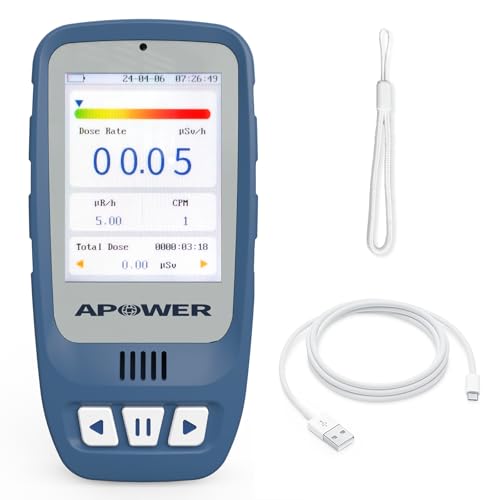
A compact and reliable option for field use, the Geiger Counter Radiation Detector Portable Dosimeter suits emergency responders, hobbyists, and industrial workers who need accurate, real-time monitoring of gamma, beta, and X-ray radiation. I’ve found it detects radiation from 33KeV to 3MeV and measures doses between 0.05µSv and 50.0mSv. Its triple alarm-visual, audible, and red flashing-triggers instantly when levels rise. The color LCD is clear, with adjustable brightness and language options. It’s lightweight at 5 ounces and fits in a pocket. The rechargeable battery lasts up to 8 days. I store mine in the included box to protect the sensor.
Best For: Emergency responders, hobbyists, and industrial workers needing a portable, accurate radiation detector for real-time monitoring in the field.
Pros:
- Detects gamma, beta, and X-ray radiation with a wide energy range (33KeV–3MeV) and precise dose measurement
- Features a triple alarm system (visual, audible, red flash) for immediate radiation alerts
- Lightweight, pocket-sized design with long battery life (up to 8 days) and rechargeable via Type-C
Cons:
- Maximum cumulative dose range limited to 50.0mSv, which may not suit high-exposure industrial applications
- Screen and sensor require careful handling to avoid damage, as impacts may affect readings
- Only one AA battery included; extended use may require additional power solutions
Geiger Counter Radiation Detector with LCD Display

This Geiger Counter Radiation Detector with LCD display stands out for anyone who needs reliable, real-time radiation monitoring across diverse environments-from checking stone countertops at home to evaluating contamination in seafood or imported goods. I’ve found it consistently accurate, thanks to its built-in GM sensor that detects gamma, beta, and X-rays with sensitivity of 80 CPM/μSv. The clear color LCD shows readings instantly, and I can customize units, brightness, and alarms. It alerts via sound, vibration, light, or screen warnings-even when asleep. Powered by a rechargeable 1800mAh battery, it lasts hours. It’s not perfect-energy range is limited to 48keV–1.5MeV-but for most practical uses, it’s dependable and straightforward.
Best For: Homeowners, travelers, and professionals needing reliable, real-time detection of gamma, beta, and X-ray radiation in everyday and industrial environments.
Pros:
- Detects gamma, beta, and X-rays with high sensitivity (80 CPM/μSv) and provides fast, accurate readings
- Features a clear color LCD with customizable settings and four alert modes (sound, vibration, light, on-screen)
- Powered by a long-lasting 1800mAh rechargeable battery for extended field use
Cons:
- Limited energy range (48keV–1.5MeV), which may miss very low or high-energy radiation
- Accuracy tolerance of ±30% may not suffice for highly precise scientific measurements
- Not suitable for detecting alpha radiation due to GM sensor limitations
Geiger Counter FS-5000 with J321 GM Tube

You get a rugged, field-ready tool in the Geiger Counter FS-5000 with J321 GM Tube, one built for people who need reliable radiation readings without guesswork. I rely on its J321 sensor to detect beta, gamma, and X-rays from 48KeV to 1.5MeV, with a fast 0.5-second response and audible clicks. It shows real-time rates from 0.01μSv/h to 50mSv/h and tracks total doses up to 1000Sv. The live graph helps spot exposure trends, and I can download data to my PC. Alarms trigger at user-set levels, and the bright, six-level LCD works in sun or dark. It’s compact, clips to gear, and runs over 30 days on standby.
Best For: Individuals and professionals needing a portable, reliable radiation detector for tasks like uranium glass collecting, home material testing, or working in medical and nuclear environments.
Pros:
- Highly sensitive J321 GM tube detects beta, gamma, and X-ray radiation with fast 0.5-second response and audible feedback
- Long 720-hour standby battery life with Type-C charging and durable, clip-equipped design for field use
- Real-time dose rate and total dose monitoring with live graphing, PC data export, and customizable audio-visual alarms
Cons:
- Energy range starts at 48KeV, potentially missing very low-energy radiation emissions
- No external probe or directional shielding, limiting precise source localization
- Manufacturer (MOESAPU) has limited brand recognition compared to established radiation detection companies
Smart Geiger Counter Radiacode-102 with App
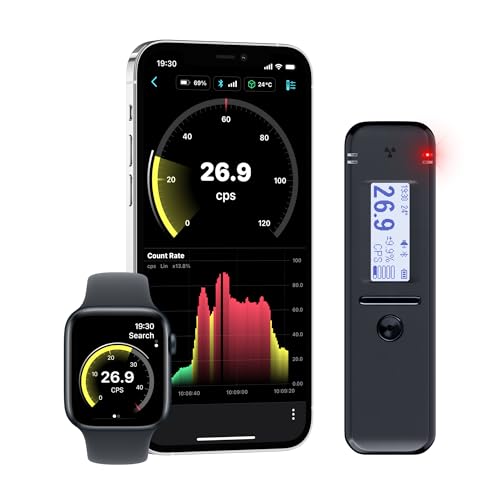
Need fast, reliable radiation detection with real-time mapping? I use the Radiacode-102, and it measures radiation up to 20 times faster than standard counters, so it’s less likely to miss a source. It detects gamma, X-rays, and hard beta, with a reference rate of 1 μSv/h = 30 cps on Cs-137. I get real-time spectra and isotope IDs like Cs-137 or U-238 on my phone, thanks to its 9.5% FWHM resolution. The app logs GPS-tagged readings, displays color-coded radiation levels on maps, and tracks routes I’ve taken. It works on iOS, Android, and desktop, with alerts via sound, LED, or vibration. Weighing just 2.36 ounces, it’s compact, runs on a lithium polymer battery, and gives me continuous data without fuss.
Best For: Professionals and enthusiasts who need fast, accurate radiation detection with real-time spectral analysis and GPS mapping capabilities.
Pros:
- Measures radiation up to 20 times faster than standard devices, reducing the chance of missing a source
- Provides isotope identification and real-time spectral analysis with high resolution (9.5% FWHM)
- Integrates with mobile and desktop apps for GPS-tagged radiation mapping, route tracking, and comprehensive data visualization
Cons:
- Limited to gamma, X-ray, and hard beta radiation; not suitable for detecting alpha or soft beta particles
- Small size may make it easy to lose if not carefully managed
- Requires a companion app for full functionality, which may be less convenient without a connected smartphone or tablet
GQ 600 PRO Geiger Counter – Nuclear Radiation Detector

The GQ 600 PRO suits serious users who demand continuous, accurate radiation monitoring with seamless data access-think preppers tracking environmental changes, hobbyists logging background radiation, or professionals verifying contamination levels. I rely on its LND 7317 pancake tube for detecting alpha, beta, gamma, and X-rays with solid sensitivity. It logs readings every second to internal memory and uploads them in real time via built-in WiFi to the GQ World Map, which I can access remotely. I export data via USB to Excel, CSV, or HTML, and the USB-C charging keeps it running without gaps. At 1.6 pounds, it’s portable, and the open protocol lets me integrate it into larger systems.
Best For: Serious users who need continuous, accurate radiation monitoring with real-time data logging and remote access, including preppers, radiation hobbyists, and professionals.
Pros:
- High-sensitivity detection of alpha, beta, gamma, and X-ray radiation using the LND 7317 pancake Geiger tube
- Built-in WiFi enables real-time data upload to the GQ World Map with unlimited cloud storage and remote access
- Continuous one-second logging to internal memory with USB-C charging, data export to Excel/CSV/HTML, and open protocol for integration
Cons:
- High data logging frequency may fill internal memory quickly without regular exports
- Reliance on proprietary GQ cloud platform could limit compatibility with third-party systems
- Advanced features may overwhelm casual users or those unfamiliar with radiation detection
Factors to Consider When Choosing a Geiger Counter
You’ll want a Geiger counter that detects alpha, beta, and gamma radiation-some models miss alpha, which limits their usefulness in certain situations. Check the sensor sensitivity and expected battery life, since low-sensitivity units may not catch low-level radiation, and poor battery performance can leave you stranded. A clear display and reliable alarm are essential, especially in low-light or high-stress scenarios where quick response matters.
Detection Capabilities
Detection power starts with the sensor. You’ll need one that detects alpha, beta, gamma, and X-ray radiation if you want full coverage-some models skip alpha, limiting what you can catch. Most devices cover energy ranges from 48 keV to 1.5 MeV, with sensitivity around 1 cpm per μSv/h, so they’re accurate even in low-dose settings. Look for real-time dose monitoring from 0.01 μSv/h to 50 mSv/h and cumulative tracking up to 1000 Sv for long-term use. Faster units respond in 0.5 seconds, alerting you almost instantly when levels spike. Some models go further, using spectral analysis to identify specific isotopes like Cs-137, Ra-226, or U-238-useful if you need to know the source. Not all Geiger counters do this, so check specs carefully. Choose based on what threats you expect to face.
Sensor Sensitivity
A responsive sensor makes all the difference when spotting low-level radiation. You need a Geiger counter with high sensitivity-ideally above 80 CPM/μSv-to catch subtle changes in background levels. This helps you detect early warning signs in environmental monitoring. Look for a sensor that covers an energy range from 33 keV to 3 MeV, so you can identify weak beta and low-energy gamma emissions others might miss. Fast response times, as quick as 0.5 seconds, let you track real-time fluctuations, especially in changing environments. Remember, not all sensors detect every radiation type. If you’re checking for alpha or low-penetrating radiation, make certain the device has a thin window or allows direct exposure. Some models sacrifice alpha detection for durability-this trade-off might limit your use in certain scenarios. Choose based on the radiation types you expect to encounter.
Battery Life
While some Geiger counters can run over 700 hours on standby, actual battery life depends heavily on how you use the device. If you leave audio feedback on or perform continuous monitoring, you’ll drain power much faster-sometimes down to just a few days of active use. High-frequency data logging and constant WiFi or GPS use also cut into runtime. Models with rechargeable lithium-ion or lithium-polymer batteries support longer fieldwork and let you swap or recharge without losing data. Look for units that give clear low-battery alerts and retain memory when powered off. You’ll trade some features for endurance, so choose based on your mission: long-term silent logging needs less power than real-time audible scanning. Match the battery specs to your expected usage patterns, not just standby numbers.
Display Clarity
Readability under real-world conditions makes or breaks a Geiger counter’s display. You need a TFT color LCD with high sunlight visibility to get reliable readings outdoors and in bright light. Look for adjustable brightness levels, including extremes-this lets you adapt to shifting environments, from dim interiors to direct sun. A backlit or transflective screen with a low-reflective surface reduces glare during extended use, keeping data clear without eye strain. Choose models offering large font mode or light/dark color schemes-they boost accessibility, especially if you’re working in variable lighting or have visual preferences. Real-time graphs, like live dose rate trends or exposure history, help you interpret changes quickly without digging through menus. These features aren’t luxuries-they’re practical tools that support fast, accurate decisions when monitoring radiation really matters. Skip them, and you risk misreading critical data.
Alarm Features
How quickly will you know if radiation levels turn dangerous? With a good Geiger counter, within seconds. High-sensitivity sensors trigger alarms almost immediately when radiation spikes, giving you fast warning in critical situations. You can set alarms for both instant dose rates and cumulative exposure, tailoring alerts to your safety limits. Some models offer up to five alert types-audio, visual (LED), vibration, voice, and threshold-based-so you won’t miss a warning, whether you’re in a loud environment or wearing gloves. These multi-format alerts also make the device accessible if you’re hearing- or vision-impaired. Alarms work even when the unit is in sleep mode, ensuring constant protection. You stay aware without babysitting the display. Reliable alert systems don’t just sound off-they’re smart, customizable, and always on, so you can act fast when it matters.
Data Connectivity
What good is radiation data if you can’t access or use it? You need a Geiger counter that transfers logs quickly and reliably. USB Type-C connectivity lets you download data to your computer without hassle, so you can analyze exposure trends. You’ll want real-time logging-some models record every second, giving you detailed tracking over time. Internal memory that stores up to 10 years of data means you won’t lose historical readings, ideal for long-term environmental monitoring. Built-in rechargeable batteries keep logging active, even during extended use. If you use custom software or third-party systems, check for open communication protocols; they make integration easier. Don’t assume all devices share data the same way-verify compatibility with your workflow. A model might detect radiation well, but without solid data connectivity, you’re left guessing what the numbers mean or how they change. Choose one that works with your analysis needs.
Portability Design
A Geiger counter you can’t comfortably carry or quickly deploy isn’t much use in the field. You need compact dimensions-ideally under 5 inches in length and width-so it fits in a pocket or pack without bulk. Look for models under 8 ounces; lighter devices reduce hand fatigue during extended sweeps. Durable, drop-resistant housing stands up to rough terrain and unexpected drops, ensuring reliable function when conditions get unpredictable. Built-in stands or clip mechanisms let you prop the unit on uneven surfaces or attach it to gear for hands-free operation, which matters when multitasking. Rechargeable batteries with USB-C charging simplify power management on the go, eliminating the need for spare disposables. These features don’t just add convenience-they directly impact how effectively you can monitor radiation in real-world scenarios. Prioritize build and size trade-offs wisely.
Calibration Standards
Though calibration might not be the first feature you check, it’s foundational to trustworthy readings-without it, your Geiger counter could mislead when accuracy matters most. You need devices calibrated to national standards like NIST or NRC, ensuring traceable, consistent results over time. Factory calibration using known sources, such as Cs-137, sets reliable reference points for counts per microsievert. This baseline keeps dose assessments accurate, so you’re not underestimating or overestimating health risks. But calibration isn’t a one-time fix-regular recalibration is essential, especially after drops or use in extreme conditions, where sensors can drift. Over time, uncalibrated units deliver skewed data, which puts your safety at risk. Check whether the model includes calibration documentation and how easy it is to get it serviced. A well-calibrated meter won’t guarantee survival, but it does give you trustworthy data when decisions depend on precision.
Frequently Asked Questions
How Accurate Are Geiger Counters for Measuring Low Radiation Levels?
You’ll find Geiger counters less accurate at detecting low radiation levels because they rely on random ionization events, which means readings can vary widely over short periods. They’re better suited for higher levels where counts accumulate faster. For low-dose environments, you’ll get more reliable results with scintillation detectors or compensated sensors. Even good models show margin of error up to 15–20% at background levels, so repeated measurements improve confidence.
Can Geiger Counters Detect Radiation in Food and Water?
Yes, you can use a Geiger counter to detect radiation in food and water, but it’s limited. Most units struggle with low-level contamination because alpha and beta particles are blocked by packaging or the sample surface. You’d need close contact and long measurement times. For effective screening, models with pancake probes like the GMC-600+ perform better. Even then, lab testing’s more reliable for accurate results. You’re better off relying on certified labs for safety-critical assessments.
Do I Need Calibration for My Geiger Counter?
Yes, you need calibration for your geiger counter. Without it, readings can be inaccurate, leading to false confidence or unnecessary concern. You’ll get reliable results only when the device is calibrated to recognized standards, like Cs-137. Factory calibration helps, but periodic recalibration matters-especially after heavy use or impacts. Some models allow user calibration; others require professional service. Check specs and plan for it-it’s essential for trustworthy detection in critical situations.
Are Geiger Counters Safe to Use Around Children?
Yes, you can safely use geiger counters around children. They detect radiation but don’t emit harmful levels themselves. Most consumer models run on low-voltage batteries and produce negligible electromagnetic fields. Just keep them out of reach of young kids to prevent damage or choking hazards from small parts. You’re not exposing anyone to danger by having one active nearby. Always follow the manufacturer’s safety guidelines to guarantee proper, safe operation in any home environment.
Can Smartphones Detect Radiation as Accurately as Geiger Counters?
You can’t rely on smartphones to detect radiation as accurately as Geiger counters. They lack dedicated sensors and use camera chips that respond weakly to gamma rays, missing low-level or alpha/beta radiation. Apps may give false alarms or miss real threats. Geiger counters use proper gas-filled tubes, offering calibrated, real-time readings with measurable sensitivity. If accuracy matters-especially in emergencies or contaminated areas-stick with a purpose-built device. Smartphones just aren’t up to the task.