Best GMRS Radios for Overlanding Adventures
You need reliable communication when terrain gets tough, and GMRS radios like the Midland MXT500 or Rugged Radios 25W deliver with 50W and 25W outputs, IP67 ratings, and proven range. Handhelds like the Midland GXT67 offer submersible durability and NOAA alerts. Mobile units with magnetic mounts and CTCSS filtering cut interference. Higher wattage means better reach, but check power needs and installation space. Knowing the trade-offs helps match the radio to your overlanding demands.
We are supported by our audience. When you purchase through links on our site, we may earn an affiliate commission, at no extra cost for you. Learn more. Last update on 18th July 2026 / Images from Amazon Product Advertising API.
Notable Insights
- High-power mobile GMRS radios like the Midland MXT500 offer 50-watt output for reliable long-range communication in remote off-road areas.
- Rugged, waterproof designs such as the Rugged Radios GMRS 25W ensure durability and performance in harsh overlanding conditions.
- Radioddity DB25-G provides 25W output and 15-mile range in mountains, ideal for challenging terrain encountered during overlanding.
- Mobile radios with external antennas and magnetic mounts enable quick installation and strong signal transmission from vehicles.
- Weather alert features like NOAA scanning with automatic alerts on Midland models keep overlanders informed of sudden environmental hazards.
Midland GXT67 5-Watt GMRS Radio
If you’re pushing through mud-choked trails or crossing dry riverbeds where dust hangs in the air and cell signals vanish, the Midland GXT67 5-Watt GMRS Radio is built for you. I rely on its IP67 rating-it survives submersion up to 3 feet and shrugs off dust. Its 5-watt output gives me clear range through trees and valleys, and repeater capability extends coverage further. Twenty-two channels with privacy codes cut interference. The display is backlit, buttons are glove-friendly, and setup takes seconds. It pairs with my MXT radio in the Jeep and fits tight spaces at 1.5 inches wide. A 3-year warranty and included battery mean I’m covered off-grid.
Best For: Off-road and overlanding enthusiasts who need rugged, reliable, long-range communication beyond cellular coverage.
Pros:
- IP67 waterproof and dustproof rating ensures durability in extreme conditions, including submersion up to 3 feet
- 5-watt GMRS power with repeater capability delivers strong range through dense terrain and valleys
- Glove-friendly oversized buttons and backlit display allow for easy use in challenging environments
Cons:
- Requires a GMRS license from the FCC for legal use in the U.S.
- Limited to 22 channels, which may restrict group coordination in crowded radio environments
- Shorter range compared to larger mobile units without repeater support
Midland MXT500 50-Watt GMRS Mobile Radio

The Midland MXT500 50-Watt GMRS Mobile Radio delivers reliable long-range communication for overlanders who need clarity and consistency in remote terrain. I use it on trails and off-road routes where signals often drop, and its 50-watt output keeps me connected. It has 8 repeater channels and a 2.1dB antenna that boosts reach without extra gear. The compact unit fits easily in my rig, and the external magnetic antenna installs fast. At 3.8 pounds, it’s sturdy but not bulky. It’s not a handheld-this is a vehicle unit, so portability isn’t the goal. I trust it because it’s built for farms, ranches, and serious off-grid travel.
Best For: Overlanders, off-road enthusiasts, and those working on farms or ranches who need reliable, long-range communication in remote areas.
Pros:
- Powerful 50-watt GMRS output and 8 repeater channels provide extended range and reliable connectivity in rugged terrain
- Compact design with a fast-install external magnetic mount antenna for easy setup and space-efficient mounting
- Durable build with a 2.1dB unity gain antenna that enhances signal reach without requiring additional equipment
Cons:
- Requires a GMRS license from the FCC, which may deter casual users
- Limited to vehicle use only, not portable for on-foot communication
- Heavier than some competing models at 3.8 pounds, which may affect installation flexibility
Rugged Radios GMRS 25W Waterproof Mobile Radio

I rely on the Rugged Radios GMR25 when I need a no-fail communication link in tough off-road conditions, and that makes it a top pick for overlanders who demand power and durability. It outputs 25 watts and handles GMRS frequencies reliably, giving me consistent range in remote terrain. The IP67 rating means it survives dust, mud, and rain without issue. At 4-3/16 x 5 x 1-9/16 inches, it fits tight dash spaces and mounts securely in any vehicle. The magnetic hand mic stays in place, even on rough trails. I’ve used it across farms and desert routes-it works. It comes with a 3-year warranty, which tells me Rugged stands behind its build.
Best For: Overlanders, off-road enthusiasts, and farmers needing a durable, high-power mobile radio for reliable communication in remote and rugged environments.
Pros:
- Delivers 25W output power with reliable GMRS frequency performance for extended range
- IP67 waterproof and dustproof rating ensures operation in harsh conditions like mud, rain, and dust
- Compact design and universal vehicle compatibility allow for easy installation in tight spaces
Cons:
- Requires a GMRS license for legal operation, which may deter casual users
- Heavier than some competing models at 3.3 pounds, potentially affecting mounting options
- Higher price point compared to basic CB or lower-powered two-way radios
Midland MXT275 MicroMobile GMRS Radio

You get 15 watts of power and up to 50 miles of range under ideal conditions with the Midland MXT275 MicroMobile GMRS Radio, making it a solid pick if you’re traversing remote trails and need reliable group communication. I’ve used it on overlanding trips where terrain blocked weaker signals, and its 15 high-power GMRS channels, including 8 repeater options, kept me connected. The 142 privacy codes reduce chatter, and NOAA Weather Scan alerts me to storms before they hit. It’s compact, mounts easily, and works with my handhelds. Range drops in dense forests, but that’s physics, not a flaw. It’s a dependable, no-frills unit for off-grid travel.
Best For: Overlanders, off-roaders, and outdoor enthusiasts who need reliable long-range communication in remote areas.
Pros:
- 15 watts of power and up to 50 miles of range under ideal conditions for strong, dependable communication
- 15 high-power GMRS channels with 8 repeater options and 142 privacy codes to minimize interference
- Integrated NOAA Weather Scan and alerts provide critical weather and emergency updates on the go
Cons:
- Range significantly reduced in dense forests or mountainous terrain due to signal obstruction
- Requires a GMRS license from the FCC for full legal operation
- Larger than handheld radios, making it less portable for on-foot use
Rugged Radios GMRS Handheld Walkie Talkie

Rugged Radios GMRS Handheld Walkie Talkie stands out for overlanders who demand reliable, long-range communication in remote terrain. I use its 22 channels and 121 privacy codes to avoid interference, and the tuned antenna delivers consistent range even off-grid. It links with all GMRS radios I’ve tested, ensuring group compatibility. The NOAA weather channels keep me informed during storms, and the flashlight and FM radio add practical value. Its safety orange color makes it easy to spot if dropped. At 14.9 ounces, it’s light enough for extended carry. The rechargeable battery lasts through multi-day trips, and the three-year warranty gives me confidence in its durability.
Best For: Overlanders and outdoor enthusiasts who need reliable, long-range communication in remote and rugged environments.
Pros:
- Offers 22 GMRS channels and 121 privacy codes for clear, interference-free communication
- Features NOAA weather channels, flashlight, and FM radio for enhanced safety and utility
- Durable design with a three-year warranty and excellent battery life for extended adventures
Cons:
- Requires a GMRS license from the FCC for legal use in the United States
- Heavier than some competing handheld models, at 14.9 ounces
- Warranty does not cover damage from misuse, improper storage, or incompatible equipment
Radioddity DB20-G GMRS Mobile Radio

A dependable companion for overlanders who rely on clear, long-range communication, the Radioddity DB20-G GMRS Mobile Radio delivers 20W of output power and access to nine programmable GMRS repeater channels, making it ideal for drivers traversing remote off-road terrain. I use it in my rig because it reaches up to 20 miles in open areas and 10 miles in mountainous zones when linked to repeaters. It supports CTCSS/DCS codes to reduce interference and syncs channel data on its color display. The handset holds all controls, including VOX, so I keep my hands on the wheel. It’s compact, rugged, and fits seamlessly in my setup.
Best For: Overlanders and off-road enthusiasts who need reliable, long-range communication with easy, hands-free operation in remote terrain.
Pros:
- 20W output power and access to 9 programmable GMRS repeater channels for extended range in remote areas
- Integrated control microphone with VOX and one-handed operation, ideal for drivers
- Supports 1075 privacy codes via CTCSS/DCS tones and syncs channel info on a clear color display
Cons:
- Limited to GMRS/FRS and NOAA bands, not suitable for amateur radio bands
- Requires GMRS license from the FCC for full-power operation
- Mounting hardware may require additional customization for some vehicle setups
Radioddity GM-30 2-Pack 5W GMRS Handheld Radios

The Radioddity GM-30 2-Pack suits overlanders who need reliable, license-compliant GMRS communication without relying on cell service. I use these 5W dual-band radios on backcountry trips, and they deliver up to 5 miles of range, depending on terrain. With 30 default channels and 250 total programmable ones, I can customize frequencies using Chirp and the included cable. The dual LCD display shows channel and frequency at once, which I find practical in fast-moving situations. USB-C charging keeps them powered, and the 1.85-pound pack includes two radios with rechargeable batteries. They’re repeater-capable, have NOAA weather alerts, and include a flashlight-simple tools that work when you need them.
Best For: Overlanders and outdoor enthusiasts who need reliable, license-compliant GMRS two-way communication in remote areas without cell service.
Pros:
- 5W dual-band GMRS radios with up to 5 miles range and repeater capability for extended coverage
- Chirp-compatible with 250 programmable channels and USB-C rechargeability for modern convenience
- Dual LCD display, NOAA weather alerts, flashlight, and VOX support offer versatile field functionality
Cons:
- Requires a GMRS license for full 5W and repeater use, which may deter casual users
- 1.85-pound pack weight may be bulky for ultralight backpackers
- Limited to 4.5-star rating with some user reports of menu complexity and battery life under heavy use
Radioddity DB25-G GMRS Mobile Radio
If you’re running long overland routes where reliable, high-power communication matters, the Radioddity DB25-G stands out with its 25W output and dual-band receive capability. I’ve used it on remote trails, and it consistently reaches 15 miles in mountainous terrain, thanks to switchable power modes. Its 130 programmable channels and Quad Watch let me monitor multiple frequencies without hassle. The LCD is clear, even in sunlight, and installation took minutes with the plug-in power cable. While it’s not compact like a handheld, its 5.5-inch size fits most dash setups. I appreciate the PC programming and 18-month warranty-practical touches that add real-world reliability.
Best For: Overlanders, off-road adventurers, and GMRS radio users needing high-power, reliable communication with dual-band receive capabilities.
Pros:
- 25W output power with switchable modes ensures strong signal reach up to 15 miles in rugged terrain
- 130 programmable channels and Quad Watch support seamless monitoring of multiple frequencies
- Easy plug-in installation and PC programmability enhance usability and customization
Cons:
- Larger size may not fit in compact dash installations compared to handhelds
- Requires external antenna and proper grounding for optimal performance
- GMRS license required for legal transmission on GMRS frequencies
Retevis RA25 GMRS Mobile Radio
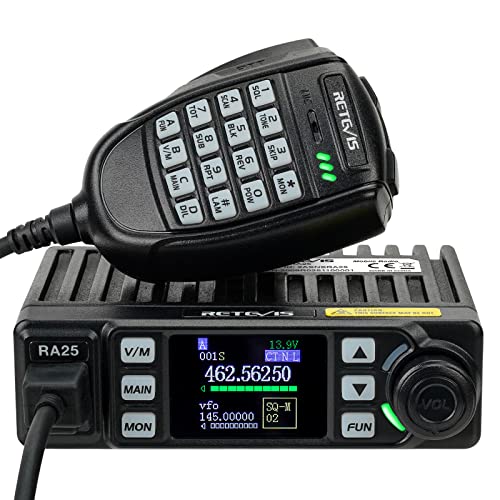
You’ll want the Retevis RA25 if you need a compact, no-fuss GMRS mobile radio that fits tight spaces and still delivers reliable long-range communication. I’ve used it on overlands and farm runs, and its 22 GMRS channels, including 8 repeater channels, keep me connected. The dual-band receiving and CTCSS/DCS filtering reduce noise, while the compander improves clarity in windy or loud conditions. At just under 16 ounces and under 5 inches wide, it fits narrow dashes. The built-in FM radio is useful for weather or news between calls. It includes all mounting hardware, and I got support from Amazon within hours when I had a question. It’s not flashy, but it works.
Best For: Farmers, overlanders, and field operators needing a compact, reliable GMRS mobile radio for long-range communication in tight spaces.
Pros:
- Compact design fits narrow dashboards and seats; lightweight at just 15.8 ounces
- 22 GMRS channels with 8 repeater channels and dual-band receiving for extended range and reduced interference
- Includes all installation accessories and built-in FM radio; responsive Amazon support within 12 hours
Cons:
- Requires separate purchase of a Lithium Ion battery, not included in the package
- Basic display and controls may lack advanced features desired by tech-savvy users
- Limited warranty on accessories (1 year) compared to the radio body (2 years)
Midland MXT115 15W GMRS Mobile Radio

Midland’s MXT115 15W GMRS Mobile Radio suits overlanders who need reliable long-range communication without relying on cell signals. I use it on remote trails where cell service drops, and its 15 watts of power delivers up to 40 miles of range in ideal conditions, though terrain cuts that in practice. It runs on AA batteries, which is handy when vehicle power isn’t available. The external antenna boosts signal, and NOAA weather alerts keep me informed during storms. With 15 channels and 142 privacy codes, I avoid interference in crowded areas. It’s compact, durable, and links well with my Midland handhelds.
Best For: Overlanders, outdoor adventurers, and off-road enthusiasts who need reliable long-range communication in remote areas without cell service.
Pros:
- Delivers up to 40 miles of range with 15 watts of power and an external antenna for improved signal
- Operates on AA batteries, enabling use when vehicle power is unavailable
- Includes NOAA weather alerts and AMBER alerts for real-time emergency information
Cons:
- Actual range is significantly reduced by terrain, obstacles, and weather conditions
- Requires an FCC license for GMRS use, which may be a barrier for some users
- Limited to line-of-sight communication without repeater channels in remote areas
Factors to Consider When Choosing a GMRS Radio for Overlanding
You’ll want to check the power output first-higher watts mean better range, but they also drain your battery faster. Make sure the radio has enough channels and includes weather alerts, since conditions can change fast when you’re off-grid. Look for a durable, sealed unit that can handle dust and rain, especially if you plan to use repeaters to extend your reach.
Power Output Level
When pushing through dense forests or traversing deep canyons, having a GMRS radio with sufficient power output makes a measurable difference in maintaining clear communication. You can legally transmit up to 50 watts, and radios in the 25–50 watt range typically deliver the best performance, extending your reach to 25 miles or more in rugged terrain. Higher power improves signal penetration through obstacles like thick foliage or rock walls, giving you more reliable contact when line-of-sight is blocked. But you don’t always need max power-lower settings (5–15 watts) save battery on short-range chatter. Choose a model with adjustable output so you can scale power based on distance, terrain, and power availability. This flexibility keeps your group connected without wasting energy. It’s not about maximum power all the time-it’s about having the right power when you need it.
Channel Availability
Though all GMRS radios give you access to the same 22 channels, how they handle repeater use, privacy codes, and channel spacing directly affects communication reliability in remote areas. You’ll want repeater channels to extend range in rugged terrain, especially when line-of-sight is blocked. Use CTCSS or DCS codes to filter out unwanted chatter on shared frequencies, letting your group communicate without constant interference. Narrowband mode (12.5 kHz) cuts congestion by doubling available space within the same spectrum, though it may slightly reduce audio range. Some radios let you program custom channel banks, so you can store specific setups for different trails or车队 operations without manual adjustments. This flexibility helps maintain quick access to critical channels when moving through varied terrain. Choose a radio that supports both analog and digital coding and allows precise channel management to stay connected when it matters most.
Weather Alert Features
What if the next storm rolls in while you’re miles off-grid? A GMRS radio with NOAA Weather Scan keeps you informed by automatically locking onto the strongest weather channel from ten dedicated frequencies. These models receive real-time alerts directly from NOAA’s transmitter network, so you get official storm warnings, flash flood alerts, and hazardous condition updates without delay. When severe weather is detected, the radio triggers an audible alarm, even if it’s on another channel. That means you won’t miss critical changes in conditions. Some units also broadcast AMBER alerts during emergencies. You don’t need constant monitoring-just enable the feature and let it run. Not all GMRS radios include this, so check specs carefully. It’s a practical safety layer, especially in remote areas where cell signals fail and weather shifts fast.
Durability And Sealing
A weather alert system won’t help if your radio fails the moment rain hits or it takes a bump on the trail. You need a GMRS radio built to survive. Look for an IP67 rating-it means your device is fully dustproof and can handle being submerged in up to 3 feet of water for 30 minutes. Sealed chassis designs block out moisture, mud, and grit, so the internals stay clean in harsh conditions. Rugged casings resist drops, vibrations, and constant off-road pounding. Avoid models with removable antennas; fixed antennas with proper seals reduce weak points where water or debris can enter. Buttons and ports should have corrosion-resistant gaskets that hold up in wet, humid environments. These details aren’t just extras-they’re what keep your radio working when you’re miles from help. Pick a model that treats durability as a baseline, not a bonus.
Range And Repeaters
If you’re covering long distances through rugged terrain, range matters more than raw power alone. A 50-watt GMRS radio can reach farther in open areas, but real-world performance depends on line-of-sight and elevation. Trees, mountains, and valleys disrupt signals, cutting effective range. Repeaters solve this by retransmitting your signal from high ground, often extending communication by dozens of miles. Most GMRS radios include repeater channels, but you’ll need the right CTCSS or DCS code to access them and avoid interference. These codes don’t encrypt your talk, but they keep shared channels quiet until your signal matches the required tone. Even with high power and repeaters, terrain and weather still limit performance. You’ll get the best results when your radio can both access repeaters and handle direct, short-range communication when repeaters aren’t available. Plan for both scenarios.
Ease Of Installation
You’ve considered how repeaters and terrain shape your communication range, but just as important is how quickly and cleanly you can get your radio running in the field. Choose models with plug-and-play power connectors that tap straight into your 12V system-no splicing or extra tools needed. Compact radios with included mounts fit snugly in irregular dash spaces, staying secure on rough trails. Magnetic mount antennas let you set up on the roof or trunk without drilling, and you can remove them fast when not in use. Look for a waterproof rating with sealed chassis; it keeps dust and moisture out during muddy, wet conditions. Integrated control mics reduce cable clutter, combining transmit, volume, and channel functions in one handheld unit. These features cut installation time and reduce points of failure, which matters when you’re miles from help and need dependable comms fast.
Privacy Code Options
Why deal with constant chatter from strangers when a clear channel is just a code away? GMRS radios use CTCSS or DCS privacy codes to mute unwanted traffic, so you only hear your group. Most models offer 100 to 121 codes, but higher-end units provide up to 260, giving you better odds of finding a quiet channel in busy areas. These codes don’t encrypt your signal-they just filter out transmissions without the matching tone, reducing cross-talk. If multiple overlanding groups use the same frequency, more code options mean less interference. Some radios let you program CTCSS and DCS codes independently per channel, adding flexibility. This helps maintain reliable communication without constant adjustments. Choosing a radio with more privacy codes improves your chance of uninterrupted contact, especially in crowded zones. It’s a practical upgrade for real-world use.
Battery Life Performance
Clear communication means nothing if your radio dies mid-trip, and that starts with reliable battery performance. You’ll face longer drains with higher-powered GMRS radios-25 to 50 watts chew through energy fast, so expect shorter run times. Handheld models with lithium-ion batteries typically last 8 to 12 hours under mixed use, which covers most day trips. You can stretch that by up to 50% using power-saving features like auto shut-off, low-power modes, or dialing down transmit power when full strength isn’t needed. Rechargeable units with USB-C charging give you faster, field-friendly refills from power banks or vehicle ports. Just remember, cold weather cuts battery capacity by up to 30% below freezing, so carry spares or keep them insulated. Plan for worst-case drain, not best. Your radio’s endurance is only as good as your backup plan.
Frequently Asked Questions
Do I Need a License to Use GMRS Radios?
Yes, you need a license to use GMRS radios. The FCC requires it, and you won’t get fined for asking-ignorance isn’t a defense. Getting one’s easy: apply online, pay $35, and it covers your family for ten years. No exam’s needed. You can transmit up to 50 watts, which beats most consumer radios. Skipping the license limits you to lower-powered FRS channels and risks penalties if caught. Just get the license-it’s cheap, quick, and keeps you legal.
Can GMRS Radios Work Internationally Outside the U.S.?
No, you can’t legally use GMRS radios outside the U.S. because they operate on frequencies reserved for U.S. licensed use only. Other countries have different regulations and band allocations, so your GMRS radio likely won’t comply. You’d need to use locally approved radios instead. While the hardware might transmit, doing so risks fines or interference. Always check local laws before using any radio abroad-your GMRS license doesn’t grant international privileges.
Are GMRS Radios Encrypted or Private for Conversations?
No, GMRS radios aren’t encrypted or truly private. You’re transmitting on shared frequencies, and anyone with a scanner or compatible radio can hear your conversations. Some models offer privacy codes like CTCSS or DCS, but those only filter chatter-they don’t encrypt signals. If privacy matters, assume your messages are exposed. For secure comms, you’ll need licensed encrypted systems. Stick to GMRS for short-range coordination where eavesdropping isn’t critical.
How Far Can GMRS Radios Typically Transmit Off-Road?
You’ll get 2–5 miles off-road with most GMRS radios in rugged terrain. Hills, trees, and valleys cut range fast, but line-of-sight pushes it to 10–20 miles. Power output matters-5 watts beats 1 watt. Higher antennas help too. Don’t count on city-range numbers when you’re deep in the backcountry. Real-world use means planning for dropouts. Always assume shorter range than advertised, especially in dense forests or canyons. Pack extras or use repeaters.
Can GMRS Handhelds Communicate With CB Radios?
No, you can’t use GMRS handhelds to talk directly to CB radios. They operate on different frequencies-GMRS uses UHF around 462–467 MHz, while CB runs on 27 MHz in the HF band. Your GMRS radio won’t transmit or receive CB signals, even with matching channels. If you need cross-communication, you’d need a dual-service radio or a separate CB unit. There’s no work-around with antennas or power adjustments.