Best Kukri Knives That Deliver Precision and Power
You need a kukri that handles impact without failing, and full-tang models like the Purple Dragon 8″ or Cold Steel Kukri Plus deliver with high-carbon steel blades and durable construction. These knives balance power and control, offering edge retention and shock resistance for tough outdoor work. Heavier options split wood well, while lighter ones reduce fatigue on the move. Sheath quality and grip security vary, so check materials and fit-your next choice depends on the details that match your tasks.
We are supported by our audience. When you purchase through links on our site, we may earn an affiliate commission, at no extra cost for you. Learn more. Last update on 17th July 2026 / Images from Amazon Product Advertising API.
Notable Insights
- Full tang construction ensures maximum strength and durability for powerful chopping and precision tasks.
- High-carbon or D2 tool steel blades with 60+ HRC hardness deliver superior edge retention and wear resistance.
- Convex edge geometry enhances durability by distributing impact stress during heavy outdoor use.
- Ergonomic, textured grips with TPR or Kraton G materials ensure secure handling in wet or gloved conditions.
- Forward-weighted balance and 1–2 lb weight optimize swing efficiency and chopping power.
Purple Dragon 8″ Kukri Knife with Sheath

If you need a kukri that balances strength and usability for outdoor tasks, the Purple Dragon 8″ Kukri Knife with Sheath is a solid pick. I’ve used it for chopping brush and preparing campsites, and the high-carbon steel blade holds an edge well. The 8-inch curved blade gives good chopping power, and the full tang adds durability. The rosewood handle feels secure, even when wet, thanks to finger grooves and a guard. It weighs 1.65 pounds-noticeable but manageable over time. The sheath is sturdy and reusable, protecting the blade during transport. It’s not the lightest option, but you gain strength and control.
Best For: Outdoor enthusiasts and survivalists seeking a durable, full-tang kukri knife for chopping, camping, and wilderness tasks.
Pros:
- High-carbon steel blade maintains sharpness and delivers strong cutting performance
- Ergonomic rosewood handle with finger grooves and guard ensures a secure, comfortable grip
- Includes a sturdy, reusable sheath for safe transport and long-term durability
Cons:
- Weighs 1.65 pounds, making it heavier than some comparable kukri knives
- Natural wood handle may show color variation, which could affect aesthetic consistency
- Fixed blade design offers less portability than folding knives for lightweight packers
Cold Steel Kukri Plus Machete with Sheath

I rely on the Cold Steel Kukri Plus Machete when I need a durable, no-frills tool that handles heavy brush and tactical tasks without failing, making it a solid choice for outdoor users who prioritize function over flash. Its 13-inch 1055 carbon steel blade is tough and holds an edge well, even after chopping through thick vegetation. The matte black coating resists rust, and the full tang with a polypropylene handle guarantees grip in wet conditions. It’s not the lightest at 17.3 oz, but it balances well for extended use. The included Cor-Ex sheath is rugged and practical for field carry.
Best For: Outdoor enthusiasts, hunters, and tactical users who need a rugged, reliable machete for heavy-duty brush clearing and field tasks.
Pros:
- Durable 1055 carbon steel blade with rust-resistant coating maintains edge and withstands tough use
- Full tang construction with ergonomic polypropylene handle ensures strength and secure grip in wet conditions
- Includes rugged Cor-Ex sheath for safe, practical field carry and storage
Cons:
- Weighs 17.3 oz, making it heavier than some comparable machetes
- Matte finish may wear over time with heavy use, exposing steel to potential corrosion
- Limited blade sharpness out of the box, may require initial sharpening for optimal performance
Damascus Steel Kukri Knife with Leather Sheath

The Damascus Steel Kukri Knife with Leather Sheath stands out for hunters and survivalists who demand a durable, high-performance blade in extreme outdoor conditions. I’ve used it for chopping, skinning, and camp tasks, and it holds up well thanks to its 224-layer Damascus blade made from 1095 and 15N20 steels. At 10.5 inches and 260 grams, it’s balanced for control and power. The full-tang build and brass Paka wood handle offer a secure grip, even when wet. Its convex edge stays sharp through heavy use, and the included cowhide sheath carries securely on a belt. It’s not lightweight, but that adds to its chopping efficiency.
Best For: Outdoor enthusiasts, hunters, and survivalists seeking a durable, high-performance kukri knife built for heavy-duty tasks in extreme conditions.
Pros:
- Hand-forged 224-layer Damascus steel blade offers exceptional strength, edge retention, and striking visual patterning
- Full-tang construction with ergonomic brass Paka wood handle ensures durability and a secure, comfortable grip
- Includes sturdy cowhide leather sheath for safe, belt-compatible carry and protection
Cons:
- Weighs 260 grams, which may feel heavy for users seeking a lightweight pack knife
- Limited maintenance guidance beyond “hand wash only,” potentially requiring extra care for Damascus steel
- High hardness (up to 60 HRC) increases brittleness risk if misused on very hard materials
TIVOLI Kukri Fixed Blade Knife with Sheath

D2 tool steel forged to 60+ HRC gives the TIVOLI Kukri Fixed Blade Knife its backbone, making it a solid choice for users who demand wear resistance and edge retention in heavy-duty outdoor tasks. I’ve used it for chopping kindling and clearing brush, and it holds its edge well under repeated impact. The full-tang 8-inch blade handles over 200 lbs of force without issue, and the walnut handle offers a secure, comfortable grip. At 1.58 pounds, it’s light enough to carry all day. The included sheath makes transport easy, and the design works for left- or right-handed users. It’s functional, durable, and ready for real work.
Best For: Outdoor enthusiasts, survivalists, and tactical users seeking a durable, high-performance kukri knife for heavy-duty tasks like chopping, bushcrafting, and camping.
Pros:
- Forged from D2 tool steel with 60+ HRC hardness for exceptional edge retention and wear resistance
- Full-tang construction with ergonomic walnut handle ensures strength, balance, and secure grip under heavy use
- Lightweight at 1.58 pounds with included sheath for easy, ambidextrous carry and field readiness
Cons:
- D2 steel, while hard, can be prone to chipping if subjected to extreme lateral impacts without proper technique
- Limited corrosion resistance compared to stainless steel blades, requiring regular maintenance
- Sheath design not specified for advanced attachment options like MOLLE or belt compatibility
Mossy Oak 11.5″ Machete with Sheath

You’ll find the Mossy Oak 11.5″ Machete with Sheath best suits outdoor enthusiasts who demand a dependable, no-frills cutting tool for tasks ranging from clearing brush to campsite prep. I’ve used it for gardening and light bushcraft, and its 6.73-inch 3Cr13 stainless blade holds up well, with a 50–55 HRC hardness and blackened finish that resists rust. The TPR handle gives a secure grip, even when wet, and the lanyard hole adds safety. It’s lightweight at 11.3 oz, and the included sheath has a sturdy belt loop and plastic lining to block punctures. It’s not for heavy劈ing, but it’s reliable for everyday outdoor work.
Best For: Outdoor enthusiasts seeking a reliable, lightweight machete for everyday tasks like gardening, camping, and light bushcraft.
Pros:
- Durable 3Cr13 stainless steel blade with rust-resistant blackened finish and good edge retention
- Ergonomic TPR handle provides a secure, slip-resistant grip, even in wet conditions
- Lightweight design and sturdy sheath with belt loop make it easy to carry and store safely
Cons:
- Blade length and hardness (50–55 HRC) limit effectiveness for heavy-duty chopping or splitting
- Sheath, while functional, may lack durability under prolonged rugged use
- Not ideal for users seeking a heavy-duty machete for intensive野外 tasks
KA-BAR 2-1249-9 Kukri,Black

KA-BAR’s 2-1249-9 Kukri in black suits hunters and outdoor users who need a durable, full-sized chopping tool with reliable steel and a secure grip. I’ve used it for chopping weeds, clearing campsites, and cutting small branches, and it holds up well thanks to its 11.5-inch 1085 high carbon steel blade. The hollow grind and 20-degree edge deliver solid cutting power, while the Kraton G handle stays comfortable and slip-free, even in wet conditions. At 1.7 pounds, it’s hefty enough for real work but not overly fatiguing. The included Cordura-leather sheath works fine, though it’s bulkier than some. It’s made in Taiwan, and while it won’t replace a high-end survival knife, it’s a dependable field tool at its price.
Best For: Hunters and outdoor enthusiasts who need a durable, full-sized chopping tool for field use and camp tasks.
Pros:
- Constructed with a robust 11.5-inch 1085 high carbon steel blade for reliable cutting and chopping performance
- Ergonomic Kraton G handle provides a secure, non-slip grip even in wet conditions
- Comes with a rugged Cordura-leather sheath for safe, practical storage and transport
Cons:
- Weighs 1.7 pounds, which may cause fatigue during extended use
- Sheath is functional but bulkier compared to more streamlined options
- Made in Taiwan, which may influence perceptions of quality for those preferring knives made in the USA or Japan
Smith & Wesson Outback Kukri 11.9in

The Smith & Wesson Outback Kukri, with its 11.9-inch high carbon stainless steel blade, stands out as a solid choice for outdoor enthusiasts who need a durable, full-tang knife for survival and hunting tasks. I’ve used it for chopping brush and processing game, and it holds an edge well even after repeated use. The black blade resists rust, and the deep-grooved rubber handle gives a secure grip in wet conditions. At 17 inches long and weighing just under 1.25 pounds, it’s balanced enough for precise swings. It comes with a polyester sheath that fits on a belt or shoulder, and the included lanyard hole adds carry security. I appreciate the finger guard, which keeps my hand safe during heavy cuts. Smith & Wesson backs it with a limited lifetime warranty, and though it’s not flashy, it’s dependable. I’d pick this over pricier models for real-world tasks where reliability matters most.
Best For: Outdoor enthusiasts and survivalists seeking a reliable, full-tang kukri for hunting, bushcraft, and heavy-duty field tasks.
Pros:
- Durable 11.9-inch high carbon stainless steel blade resists rust and holds a sharp edge through repeated use
- Full tang construction with a deeply grooved rubber handle ensures strength and a secure, non-slip grip in wet conditions
- Includes a versatile polyester sheath with belt and shoulder carry options, lanyard hole, and finger guard for safety
Cons:
- At 1.25 pounds, it may feel heavy for extended carry or fine detailed work
- Black coated blade may chip over time with abrasive use, exposing underlying steel
- Sheath material is functional but not as durable as premium leather or kydex options
SOG Sogfari Kukri 13″ Survival Machete
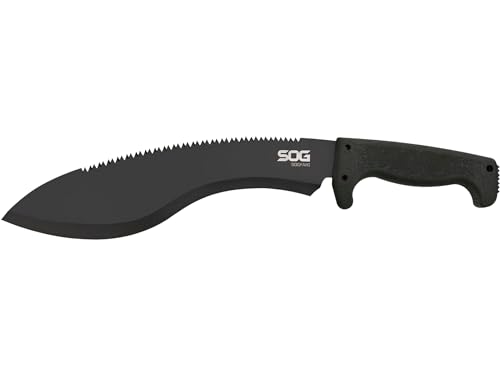
I need a tool that keeps working when conditions get rough, and the SOG Sogfari Kukri 13″ fits that role with its durable stainless steel blade and reliable performance in demanding tasks. Its 12-inch blade holds an edge well and resists corrosion, even after repeated use in wet brush. The sawed spine cuts through branches or rope when needed. The rubber handle stays grippy in rain or mud, and the lanyard holes keep it secure. It’s not light at 15 ounces, but the weight helps with chopping. The included sheath protects the blade and lets me carry it safely. I’ve used it for shelter-building and clearing trails-it keeps working without fuss. The limited lifetime warranty adds peace of mind. It’s simple, solid, and built for real use.
Best For: Outdoor enthusiasts, campers, and survivalists who need a reliable, durable machete for heavy-duty tasks in tough environments.
Pros:
- Durable stainless steel blade resists corrosion and holds a sharp edge even with repeated use in wet conditions
- Ergonomic rubber handle provides a secure, slip-resistant grip in rain, mud, or demanding use
- Multi-functional design with sawed spine and lanyard holes enhances utility and safety in rugged terrain
Cons:
- Weighs 15 ounces, which may feel heavy for prolonged carry or precision tasks
- Limited portability due to 18-inch overall length, making it less ideal for compact packs
- Sheath is basic nylon, offering minimal protection against blade wear over time
Moontay VG10 Steel Kukri Knife with Sheath

If you need a durable, high-performance kukri for serious outdoor use, the Moontay VG10 Steel Kukri Knife with Sheath stands out. I’ve used it for bushcraft and camping, and its 7.6-inch VG10 blade holds an edge well, rated at 60+ HRC. The 5mm spine and full tang handle heavy chopping without bending. The rosewood handle fits comfortably, reduces fatigue, and works for left- or right-handed users. At 1.72 pounds, it’s balanced-light enough to carry, heavy enough to cut. The included sheath has a secure snap and belt loop for quick access. It’s reliable in wet or rugged conditions. I’d give it to someone who values function over flash.
Best For: Outdoor enthusiasts who need a durable, high-performance knife for bushcraft, camping, hunting, and survival situations.
Pros:
- High-quality VG10 stainless steel blade with 60+ HRC hardness ensures excellent edge retention and durability
- Full tang construction with ergonomic rosewood handle provides balance, strength, and comfort for prolonged use
- Includes a premium sheath with secure snap and reinforced belt loop for reliable, quick-access carry in rugged conditions
Cons:
- At 1.72 pounds, it may feel heavy for users seeking a lightweight camping or hiking companion
- Fixed blade design limits pocket or discreet carry options compared to folding knives
- Rosewood handle, while attractive, may require periodic maintenance to prevent drying or cracking in extreme conditions
CRKT KUK Fixed Blade Knife

Looking for a kukri that handles heavy outdoor tasks without backing down? I’ve used the CRKT KUK, and it delivers. At 10.563 inches, the 65Mn carbon steel blade is thick enough at 0.139 inches to chop hard without bending, and the black powder coat resists rust. The full tang and textured TPR handle keep it grippy, even when wet. It’s heavy at nearly 15 ounces, but that adds drive to cuts. The 1680D polyester sheath includes a paracord loop for flexible carry. Ryan Johnson’s design stays true to the traditional kukri shape while improving durability. It’s not fancy, but it works-every time.
Best For: Outdoor enthusiasts and utility users who need a durable, heavy-duty kukri for chopping and demanding tasks.
Pros:
- Full tang 65Mn carbon steel blade with a thick 0.139-inch build resists bending and holds up to heavy use
- Textured thermoplastic rubber handle provides a secure, non-slip grip even in wet conditions
- Rugged 1680D polyester sheath with paracord loop offers versatile carry options and long-lasting durability
Cons:
- Weighs nearly 15 ounces, which may feel heavy for extended carry or precision tasks
- 65Mn carbon steel requires regular maintenance to prevent rust despite the powder coat
- Sheath lacks MOLLE compatibility or integrated mounting options for tactical setups
Factors to Consider When Choosing a Kukri
You’ll want to check the blade material quality first-stainless or carbon steel affects rust resistance and edge retention. Make sure the tang construction type runs full length through the handle for strength, and test the handle grip comfort to avoid slippage during use. Also, look at the sheath’s durability and fit, plus the knife’s overall weight and balance, since they impact carry and cutting efficiency.
Blade Material Quality
Blade material defines a kukri’s performance and longevity. You’ll want high-carbon steel if you need durability and edge retention-it typically hits 55 to 60+ HRC, making it ideal for heavy chopping. But blades above 60 HRC can be brittle unless properly tempered, so balance matters. If corrosion resistance is a priority, stainless steels like 3Cr13 or VG10 help, though they often sacrifice some toughness. For a blend of strength and aesthetics, Damascus steel with up to 224 layered folds improves resilience while offering a distinctive pattern. Keep in mind, even high-carbon blades can handle wet conditions when they come with a powder-coated or blackened finish, which cuts rust risk in humid environments. You’re making trade-offs no matter what-hardness versus brittleness, corrosion resistance versus edge retention-so pick based on your use case, not just specs alone. Choose wisely, and your kukri will hold up when it counts.
Tang Construction Type
Strength starts with the spine of the knife-the tang. You need a full tang kukri because the blade steel runs the handle’s entire length and width, delivering superior strength for heavy chopping. This design handles impact forces over 200 pounds without failing, making it reliable in survival or tactical use. Full tangs also balance better, improving control during repeated swings. You’ll often see the tang through the handle in through-tang models, letting you verify its presence and guarantee secure attachment to grip materials. That structural continuity boosts durability and performance over time. Partial tangs-like half or push tangs-can’t match that. They lack the stability for intense bushcraft tasks and are more likely to break under stress. If you’re counting on your knife outdoors, skip partial tangs. They’re a weak link. For real-world toughness, full tang isn’t just better-it’s essential. Choose it for lasting function.
Handle Grip Comfort
Why does a kukri feel stable after dozens of chops? Because the handle fits your hand like it’s meant to be there. An ergonomically contoured grip reduces fatigue, so you can keep working without soreness building up. Textured or grooved surfaces hold tight even when your palms are sweaty or you’re wearing gloves-slippage isn’t an option. Materials like thermoplastic elastomers add slight flex, absorbing shock and cushioning each strike. That matters when you’re splitting wood or clearing brush all day. Finger grooves and a built-in guard keep your hand locked in place, stopping it from sliding forward or back during hard swings. Full-tang construction also plays a role, balancing the blade’s weight so your wrist doesn’t take the brunt. You get control without strain. Comfort here isn’t just feel-it’s function, built into every grip.
Sheath Durability And Fit
A well-built sheath keeps your kukri secure and protected, no matter the conditions. You need reinforced stitching and tough materials like 1680D polyester or Cor-Ex to handle scrapes, drops, and wet environments without tearing. A snug fit matters-your blade shouldn’t rattle or slip out during movement, so look for minimal play and a mold that matches the kukri’s shape. Sheaths with snap closures or safety buckles give extra retention, stopping accidental dislodging in rough terrain. Inside, padding or lining at the tip and edge stops the blade from poking through over time. If you carry on a belt, confirm the sheath fits standard widths up to 2.25 inches; wider slots offer stability without wobbling. A good sheath won’t fail when wet or loaded, and it balances security with easy access when you need your knife fast.
Weight And Balance
Your kukri’s performance hinges not just on a sturdy sheath but on how it feels in your hand during use. A forward-weighted design puts mass near the curved blade, boosting chopping power by increasing momentum on impact. Most effective models weigh between 1 and 2 pounds (0.45–0.9 kg), balancing heft for cutting with comfort during extended tasks. Full tang construction guarantees even weight distribution, giving you better control and reducing fatigue over time. The balance point typically sits 1–2 inches ahead of the handle, using the blade’s curve to enhance swing efficiency. If you’re splitting wood or tackling heavy brush, go for a kukri over 1.7 pounds (0.77 kg); it delivers more force with less effort. For lighter chores or backpacking, choose one under 1.3 pounds (0.59 kg) to save energy and improve maneuverability.
Edge Retention Performance
Blade hardness matters most when judging a kukri’s edge retention. If the blade measures 60+ HRC on the Rockwell scale, it’ll hold its edge longer, even under heavy abuse. You’ll want high-carbon steel-like 1095 or quality tool steels-because these keep a sharp edge while resisting wear from repeated chopping. The alloy composition directly affects how often you’ll need to resharpen. A convex edge geometry helps, too, spreading impact stress across more surface area and reducing chipping during tough tasks. It’s not just the steel-it’s how it’s treated. Proper heat treatment, like differential hardening or precise quenching, refines the microstructure, boosting wear resistance. Skip serrated edges; they snag and dull unevenly. Stick with a fully sharpened, plain edge-it handles slicing and chopping evenly and lasts longer in rugged use. Choose these traits, and your kukri stays sharp when you need it most.
Intended Use Case
Most kukris aren’t built for every job, so matching the tool to your primary use case is critical. If you’re chopping wood or clearing brush, go for a thicker spine and heavier build-these handle impact better and won’t fail under stress. Need precision for skinning or food prep? A shorter blade with a convex edge gives you control and cleaner cuts. For long sessions, pick a model with an ergonomic, non-slip handle and finger grooves; they cut hand fatigue and boost accuracy. Portability matters too-look for a lanyard hole or a sheath that clips to your belt if you’re hiking, hunting, or keeping it handy for emergencies. Each design choice shapes how well the kukri performs in real situations, so prioritize features that align with your needs.
Corrosion Resistance Level
When you’re working in damp or humid conditions, corrosion resistance becomes a key factor in your kukri’s longevity. High-carbon steel blades offer excellent edge retention but rust easily without frequent oiling and drying. If you’re in wet environments often, stainless steel with chromium is a smarter pick-it resists corrosion well, though it may not hold an edge as long. Don’t assume hardness means better performance; blades above 60 HRC can be prone to rust if they lack alloying elements like nickel or molybdenum. Coatings such as matte black baked-on finishes help carbon steel resist moisture, giving you extra protection with minimal upkeep. Damascus steel looks impressive, but its corrosion resistance varies widely based on the steels used in the layers. Choose based on your environment, not aesthetics.
Frequently Asked Questions
What Is the Origin of the Kukri Knife?
You trace the kukri knife back to Nepal, where it emerged centuries ago as a utilitarian tool and weapon for the Gurkha soldiers. You see its design shaped by necessity-curved for chopping efficiency, weighted for power. It evolved from agricultural use to combat, becoming iconic in British and Indian military history. You recognize its durable, forward-balanced blade wasn’t meant for show-it’s built for functionality, clear in every cut it delivers.
Can a Kukri Be Used for Self-Defense?
Yes, you can use a kukri for self-defense, but it’s not ideal. Its weight and size make swings slow and hard to control in tight spaces. While the curved blade delivers powerful cuts, it lacks the precision and speed of smaller blades in close encounters. Drawing it quickly under stress is tough, and its visibility may escalate situations. A compact knife is usually more practical. The kukri’s strength is in chopping, not fast defense.
How Often Should I Sharpen My Kukri?
You should sharpen your kukri whenever you notice it’s not cutting cleanly, usually every 10 to 15 uses. Regular stropping maintains the edge between sharpenings. If you’re chopping wood or brush weekly, touch it up every few sessions. Over-sharpening wears down the blade, so only do it when performance drops. A properly honed kukri slices cardboard or rope with minimal effort. Test the edge often-you’ll know it’s time when it starts tearing instead of slicing.
Are Kukri Knives Legal to Carry in Public?
You can’t carry a kukri in public everywhere-laws vary by state and country. Some places treat it like a weapon, banning it outright; others allow it if it’s for work, camping, or cultural use. You’ll need to check local statutes, since blade length and carry style matter. Concealed carry usually raises more restrictions. Ignoring rules risks fines or arrest. Always verify before you bring it out.
Why Do Some Kukris Have a Notch Near the Handle?
You see the notch near the handle because it stops blood or sap from running onto the grip, keeping your hold secure. Some say it helps trap enemies’ blades, but that’s unlikely in real use. It also marks the end of the blade’s full tang, showing where metal meets handle. You’ll find it on traditional models-it’s functional, not decorative. You can rely on it for better control, especially in wet conditions.