Best Portable Ham Antennas: JPC-12, HF-009, GRA-7350T Compared
You need a lightweight, durable antenna that covers multiple bands without constant tuning. The JPC-12 handles 7–50 MHz with stable SWR under 1.3 and sets up fast. Radioddity HF-009 offers 5–50 MHz coverage, 150W power, and packs small. GRA-7350T works 8 bands with no tuner needed. For lower power, the end-fed 1–30 MHz model gives broad range at just 11.1 oz. Solid builds use aluminum, stainless steel, and sealed components to survive field use. Trade-offs exist between size, power, and bandwidth-know your priorities. Each choice balances performance, portability, and setup speed in real conditions, and there’s more to explore if you’re serious about staying connected.
We are supported by our audience. When you purchase through links on our site, we may earn an affiliate commission, at no extra cost for you. Learn more. Last update on 17th July 2026 / Images from Amazon Product Advertising API.
Notable Insights
- Lightweight antennas like the Radioddity HF-009 (1 kg) and GRA-ULT01 tripod (15.2 oz) are ideal for on-the-go ham operators.
- Quick assembly designs, such as tool-free slide regulators on the JPC-12, enable setup in under 5 minutes in the field.
- Broad frequency coverage from 5–50 MHz allows multi-band operation without carrying multiple antennas.
- Low SWR (≤1.5) across bands ensures efficient transmission without an external tuner, improving portability and reliability.
- Compact, telescopic models like the QRP 5M pack under 20 inches and handle up to 300W for high-performance field use.
JPC-12 HF Antenna 7MHz-50MHz 8 Bands

If you’re a field operator who values speed and reliability, the JPC-12 HF Antenna is built for your workflow. I use it across 40 to 6 meters, and it covers 7–50MHz without a tuner, delivering stable SWR ≤1.1. The slide regulator lets me adjust quickly, no tools needed. Its reinforced coil maintains contact, reducing noise. I’ve deployed it alone in under five minutes-lightweight at 1.35 kg and compact when split. The 2.5m stainless rod resists bending, and the ground mesh helps in varied terrain. It handles 100W SSB, works with any HF rig, and fits in a small bag. I rely on it for POTA, SOTA, and emergency ops-no guesswork, just solid performance.
Best For: Field operators and amateur radio enthusiasts who need a portable, reliable, and quickly deployable HF antenna for outdoor activities like POTA, SOTA, and emergency communications.
Pros:
- Covers 8 HF bands from 7–50MHz with stable SWR ≤1.1, eliminating the need for an antenna tuner
- Tool-free slide regulator and modular design allow for fast, simple tuning and setup in under 5 minutes
- Lightweight (1.35 kg) and compact when disassembled, making it ideal for portable and field operations
Cons:
- Limited to 100W SSB power handling, which may not suit high-power applications
- Requires proper grounding with included mesh and anchor for optimal performance, which may be restrictive in some locations
- Stainless steel rod, while durable, may be prone to wind noise or vibration in exposed environments
Radioddity HF-009 Portable HF Antenna

The Radioddity HF-009 delivers reliable HF performance for operators who need proven efficiency across 60m to 6m bands without the hassle of constant tuning. I’ve used it from 5–50 MHz and found the SWR consistently between 1.0–1.5, which means fewer adjustments and better signal transmission. It handles up to 150W PEP, so it works fine with my Xiegu and Radioddity rigs. At just 1kg and with a collapsible design, it fits in the included padded bag and survives rough handling. The aluminum and stainless steel construction resists corrosion, and the sealed tuning coil holds up in rain. I ground it with the included spike-no vehicle needed-and switch bands quickly using the slide-lock tuner.
Best For: Portable HF operators who need a durable, easy-to-deploy antenna for field operations like POTA/SOTA, camping, or mobile use without requiring vehicle mounts or complex tuning.
Pros:
- Covers 60m to 6m bands (5–50 MHz) with excellent SWR (1.0–1.5), ensuring efficient transmission with minimal adjustment
- Lightweight (1kg) and collapsible design with rugged carry bag makes it highly portable and ideal for outdoor adventures
- Durable construction with aluminum alloy, stainless steel, and sealed tuning coil provides strong resistance to weather and corrosion
Cons:
- Requires ground spike installation for optimal performance, which may limit use on hard surfaces like concrete
- Slide-and-lock tuning system, while quick, is manual and may require some trial and error for fine-tuning
- 5-meter coax cable may be limiting for certain remote setups without additional extensions
JYR8010-150W 8-Band Ham Radio Antenna

You’ll want the JYR8010-150W if you run HF across multiple bands and need one antenna that just works-no tuner, no fuss. It covers 10m through 80m with low SWR and handles up to 150W on SSB. The 1:64 balun matches impedance efficiently, so I use it straight out of the box on my Xiegu and Yaesu rigs. It’s built tough-heavy-gauge wire, reinforced insulator, and a sealed ABS housing that holds up in rain or heat. I’ve set it up horizontally in the field and vertically in my backyard, and it performs consistently. Just keep it 3m clear of objects and 5m from metal. At under 2 pounds, it’s ideal for POTA, SOTA, or overlanding. Passive cooling keeps the balun from overheating during long FT8 sessions. It’s not flashy, but it’s reliable.
Best For: HF radio operators who need a durable, multi-band end-fed antenna that performs reliably across 10m to 80m without requiring a tuner.
Pros:
- Covers 8 HF bands with consistently low SWR and no external tuner needed
- Robust construction with weather-sealed housing and heavy-gauge wire for long-term outdoor use
- Lightweight and versatile installation options make it ideal for portable operations like POTA, SOTA, and overlanding
Cons:
- Requires significant clearance (3m from objects, 5m from metal) which may limit deployment in tight spaces
- Power handling reduced to 100W for CW/FT8, below the 150W SSB rating
- Limited to end-fed configuration, which may not suit all station setups or antenna preferences
QRP 5M HF Antenna 300W Portable

I rely on the QRP 5M HF Antenna when I need a durable, high-efficiency solution for portable operations in the 14–30MHz range, especially at its optimized frequency of 14.270MHz. It’s built with stainless steel and features a 1/4 wavelength design, extending to 5 meters. I’ve used it at up to 300W continuous power, with peaks to 600W, and it holds up well. At 1.25 pounds and under 20 inches when packed, it’s easy to carry. My setup’s ready fast-just the antenna and accessories in the package. I’ve seen minor color and print variations between batches, but nothing affects function. Tolerance is ±1–3cm. It’s practical, no-frills gear I trust in the field.
Best For: Radio operators who need a lightweight, durable, and efficient portable HF antenna for field use in the 14–30MHz range, particularly at 14.270MHz.
Pros:
- Compact and lightweight (1.25 lbs, under 20 in packed) for easy portability
- Handles up to 300W continuous power with peak tolerance up to 600W
- Stainless steel 1/4 wavelength design offers high efficiency and durability
Cons:
- Only optimized for a narrow frequency (best performance at 14.270MHz)
- Package includes minimal components-just antenna and accessories, no radio
- Minor color and print variations between batches due to manufacturing differences
Laser-Engraved GRA-7350TC HF Antenna

Laser engraving on the GRA-7350TC isn’t just for looks-it marks a no-fail identity for anyone serious about field reliability and quick setup under pressure. I’ve used this antenna from 3.5 to 50 MHz, and with the extra coil, it hits 7–54 MHz, making it truly multi-band. The stainless steel whip extends smoothly, and the FRP base keeps it light at just 1.06 pounds. It packs small and connects via a standard 3/8-24 thread, so mounting’s fast. No tools needed for tuning-I adjust the coil tap on the fly. SWR stays low, and signal clarity’s solid. Built by GABIL, it’s been tough in rough conditions since I got mine in June 2023.
Best For: Ham radio operators who need a durable, portable, and easily tunable multi-band HF antenna for field, mobile, or outdoor use.
Pros:
- Operates across a wide frequency range (3.5–50 MHz, extendable to 7–54 MHz) for versatile multi-band communication
- Lightweight and rugged design with stainless steel whip and FRP base, ideal for camping, hiking, and mobile deployments
- Tool-free tuning with adjustable coil tap and low SWR for efficient, clear signal transmission
Cons:
- Extended frequency range requires an additional coil, which may be sold separately
- Telescopic whip may be susceptible to wear over time with frequent extension/retraction
- Limited mounting options outside of standard 3/8-24 threaded setups
JPC-12 HF Antenna for Ham Radio (8 Bands)

The JPC-12 HF Antenna is a top pick for portable operators who need reliable, multi-band performance in the field without hauling bulky gear. It covers 8 bands from 40m to 6m, with SWR under 1.3 on all bands and no tuner needed. I can set it up alone in under 3 minutes using the split aluminum tubes and extendable rod. At 13.45 feet tall, it’s compact when packed but performs well on 100W SSB. The grounding mesh and anchor stabilize it outdoors, and adjusting the coil and rod length fine-tunes resonance. It’s lightweight, durable, and works straight out of the box with any transceiver.
Best For: Portable amateur radio operators who need a lightweight, quick-deploy, multi-band HF antenna for field operations like POTA/SOTA, travel, or small-space installations.
Pros:
- Covers 8 HF/VHF bands (40m to 6m) with excellent SWR performance (under 1.3) without requiring an external tuner
- Quick, tool-free assembly in under 3 minutes with compact, backpack-friendly design for true portability
- Includes grounding mesh and anchor for stable, optimized performance in outdoor environments
Cons:
- Limited to 100W maximum power, which may not suit high-power amplification users
- Requires manual tuning via coil wrapping and rod extension for each band, which may deter beginners
- Stainless steel rod and aluminum components, while lightweight, may be less durable under extreme field conditions
GRA-ULT01 MK3 Portable Antenna Tripod Mast

A lightweight, rugged solution suits operators needing fast, reliable antenna setup in unpredictable terrain. I rely on the GRA-ULT01 MK3 because it weighs just 15.2 ounces and packs down to 3.35 inches, yet extends to 2.6 feet. Its aircraft-grade aluminum holds up to 6.6 pounds, stable on grass or soil. I’ve used it with my GRA-7350T, and the SO239 and 3/8″-24 connectors made linking up simple. It includes a grounding wire, which I appreciate for reducing interference. Setup’s quick, and the warranty gives peace of mind. It’s compact enough for field use but solid enough for backyard operations.
Best For: Amateur radio operators and field communicators needing a portable, durable antenna support for quick deployment in varied terrain.
Pros:
- Lightweight at 15.2 ounces and highly portable, ideal for mobile or outdoor use
- Aircraft-grade aluminum construction supports up to 6.6 pounds and handles rugged environments
- Includes SO239 and 3/8″-24 connectors plus grounding wire for easy setup and reduced interference
Cons:
- Limited height extension (max 2.6 feet) restricts signal range in open areas
- 3/8″-24 and SO239 connectors included but UHF-BNC requires separate purchase
- May lack stability in high winds due to lightweight portable design
HF Antenna for Ham Radio JPC-12

You want an antenna that keeps working when conditions turn tough, and the HF Antenna for Ham Radio JPC-12 delivers where it counts. I use it across 7–50MHz, covering 8 bands from 40m to 6m with solid performance. It handles 100W, maintains a 1.1–1.3 SWR, and shows low loss thanks to its 50-ohm design. The aluminum alloy body resists corrosion, and at 3.08 pounds, it’s light but sturdy. I’ve deployed it solo in under 5 minutes-the modular pieces pack down to 13.6 inches. The sliding rheostat lets me shift bands fast with no tools. It’s built for real use, not just specs.
Best For: Ham radio operators who need a durable, portable, and quickly deployable HF antenna for field, emergency, or travel use across multiple high-frequency bands.
Pros:
- Covers 8 amateur bands from 7–50MHz with excellent SWR (1.1–1.3) and 100W power handling for reliable signal transmission
- Lightweight (3.08 lbs) modular design packs down to 13.6 inches and assembles in under 5 minutes without tools
- Built with corrosion-resistant aluminum alloy and a sliding rheostat for fast, tool-free band changes
Cons:
- Limited to HF and lower VHF bands; does not cover popular VHF/UHF frequencies beyond 6m
- Requires a ground anchor (240mm) and proper setup for optimal performance, which may not be ideal for all environments
- Sliding rheostat, while convenient, may wear over time with frequent adjustments in harsh conditions
Upgraded JPC-350 100W HF Antenna (8 Bands)

Choosing the Upgraded JPC-350 100W HF Antenna makes sense when covering eight HF bands without sacrificing portability. I’ve used it across 80m to 6m, and its SWR stays ≤1.5, ensuring solid signal transmission. At just 3.19 pounds and 5.6 meters tall, it’s light and compact enough for quick field deployment. The split-segment design lets me set it up alone in under 5 minutes-no tools needed. Built with aluminum alloy and stainless steel, it holds up well in harsh conditions. It’s ideal for emergency use or mobile ops, though I always avoid it during thunderstorms. Compared to the JPC-12, it offers wider band coverage and better performance, making it a clear upgrade.
Best For: Amateur radio operators seeking a portable, multi-band HF antenna for field operations, emergency communications, or mobile setups.
Pros:
- Covers 8 HF bands (80m–6m) with excellent SWR performance (≤1.5) for reliable transmission
- Lightweight and modular design allows tool-free assembly in under 5 minutes by one person
- Durable construction using aluminum alloy and stainless steel for resilience in harsh environments
Cons:
- Limited to 100W power handling, which may not suit high-power applications
- Requires external ground system for optimal performance, not included in package
- Should not be used during thunderstorms due to lightning risk, limiting operational windows
Portable HF End Fed Antenna 1-30MHz
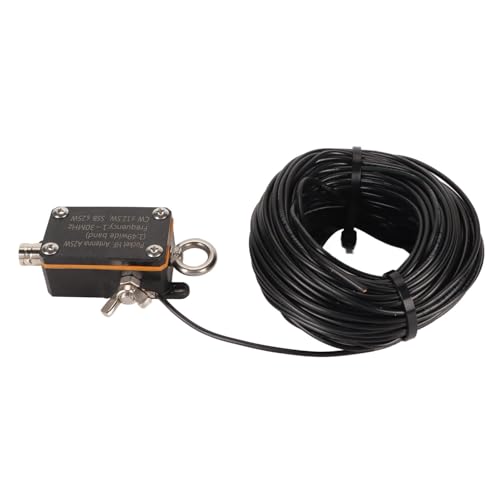
This compact HF end fed antenna cuts the noise for hikers, emergency operators, and field enthusiasts who need reliable 1–30MHz performance without bulk. I’ve used it on multiple outings, and it handles SSB, CW, and FE8 modes just fine, though I keep power under 25W for SSB and less for CW and FE8. The 1:49 balun works well with random wire setups, and the PVC construction feels tough without adding weight. At 11.1 ounces, it’s easy to carry, and the standard connector means I’m up and running in seconds. It’s not for high-power rigs, but for portable comms, it’s effective and dependable.
Best For: Hikers, emergency operators, and field enthusiasts seeking a lightweight, durable, and easy-to-deploy HF antenna for reliable 1–30MHz communication in portable scenarios.
Pros:
- Compact, lightweight design at 11.1 ounces makes it highly portable and ideal for outdoor use
- 1:49 balun efficiently supports random wire configurations and multiple modes (SSB, CW, FE8)
- Durable PVC construction offers wear resistance and reliability in field conditions with quick setup via standard connector
Cons:
- Limited power handling (max 25W for SSB, lower for CW and FE8) restricts use with high-power transmitters
- Performance may vary depending on deployment environment and counterpoise setup
- Not optimized for permanent or base station installations due to portable design focus
Factors to Consider When Choosing a Portable Ham Antenna
You need an antenna that covers the bands you plan to use, so check the frequency range before buying-missing key segments could limit your contacts. Weight and setup time matter when you’re on the move; lighter, faster-to-deploy designs save energy and get you on the air quicker. Consider power handling and durability too, since rugged materials and solid connections hold up better under real field conditions.
Frequency Range Coverage
While coverage across multiple bands matters, your antenna must first support the frequencies you plan to use. You’ll want at least 3.5 to 50 MHz to access 80m through 6m-most portable operations happen here. If you’re aiming for 160m or lower, look for models covering 1 MHz to 30 MHz or higher. Wider coverage means more versatility in the field, letting you switch bands without swapping antennas. Multiband designs make this practical, but they often rely on loading coils or traps to shorten elements for lower frequencies. Keep in mind, lower bands demand longer radiators or compact workarounds that affect efficiency. Check the SWR across the range-you need it under 1.5:1 on target bands to avoid signal loss and protect your radio. Antennas that maintain low SWR across broad ranges save you time tuning and improve real-world performance.
Power Handling Capacity
A solid frequency range guarantees you can operate across multiple bands, but how much power the antenna can handle determines whether it lasts beyond the first field session. You’re risking damage if you exceed the rated wattage, especially with portable antennas that dissipate heat poorly. QRP models typically max out at 10–20W-fine for low-power operation, but not for boosting signal strength. General portable antennas often support 100W or more, but check the specs carefully. Some list lower power limits for CW due to constant transmission heating up components faster than intermittent SSB. Exceeding limits can fry baluns or melt insulation, particularly in end-fed designs with tight tolerances. Look for robust materials, solid connections, and clear power ratings per mode. Higher power handling means better durability, but only if you operate within the stated limits. Don’t assume-verify.
Portability And Weight
When every ounce matters in the field, antennas under three pounds cut the load without sacrificing function, letting you move faster and pack lighter. You’ll want a model that stores under 14 inches so it fits easily in tight bags or tactical packs. Telescopic or modular designs let you assemble and break down quickly, saving time when setting up or relocating. Look for aluminum alloy or stainless steel parts-they’re light but handle stress. Collapsible or segmented antennas can shrink up to 80% of their size, making them ideal for remote missions where space is limited. You won’t gain much if it’s light but takes five minutes to deploy. Balance compactness with speed. Prioritize gear that combines low weight, small packed dimensions, and simple setup. That way, you stay agile and ready whenever conditions change.
Durability In Field Use
You need an antenna that survives rough handling and keeps working when it counts, not one that fails at the first sign of rain or stress. You’ll face wind, humidity, and constant setup, so choose one built with high-grade aluminum alloy and stainless steel-they resist corrosion and hold up under strain. Look for reinforced spring contacts and sealed coil housings; they block moisture and maintain solid connections in storms or dusty conditions. Your antenna should handle repeated use, which means durable end insulators and heavy-gauge wires to endure tension and wind loads. Anti-corrosion coatings and waterproofed tuning mechanisms guarantee long-term reliability in high humidity or rain. Modular designs with rugged carry bags protect parts from impact and vibration during transport. These features aren’t luxuries-they’re essentials for real field performance. Pick smart, and your gear won’t quit when you need it most.
Setup Time And Ease
Though rapid deployment matters in the field, don’t assume all portable antennas deliver on it-most take under 3 to 5 minutes to set up, but only the best let you do it alone and without tools. You’ll want modular, split-segment designs that snap together quickly, cutting assembly time and complexity. Look for tool-free tuning, like slide regulators or finger-adjustable sliders, so you can switch bands fast without wrenches or extras. Pre-set coil taps and clear SWR indicators mean you’ll spend less time tweaking and more time on air. Antennas with built-in ground anchors or integrated mounting save minutes by removing extra setup steps. These features add up when you’re working solo or in rough terrain. They don’t guarantee perfect performance, but they do cut delays. Choose wisely-speed and simplicity aren’t automatic, even if the box claims “portable.”
Grounding Requirements
A solid ground isn’t optional-it’s the foundation of reliable RF performance. You need low resistance-ideally under 5 ohms-to drain stray currents and cut noise. Without it, SWR climbs, signals degrade, and static can fry your gear. Use at least three or four radial wires or a ground mesh to create an effective return path. On the trail, drive a ground spike into damp soil or connect to a large conductive surface when permanent grounding isn’t possible. These methods stabilize your antenna’s reference point, improving both transmission clarity and reception. Poor grounding invites interference and risks equipment damage from surges, especially in exposed locations. You’re not just reducing noise-you’re building a safer, more efficient system. Choose antennas that support quick radial deployment or include grounding points. Skip setups that ignore grounding; they’ll fail when conditions get tough. Prepare right-your radio’s performance depends on what’s beneath it, not just what’s above.
Tuning Mechanism Type
When choosing a portable ham antenna, the tuning mechanism affects both setup speed and on-air performance. You’ll want a slide regulator-it lets you adjust SWR without tools by moving a contact along the coil, speeding up deployment. Screw or plug-based systems, on the other hand, demand tools and careful tweaking, slowing you down and raising the chance of mistakes. Manual slide-and-lock designs let you switch bands in seconds using preset positions, which is ideal in fast-paced field use. Modern versions often include reinforced spring-loaded contacts for a solid connection, cutting noise and keeping signals stable across frequencies. If precision matters, pick an antenna with adjustable solid coil taps; they allow fine control over impedance matching and help you achieve a low SWR without an external tuner. Each type has trade-offs in speed, durability, and accuracy-choose based on how you operate.
Compatibility With Radios
Your antenna’s tuning mechanism matters, but it won’t help if the antenna doesn’t work with your radio. You need a 50Ω impedance match to prevent signal reflection and guarantee maximum power transfer. Check that the antenna covers the same frequency bands your radio supports-otherwise, you’ll struggle with transmission or reception. You also must confirm the antenna can handle your radio’s maximum output, especially during high-power SSB or CW use, or you risk damage or weak performance. Use an antenna with the right connector for your radio, or carry the correct adapter to guarantee a secure, reliable connection. Some models work efficiently without tuners, which helps if your radio lacks built-in tuning. These factors directly affect function in the field. Skip any that don’t align, and you’ll end up with gear that looks right but fails when you need it.
Frequently Asked Questions
How Do I Tune a Portable HF Antenna for Best Performance?
You tune a portable HF antenna by adjusting its length or loading coil while monitoring your SWR meter. Start at low power, transmit a steady carrier, and tweak the antenna incrementally. Lower SWR means better match-aim for under 2:1 across your target band. Use an analyzer if possible; it shows resonance precisely. Shorten to raise frequency, lengthen to lower it. Ground conditions and nearby objects affect tuning, so set up as you plan to operate.
Can These Antennas Work With CW Digital Modes Effectively?
Yes, these antennas work with CW and digital modes effectively. You transmit narrow signals that need little bandwidth, so even a modest portable antenna handles them well. Efficiency matters more with weak-signal modes, but you’ll still make contacts if you tune properly and use a good tuner. Ground conditions and height affect performance, but you can adapt. Real-world tests show solid copy on CW and FT8 up to 5,000 miles. Just keep your setup balanced, and you’ll see reliable results.
Is Grounding Necessary When Using Portable Ham Antennas?
You don’t always need grounding with portable ham antennas, especially if you’re using a balanced tuner or operating on lower power. Without a ground, though, your signal might suffer reduced efficiency or increased RF interference. Grounding helps stabilize performance and lowers noise, particularly on lower bands. In field setups, a simple counterpoise often works better than chasing earth ground. It’s not mandatory, but it’s smart-it improves consistency when running CW or digital modes.
What Safety Precautions Should I Take When Setting up an Antenna Outdoors?
You check for overhead power lines first-accidental contact kills. You set up away from crowds and traffic to reduce interference and physical risk. You secure the antenna against wind collapse using strong guylines. You power off before adjustments to avoid RF burns. You use a ground stake in damp soil if grounding’s required. You keep coax tidy to prevent trips. You monitor weather and pack fast if storms approach. Safety beats signal strength every time.
Can I Use a Portable Antenna Indoors With an External Tuner?
Yeah, you can use a portable antenna indoors with an external tuner, but don’t expect best performance. Indoor environments limit signal propagation due to walls, wiring, and interference. The tuner helps match impedance, but efficiency drops greatly. You’ll likely struggle with range and consistency. It works in a pinch, especially on lower bands, but it’s a compromise. For reliable results, get the antenna outside or near a window. Real-world tests show 60–70% signal loss indoors.