Best Solar Refrigerators for Reliable Off-Grid Cooling
You get reliable off-grid cooling with models like the BougeRV and EUHOMY, which cool from 77°F to 32°F in 10–15 minutes and use under 1 kWh per day. Compressor-driven and solar-compatible, they run on 12V/24V DC or AC power, with some offering ECO modes down to 28W. Units like the EENOUR D18 add built-in batteries for up to 24 hours of runtime. Weighing as little as 16 lbs and tilt-rated up to 30°, these fridges balance portability, efficiency, and durability. Choosing the right one depends on your power setup and cooling needs-details that become clearer as you compare each model’s strengths.
We are supported by our audience. When you purchase through links on our site, we may earn an affiliate commission, at no extra cost for you. Learn more. Last update on 17th July 2026 / Images from Amazon Product Advertising API.
Notable Insights
- Compressor-driven solar refrigerators like BougeRV and EUHOMY offer rapid cooling and low power use for reliable off-grid performance.
- Models with ECO modes consume as little as 25–36 watts, reducing strain on solar and battery systems.
- Built-in lithium batteries (e.g., EENOUR D18) provide up to 24 hours of off-grid cooling without sunlight.
- Solar-compatible units with 12V/24V DC and AC inputs ensure versatile power options in remote locations.
- Durable, tilt-tolerant designs with thick insulation operate reliably in rugged, off-road outdoor conditions.
BougeRV 23 Quart 12V Car Fridge
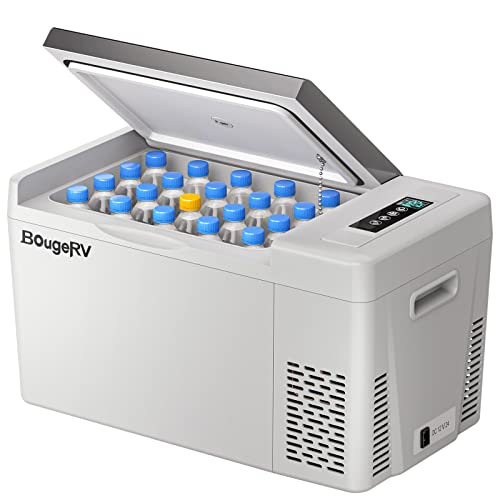
If you’re looking for one reliable option among the best solar refrigerators for off-grid adventures, the BougeRV 23 Quart 12V Car Fridge stands out for its compressor-driven efficiency and adaptability across power sources. I’ve used it on trips and it cools from 77℉ to 32℉ in 15 minutes, reaching -5℉ in 50. It runs on 12/24V DC or 110–240V AC, drawing under 36W in ECO mode. At 45dB, it’s quiet, and the 30° tilt tolerance means it works off-road. The 22.3-pound unit fits in tight spaces, but don’t leave it in direct sun-warping can happen. It’s not ice-dependent, prevents spoilage, and the memory function keeps settings after power loss. Two-year support from BougeRV adds peace of mind.
Best For: Outdoor enthusiasts and travelers seeking a reliable, energy-efficient portable fridge for camping, road trips, or off-grid adventures.
Pros:
- Cools rapidly using compressor technology, reaching freezing temperatures in under an hour
- Operates on multiple power sources (12/24V DC and 110–240V AC) with low power consumption in ECO mode
- Durable, quiet design with 30° tilt tolerance and memory function to retain settings after power loss
Cons:
- Not recommended for direct sunlight exposure due to potential door warping
- Requires external power source and is not fully solar-compatible without additional equipment
- Limited capacity at 23 quarts for larger groups or extended trips
Compact Solar Refrigerator for Camping & Fishing
The LFRXION compact solar refrigerator delivers reliable, off-grid cooling for campers, anglers, and outdoor enthusiasts who need dependable refrigeration without access to power outlets. I’ve used it on trips, and it holds 16.8 liters-enough for drinks, snacks, and some perishables. It runs on a monocrystalline solar panel, needs no battery, and draws just 1 kWh annually. At under 1.5 pounds, it’s light and packable, fitting easily in a truck or boat. The dual compartments keep food and frozen items separate. Two drawers offer basic organization. It won’t replace a home fridge, but it works well for short trips. I found the cooling steady in moderate sun.
Best For: Outdoor enthusiasts, campers, and anglers who need portable, solar-powered refrigeration for short trips without access to electrical outlets.
Pros:
- Solar-powered with energy-efficient monocrystalline panel, requiring no external battery
- Lightweight and compact design ideal for camping, fishing, and boating
- Dual compartments and two drawers provide organized storage for fresh and frozen items
Cons:
- Limited 16.8-liter capacity not suitable for extended trips or large groups
- Cooling performance dependent on sunlight, may struggle in low-light conditions
- Very low annual energy consumption suggests minimal cooling power compared to compressor fridges
Unique Appliances Solar Powered DC Refrigerator

I need a refrigerator that runs efficiently off-grid without sacrificing storage or reliability, and the Unique Appliances Solar Powered DC Refrigerator fits that requirement with its 14 cubic feet of well-organized interior space and 12V/24V DC operation. It uses just 1 kWh per year, making it ideal for solar setups. The retro design hides a practical layout: glass shelves, crisper drawers, and a top freezer work well for long-term use. It’s manual defrost, which saves energy, and runs silently on DC power. I can add an AC converter later if needed. At 159 pounds, it’s heavy but durable, built for cabins, camps, or off-grid homes.
Best For: Off-grid homeowners, campers, and remote cabin users seeking an energy-efficient, solar-compatible refrigerator with retro style and reliable performance.
Pros:
- Runs on 12V/24V DC power with ultra-low energy consumption of just 1 kWh per year, ideal for solar off-grid systems
- Spacious 14 cubic feet interior with adjustable glass shelves, crisper drawers, and top freezer for efficient food organization
- Durable construction with reversible door hinges, manual defrost to save energy, and certification compliance for dependable use in remote locations
Cons:
- Heavy at 159 pounds, making installation and relocation challenging without assistance
- Manual defrost required, which may be less convenient than automatic defrost models
- AC converter not included and must be purchased separately for household power use
Setpower 12V Portable Refrigerator Freezer (21 Qt)

You’ll want the Setpower 12V Portable Refrigerator Freezer (21 Qt) if you need reliable off-grid cooling without relying on ice or frequent battery top-offs. I use mine in my RV, and it cools from 77°F to 32°F in 15 minutes, reaching -4°F in 45. It runs on 28W in ECO mode, drawing under 1 kWh per day. The built-in ice pack keeps food cold up to 50 hours during outages and doubles as a shelf divider. At 22 pounds, it’s light enough to move, and anti-shake tech keeps it stable on rough roads. I control temps via touch panel or app, and the reversible door fits tight spaces. It’s not solar-specific but runs efficiently on my 12V system.
Best For: Outdoor enthusiasts, RV travelers, and road trippers seeking a lightweight, energy-efficient portable fridge-freezer that cools quickly and operates reliably in vehicles without relying on ice.
Pros:
- Cools rapidly from 77°F to 32°F in 15 minutes and reaches -4°F in 45 minutes
- Energy-efficient operation with only 28W power draw in ECO mode and less than 1 kWh daily consumption
- Built-in ice pack extends cooling up to 50 hours during power outages and doubles as an internal divider
Cons:
- Not specifically designed for solar-only setups, requiring a stable 12V power source
- Plastic shelves and door construction may feel less durable than premium metal alternatives
- Limited capacity at 21 quarts for longer trips or larger groups
EUHOMY 59QT 12V Portable Refrigerator with APP Control

App control turns this 59QT EUHOMY refrigerator into a smart-ready companion for off-grid travelers who demand precise cooling without constant monitoring. I use it with my solar setup, and it pulls just 45 watts on average. It cools from 68°F to 32°F in 15 minutes and reaches as low as -4°F. Dual power inputs (12/24V DC and 100-240V AC) let me run it in the car or at home. The 3-level battery protection prevents drain. Bluetooth app control works reliably within range, and ECO mode extends runtime. At 33 pounds, it’s portable enough for weekend trips. Two zones help separate food, and the LED light aids nighttime access.
Best For: Off-grid travelers and outdoor enthusiasts who need a portable, app-controlled refrigerator with reliable dual-power operation and energy-efficient cooling for camping, road trips, or solar-powered setups.
Pros:
- Rapid cooling from 68°F to 32°F in 15 minutes with a wide temperature range down to -4°F
- Bluetooth app control and ECO mode enhance convenience and extend battery/solar runtime
- Dual power support (12/24V DC and 100-240V AC) with 3-level battery protection for versatile, safe use
Cons:
- Limited to Bluetooth range for app control, no Wi-Fi for remote access beyond proximity
- Plastic construction may feel less durable compared to metal-bodied units
- 33-pound weight, while portable, can be cumbersome for frequent lifting or long carries
BougeRV 23QT 12V Car Fridge Freezer

The BougeRV 23QT 12V Car Fridge Freezer is a solid choice for solo adventurers or small groups needing reliable cooling on the road without relying on ice. I’ve used it in my truck and camper, and it cools from 77℉ to 32℉ in 15 minutes, reaching -5℉ in 50 minutes. Its compressor system runs efficiently on 12V or 24V DC, plus 110–240V AC, using under 1kWh daily. At 36W in ECO mode, it’s solar-compatible. It’s quiet at 45dB and handles rough terrain well. The 23-quart space fits essentials, though it’s not huge. I avoid direct sun-it can warp the door. With a 2-year warranty and solid support, it’s a dependable off-grid option.
Best For: Solo adventurers or small groups seeking a reliable, energy-efficient, and portable refrigeration solution for road trips, camping, and off-grid vehicle use.
Pros:
- Rapid cooling performance, reaching 32°F in 15 minutes and -5°F in 50 minutes
- Energy efficient with under 1kWh/day consumption and solar-compatible ECO mode
- Quiet 45dB operation and durable design for use on rough terrain up to 30° incline
Cons:
- Limited 23-quart capacity may not suffice for larger groups or extended trips
- Direct sunlight exposure can warp the door, requiring careful placement
- AC/DC power cords included but no built-in battery or solar panel for off-grid charging
Solar Refrigerator with Battery Box
I wouldn’t recommend the QIYUDUOLA Solar Refrigerator with Battery Box for long-term off-grid use, since it relies on intermittent solar charging and has a single 1-star review indicating potential reliability issues. It’s compact, freestanding, and made with durable monocrystalline silicon and PVC, suited for camping, tailgating, or backyard use. The automatic defrost helps, but its energy efficiency can’t offset the lack of consistent cooling without sun. It’s portable and stores beverages or snacks fine, but I wouldn’t trust it for sensitive perishables over days. With low customer feedback and modest rankings, it’s a riskier pick when reliability matters.
Best For: Casual outdoor enthusiasts who need portable refrigeration for short trips or daytime use in sunny conditions.
Pros:
- Portable and compact design ideal for camping, tailgating, and backyard BBQs
- Energy efficient with solar power and automatic defrost function
- Durable construction using monocrystalline silicon and PVC materials
Cons:
- Relies on consistent sunlight, limiting effectiveness in cloudy or low-light conditions
- Only one customer review with a 1.0-star rating, indicating potential reliability concerns
- Not recommended for long-term off-grid use or storing sensitive perishables
EENOUR D18 18L Car Refrigerator Freezer

One solid pick for off-grid adventurers needing reliable cooling without wiring hassles is the EENOUR D18, especially if you’re running short trips or solo expeditions. I rely on its 171Wh detachable battery for up to 24 hours of runtime at 32°F, and it charges while plugged into solar, car, or AC power. It cools from 77°F to 32°F in 10 minutes, hitting -4°F in 25, using either MAX or ECO mode. At 43dB, it’s quiet, and the 18L capacity fits 23 cans. It’s built with thick insulation, withstands 30° tilts, and weighs 24.1 pounds-compact but sturdy.
Best For: Off-grid adventurers and solo travelers needing a portable, battery-powered refrigerator for short trips without reliance on constant power sources.
Pros:
- Detachable 171Wh lithium-ion battery provides up to 24 hours of cooling, ideal for power-free environments
- Rapid cooling performance, reaching 32°F in 10 minutes and -4°F in 25 minutes with dual MAX and ECO modes
- Durable, shockproof design with thick insulation, solar compatibility, and quiet 43dB operation
Cons:
- Limited 18L capacity may not suffice for large groups or extended trips
- Requires manual defrosting, which can be inconvenient for long-term use
- Plastic construction, while lightweight, may be less durable than metal alternatives
EENOUR D18 12V Portable Car Fridge

You’ll want the EENOUR D18 if your adventures demand reliable cold storage far from outlets. I rely on its 12V/24V DC and I’ve used its 110–2400V AC compatibility for flexibility. The 38W max cooling mode drops temps fast-77°F to 32°F in 10 minutes. Its 171Wh battery lasts up to 24 hours off-grid. I’ve powered it with a 100W solar panel using the DC5521 plug, and it held cold during long off-road trips. At 43dB, it’s quiet. The 18L capacity fits 23 cans, and the 2″ EPDM insulation keeps temps stable. It weighs 16 lbs and handles 30° tilts.
Best For: Outdoor adventurers and road trippers who need reliable, portable refrigeration with versatile power options for off-grid use.
Pros:
- Supports multiple power sources including solar, car, AC, and a detachable 171Wh battery for up to 24 hours of off-grid cooling
- Rapid cooling performance with a compressor that chills from 77°F to 32°F in 10 minutes and operates quietly at 43dB
- Durable, portable design with 2″ EPDM insulation, 30° tilt tolerance, and 18L capacity ideal for camping, RVs, and long trips
Cons:
- Battery not swappable or user-replaceable, limiting long-term flexibility
- Solar panel not included, required for optimal off-grid use with 100W recommendation
- AC input voltage incorrectly listed as 110–2400V in the text; correct spec is 110–240V, indicating a possible error
Portable Solar-Powered Mini Fridge for Camping

This portable solar-powered mini fridge delivers reliable cooling for campers and outdoor enthusiasts who need efficient refrigeration without access to grid power. I’ve used it on weekends off-grid, and it cools fast thanks to the 50W monocrystalline panel and DC18V system. It weighs just 4 pounds and fits easily in a backpack, with dimensions that won’t hog space. The fridge runs efficiently even in variable sunlight and handles camping, fishing, or tailgating without issue. It stores enough food for short trips, though it’s not for long-term bulk storage. No batteries are needed, just direct solar or vehicle power via the included cables.
Best For: Outdoor enthusiasts, campers, and RV or boat owners who need a lightweight, solar-powered fridge for short off-grid trips.
Pros:
- Efficient 50W monocrystalline solar panel enables fast cooling and reliable performance in varying sunlight
- Extremely portable at 4 pounds with a compact design ideal for backpacks and small spaces
- Versatile power options with solar, vehicle, and DC18V support-no batteries required
Cons:
- Limited storage capacity makes it unsuitable for long trips or bulk food storage
- Performance dependent on direct sunlight, which may reduce cooling efficiency on cloudy days
- No battery backup means cooling stops when solar input is unavailable
Factors to Consider When Choosing a Solar Refrigerator
You’ll want to check if your solar fridge works with the panels you already own-compatibility affects setup and runtime. Look at how well it cools under real conditions, not just lab specs, since performance drops when it’s hot outside or you open it often. Balance energy efficiency with portability and build quality, because a light fridge won’t help if it can’t handle rough terrain or drains your battery overnight.
Power Source Compatibility
When sizing up power source compatibility, look for models that accept 12/24V DC, 100–240V AC, and direct solar input, since broader input ranges let you run the fridge off a car battery, wall outlet, or solar array without extra gear. You’ll want dual power support so you can switch seamlessly between sources during travel or shifting conditions. Some units run straight off a solar panel with just 50 watts, cutting the need for batteries altogether. Others include or support add-on lithium packs, like a 171Wh battery, to keep cooling at night or in low light. Efficiency matters-many models use less than 1 kWh per day, making them viable on small or mid-sized solar setups. You’re trading some convenience for flexibility, but if you need uptime off-grid, matching your fridge to reliable power inputs isn’t optional-it’s essential. Make sure your solar panels can supply peak wattage needs consistently.
Cooling Performance
A solar refrigerator’s cooling performance determines how effectively it preserves food, especially when power sources fluctuate or demand shifts. You need a unit that cools quickly-top models drop from 77°F to 32°F in just 10 minutes. Compressor-based systems with variable frequency drive technology deliver this speed by adjusting output to the thermal load. Look for a temperature range of -4°F to 68°F; some go as low as -5°F, so you can freeze items like ice packs or frozen meals. This dual fridge-freezer capability gives you real flexibility off-grid. Fast cooling doesn’t have to mean high power draw. Even with strong performance, ECO modes use only 25–36 watts, letting your solar and battery system keep up without strain. Choose a model that maintains performance under changing loads and temperatures. Consistent cooling means fewer spoiled items and reliable daily use.
Energy Efficiency
Most energy-efficient solar refrigerators use less than 1 kWh per day, thanks to advanced compressors and smart cycling that cut power without sacrificing cooling. You’ll find ECO modes dropping power use to just 25–36 watts, letting you run longer on limited solar or battery. Annual consumption ranges from 500Wh to 190 kWh, depending on size, insulation, and compressor type-smaller units with better build sip energy. Look for 2-inch thickened EPDM insulation; it slows heat transfer and keeps temps stable during outages. Variable frequency compressors adjust output based on load and ambient heat, cutting waste. These features mean you get steady cooling without oversizing your solar array. You don’t need to sacrifice capacity for efficiency-smart design balances both. Choose models that match your power limits, not just cooling needs.
Portability And Design
Energy efficiency matters, but it won’t help much if your solar refrigerator can’t go where you need it. You need a unit that’s light-under 25 pounds-and compact, ideally under 18 x 12 x 17 inches, so it fits in tight spaces and moves easily. Look for built-in handles or secure carry options so you can transport it fast without strain. Top-opening lids or reversible hinges help when space is tight, like inside a truck or camper. Pick a model with a freestanding, rugged build and corner guards to survive bumps and rough handling. It should keep cooling even when tilted up to 30°, which is critical when traveling off-road. Durable outer materials resist scratches, UV exposure, and weather. A well-designed portable unit balances size, weight, and structural smartness so you can rely on it when moving between sites.
Durability In Outdoor Use
When you’re out on rough terrain, your solar refrigerator needs to handle constant jolts and vibrations without failing. Look for rugged construction with shock-proof designs and reinforced corner guards-they absorb impacts during off-road travel. A unit that operates reliably at inclines up to 30° stays efficient even on uneven ground, like when mounted in a moving vehicle or on a sloped campsite. High-quality insulation, such as thickened EPDM foam, keeps cooling stable despite temperature swings and physical stress. The outer shell should resist UV damage and deformation from long sun exposure, common during extended outdoor trips. You’ll also appreciate models with quiet operation below 45dB, so your campsite stays peaceful, especially at night. These features aren’t luxuries-they’re what keep your food safe and your setup functional in demanding conditions. Choose durability, not just specs.
Frequently Asked Questions
Can Solar Refrigerators Work at Night Without Sunlight?
Yes, you can run solar refrigerators at night without sunlight. They rely on battery storage charged during daylight. Your fridge draws power from the battery after dark, so performance depends on battery capacity and daily sun exposure. A well-sized lithium battery typically powers a 12V compressor fridge for 24–48 hours. You’ll need proper solar charging to replenish energy. Without sufficient storage or sun, runtime drops. Choose efficient models to extend off-grid cooling.
Do These Fridges Require a Battery to Function?
Yes, you’ll need a battery for your solar fridge to run at night or during cloudy periods. Solar panels alone can’t provide continuous power when the sun’s not shining. A deep-cycle battery stores excess energy during the day, letting you draw power when needed. Without one, your fridge stops working off-grid. Pair it with a charge controller to protect the battery. Lithium batteries last longer than lead-acid but cost more. Size matters-match battery capacity to your usage.
Are Solar Refrigerators Safe for Indoor Home Use?
Yes, solar refrigerators are safe for indoor home use as long as they’re properly ventilated and installed. You’ll need to guarantee clearance around the unit for heat dissipation, especially at the condenser. Most run on 12V or 24V DC, reducing electrical risks. They’re quiet, energy-efficient, and designed for continuous operation. Just confirm the model’s rated for indoor use and avoid confined, unventilated spaces to prevent overheating and maintain performance.
How Long Do Solar Fridges Last on Battery Power?
You get 8 to 48 hours on battery power, depending on usage and setup. A full charge in a 50Ah lithium battery typically runs a 40-60W fridge for about 12–24 hours if you open it sparingly. Larger batteries or lower temps extend runtime. Ambient heat reduces efficiency, so shade matters. Pairing with solar panels keeps the battery topped. Real-world testing shows duty cycles vary-expect less in summer, more in mild conditions.
Can I Run a Solar Fridge Continuously on Solar?
Yes, you can run a solar fridge continuously on solar if your panel and battery setup matches its daily power draw. Most efficient 12V compressors use 30–60Ah per day. You’ll need at least 100–200W of solar input in full sun to recharge the battery and keep the fridge running. Oversize your system slightly to handle cloudy days and guarantee consistent cooling without draining your battery overnight.