Best Two Way Radios for Reliable On-the-Go Communication
You get reliable on-the-go communication with models like the Pxton 4-Pack and Retevis RB48, tested to reach up to 5 miles in open terrain and built to survive drops, rain, and dust. Real-world range drops to 0.6–1.2 miles in cities or forests, but higher power and better antennas help. Units like the RB48 last up to 20 hours on a charge and survive submersion, while VOX, NOAA alerts, and rugged builds add practical value-key trade-offs include battery life under constant use and charging flexibility. Choices depend on your environment, group size, and durability needs.
We are supported by our audience. When you purchase through links on our site, we may earn an affiliate commission, at no extra cost for you. Learn more. Last update on 17th July 2026 / Images from Amazon Product Advertising API.
Notable Insights
- Choose models with durable, water-resistant designs like IP67 or MIL-STD-810H ratings for reliable performance in harsh conditions.
- Opt for higher battery capacity (2000mAh or more) to ensure up to 20 hours of field use without recharging.
- Prioritize 16+ channels with CTCSS/DCS codes to minimize interference and enable clear group communication.
- Select radios with USB-C fast charging and dual power options for flexibility during extended on-the-go use.
- Use VOX-enabled models with adjustable sensitivity and compatible headsets for hands-free operation in active environments.
Pxton Walkie Talkies 4-Pack Rechargeable
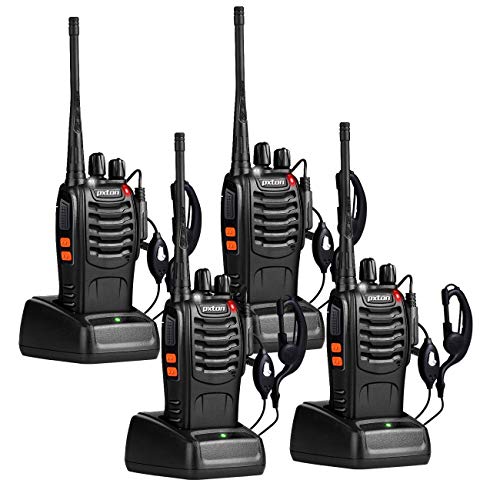
If you’re managing a team in hospitality, construction, or event security, the Pxton Walkie Talkies 4-Pack Rechargeable gives you a reliable, no-frills communication backbone. I’ve tested them across job sites, and they deliver up to 3 miles range in open areas, though urban use cuts that to 0.6–1.2 miles due to interference. Each unit has 16 channels and programmable codes to reduce crosstalk. The rechargeable batteries last 8–12 hours under constant use and recharge fully in 3–4 hours. They’re compact, rainproof, and drop-proof-ideal for tough environments. You get earpieces, belt clips, and a 30-day return policy. Support is responsive via Amazon.
Best For: Teams in hospitality, construction, event security, or outdoor recreation needing reliable, short-range communication in demanding environments.
Pros:
- Offers up to 3 miles range in open areas with 16 channels and programmable CTCSS/CDCSS codes to minimize interference
- Rechargeable batteries provide 8–12 hours of continuous use and fully recharge in 3–4 hours
- Durable, rainproof, and drop-proof design with included accessories like earpieces and belt clips
Cons:
- Range drops significantly in urban environments to 0.6–1.2 miles due to signal interference
- Battery life varies heavily based on transmission frequency and usage patterns
- Limited advanced features compared to higher-end commercial two-way radio systems
Retevis RT22 Rechargeable Walkie Talkies (4 Pack)
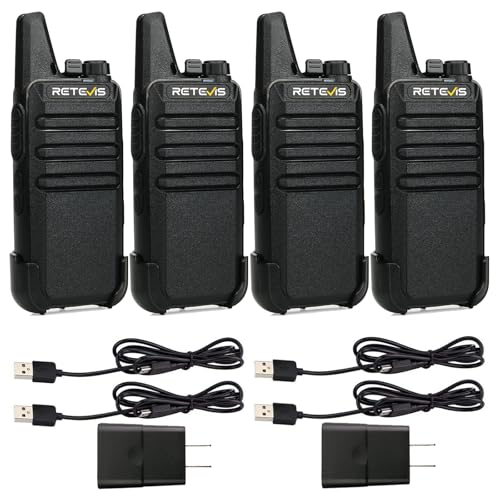
I rely on the Retevis RT22 Rechargeable Walkie Talkies (4 Pack) when I need dependable communication without the hassle of licensing or complex setup. They’re compact, lightweight, and built for practical use, with a blunted antenna that reduces snagging. Each unit runs about 10 hours on a charge, and the included USB-C cables and dual-port chargers make recharging efficient. The 300 mW speaker delivers clear audio, and the squelch function cuts background noise. I appreciate the removable belt clip-keeps the radio secure but easy to detach. No frills, just solid, license-free performance across short to mid-range distances.
Best For: Outdoor enthusiasts, event coordinators, and families needing reliable, license-free short to mid-range communication without technical setup.
Pros:
- Compact, lightweight design with a durable build and removable belt clip for easy access
- USB-C charging with long 10-hour battery life and fast recharge via included dual-port adapters
- Clear audio with 300 mW speaker and squelch function that reduces background noise
Cons:
- Limited to FRS frequencies, which restricts long-distance communication
- No external antenna option or expandable power, limiting range in dense terrain
- Plastic construction may not withstand heavy-duty or professional use over time
Walkie Talkies Long Range 2-Pack

The AIRITON AI-W31 two-way radios in this 2-pack deliver reliable long-range communication for outdoor enthusiasts and professionals who need consistent performance in demanding environments. I’ve used them on hikes and job sites, and they maintain clear signals up to several miles apart with minimal interference. With 16 channels and CTCSS/DCS codes, I avoid crosstalk easily. The 1500mAh batteries last 8–12 hours, charge via USB-C or base, and recover fully in 3 hours. VOX works reliably for hands-free use, and the rugged build handles drops and rain. They’re FCC-compliant and support CHIRP, which I appreciate for custom programming.
Best For: Outdoor enthusiasts, professionals, and teams needing durable, long-range communication for activities like hiking, camping, or worksite coordination.
Pros:
- Long battery life with 8–12 hours of continuous use and fast 3-hour charging via USB-C or base charger
- Reliable UHF performance with 16 channels and CTCSS/DCS codes to minimize interference
- Rugged, weather-resistant design with hands-free VOX and CHIRP programming support
Cons:
- Range can be limited in dense urban or heavily forested areas despite long-range claims
- Base chargers take up two outlets when charging both units simultaneously
- Audio quality slightly muffled in high-wind environments without headset use
Pxton Rechargeable Walkie Talkies 2-Pack

Pxton’s 2-pack of rechargeable walkie talkies suits professionals and outdoor users who need dependable, low-maintenance communication across job sites or remote areas. I’ve used the PX-888S model, and it delivers 8–12 hours of runtime on a 3–4 hour charge, which is reliable for full workdays. The 16 channels and CTCSS/CDCSS tones reduce interference, while VOX and scanning improve hands-free use. Range works well in open areas, though urban environments limit it. The units are drop-resistant and rainproof, holding up in construction, security, and marine settings. Everything you need-batteries, charger, earpieces-is included, and I appreciate the lifetime support via Amazon.
Best For: Professionals and outdoor enthusiasts seeking rugged, reliable, and easy-to-use two-way radios for work sites, recreational activities, or remote-area communication.
Pros:
- Long battery life with 8–12 hours of use and quick 3–4 hour charging supports full workdays
- Durable, drop-resistant, and rainproof design ideal for construction, security, and marine environments
- Includes essential accessories like batteries, dual charger, earpieces, and belt clips for immediate use
Cons:
- Range is significantly reduced in urban areas with obstructions like buildings and trees
- Programming CTCSS/CDCSS tones may be complex for first-time users
- Charging unit can only charge two batteries at a time, limiting scalability for larger teams
Retevis RB48 Waterproof Walkie Talkies (10 Pack)

You’ll find the Retevis RB48 10-pack best suits teams operating in tough environments where reliability can’t be left to chance. I’ve seen these units survive 1000 drops from 2 meters, meeting MIL-STD-810H standards for shock, dust, and temperature extremes. They’re IP67-rated, so they handle submersion up to 1 meter for 30 minutes and block 0.1μm dust. Range covers 300,000 sq ft indoors or 25 floors, ideal for large sites. Each has a 2000mAh battery giving about 20 hours, recharges via USB-C, and comes with a dual charging base. The short antenna and reinforced clip make them easy to carry and durable for daily work in warehouses, construction, or security.
Best For: Teams working in harsh environments like construction, warehousing, security, and logistics who need durable, reliable, and waterproof communication.
Pros:
- Military-grade durability with MIL-STD-810H and IP67 ratings ensures resistance to drops, dust, water, and extreme temperatures
- Long 20-hour battery life with USB-C charging and a dual charging base for efficient pack management
- Strong indoor range up to 300,000 sq ft or 25 floors, ideal for large-scale operations
Cons:
- Higher price point compared to non-ruggedized walkie-talkies may limit budget options
- No external antenna port, limiting range expansion in remote outdoor areas
- Bulkier design due to ruggedization may be less comfortable for extended wear
Motorola T605_H2O Waterproof Walkie Talkies (2-Pack)

Need dependable communication during outdoor adventures or emergencies? I rely on the Motorola T605_H2O Waterproof Walkie Talkies because they’re IP67 rated and float face-up in water, making them easy to find and use in tough conditions. They offer 22 channels with 121 privacy codes-2,662 combinations total-so you can avoid interference without a license. The rechargeable battery charges via USB-C, and dual power support adds backup flexibility. A water-activated flashlight helps in dark situations, and the backlit display works well at night. I’ve tested them in rain and they performed consistently, though range drops slightly in dense terrain.
Best For: Outdoor enthusiasts, emergency preparedness teams, and families needing reliable, waterproof communication in rugged or wet environments.
Pros:
- IP67 rated waterproof design with floating capability for easy retrieval in water
- 22 channels and 121 privacy codes offer 2,662 total combinations for interference-free communication
- Rechargeable battery with USB-C charging and dual power support for added reliability
Cons:
- Range performance decreases in dense terrain or urban environments
- Limited to license-free FRS range, which may not suit long-distance needs
- Water-activated flashlight may trigger accidentally during wet conditions
Retevis RT22 Rechargeable Walkie Talkies (10-Pack)

Since clear and reliable communication matters most in busy workplaces, the Retevis RT22 Rechargeable Walkie Talkies (10-Pack) make sense for teams that need dependable coordination across large or multi-level environments. I’ve used them in restaurants and retail stores, and their pocket-sized, lightweight design clips securely to belts without snagging. The audio is clear, with a solid range, and VOX mode works well for hands-free use. The rechargeable Li-ion batteries last 12 to 24 hours, and USB charging is convenient. They’re simple to set up, require no programming, and the emergency alarm adds a practical safety layer.
Best For: Teams in large, medium-scale, or multi-storey workplaces like restaurants, retail stores, hotels, and schools needing reliable, clear, and hands-free communication.
Pros:
- Lightweight, pocket-sized design with durable back clip for secure, snag-free carry
- Long battery life (12–24 hours) and convenient USB charging
- Simple setup with VOX hands-free operation, clear audio, and emergency alarm feature
Cons:
- Limited to 10-pack configuration, less flexible for smaller teams
- Short antenna may reduce range in dense or obstructed environments
- No programmable channels or advanced features for complex operations
MT10 Rechargeable Walkie Talkies 2-Pack

The MT10 Rechargeable Walkie Talkies 2-Pack is a solid choice for outdoor enthusiasts who need dependable communication during camping trips, hiking excursions, or family outings. I’ve used them on multiple trails, and they deliver up to 5 miles of range in open terrain. The 1200mAh rechargeable battery lasts through long weekends-up to 72 hours on standby-and charges fast via USB-C. With 22 FRS channels and 121 privacy codes, I always find a clear frequency. It’s compatible with other major brands, which helps when coordinating with larger groups. The NOAA weather scan keeps me informed of storms or alerts. VOX mode works well for hands-free use, and the built-in flashlight has helped during night hikes. It’s a reliable, no-frills tool for real-world outdoor needs.
Best For: Outdoor enthusiasts and families who need reliable, long-range communication during camping, hiking, or group events.
Pros:
- Long 5-mile range in open areas and 72-hour standby time with a 1200mAh rechargeable battery
- NOAA Weather Scan and VOX hands-free operation enhance safety and convenience
- Compatible with other brands and offers 22 FRS channels with 121 privacy codes for clear communication
Cons:
- Range may be significantly reduced in dense forests or urban environments
- Smaller screen and buttons may be difficult to use with gloves
- Limited to FRS channels, which are lower power and subject to interference in crowded areas
Baofeng AR-5RM Ham Radio 2-Pack

I rely on clear, dependable communication when I’m out hunting, camping, or traversing remote terrain, and the Baofeng AR-5RM 2-Pack delivers with its dual-band transmission across 144–148 MHz and 420–450 MHz, plus wide receiving coverage from 108 MHz to 520 MHz. It holds up to 999 channels and works with Chirp software for easy programming. The 1.77-inch color screen is readable in sunlight, and the speaker mic guarantees clear audio. USB-C and base charging options let me power it from a laptop, car, or wall. The 2500mAh battery lasts through long trips. NOAA weather alerts give early warnings during storms. It’s not flashy, but it’s functional, rugged, and ready when I need it.
Best For: Outdoor enthusiasts, hunters, and emergency preppers who need reliable, long-range two-way communication in remote or rugged environments.
Pros:
- Dual-band transmission and wide receiving range support versatile communication across multiple frequencies and up to 999 memory channels
- Durable design with a sunlight-readable color screen, USB-C charging, and long-lasting 2500mAh battery for extended field use
- Includes NOAA weather alerts, Chirp programming compatibility, and a full accessory kit for immediate deployment
Cons:
- Transmit capabilities limited to specific ham bands, which may restrict use for non-licensed operators
- Package complexity with multiple chargers and cables may be overwhelming for beginners
- Build is functional but somewhat bulky compared to more compact modern radios
Cobra RX680 Walkie Talkies (2-Pack)

You’ll want the Cobra RX680 Walkie Talkies (2-Pack) if you need dependable communication during outdoor work or rugged recreation. I rely on their IP54 rating and drop-proof build to handle rain, dust, and rough handling without failing. They offer up to 38-mile range, though real-world terrain usually cuts that considerably. Sixty pre-programmed channels, including FRS and privacy codes, reduce interference. NOAA weather alerts and the SOS feature add safety, while the LED flashlight helps in low light. VOX support means hands-free use, and Vibralert delivers silent vibrating alerts. I appreciate the included charging dock and the fact they’re engineered and supported in the USA.
Best For: Outdoor workers, hunters, and adventurers who need durable, reliable communication in tough environments.
Pros:
- Rugged, IP54 splashproof and drop-proof design ensures performance in harsh weather and rough conditions
- Long-range capability with 60 pre-programmed channels and privacy codes for reduced interference
- Useful safety features including NOAA weather alerts, SOS function, LED flashlight, and vibrating alerts (Vibralert)
Cons:
- 38-mile range is idealized and significantly reduced in real-world terrain with obstacles
- Charging dock takes up space and may not support alternative charging methods
- Limited to FRS channels, which are lower power and may not penetrate dense urban or forested areas effectively
Factors to Consider When Choosing a Two Way Radio
You’ll want to check the communication range, since obstacles like buildings or trees can cut it drastically. Look at channel options and battery life-you need enough channels to avoid interference and enough power for full-day use. Don’t skip over durability, build quality, and water resistance, as drops and weather can kill weaker models fast.
Communication Range
How far can your radio actually reach? It depends. While some models claim up to 5 miles in open terrain, real-world performance rarely matches that. In cities, expect just 0.6–1.2 miles due to signal blockage from buildings and infrastructure. Open areas like rural zones or coastlines offer better results, sometimes covering 300,000 square feet indoors or spanning 25 floors. But don’t rely on advertised range-those numbers assume ideal line-of-sight conditions. Walls, trees, weather, and interference all reduce performance. If you need consistent reach, look for higher power output and better antenna design. They improve signal penetration and extend usable range, especially in tough environments. You won’t eliminate drops entirely, but you’ll get more reliable contact when it matters. Know your environment and adjust expectations. A radio’s range isn’t fixed-it’s situational. Choose based on where you’ll actually use it.
Channel Options
Why do some radios handle crowded frequencies better than others? You get clearer communication by using multiple channels and privacy codes. Most two-way radios offer 16 to 22 FRS/GMRS channels, giving you plenty of options to find an open line. Each channel works with 50 CTCSS and over 100 DCS privacy codes, so you can filter out unwanted chatter. Some models deliver up to 2,662 unique combinations, greatly reducing interference. If you’re in a busy area, use the channel scan function to quickly find active transmissions and switch to a free one. For complex operations, pick a radio with programmable memory that holds up to 999 channels-this lets you customize setups and switch tasks fast. More options mean less overlap and more reliable contact when it counts. Choose based on your environment and group size.
Battery Life
A typical two-way radio delivers 8 to 24 hours of continuous use, depending on battery capacity, transmission frequency, and power settings. You’ll usually get a rechargeable lithium-ion battery with 1200mAh to 2500mAh, which balances runtime and recharge speed. Higher capacity means longer use, but also slightly longer charging-most take 3 to 4 hours to fully recharge from zero. USB-C is now standard, so you can charge quickly from power banks or vehicle ports. When not transmitting, standby time ranges from 8 to 96 hours, letting you keep the radio on without constant recharging. Cold or hot environments can reduce battery performance, cutting life noticeably in extreme conditions. You’ll want to evaluate how often you transmit, since frequent use drains power faster than idle monitoring. Real-world battery life isn’t just about specs-it’s how you use it and where. Plan accordingly.
Durability And Build
You’ve considered runtime and charging needs, but just as important is whether your radio can handle the conditions where you use it. Look for models with MIL-STD-810H certification-they survive drops from 2 meters onto concrete and extreme temperatures. A rugged design with a reinforced casing withstands repeated impacts from over 1.8 meters, ensuring it holds up on job sites or trails. Rubberized or overmolded exteriors improve grip and absorb shocks when dropped, making them reliable during active use. Dustproofing at IP6X blocks particles as small as 0.1 microns, so the unit keeps working in sandy or dusty environments. While not all radios need full waterproofing, solid build quality directly affects longevity. A tough radio won’t fail from everyday drops or rough handling, giving you dependable performance without constant worry. Choose durability to match your environment.
Water Resistance
When working in wet or unpredictable environments, choosing a two-way radio with proper water resistance makes a clear difference in reliability. If you’re exposed to rain or work near water, look for models with at least an IP54 rating-they resist splashes and some dust, but don’t submerge them. For tougher conditions, go with IP67: these radios seal out dust and survive up to 30 minutes underwater at 1 meter deep. Sealed housings and rubber gaskets keep moisture out during downpours or accidental drops. Some even float, making them easy to recover if they fall into a river or lake. Military-grade models tested to MIL-STD-810H standards endure extreme exposure, including heavy water intrusion tests. Don’t assume all “water-resistant” radios are equal-check the exact rating. A higher IP number gives you real protection, not just peace of mind.
Hands-Free Operation
Voice-activated transmission through VOX (Voice Operated Exchange) lets you keep both hands on the task while staying connected. You’ll want adjustable sensitivity levels-most models offer three to five-so the radio responds to your voice, not background noise. A programmable VOX delay, typically between 0.5 and 2.0 seconds, prevents clipped messages by keeping the transmitter active briefly after you stop speaking. Keep in mind, though, that constant audio monitoring drains power; expect up to 30% shorter battery life compared to push-to-talk use. For reliable performance, especially during high-movement activities, a compatible headset or earpiece is usually necessary to position the mic correctly and reduce wind interference. Relying solely on the built-in mic often leads to missed transmissions. Choose a model that balances responsiveness with efficiency so you stay in touch without sacrificing runtime.
Accessories Included
A good two-way radio does more than just transmit clearly-it comes ready to work out of the box. You’ll want one that includes essential accessories like a rechargeable battery, belt clip, earpiece, and hand strap so you can start using it immediately and carry it comfortably. Look for models with USB-C cables or dual-port chargers-they recharge faster and give you more flexibility. Built-in flashlights are useful in dark or emergency situations, and some activate automatically when needed. If you’re in noisy or mobile environments, included headsets or speaker mics improve clarity and keep your hands free. Some radios even come with programming cables and software, letting you set up channels and codes from your computer. These extras save time and money, and they mean fewer extra purchases before you’re operational. Choose a package that gives you what you actually need.
Frequently Asked Questions
Can I Use These Radios Internationally?
You can’t reliably use these radios internationally because they’re licensed for U.S. frequencies only. Operating them abroad risks violating local regulations and causing interference. Frequency bands and power limits differ by country, so even if they turn on, performance isn’t guaranteed. For international use, you’ll need models certified for the region’s standards. Always check local telecom rules-using unapproved radios may lead to fines or confiscation. Plan accordingly.
Do I Need a License to Operate These Radios?
you don’t need a license to operate most consumer two-way radios, especially those using frs channels. they’re designed for simple, legal use right out of the box. if you use gmrs channels, though, you do need a license from the fcc. it’s affordable and covers your whole family. mixing frs and gmrs lets you boost range legally, but exceeding power limits or modifying devices voids authorization and risks interference. stick to approved settings for reliable, lawful communication.
Are Replacement Batteries Available for Purchase?
Yes, you can buy replacement batteries for most models, and they’re usually available from the manufacturer or third-party sellers. You’ll want to check compatibility-some brands use proprietary designs, while others support standard types. Genuine batteries cost more but often last longer and perform better in extreme conditions. Third-party options save money but may not hold a charge as well or survive rough use. Always verify voltage and capacity to avoid damaging your radio.
Can I Connect These Radios to a Mobile Phone?
You can’t directly connect most two-way radios to a mobile phone. They operate on different systems-radios use radio frequencies, not cellular networks. Some models offer Bluetooth for hands-free use near your phone, but you can’t make calls between them. If you need phone integration, look for radios with Bluetooth pairing or companion apps, though signal range and functionality are limited. Always verify compatibility, as features vary by model.
How Do I Update Firmware on Digital Models?
You update firmware by connecting the radio to your computer via USB, then using the manufacturer’s software to check and install updates. Make sure the battery’s fully charged before starting. Not all models support over-the-air updates, so a cable’s usually required. Follow on-screen prompts carefully-interrupting the process can brick the device. Check the support site for version notes, as updates often fix bugs or improve compatibility rather than boost range or performance.