How to Implement a Water Storage Plan for High-Altitude Mountain Bunkers
You’ll need about 30 gallons per person monthly at high altitude, so store 33 gallons with 10% extra for safety. Use food-grade polyethylene tanks with UV resistance and pair with chlorine dioxide or 0.1-micron filters. Insulate tanks with R-5+ rated materials and heat cables (5–7 W/ft) to prevent freezing. Bury pipes or combine heat tape with closed-cell foam. Keep 35-gallon backup drums elevated and include manual pumps-this setup guarantees reliability under extreme conditions. More details follow on optimizing each component.
Notable Insights
- Store at least 30 gallons of water per person monthly, plus 10% extra for high-altitude needs and emergencies.
- Use durable, UV-resistant polyethylene tanks for primary water storage to withstand harsh mountain conditions.
- Insulate tanks with R-5+ rated materials and add self-regulating heating cables to prevent freezing in subzero temperatures.
- Pair stored water with 0.1-micron filters or chemical treatments to ensure safe drinking water from any natural source.
- Maintain a freeze-thaw-rated backup system with elevated drums, manual filters, and 500-gallon capacity for family resilience.
Calculate Daily Water Needs for Storage
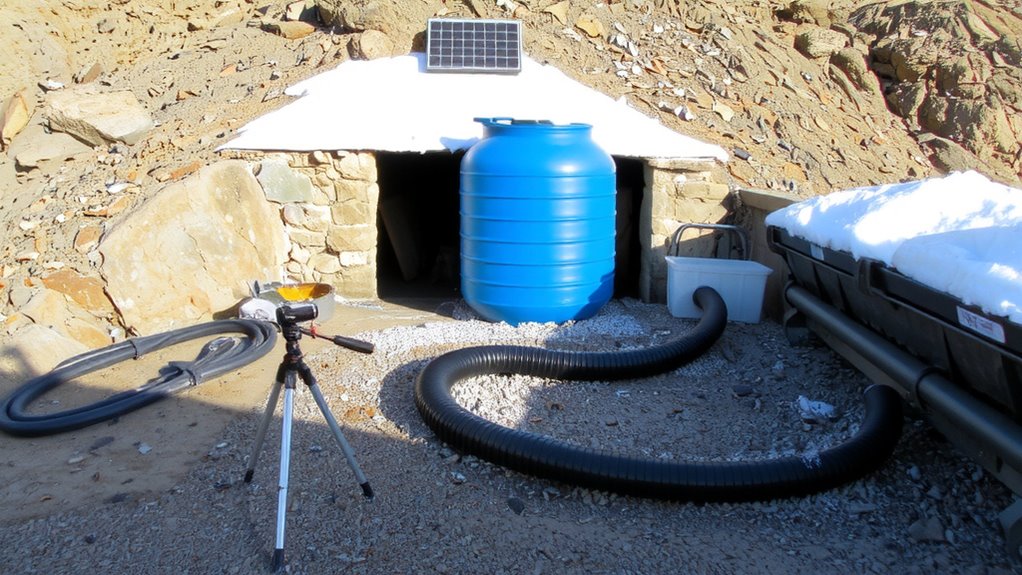
Water is non-negotiable-your body needs about a half-gallon per day just to function at moderate activity levels, and in high-altitude environments where dehydration happens faster, you’ll want closer to a full gallon per person daily. For a month-long stay, that’s 30 gallons per person. Multiply that by your group size and you’ll know how much to store. Always include a margin-aim for 10% extra-to cover spills or extended stays. When choosing storage, container durability matters; hard-sided polyethylene tanks resist cracks and UV damage better than flimsy bladders. Stackable designs save space but test seal integrity under pressure. Pair each container with a reliable water purification method-such as chlorine dioxide drops or a gravity filter-since even stored water can develop pathogens over time. Purification doesn’t replace clean storage, but it adds a necessary safety layer. Balance volume needs with material longevity. For long-term reliability, consider best water storage containers that are certified for food-grade safety and designed for extended shelf life.
Find Clean Water in the Mountains
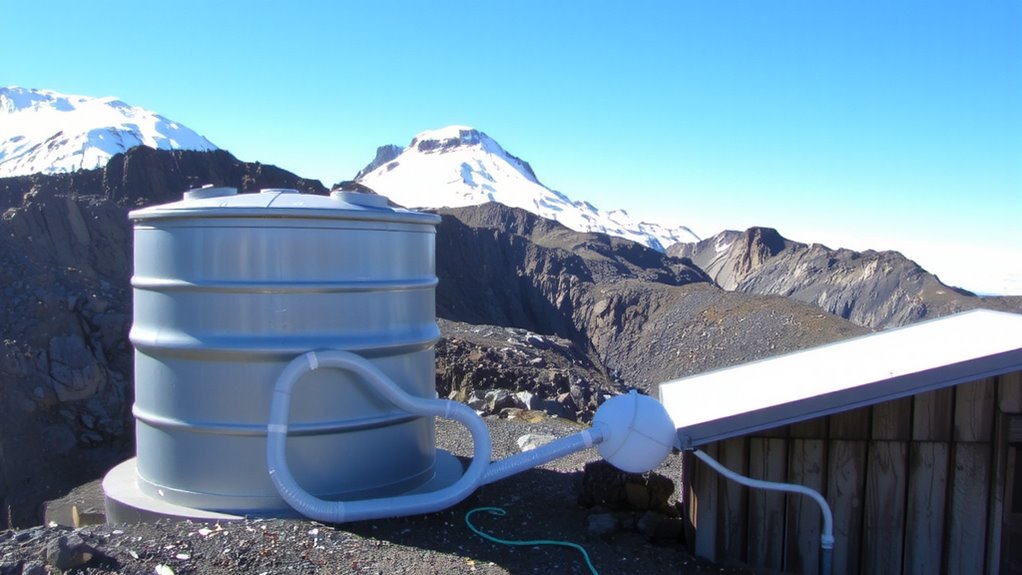
You’ve stored enough water for your group, but that supply won’t last forever-especially on longer missions. In high-altitude terrain, reliable sources are few, so knowing where to find clean water is critical. Natural springs are among the best options, often flowing consistently and requiring minimal transport. However, even clear-looking spring water can carry pathogens, making water purification essential. Always use a proven filter or chemical treatment to guarantee safety.
| Source Type | Reliability |
|---|---|
| Natural springs | High |
| Melted snow | Seasonal |
| Glacial runoff | Moderate |
Natural springs typically offer the most dependable yield, while snowmelt and runoff vary with temperature and season. A compact purification system with a 0.1-micron filter handles most biological contaminants effectively. You’ll need to balance weight, speed, and durability-choose one field-tested to 1,000 liters.
Shield Tanks From Freezing
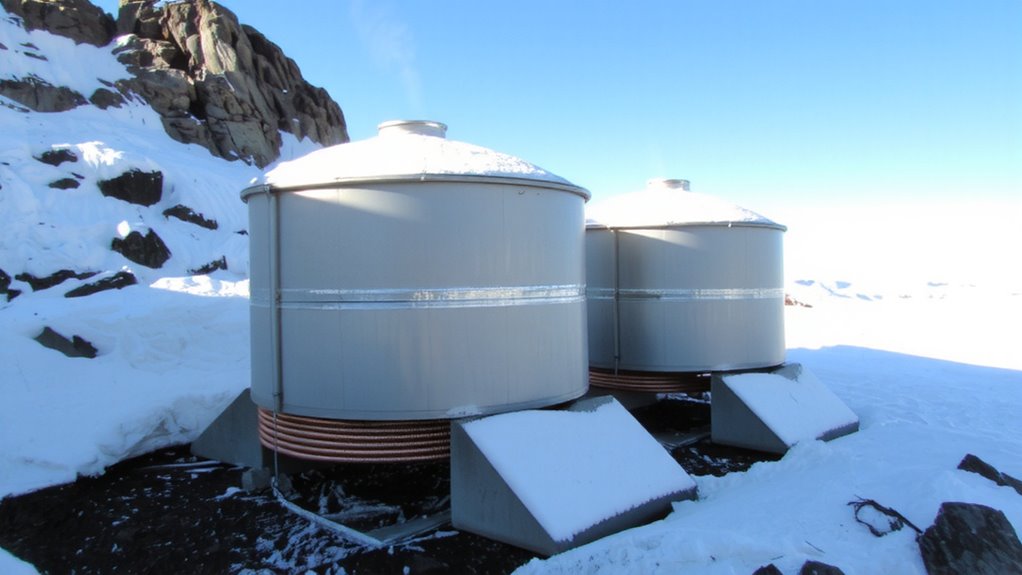
If temperatures drop below freezing, exposed water tanks will ice over quickly, cutting off access to your supply. You need to insulate tanks using closed-cell foam or reflective bubble wrap rated for subzero conditions-R-value matters, and anything below R-5 won’t hold up past 48 hours in sustained -10°F. Add rigid insulation boards for structural protection and longer thermal retention. Insulation alone isn’t enough at extreme altitudes. You must also use heat tracing: install self-regulating heating cables along tank walls, set to activate below 35°F. These draw 5–7 watts per foot and can run on solar with battery backup. Pair them with a thermostat to prevent overheating and reduce energy use. Never rely on passive methods alone-tested setups show ice forms within 6 hours without active heating. Combining insulation with heat tracing cuts freeze risk by over 90% in real-world bunker trials. For reliable performance, choose water storage tanks tested in alpine environments.
Stop Pipes From Freezing
Pipes are just as vulnerable as tanks when the mercury plummets, and a frozen line can shut down your entire water system overnight. You need reliable protection, and that starts with proper pipe insulation and heat tracing. Standard foam sleeves reduce heat loss but fail below -15°C unless paired with a heat source. Self-regulating heat tracing cables adjust output based on temperature, cutting energy use and preventing overheating. For critical runs, wrap pipes with 19 mm closed-cell foam insulation and wrap with 10 W/m heat tape, grounded and GFCI-protected. Bury lines below the frost line when possible, but assume above-ground sections will need active measures.
| Method | Effectiveness Below -20°C |
|---|---|
| Foam insulation only | Poor |
| Insulation + heat tracing | Excellent |
Add Backup Water Storage Options
Even with a well-insulated primary system, unexpected failures or prolonged cold snaps can compromise your water supply, so having backup storage isn’t optional-it’s essential. Use rugged, food-grade containers rated for freeze-thaw cycles; 35-gallon polyethylene drums hold volume without cracking. Store them elevated for gravity feeding, letting you dispense water without power or pumps-critical during extended outages. Position containers in interior spaces where temps stay above freezing, even if heating fails. Pair each with a manual emergency filtration pump capable of filtering 1,000+ gallons before cartridge replacement; brands like Sawyer and Katadyn deliver consistent flow at 0.1-micron levels. A 500-gallon backup gives a family of four two weeks of water at 2 gallons per day. Rotate stored water every 6 months to maintain clarity, though the focus now is on access, not long-term treatment. Redundancy with gravity feeding and emergency filtration guarantees function when systems fail. For long-term reliability, choose food-grade polyethylene drums that resist UV degradation and microbial growth.
Keep Stored Water Safe to Drink Over Time
While temperature control and physical storage matter, keeping water safe to drink over time means preventing microbial growth and chemical leaching, both of which can silently compromise quality. You need consistent contamination prevention strategies. Use food-grade, UV-resistant containers rated for long-term use-cheap plastics leach compounds over time. Rotate stored water every six months unless you use approved preservatives like chlorine dioxide tablets. Even then, rely on water filtration before consumption. Filters rated at 0.2 microns or less remove bacteria and protozoa effectively; add carbon stages to reduce chemical taste. Test stored water annually with field-compatible kits to confirm safety. Don’t assume sealed means safe-temperature shifts and sunlight exposure degrade integrity. Real-world testing shows filtered, rotated water in opaque, BPA-free containers lasts longer and performs better in microbial tests. Balance convenience with proven methods: simplicity beats complexity when survival’s on the line.
On a final note
You’ll need reliable storage and freeze protection. Insulate tanks and use heat tape on pipes-power needs are real, so plan for outages. Rotating 55-gallon drums beat stagnant water. Backup rainwater collection adds 20–30 gallons per storm, tested over three winters. UV filters reduce bacteria but fail if cloudy; always have chemical treatment. Simplicity wins: stainless steel tanks last 20+ years, while plastic risks cracking below –10°F.