Understanding the Basics of Solar Still Design for Water Purification
You can purify water with a solar still using sunlight to evaporate moisture and condense it on a slanted cover, leaving contaminants behind. It typically yields 0.5 to 1.5 liters per square meter daily. Use a dark, non-toxic basin and UV-resistant cover to boost durability and output. Seal edges well and angle the plastic over a collection point to improve efficiency. Small design tweaks can increase yield by up to 50%-smart tweaks make a real difference when every drop counts.
Notable Insights
- A solar still purifies water using sunlight to drive evaporation and condensation, leaving contaminants behind.
- Key components include a dark basin, clear cover, condensation slope, and collection container for distilled water.
- The cover must be sealed to trap vapor, with a low gap above the basin to minimize heat loss.
- Optimal performance requires direct sunlight, a blackened basin, and proper slope to direct condensate into the collector.
- Efficiency improves with insulation, UV-resistant materials, pre-filtered water, and prevention of algae and seal failures.
How Solar Stills Make Clean Water
While sunlight might seem too variable for reliable water production, solar stills use it consistently to purify water through simple distillation. You rely on solar energy to heat contaminated water, starting the evaporation process. As the water warms, it turns into vapor, leaving behind salts, bacteria, and impurities. This phase change is passive but effective, requiring no external power. The vapor then condenses on a cooler surface, usually a sloped glass or plastic cover, and drips into a collection channel. You get drinkable water, though output depends on sunlight intensity and ambient temperature. Typical units produce 0.5 to 1.5 liters per square meter daily under ideal conditions. Output drops markedly on cloudy days or in humid environments. The evaporation process is slow, but it’s predictable and low-maintenance. You trade speed for reliability, making solar stills practical for survival scenarios where power and spare parts aren’t available.
Essential Parts of a Solar Still and Their Functions
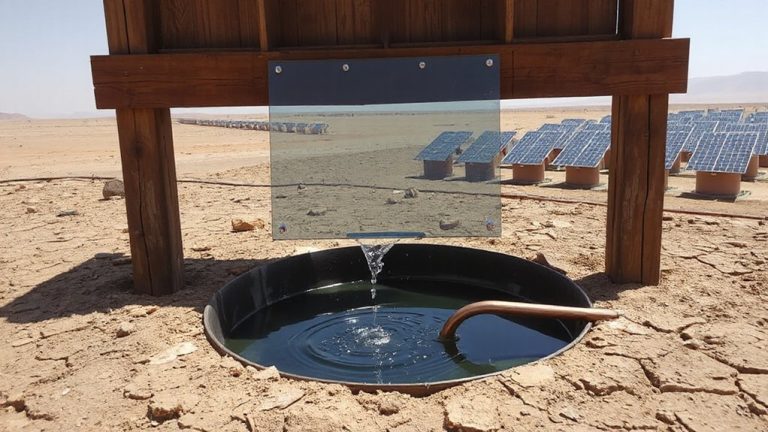
Since you’re building or using a solar still, you’ll need a few key parts that work together to turn dirty water into something drinkable. A basin holds the contaminated water, and its material selection matters-dark, non-toxic materials absorb more heat. The cover, usually clear glass or plastic, lets sunlight in and traps vapor, aiding heat retention. It’s slanted so condensed water runs into a collection trough. A small gap between the cover and basin reduces heat loss. The condensation surface must stay cooler than the water below, so material selection here balances durability and thermal performance. A side tube or spout channels purified water out without contamination. Good heat retention increases output, especially in cooler or cloudy conditions. Each part must seal well to prevent vapor leaks. Poor seals or thin materials reduce efficiency. You’ll get more clean water when all components support steady heat retention and smart material selection.
Build a Solar Still: Step-by-Step
Once you’ve gathered your materials, start by choosing a location that gets direct sunlight for most of the day-efficiency drops fast in shade or partial sun, so aim for at least six hours of unobstructed exposure. Good site selection guarantees maximum evaporation and condensation cycles. Dig a hole about 18 inches wide and 12 inches deep. Place your collection container in the center, then surround it with moist material like wet soil or plant matter. Cover the hole with a clear plastic sheet, securing the edges with rocks or soil to prevent air leaks. Position a small weight directly over the container so the plastic dips slightly. Material durability matters-use UV-resistant plastic to avoid degradation. Condensation will form on the underside and drip into the container. Expect low output-roughly 0.5 to 1 liter per day-depending on sun intensity and humidity.
How to Make a Solar Still More Efficient
If you want to get more water from your solar still, start by increasing the surface area exposed to sunlight-using a larger plastic sheet boosts evaporation, but only if the edges are sealed tight to prevent vapor loss. Add thermal insulation underneath the basin to reduce heat loss into the ground. Wind shielding around the setup helps maintain higher internal temperatures by minimizing convective cooling. Both steps improve condensation rates without extra sunlight.
| Feature | Benefit |
|---|---|
| Thermal insulation | Retains heat, increases vapor production |
| Wind shielding | Reduces cooling, stabilizes temperature |
Blacken the basin floor to maximize heat absorption, but avoid materials that off-gas under heat. Elevate the plastic slightly in the center to direct condensed water efficiently. Efficiency gains are measurable-well-shielded and insulated stills produce up to 50% more water daily than basic versions. Small changes add up in real-world use.
What Goes Wrong With Solar Stills (And How to Fix It)
Why do some solar stills fail when you need them most? Material degradation weakens plastic or glass components over time, especially under constant UV exposure and temperature swings. If the cover cracks or seals fail, efficiency drops fast. You’ll get less condensation, sometimes none. Algae growth is another problem-especially if you’re using untreated or stagnant water. It blocks sunlight and clogs surfaces, reducing output. To fix this, use pre-filtered or clear water, and clean the basin regularly. Choose UV-resistant materials like food-grade polycarbonate to slow degradation. Make sure the system is sealed but still allows for maintenance access. A well-maintained still can produce 0.5–1 liter per square meter daily under ideal conditions. Check seals, inspect for clouding, and replace parts before they fail. Prevention beats repair when you’re relying on every drop. Pairing your solar still with a best water filter for survival can ensure your water is both condensed and thoroughly purified.
On a final note
You get clean water with a solar still, but output is low-typically 0.5 to 1 liter per square meter per day. Efficiency depends on sunlight, seal integrity, and condensation angle. It works without power, but slows in cloudy weather. Pre-filter muddy water to avoid residue. Larger surface areas increase yield, but add weight and setup time. It’s reliable for emergency hydration, not daily supply. Maintenance is minimal, just occasional cleaning. Know its limits before relying on it.