How to Use Passive Solar Distillers to Recharge Stored Water Supplies
Set up a passive solar distiller in direct sunlight for at least six hours daily to turn impure water into clean, drinkable water. Use a dark basin and sloped, airtight cover to maximize evaporation and condensation. You’ll get 0.5 to 1 gallon per square meter daily, depending on climate and design. Position it south-facing in the Northern Hemisphere and on reflective ground to boost output. Keep seals tight and surfaces clean-small leaks or dust cut efficiency fast. Better results come from matching materials and angle to your local conditions.
Notable Insights
- Position passive solar distillers in sunny, unshaded areas with reflective ground surfaces to maximize water production for storage.
- Align the distiller’s cover at an angle close to local latitude to optimize solar exposure and daily output.
- Use dark, thermally absorbent basins and airtight, clear covers to enhance evaporation and condensation efficiency.
- Connect the condensation trough directly to clean storage containers to continuously recharge water supplies without contamination.
- Perform weekly maintenance by checking seals, clearing cover debris, and inspecting for leaks to maintain peak distillation performance.
Build a Simple Solar Still in 5 Steps
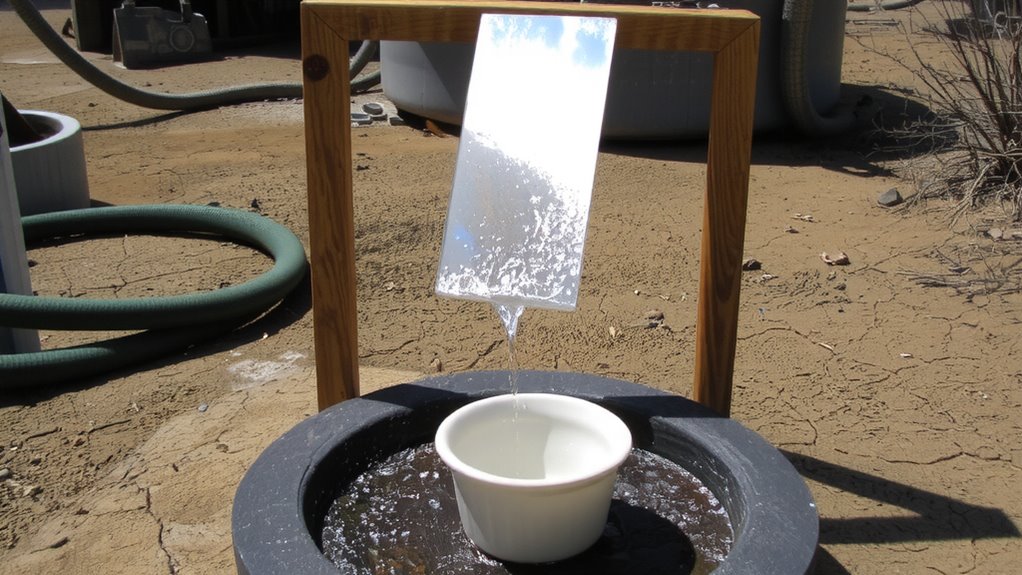
While you might think building a solar still requires advanced tools or materials, it’s something you can set up quickly with basic supplies. Start with proper material selection: use a clear, airtight plastic sheet for condensation and a dark-colored container to absorb heat. Place your still in an area with maximum sunlight exposure-ideally, six or more hours of direct sun. A slight slope in the plastic helps channel condensed water into the collection vessel. Dig a hole, position the container in the center, and cover with the plastic, securing the edges with rocks or soil. The sun heats the moist ground, evaporating water that then condenses on the cooler plastic underside. Material selection affects durability and efficiency; thin plastic may degrade, while thicker grades last longer but cost more. Sunlight exposure directly impacts output-shaded or overcast conditions reduce yield markedly. This method works reliably in dry, sunny climates but produces limited water daily, usually under one liter per square meter.
How Passive Solar Distillers Make Clean Water
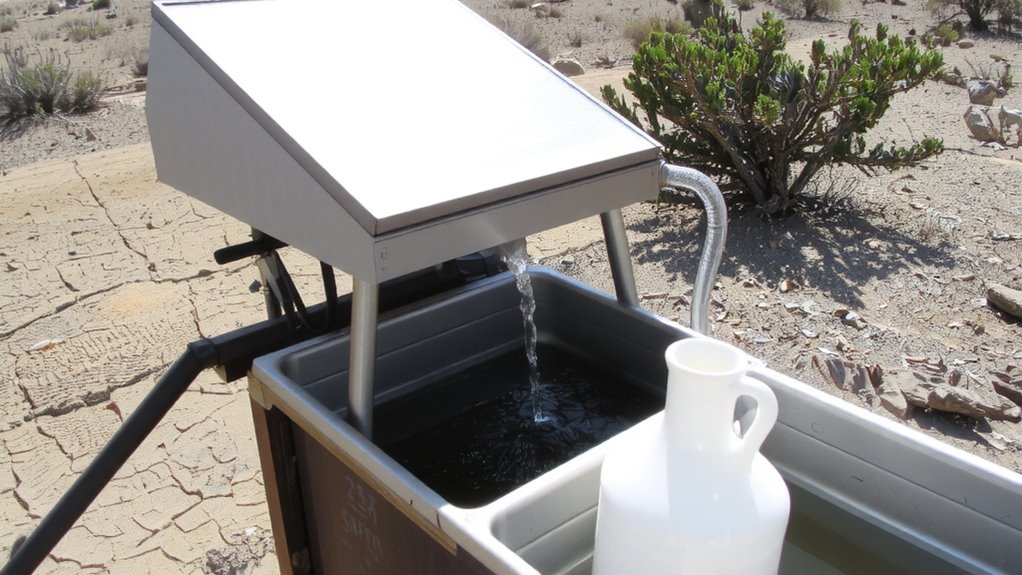
Since solar distillation relies on basic principles of evaporation and condensation, you can count on passive solar distillers to turn nearly any impure water source-seawater, brackish groundwater, even contaminated runoff-into drinkable water using only sunlight. You pour the dirty or salty water into the basin, where it absorbs heat through thermal conduction from the sun-warmed surface. As the water heats, it evaporates, leaving salts, bacteria, and most contaminants behind. The vapor rises and meets the cooler transparent cover, where vapor condensation occurs. The slope of the cover guides the droplets into a collection trough. This process removes over 99% of impurities, delivering water safe to drink. No pumps, no filters, no power-just physics. You get roughly 0.5 to 1 gallon per square meter per day, depending on sun intensity. Output is modest but reliable when other methods fail.
Pick the Best Design for Your Climate
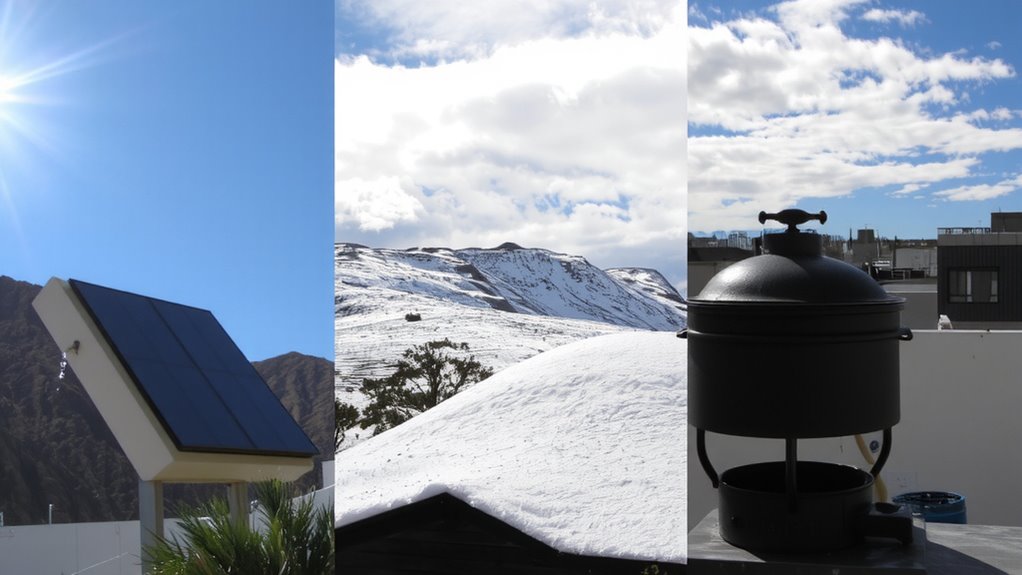
If you’re working with limited sunlight or cooler temperatures, going with a tilted glass cover at a 45–60° angle helps capture more solar radiation and boosts condensation efficiency. Your material selection直接影响 durability and heat retention-polycarbonate resists impact but loses heat faster than glass. For hot, arid climates, a simple basin design works well, while humid or cloudy regions need enhanced thermal mass to stabilize output. Climate adaptation means matching design features to local conditions to maintain consistent yield.
| Climate Type | Recommended Design Feature |
|---|---|
| Arid/Sunny | Shallow basin, black PVC liner |
| Temperate | Tilted glass, insulated sides |
| Humid/Cloudy | Dark thermal mass, double glazing |
Choose materials and angles based on sun exposure and average temps. This isn’t about ideal conditions-it’s about reliable function when water’s scarce.
Place Your Still to Maximize Water Output
Every hour of direct sunlight counts, so position your still due south in the Northern Hemisphere-or due north in the Southern Hemisphere-for maximum sun exposure. Tilt the cover at an angle close to your latitude to capture more direct rays throughout the day. Avoid shadows from trees, buildings, or terrain, as even partial shading cuts output fast. Place the still on a surface with high ground reflectivity, like light sand, concrete, or aluminum foil, to bounce additional light onto the basin. Dark surfaces absorb heat but offer low reflectivity, reducing secondary gain. A reflective base can boost efficiency by up to 20% in field tests. Keep the still level so condensed water flows properly into the collector. Don’t elevate it unless necessary-ground placement improves heat transfer. Sun exposure and ground reflectivity together determine daily yield, so optimize both. Every degree off alignment or patch of shade chips away at performance.
Fix Problems and Keep Your Still Working
You’ve got your still in the right spot and angled for peak sunlight, but even a well-placed system can underperform if small issues go unchecked. Regular maintenance checks prevent efficiency drops. Inspect seals and joints weekly-degraded gaskets cause vapor leaks, reducing output by up to 40%. Clean the glass cover every few days; dust and salt buildup block sunlight and lower evaporation rates. Check the basin liner for cracks or punctures-damaged material risks contamination and leaks. Use silicone sealant for minor fixes, but replace components if wear is significant. Leak prevention isn’t just about seams-it includes proper frame leveling to avoid pooling that stresses joints. Make certain the condensation trough slopes correctly so distilled water flows into the collection tube without spillage. Replace plastic tubing if it becomes brittle. A well-maintained still runs reliably for years, producing 0.5 to 1.2 liters per square meter daily, depending on sun exposure and design.
On a final note
You get about 0.5–1 gallon per day from a basic solar still, depending on sun exposure and design. It’s slow but reliable when power isn’t available. Efficiency drops in cloudy or cold climates, so adjust expectations accordingly. Maintain clear plastic and good seals to avoid leaks. This isn’t a primary water source-it’s a backup. Use it to sanitize questionable water or extend stored supplies. Simple, low-cost, and functional when used right.