Building a Water Storage Vault With Blast-Resistant Ventilation
You need a blast-resistant water vault to survive disasters with both shockwaves and contamination. Build it from 12-inch reinforced concrete, rated for 5 psi, on stable bedrock away from flood zones. Use military-spec ventilation with 10 psi-rated dampers and HEPA-carbon filters to keep air safe. Seal all penetrations with fire-rated foam and EPDM grommets. Test seals yearly with a pressure decay check. Proven designs follow UFC 4-010-01-they’ve kept supplies intact in real blast events. There’s more to get right if you want long-term reliability.
Notable Insights
- Use 12-inch-thick reinforced concrete with 4,000 psi strength for blast and radiation resistance.
- Position the vault 50–100 feet from shelter on stable bedrock to minimize blast and flood risks.
- Install spring-loaded blast dampers rated for 10 psi on ventilation pathways.
- Seal all joints with waterstops and epoxy-coated rebar to prevent contamination and corrosion.
- Test ventilation and seals via pressure decay or smoke tracer methods annually.
Why a Blast-Resistant Water Vault Could Save Your Life
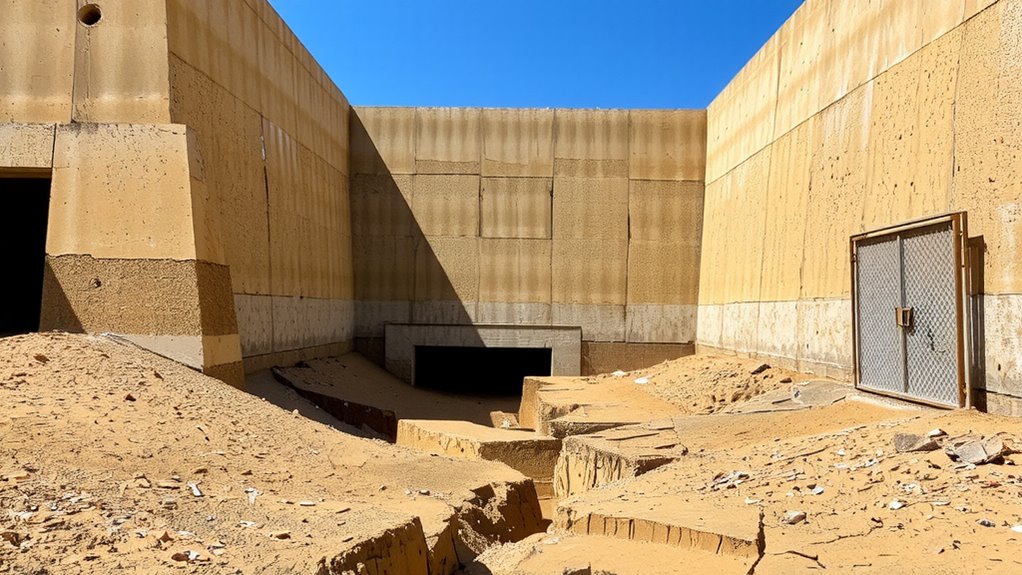
If you’re serious about surviving a disaster, storing water isn’t enough-your water needs protection from blast overpressure and debris, and that’s where a blast-resistant vault makes the difference. Standard containers can rupture under pressure, exposing your supply to contamination. A reinforced vault withstands impacts and extreme pressure, keeping water safe and usable. It also provides radiation shielding, reducing exposure from fallout by blocking gamma and neutron radiation-critical when sheltering for days or weeks. You’ll likely store emergency rations inside, so the vault doubles as secure, climate-stable storage. Units tested to military-grade standards (like UFC 4-010-01) resist blasts up to 5 psi overpressure, a realistic benchmark for nearby detonations. While heavier and costlier than basic shelters, the protection justifies the investment. Without it, your supplies-even if sealed-may be compromised when you need them most.
Choose the Best Location for Your Vault
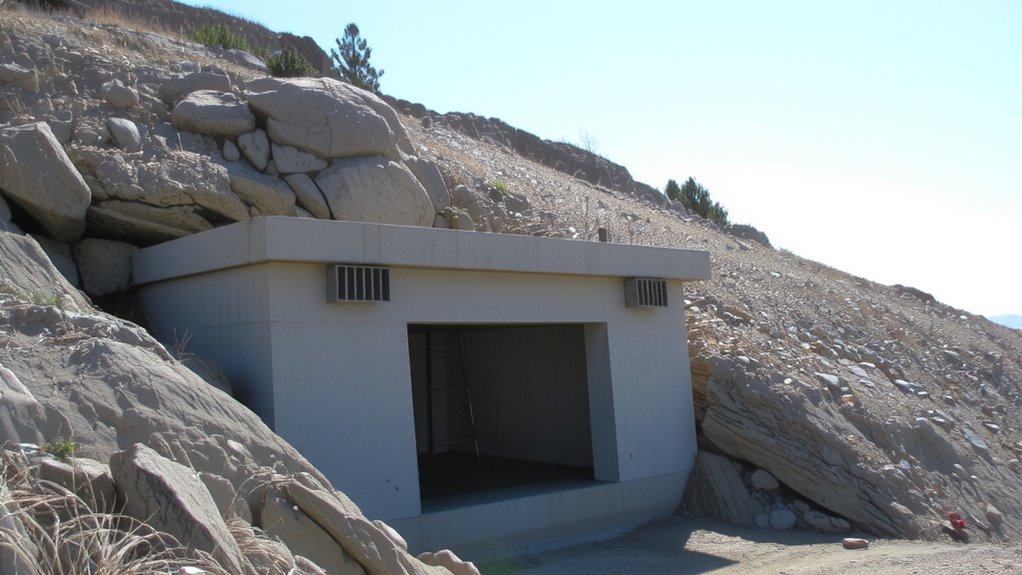
Where should you put your water vault to guarantee maximum protection and accessibility? Choose a site with proven geological stability to avoid collapse during seismic events or explosions. Soft soil or flood-prone areas increase risk, so opt for elevated, solid bedrock or compacted clay. You’ll also want proximity to resources-your vault shouldn’t be so far from your shelter that carrying water becomes impractical during an emergency. A distance of 50–100 feet is ideal, balancing safety and access. Avoid placing it near fuel tanks, chemical stores, or power lines to reduce secondary hazards. Consider natural cover like hills or dense vegetation for added blast protection without sacrificing retrieval speed. Underground placement enhances shielding but requires proper grading to prevent water infiltration. Assess the terrain’s long-term stability, not just surface appearance. Poor location choices compromise even the best-built vault.
Build a Waterproof, Blast-Resistant Enclosure
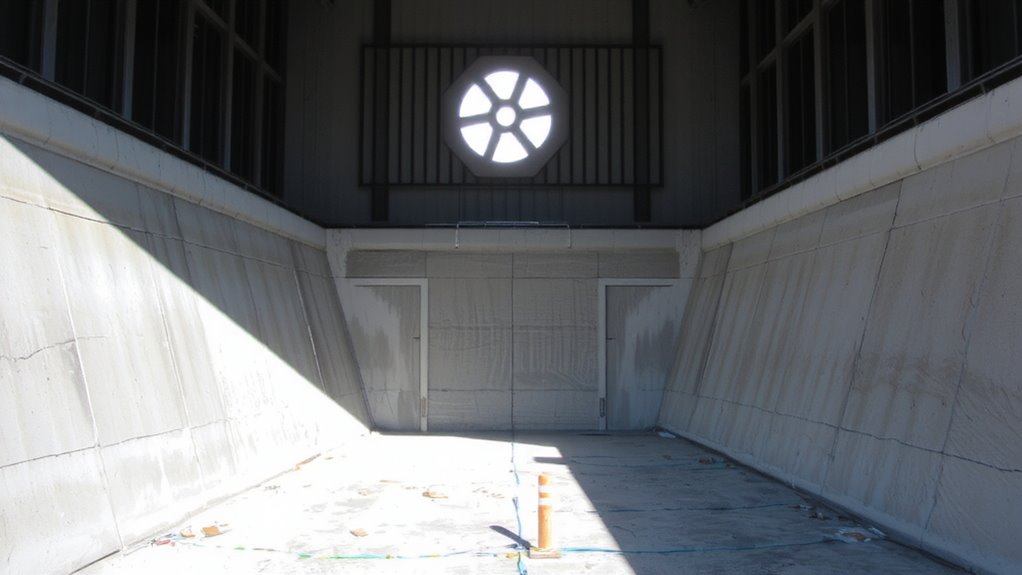
Your enclosure’s shell is the difference between safe water and total loss. You need reinforced concrete at least 12 inches thick to withstand overpressure from nearby detonations. This isn’t optional-it’s structural necessity. Use a mix with a compressive strength of 4,000 psi or higher, and guarantee rebar spacing is no more than 6 inches on center for full load distribution. Apply epoxy-coated rebar to improve corrosion protection in humid environments. The form work must be seamless, with waterstops at joints to prevent seepage. Once poured, cure the concrete for at least seven days to achieve full strength. A vapor barrier on the exterior adds waterproofing, while a non-corrosive sealant on interior surfaces extends material life. These measures aren’t overkill-they’re baseline for integrity under stress. Skip shortcuts here, and the vault fails when you need it most.
Install Blast-Resistant Ventilation
Though ventilation is critical for air quality, it’s also a weak point under blast conditions, so you’ll need purpose-built dampers rated for overpressure survival. Standard vents collapse or leak under pressure, but blast-resistant models seal automatically during an event, maintaining structural integrity. You’ll want dampers tested to withstand at least 10 psi; models with spring-loaded or flap mechanisms perform reliably in trials. Pair them with dedicated air filtration to remove contaminants without compromising flow. These systems integrate pressure regulation to equalize internal and external forces gradually, preventing container deformation. You’re not just ventilating-you’re balancing safety and system longevity. Some units combine filtration and pressure relief in one housing, reducing failure points. Guarantee all components meet MIL-STD or UFC guidelines so they perform when needed. Improvised solutions fail under real loads, so rely on certified hardware. Proper installation aligns dampers with prevailing winds for passive airflow while maintaining protection.
Seal All Entry Points Against Pressure and Toxins
Blast-resistant ventilation handles airflow under pressure, but it’s only one part of a broader strategy-every opening is a potential breach. You must seal all entry points completely to maintain internal integrity. Gaps around pipes, cables, or access hatches compromise both pressure retention and toxic shielding. Use self-expanding fire-rated foam combined with silicone-based sealants rated for chemical resistance. These materials perform well in pressure tests up to 10 psi, maintaining seal integrity. For conduits, install compression grommets with EPDM washers-they’re repeatable and durable. Air filtration units only work if unfiltered air isn’t leaking past them; even small gaps undermine performance. Test seals with a smoke tracer or pressure decay method-real results matter more than visual checks. Consider toxic shielding a system, not a coating: layered barriers outperform single solutions. Sealed entries guarantee your vault’s air filtration and overpressure function as designed when needed most.
Keep Water Safe and Air Fresh Over Time
While keeping air and water sealed is essential, maintaining their quality over time demands active management. You’ll need reliable water purification to prevent microbial growth and chemical contamination in stored supplies. Use UV-C systems or gravity-fed ceramic filters with sub-micron ratings-they’re proven to remove 99.99% of pathogens without chemicals. Rotate water every six months if not using long-term stabilizers. For air filtration, pair HEPA filters (capable of trapping 99.97% of particles 0.3 microns) with activated carbon layers to reduce CO2 buildup and eliminate odors. These systems require periodic filter changes, so stock spares. Passive sealing alone isn’t enough-without ongoing purification and filtration, air turns stale and water becomes unsafe. You’re balancing longevity with maintenance. Simple, field-tested gear outperforms complex setups when durability and consistency matter most. Plan for both. In survival scenarios, having a best water filter ensures access to safe drinking water even when standard systems fail.
Test and Upgrade Your Vault’s Safety
You’ve sealed the air, purified the water, and set up filtration that keeps your environment livable, but none of it matters if the structure holding it all fails under pressure. Test welds, seals, and vent baffles under maximum expected load-use a pressure gauge to confirm integrity up to 5 PSI over design specs. Conduct weekly water testing for microbial contamination and pH shifts; replace storage liners every five years or sooner if cracks appear. Inspect air filtration units monthly-replace HEPA filters when airflow drops 20% or after 12 months, whichever comes first. Upgrade to redundant filtration if spore or particulate levels rise. Install a secondary blast valve if initial models fail to reset after testing. Materials matter: steel outperforms concrete under shock loads but requires corrosion checks. Sensors for humidity, CO2, and filter efficiency should trigger alerts. Upgrade weak points early. Real-world survivability depends on consistent verification, not assumptions.
On a final note
You’ve built a secure water vault with blast-resistant ventilation, but its real value lies in consistent performance under pressure. A properly sealed enclosure handles shockwaves; the vent cuts contamination risk without compromising airflow. Test seals annually and monitor humidity. Some systems cost more, but fail less. Simpler designs work if materials meet ASTM blast standards. This isn’t overkill-it’s measured prep. Your survival hinges on these details working exactly when needed.