Using Solar Stills to Harvest Drinking Water in Arid Emergency Environments
You can get up to 1 liter per square meter daily from a solar still, even in arid conditions. Use UV-resistant 4-mil plastic and a sturdy container to guarantee durability and efficiency. Build it over damp soil in a sealed pit, angled to drip condensation into the collector. Performance depends on sun exposure and material quality. Multiple units boost output. Expect modest yields, but it’s reliable when filters or fuel aren’t available. Better designs and placement can markedly improve results.
Notable Insights
- Solar stills purify water by evaporating moisture from soil or plants and condensing it on a cooled transparent cover.
- Use UV-resistant plastic sheeting and a sturdy container to ensure durability and efficient condensation collection in harsh conditions.
- Dig a pit, place a collection container in the center, and cover with plastic weighted in the middle to direct drips.
- Increase output by using dark, damp materials, pre-heating soil, and positioning stills for full morning-to-midday sun exposure.
- Seal edges airtight with rocks or stakes and fix leaks promptly to prevent vapor loss and maintain optimal efficiency.
Understand How Solar Stills Work
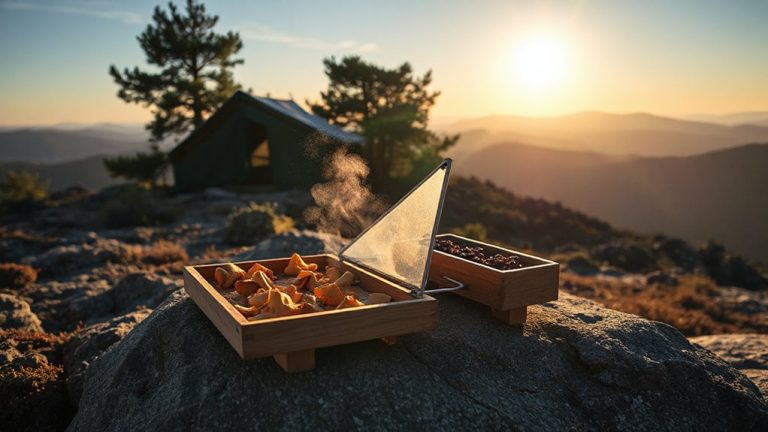
While sunlight drives the process, a solar still works by trapping solar energy to evaporate water and then condensing the vapor to collect purified drinking water. You rely on the evaporation process to separate contaminants, leaving behind salts, bacteria, and debris. As moisture turns to vapor, it rises and contacts the cooler inner surface of the still. This triggers the condensation cycle, where vapor returns to liquid form and flows into a collection trough. The design depends on a transparent cover angled to maximize sun exposure while minimizing heat loss. Output is typically low-around 0.5 to 1 liter per square meter per day-making efficiency a trade-off for simplicity. It works without power or filters, but performance drops under cloud cover or high humidity. You get safe water, assuming the base material isn’t contaminated. It’s basic physics, not innovation-effective when you understand its limits and depend on consistent sunlight to keep both cycles running.
Gather Emergency-Grade Materials
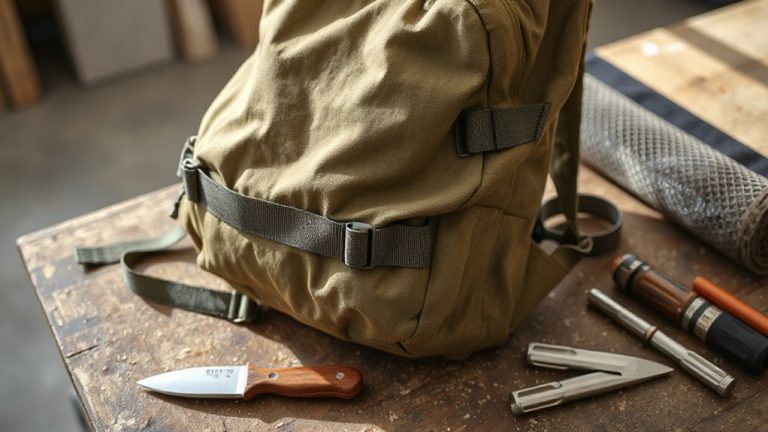
You can build a functional solar still with basic materials, but reliability in an emergency depends on choosing components that hold up under prolonged sun exposure and temperature swings. Material selection matters-clear, UV-resistant plastic sheeting (at least 4 mil thick) outperforms thin bags that crack or cloud over time. Use a sturdy container to collect condensation; lightweight cups may tip or degrade. Metal stakes or heavy rocks seal edges better than weak ties that loosen in wind. For tool improvisation, a fixed-blade knife works best to cut vegetation and shape supports, while a Mylar blanket can substitute for plastic if needed. Avoid adhesives or fragile parts-they fail under thermal cycling. Test materials in direct sun for an hour before final assembly. Durability trumps convenience. Choose items that maintain integrity across temperature extremes and resist punctures. These choices guarantee consistent performance when water is critical. High-quality Mylar bags for food storage are also UV-resistant and puncture-proof, making them a reliable backup material for sealing moisture in emergency water collection systems.
Build a Solar Still With Basic Supplies
If you’ve got a clear plastic sheet, a container, and some rocks, you’re ready to build a solar still that actually works. Dig a shallow pit, place the container in the center, and surround it with damp soil or vegetation if available. Stretch the plastic sheet tightly over the hole, seal the edges with rocks to guarantee material durability, and place a small stone in the center to create a low point. As sunlight heats the ground, moisture evaporates, condenses on the underside of the plastic, and drips into the container. This method improves water purity by filtering out most contaminants and pathogens through natural distillation. The clear plastic must resist UV degradation, so thicker gauge sheets perform longer. Condensation forms slowly, so patience is necessary. Your setup’s efficiency depends on sun exposure and initial moisture. Even basic supplies can yield drinkable water when built correctly.
Boost Daily Water Production
A single solar still using basic supplies might yield only 0.5 to 1 liter per day, depending on sunlight and soil moisture, which often isn’t enough for more than one person. You can boost daily water production by building multiple stills in parallel-doubling the units roughly doubles your output. Use darker, moisture-rich soil if available, and orient the still to face the sun directly from morning to midday. Pre-heating the soil with black plastic increases evaporation rates. A larger collection basin improves condensation capture, but keep the plastic cover at a 30-degree angle for maximum drip flow. These improvements enhance water purification efficiency and support long-term climate adaptation strategies. While output remains limited, strategic scaling and placement allow you to generate up to 3 liters daily across three units. It’s not high-volume, but in an emergency, it’s often enough to maintain hydration.
Fix Leaks, Condensation, and Low Yield
Though efficiency depends on construction accuracy, most solar stills underperform due to avoidable issues like leaks, poor condensation flow, and low evaporation rates. You can fix leaks by checking all seams and edges-any gap breaks seal integrity and lets vapor escape. Use waterproof tape or sealant on joints, especially where the cover meets the basin. If condensation doesn’t drip into your collector, tilt the plastic sheet more steeply so water runs down smoothly. Poor vapor retention cuts output; make certain the still is airtight and the transparent cover is clean and tight. Low yield often stems from insufficient sun exposure or thin water layers-use dark material to boost evaporation. Monitor daily output: a well-sealed still in full sun should produce 0.5–1 liter per square meter. Fix these issues, and you’ll see measurable gains in collected water.
Compare Solar Stills to Other Water Methods
You’ve fixed leaks, improved condensation flow, and maximized yield-now it’s worth asking how well your solar still stacks up against other water collection methods. Compared to chemical filtration, solar stills don’t require spare parts or chemicals, making them reliable long-term, but they produce less water-typically 0.5 to 1 liter per day per square meter. Chemical filtration is faster and portable, yet depends on consumables that can run out. Solar stills excel in atmospheric harvesting by pulling moisture from the air without power, unlike some electric systems. However, they need sustained sunlight and space. Other atmospheric harvesting methods, like dew collectors, work at night but yield even less. Each method has trade-offs: solar stills offer purity through distillation but demand time and ideal conditions. Choose based on environment, duration, and needs-solar stills suit prolonged arid emergencies when simplicity and reliability matter most.
On a final note
You’ll get about 0.5 to 1 liter per day from a basic solar still, depending on sun exposure and setup. It’s slow but reliable when no other water sources exist. While portable filters are faster, they need replaceable parts you might not have. Solar stills work with minimal materials and handle dirty or salty water. They won’t replace other methods but serve as a critical backup. Know the limits, build it right, and you’ll have water when you need it most.