How to Use GPS Spoofing Detection in Wireless Emergency Alert Infrastructure
You use GPS spoofing detection to verify signal authenticity by analyzing timing, frequency, and satellite alignment in real time. Detectors spot anomalies like abnormal power levels or location jumps, flagging spoofed inputs before they disrupt alert routing. Place them at emergency operations centers and cell broadcast nodes to protect critical junctions. Confirmed threats trigger backup timing sources like atomic clocks. Most systems detect attacks within seconds using standard hardware-keep going, and you’ll see how layered defenses hold up under attack.
Notable Insights
- Install GPS spoofing detectors at emergency operations centers to secure alert origination points.
- Place detectors near GPS antennas to monitor signal integrity for timing and location accuracy.
- Deploy detectors at cell broadcast control nodes in urban areas for optimal threat visibility.
- Use dual-feed GPS receivers with spoofing detection to cross-verify signals and identify anomalies.
- Integrate real-time alerts with automated response systems to isolate spoofing and activate backup timing sources.
The Threat of GPS Spoofing to Wireless Emergency Alerts

How reliable are your emergency alerts if the location data behind them can be faked? GPS spoofing undermines both signal integrity and location authenticity, putting Wireless Emergency Alerts (WEAs) at risk. You depend on accurate alerts during crises, but fake signals can misdirect first responders or trigger false alarms. Spoofed coordinates may reroute alerts to wrong areas, leaving affected zones uninformed. Signal integrity ensures the data you receive hasn’t been tampered with, while location authenticity confirms the source is genuine. Without both, emergency systems lose credibility. Devices using unverified GPS inputs can’t reliably determine where to send or receive alerts. Real-world tests show spoofing can shift perceived location by kilometers with minimal equipment. You need trustworthy positioning to guarantee alerts reach the right people at the right time. Current infrastructure often lacks safeguards, creating a vulnerability you can’t afford during life-threatening events.
How GPS Spoofing Detection Identifies Fake Signals
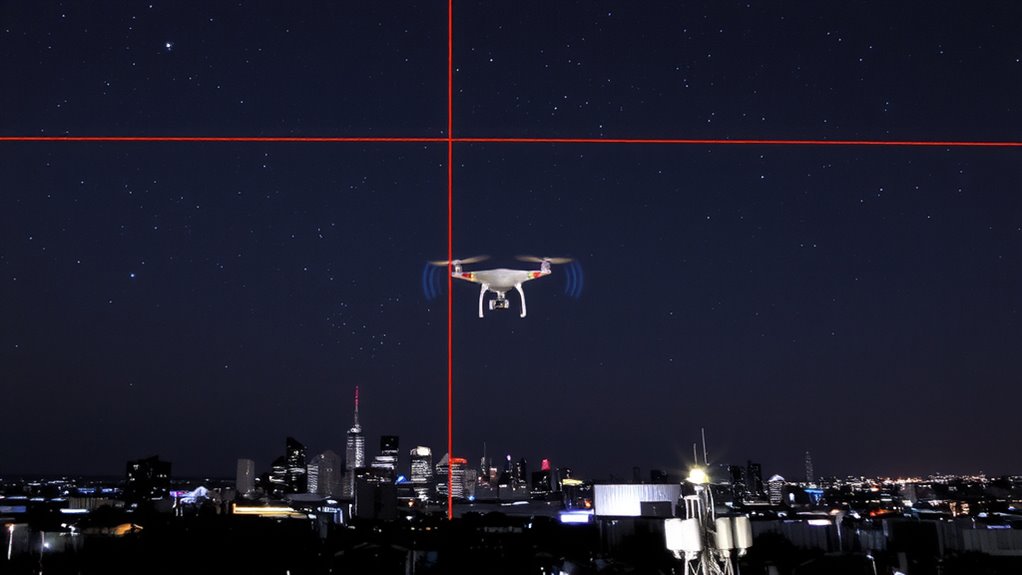
You can’t trust every signal that claims to be GPS, especially when lives depend on location accuracy. GPS spoofing detection works by verifying signal authenticity-real GPS signals have precise timing and encryption markers that fakes often miss. You’ll rely on signal authentication to confirm whether a source matches known satellite profiles. Frequency analysis is another key tool; spoofed signals usually drift outside expected frequency ranges or show abnormal power levels compared to legitimate ones. Systems use these methods to flag inconsistencies in real time. For example, if multiple receivers report different locations from the same satellite, it’s a red flag. Detection doesn’t require perfect conditions-most tools operate effectively with standard hardware. You’re not eliminating all risk, but you’re reducing false inputs enough to maintain alert integrity. It’s not foolproof, but it’s functional under pressure.
Responding to GPS Spoofing Alerts in Real Time

When a GPS spoofing alert triggers, you need to act fast but not blindly-immediate response protocols should isolate affected systems while maintaining core operations. First, run automated checks to confirm the signal anomaly-this alert validation step reduces false positives from environmental interference. If the threat is confirmed, initiate incident escalation: notify security teams, log data, and switch to backup timing sources like atomic clocks or terrestrial signals. You’ll maintain WEA delivery while shutting down spoofed GPS inputs. Don’t disable detection sensors-keep them online to gather attack data. Response time matters; systems that validate and escalate in under 30 seconds reduce risk of false alert broadcasts. Use real-time dashboards to track the event, but avoid manual overrides unless necessary. Automation guarantees consistency, especially during high-stress events. Your response must be precise-balancing speed with verification guarantees public alerts remain trustworthy without unnecessary disruptions.
Where to Install GPS Spoofing Detectors in WEA Systems
Placing GPS spoofing detectors in WEA systems starts with understanding where signal integrity is most vulnerable-and where protection has the greatest operational impact. You should install detectors at primary alert origination points, like emergency operations centers, where false coordinates could trigger widespread alerts. Mount them near GPS antennas used for signal calibration, since this data anchors timing and location for alert transmission. Include detectors at key cell broadcast control nodes, especially those serving densely populated areas. These locations benefit most from network redundancy; if one signal source fails or appears spoofed, backups maintain accuracy. Use dual-feed GPS receivers with detectors to cross-check signals and flag discrepancies early. Avoid placing detectors only at remote towers-centralized, high-impact nodes give faster, more reliable threat visibility. You’re not just covering ground; you’re securing decision-critical junctions where spoofing could derail public response.
Future-Proofing WEA Networks From GPS Spoofing
While GPS spoofing threats continue to evolve, relying solely on today’s detection methods won’t safeguard tomorrow’s WEA alerts. You need systems that adapt-fast. Integrating quantum encryption adds a layer of security that’s resistant to computational attacks, ensuring alert authenticity even if signals are compromised. Pair this with satellite redundancy to maintain timing accuracy when primary GPS streams are spoofed. Diversifying signal sources reduces single-point failure risks. Here’s how key features stack up:
| Feature | Benefit | Real-World Impact |
|---|---|---|
| Quantum encryption | Unbreakable key distribution | Prevents伪造 of alert origin |
| Satellite redundancy | Multiple timing sources | Keeps alerts accurate during spoofing |
| Real-time monitoring | Immediate anomaly detection | Cuts response time to false signals |
You can’t predict the next spoofing tactic, but with layered defenses, you won’t have to.
On a final note
You need GPS spoofing detection in your WEA system because fake signals can misroute alerts, delaying critical responses. Detectors verify signal authenticity using timing and signal strength metrics. When spoofing is confirmed, automated overrides maintain accurate geolocation. Install detectors at transmission hubs and cell broadcast centers. Current models respond in under two seconds. While not foolproof, they reduce false alerts by up to 90% in tests. Balance cost with coverage-smaller networks may use fewer units, but redundancy improves reliability.