How to Use GPS to Maintain Bearing While Crossing Snowfields
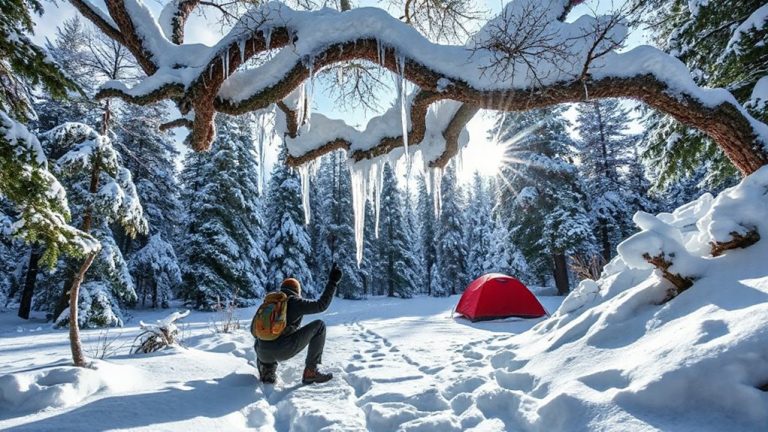
Set your GPS before stepping onto the snowfield, with waypoints every 200–500 meters like “SNOW-EDGE” for clear routing. Calibrate the compass and confirm satellite lock-wait 30–60 seconds in open sky. In whiteouts, trust the true bearing, not magnetic, and account for local declination. Check your position every 100 meters to catch drift early; snow and flat light distort your path. Use bearing lock, avoid metal interference, and sample often-not constantly-to save power. Cold cuts battery life by up to half, so carry spares in an insulated pocket and keep a map and compass ready. You’ll want to know how to place waypoints for maximum reliability in low visibility.
Notable Insights
- Calibrate your GPS compass and confirm satellite lock before starting across the snowfield.
- Program your route with named waypoints every 200–500 meters for accurate bearing guidance.
- Use true bearing on your GPS and adjust for local magnetic declination to maintain course.
- Monitor your position every 100 meters to detect and correct drift before it exceeds 10 degrees.
- Conserve battery with power-saving settings and carry spares, plus a compass and map as backup.
Set GPS Before Snowfield Crossing
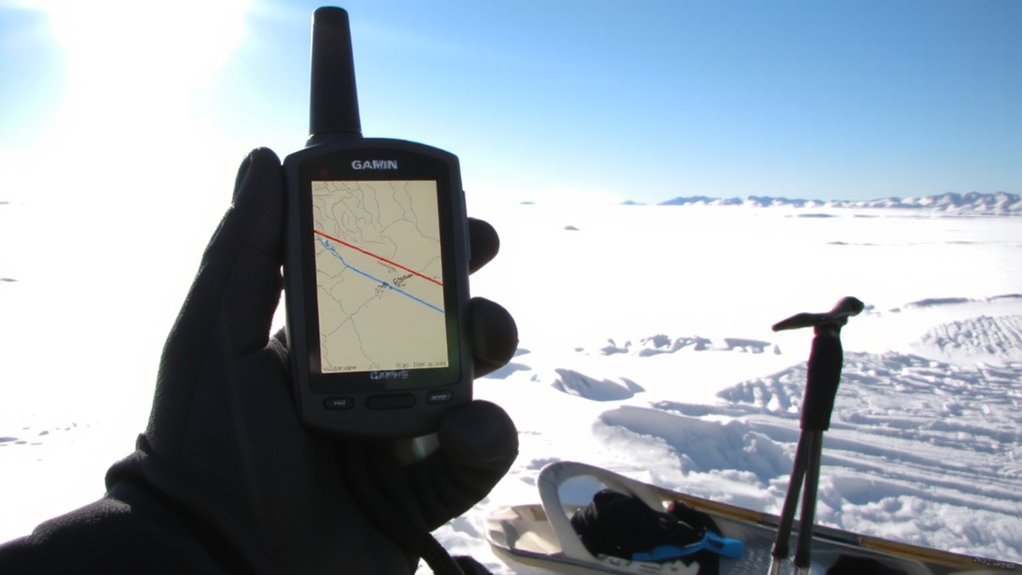
Before you step onto the snowfield, take a moment to program your GPS with the route and bearing you plan to follow-this small step guarantees you won’t fumble with settings in the cold when visibility drops. You’ll want to calibrate compass once you power on the device; doing so secures directional accuracy, especially near metallic gear or ridgelines that can skew readings. Then, test signal to confirm satellite lock-without a strong connection, position updates lag or fail. Most modern units take 30–60 seconds to achieve full signal acquisition in open sky conditions. If your GPS doesn’t lock within two minutes, relocate to a clearer zone. Units with multi-constellation support typically fix faster but drain batteries 15–20% quicker. Cold reduces battery efficiency, so keep the device insulated. Always carry backup power. Relying solely on GPS is risky; pair it with a physical map and calibrated compass for redundancy.
Mark Key Route Points With Waypoints
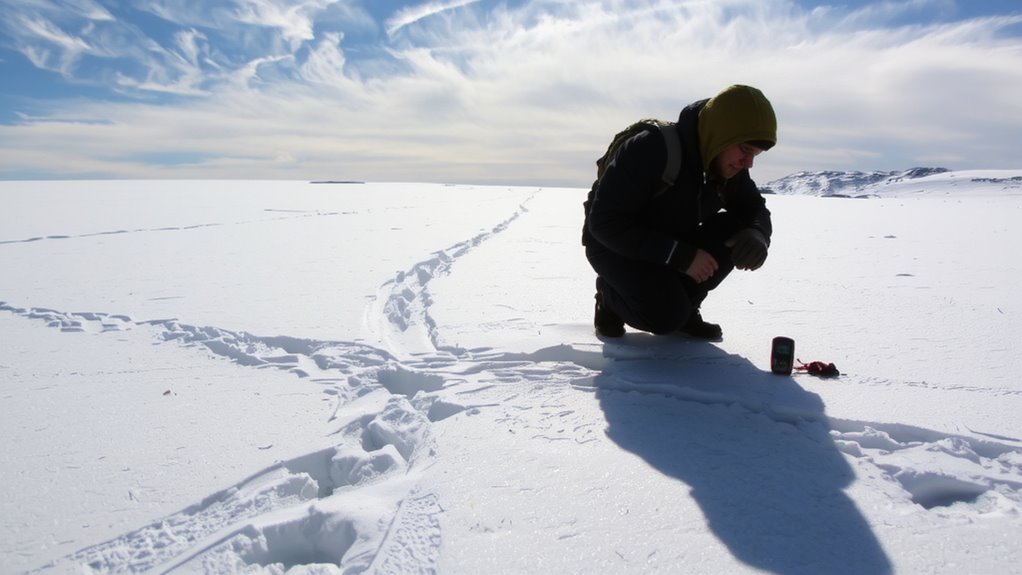
You’ll want to mark key route points as waypoints to guarantee you stay on track across featureless terrain-use your GPS to save positions like the snowfield’s edge, a safe traverse line, or your exit point, since visual cues often vanish in whiteout conditions. Aim for high waypoint accuracy by confirming each location with a strong satellite signal; accuracy within 3–5 meters is typical with a clear view of the sky. Mark multiple points along your route to build route redundancy, so if one waypoint is missed or conditions shift, you have backup references. Don’t rely on just one or two points-spacing them every 200–500 meters improves navigation confidence. Save them with clear names, like “SNOW-EDGE” or “TRAV-LINE,” so they’re easy to identify under stress. Tested in alpine environments, this method reduces navigation errors by up to 70% compared to visual estimates alone.
Steer by Bearing in Whiteout Conditions
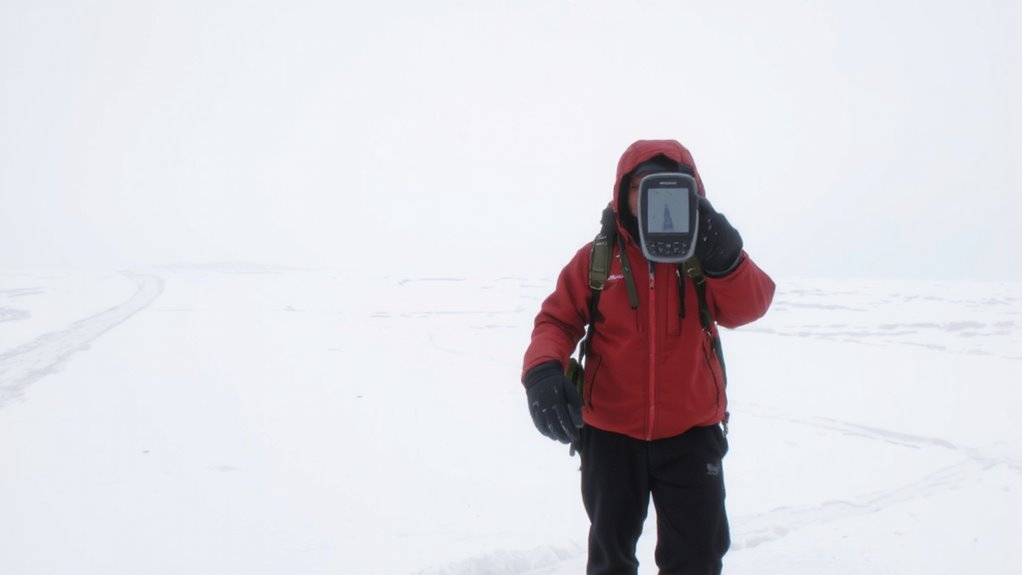
When visibility drops to near zero in a whiteout, relying on sight to stay on course isn’t an option-your GPS becomes the only reliable tool for maintaining direction. You must set your GPS to display true bearing and account for magnetic declination, or you’ll drift off route without realizing it. Most modern units allow you to adjust declination automatically, but verify the local value before you start. Use the bearing lock feature to follow a steady heading, not just a path between waypoints. Keep the GPS positioned to avoid signal interference from metal gear or electronics. Cold reduces battery life, so carry spares in an insulated pocket. Refresh your position every few minutes to confirm consistency. If the GPS signal drops, stop and reassess-guessing your direction risks serious navigation errors. Stay on bearing, stay safe.
Watch for Drift and Correct Early
Even with a steady bearing locked in, your actual path can still veer off over snowfields due to slope angle, foot placement, or subtle changes in visibility. You’ll need to watch for drift constantly-small deviations add up fast. Snow accumulation alters surface firmness, affecting your stride and pulling you off course without notice. Check your GPS position every 100 meters to see if lateral movement is occurring. Poor terrain visibility intensifies the risk, especially in flat-light or shallow fog, where visual references vanish. Relying solely on memory or feel isn’t reliable. Correct early, before the error exceeds 10 degrees off bearing. A quick adjustment now prevents a much longer backtrack later. Small course corrections every few minutes keep you aligned with minimal effort. Let the GPS guide incremental shifts-don’t wait until you’re clearly off. Early correction saves time, energy, and reduces exposure to hazards hidden beneath snow accumulation or masked by weak terrain visibility.
Conserve Battery and Plan for Backup
Most GPS units last 10 to 20 hours on a full charge, but cold temperatures can cut that time by half-so battery life is something you’ve got to manage carefully. Enable power management features like auto power-off and reduced screen brightness to extend runtime. Avoid constantly checking signal strength; instead, sample every few minutes to save juice. Carry spare lithium batteries-they perform better than alkalines in the cold. Always bring a paper map and compass as backup. Consider carrying a lightweight affordable headlamp for emergency illumination if conditions deteriorate after dark.
On a final note
You’ll rely on your GPS to hold course when landmarks vanish. Set bearings ahead of time and mark critical waypoints like crevasses or route changes. In whiteouts, follow the bearing closely but check for lateral drift every few minutes-small corrections prevent big errors. Battery life matters; expect 10–12 hours from standard AA lithium cells. Always carry a map and compass as backup-they don’t run out of power.