Why Satellite Messaging Devices Are Essential for Arctic Expedition Safety
You need a satellite messenger in the Arctic because cell networks don’t exist there, and terrain blocks most signals. These devices connect directly to satellites, so they work across ice fields, ridgelines, and storms. They send GPS coordinates, emergency SOS alerts, and weather updates-even with limited sky view. Battery life lasts days in extreme cold, and models tested for fast signal acquisition (<2 min) and GPS lock (90 sec) guarantee reliability. Real-world rescues prove they save lives when every minute counts-knowing how to use one could be your critical edge.
Notable Insights
- Satellite messaging works in the Arctic where cell networks are absent due to lack of ground towers.
- Devices connect directly to low-orbit satellites, ensuring reliable communication in remote ice fields and behind ridgelines.
- GPS location sharing enables real-time tracking and precise coordinates for rescue teams during emergencies.
- Emergency SOS features send immediate alerts with exact location to global response networks within minutes.
- Devices provide critical weather alerts and operate reliably in extreme cold with extended battery life.
Why Satellite Messaging Is Critical in the Arctic
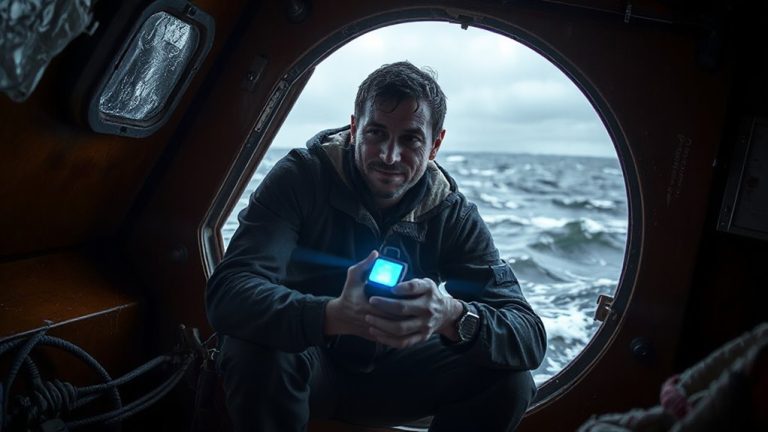
How do you call for help when there’s no cell signal for hundreds of miles? In the Arctic, you rely on satellite messaging because cell networks don’t exist there. Signal reliability depends on satellite coverage, not ground towers, so your device works where phones fail. Terrain challenges like ice fields, ridgelines, and polar storms block signals, but satellites in low orbit maintain connections where others drop. These devices use robust protocols to send short messages even with partial sky view. You won’t stream data, but you can transmit GPS coordinates and emergency alerts. Battery life lasts days, not hours, under real cold-weather use. They’re small, durable, and tested in extreme conditions. Choosing one isn’t about features-it’s about survival. Without satellite messaging, you’re on your own. With it, help can still reach you, even in the most remote zones.
How Satellite Messaging Beats Cell Networks in Polar Regions
Even if you’ve got the latest smartphone, it won’t do you any good above the Arctic Circle-cell networks simply don’t reach that far, leaving you without communication when you need it most. Satellite messaging devices, on the other hand, offer signal reliability and network independence critical in extreme conditions.
| Feature | Cell Networks |
|---|---|
| Coverage | Limited to populated |
| Signal reliability | Unstable, inconsistent |
| Network independence | Dependent on towers |
| Polar operation | Not functional |
| Battery efficiency | Lower due to searching |
These devices bypass infrastructure, connecting directly to satellites. You get reliable message delivery regardless of ground-based outages or terrain blockage. While not as fast as urban networks, they deliver essential comms where lives depend on them. That’s real network independence.
Share Your GPS Location to Stay Found in Remote Areas
When you’re traveling in the Arctic, sharing your GPS location regularly can make the difference between a close call and a crisis, since rescue teams rely on precise coordinates to reach you quickly. Location tracking guarantees someone always knows your position, even when you’re out of sight. Most satellite messengers update your location automatically at set intervals, using satellites instead of cell towers. This works across ice fields, fjords, and mountain ranges where traditional networks fail. Route sharing lets your team or family monitor your progress in real time, spotting delays or deviations early. It doesn’t require constant messaging-just periodic pings. Devices with GPS logging store your path, which helps if signal is lost. Some models offer customizable tracking intervals from 5 to 60 minutes, balancing battery life and monitoring needs. In whiteout conditions or sudden storms, consistent location tracking means help knows exactly where to look.
Send an SOS: Emergency Alerts That Save Lives
If you’re in trouble and can’t wait for a rescue that might take hours or days to coordinate, activating an SOS on a satellite messenger gets your emergency signal to response teams within minutes. These devices use global satellite networks to transmit your exact GPS coordinates, streamlining rescue coordination even in the most remote Arctic zones. Unlike cell phones, they work beyond coverage areas, ensuring help is reachable when traditional communication fails. Most models require holding the SOS button for several seconds to prevent false alarms, a necessary safeguard given the high cost and effort of mounting rescues. Some devices include confirmation screens or secondary checks to further reduce accidental triggers. Though false alarms strain resources, proper training and device familiarity minimize risks. Units like the Garmin inReach and Zoleo support two-way messaging during emergencies, letting you provide updates and receive instructions. In extreme environments, reliable SOS capability isn’t a luxury-it’s a critical layer of survival planning backed by real-world response data.
Get Real-Time Weather Alerts in the Arctic
Why wait for changing conditions to catch you off guard in the Arctic, where weather shifts can turn survivable situations into life-threatening ones in hours? With satellite messaging devices, you receive real-time updates on Arctic climate patterns, letting you adjust routes or shelter plans before storms hit. These alerts are powered by accurate polar weather forecasting systems that track temperature drops, wind speed, and pressure changes specific to high latitudes.
| Feature | Benefit |
|---|---|
| Live weather alerts | Avoid sudden blizzards |
| Forecast updates every 3 hours | Stay ahead of Arctic climate patterns |
| Wind chill warnings | Prevent frostbite exposure |
| Integrated with GPS | Match forecasts to your exact location |
You won’t always get cell service, but polar weather forecasting via satellite is reliable when you need it most.
Choose the Best Satellite Device for Polar Expeditions
Though all satellite messengers work in theory, not all perform equally under the extreme cold and limited visibility of polar regions, so picking the right one matters. You need proven device durability to survive sub-zero temperatures, ice exposure, and rugged handling. Look for housings rated to at least -30°C and models tested in Arctic conditions. Battery efficiency is just as critical-lithium batteries typically perform best in cold, but runtime varies widely. Some devices lose charge fast when temperatures drop, cutting your communication window. Check real-world tests: a device claiming 200 hours may only deliver 80 in polar cold. Garmin inReach and Zoleo support global coverage with reliable two-way messaging, while battery-swap options add flexibility. Prioritize devices with low power modes and efficient signal acquisition. Choose based on verified specs, not promises.
Test Your Satellite Messenger Before You Deploy
Once you’ve picked your satellite messenger, don’t assume it’s ready for the Arctic-devices can fail even when new. You need to confirm function through device calibration and real-world signal testing before deployment. Cold affects batteries and components, so check performance in conditions similar to those you’ll face. Power on the unit, establish a satellite link, and send a test message. Verify GPS acquisition and tracking accuracy. Below are key checks:
| Test Type | Recommended Outcome |
|---|---|
| Device calibration | Internal sensors aligned |
| Signal testing | Message sent in <2 minutes |
| GPS lock | Achieved within 90 seconds |
Failure in any step means troubleshooting or replacement. Don’t cut corners-your safety depends on reliable communication. Test early, test often, and guarantee compatibility with rescue networks. A working device today beats a paperweight tomorrow.
On a final note
You need a satellite messenger in the Arctic because cell networks don’t reach there. These devices send GPS locations and SOS alerts reliably, even in extreme cold. They pull real-time weather data, helping you avoid storms. Models like the Garmin inReach Mini 2 work globally, with Iridium coverage. Battery life lasts days, but cold reduces it. Test your device before departure-functionality is non-negotiable when survival’s on the line.