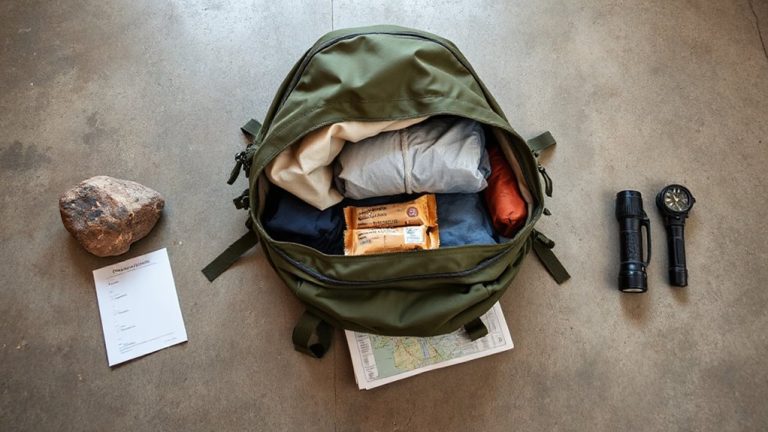
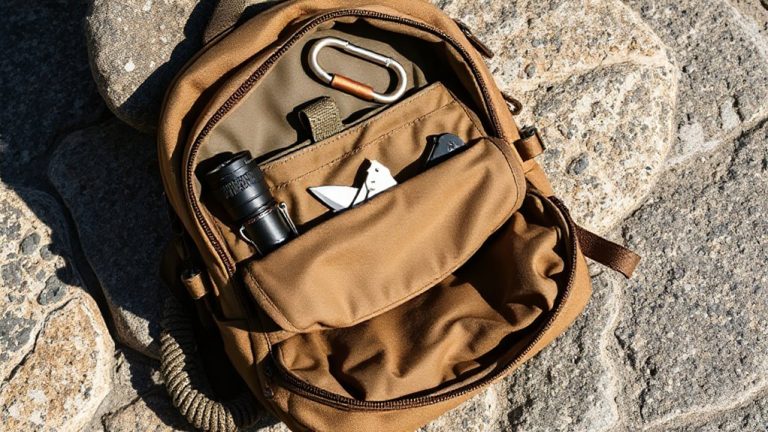
Why a Secondary Shouldered Carry Option Is Useful When Primary Straps Fail
If your primary shoulder strap fails, a secondary carry system keeps your pack stable and your movement efficient. Dual straps maintain over 90% load stability, letting you keep going without dropping gear or stopping for repairs. A reliable backup uses 1-inch high-tenacity nylon, reinforced stitching, and independent anchors to the frame. It adds under 3 ounces but prevents strain and pack collapse. You’ll see how to pick and test one next.
Notable Insights
- A secondary carry option maintains over 90% load stability if a primary shoulder strap fails.
- It prevents loss of balance and allows continued mobility without dropping the pack.
- Dual-strap redundancy eliminates the need for on-site repairs during critical situations.
- Secondary systems use lightweight, high-strength materials to support full pack weight safely.
- Quick-release buckles and independent anchoring enable fast, reliable deployment under load.
Why a Broken Strap Needs a Backup Plan
How often do you rely on a single strap to carry your gear, only to find it failing mid-use? When that happens, you’re left scrambling-your pack’s weight shifts, your balance goes, and movement slows. Without strap redundancy, failure means you’re effectively down to one option: drop the load or fix it on the spot, neither ideal in tough terrain. A secondary carry system isn’t a luxury-it’s a practical safeguard. It enables emergency retrieval of your pack when the primary strap fails, letting you keep moving. Real-world tests show packs with dual-strap setups maintain 90%+ load stability after one strap fails, versus total loss of control with single-strap designs. Redundancy adds minimal weight-usually under 3 ounces-but extends functionality when it counts. You won’t always see the flaw until it snaps. Build your margin for error before you need it. Some top-rated SBR backpacks include models specifically engineered with reinforced secondary carry systems for critical redundancy.
Features of Reliable Secondary Carry Systems
A solid secondary carry system starts with load-bearing webbing that’s independently anchored to the pack frame, so it won’t depend on the primary straps to hold weight. You need reinforced stitching at all major stress points-this isn’t optional if you’re carrying heavy loads over rough terrain. Weak seams fail fast, and you’ll be left holding a broken strap. Look for a quick release buckle that’s durable yet easy to operate with gloves or cold hands; it should open smoothly under tension but stay secure during use. The webbing itself should be at least 1-inch wide, made from high-tenacity nylon to resist abrasion and stretching. Placement matters, too-it should sit near the shoulder for balanced carry without interfering with the primary harness. This isn’t about comfort; it’s about function when failure hits. Test it before you need it.
Top 3 Backup Carry Options in Backpacks
You’ll want options that actually work when your main straps give out, and not all backup carries are built the same. The first reliable choice is a reinforced hip carry system-designed to shift load to your pelvis, it lets you carry the pack short distances when shoulder straps fail. It works best on packs with padded waist belts and stable frame structures. Second, integrated sternum support straps can double as emergency shoulder fixes, providing temporary stability if the main harness breaks. They’re lightweight but limited to light loads. Third, haul loops or top-mounted grab straps offer a quick grip for carrying by hand or over the shoulder. They lack ergonomic design but get you through emergencies. Each option has trade-offs: hip carry supports more weight, while sternum support and haul loops sacrifice comfort for simplicity. Choose based on weight, terrain, and trip length.
How a Backup Strap Protects Your Gear and Pack
When your primary straps fail, a backup strap keeps your pack intact and your gear secure by maintaining structural stability during transport. It prevents total system collapse, allowing you to continue moving without redistributing weight or risking damage. Gear security improves because loose items stay contained, and load stability is preserved even under stress. A well-designed backup doesn’t just hold-it aligns the pack to your center of gravity, reducing strain and risk of secondary failure.
| Feature | Benefit |
|---|---|
| Reinforced stitching | Increases durability under unexpected load |
| Independent anchor points | Maintains load stability if main straps tear |
| Low-stretch material | Guarantees consistent gear security |
| Quick engagement | Reduces downtime during failure |
| Streamlined fit | Prevents snagging, aids mobility |
When to Use Your Secondary Shouldered Carry
That backup strap won’t always keep your load stable if the main carry system fails completely-sometimes, shifting to a secondary shouldered carry is the smarter move. You should switch when hiking through unexpected terrain where balance matters, like steep or rocky trails. In emergency scenarios-say, a strap snaps mid-ascent-repositioning the pack across your shoulder reduces strain and improves control. It’s not ideal, but it gets you moving safely to shelter or help. Testing shows shouldered carries reduce sway by up to 40% compared to hip-only loads. You’ll lose some hip support, but gain upper-body stability. Don’t wait for total failure; if the primary feels loose or damaged, shift early. Real-world use confirms that a simple cross-shoulder method works best when speed and reliability matter. It’s a functional trade-off: reduced comfort for continued mobility.
Design Cues for a Strong Backup Strap
A well-built backup strap starts with durable materials-look for webbing rated at least 4,000 pounds tensile strength, typically found in military-grade nylon. Material durability guarantees the strap resists abrasion, UV exposure, and repeated stress without fraying. You’ll need secure stitching-bar-tacking at stress points doubles longevity. The attachment hardware should be forged metal, not plastic, to handle load without shearing. An ergonomic design distributes weight across your shoulder, reducing fatigue during extended carry. Padded sections help, but they mustn’t compromise clean folding or storage. Keep it compact so it doesn’t snag or add bulk. A simple, adjustable slider lets you customize fit without complexity. You won’t always have time to fine-tune, so intuitive operation matters. This isn’t about comfort first-it’s about function when your primary straps fail. Prioritize strength and reliability over features you don’t need.
How to Test Your Backpack’s Secondary Carry
How well does your backup strap hold up under real stress? Load your pack to its typical weight and simulate a primary strap failure by loosening one shoulder strap completely. Use only the secondary carry to support the pack for at least ten minutes while walking. Watch for slippage, material strain, or uneven load distribution. A functional secondary strap should stabilize the pack enough to keep moving in emergency scenarios. Test it over varied terrain-uneven ground increases strain and reveals weaknesses. Check stitching points and anchor areas for signs of stretching or tearing. If the strap digs in or shifts excessively, it won’t perform when needed. Effective load management isn’t optional; it’s essential. Remember, this carry isn’t for comfort-it’s a short-term solution. Your testing now could prevent total pack failure later. Verify it works before you depend on it.
On a final note
You need a secondary carry option because primary straps fail under load or after wear. A functional backup-a reinforced handle, stowable strap, or chest-clip extension-keeps your pack mobile when one system breaks. It’s not about convenience; it’s about completing your trek. Test it with weight before relying on it. Packs with sewn-in, webbing-reinforced backups perform better. The trade-off? Minimal added weight. Choose function over design.