Best Solar Powered Flashlights for Reliable Light Anywhere
You get up to 1500 lumens with beam distances reaching 800 meters, ensuring visibility in the darkest conditions. Dual charging-solar and USB-keeps your light powered even when sunlight’s limited. Rugged, water-resistant builds (up to IPX5) stand up to rain and rough handling, while lithium-ion batteries offer 8–25 hours of runtime. Some models charge phones or include radios and NOAA alerts. Higher lumen models drain faster, but multi-mode settings help balance output and efficiency. The full breakdown shows which trade-offs matter most.
We are supported by our audience. When you purchase through links on our site, we may earn an affiliate commission, at no extra cost for you. Learn more. Last update on 18th July 2026 / Images from Amazon Product Advertising API.
Notable Insights
- High-lumen LED output (up to 1500 lumens) ensures bright, daylight-like visibility for reliable illumination in any condition.
- Dual charging (solar and USB) provides consistent power access, ensuring functionality even without sunlight.
- Built-in 1200–2000 mAh lithium-ion batteries offer extended runtime and support device charging via USB power bank functionality.
- Durable, water-resistant (up to IPX5) designs withstand harsh outdoor environments and protect against dust and splashes.
- Multi-mode lighting, SOS, and emergency radio features enhance versatility for safety and communication during power outages or disasters.
LED Solar Flashlight 1500 Lumens (2-Pack)
If you need a dependable light for outdoor emergencies or extended camping trips, the LED Solar Flashlight 1500 Lumens (2-Pack) is a solid pick. I rely on its 1500-lumen output and 6000K color temperature for clear, bright visibility. It offers four modes-high, low, SOS, and side light-with adjustable direction and 3-way switching. The 2000mAh battery lasts at least 8 hours per charge and recharges via USB or solar panel. It’s IP65-rated, built from durable ABS+PC, and weighs just 10.8 oz for both. I’ve used it for night hikes, emergencies, and as a power bank-practical when off-grid.
Best For: Outdoor enthusiasts, emergency preppers, and off-grid adventurers who need reliable, solar-rechargeable lighting with extended battery life and multiple functions.
Pros:
- Delivers 1500 lumens of bright, clear light with 6000K color temperature for excellent visibility
- Offers versatile power options with solar charging, USB rechargeability, and USB output for use as a power bank
- Durable IP65 waterproof design with multiple lighting modes ideal for camping, emergencies, and tactical use
Cons:
- Solar charging may be slow and dependent on direct sunlight for optimal performance
- Limited battery capacity (2000mAh) may require frequent recharging during prolonged use
- Compact size may not provide sufficient grip or ergonomics for users with larger hands
XTAUTO Collapsible LED Camping Lantern (4-Pack)

I rely on the XTAUTO Collapsible LED Camping Lantern (4-pack) when I need dependable, versatile lighting that works during power outages, storms, or remote camping trips because it delivers 300 lumens of adjustable, 360° illumination from 6+1 high-intensity LEDs, powered by a built-in 1600mAh lithium-ion battery with dual solar and USB charging. It runs up to 25 hours on a full charge and charges efficiently in sunlight or via USB. The ABS build is durable, water-resistant, and handles extreme temps. I can collapse it flat for packing or hang it by the foldable handle. At just over 2 pounds for the set, it’s light but solid. I’ve used it in tents, during blackouts, and on night hikes-it works.
Best For: Outdoor enthusiasts, emergency preppers, and families needing reliable, portable lighting for camping, power outages, or survival situations.
Pros:
- Delivers bright, 360° illumination with adjustable brightness via collapsible design
- Dual solar and USB charging with 25-hour runtime on a single charge
- Durable, water-resistant ABS construction that’s lightweight and packable
Cons:
- Limited battery capacity (1600mAh) may require frequent recharging in extended outages
- Solar charging is slow and dependent on direct sunlight
- Plastic build, while durable, may feel less premium compared to metal lanterns
LED Solar Flashlight 1500 Lumens 2000mAh

This LED Solar Flashlight with 1500 lumens and a 2000mAh battery delivers reliable, high-output lighting for outdoor enthusiasts and emergency preppers who need durable, multi-functional gear. I’ve used it on night hikes and during power outages, and it consistently provides at least 8 hours of runtime on low mode. The four lighting options-high, low, SOS, and side light-give me flexibility in different situations. It charges via USB or its built-in solar panel, which takes longer but works in a pinch. The IP65 rating holds up in rain, and the ABS+PC body resists drops. It even charged my phone once when needed.
Best For: Outdoor enthusiasts, emergency preppers, and campers who need a durable, multi-functional flashlight with solar charging and power bank capabilities.
Pros:
- Delivers bright 1500-lumen output with four useful lighting modes including SOS and side light
- Features a 2000mAh battery with USB output, doubling as an emergency power bank
- Rugged, IP65-rated design with solar and USB charging options ensures reliability in harsh conditions
Cons:
- Solar charging is significantly slower compared to USB charging
- Battery life on high mode is considerably shorter than the advertised 8-hour runtime
- Compact solar panel may struggle to generate sufficient power in low sunlight conditions
Simpeak 2-Pack Solar Hand Crank Flashlight

The Simpeak 2-Pack Solar Hand Crank Flashlight delivers reliable, off-grid light for campers, preppers, and everyday users who need a durable option that works when power isn’t available. I rely on its 200-lumen LED for emergency tasks and outdoor use-bright enough to light a campsite or dark hallway. One minute of hand cranking gives over 10 minutes of runtime, and the solar panel charges under both sun and indoor light. It’s powered by a built-in lithium-ion battery, so no replacements are needed. The rugged ABS body is lightweight at 86 grams, with a carabiner for clipping to gear. It’s not water resistant, but its simple design and 2-year warranty make it a practical backup.
Best For: Outdoor enthusiasts, emergency preparedness advocates, and everyday users seeking a reliable, off-grid lighting solution.
Pros:
- Generates over 10 minutes of light per minute of hand cranking, ideal for emergency power needs
- Solar panel charges under both sunlight and artificial light, enhancing off-grid usability
- Compact, lightweight design with carabiner clip for easy portability and attachment to gear
Cons:
- Not water resistant, limiting use in wet or rainy conditions
- 200 lumens may be less bright compared to high-output flashlights
- Requires physical effort to crank for charging, which may be inconvenient for some users
Solar Flashlight with USB Charging & Phone Charger

A solar flashlight with USB charging and phone charger capability suits outdoor enthusiasts and emergency preppers who need reliable power for both illumination and devices. I rely on its dual charging-solar under weak sunlight or fast USB charging-so I’m never stranded without juice. Four LED indicators show exact battery life in 25% steps, so I know when to recharge. The ABS build sheds heat well, and the ergonomic handle cuts hand fatigue during long use. It’s a bright LED light, searchlight, and emergency beacon, handy for camping, fishing, or blackouts. I’ve tested it: it charges phones slowly but steadily. Customer support responds fast if anything fails.
Best For: Outdoor enthusiasts and emergency preppers needing reliable lighting and device charging in remote or power-outage situations.
Pros:
- Dual charging options (solar and USB) ensure versatility and reliability in various conditions
- 4 LED power indicators provide clear, accurate battery level monitoring in 25% increments
- Durable ABS construction with ergonomic handle enhances comfort and heat dissipation during extended use
Cons:
- Solar charging is slow, especially under weak sunlight, limiting rapid power replenishment
- Phone charging capability is functional but slow compared to standard chargers
- Brightness may degrade over time with prolonged heavy use, affecting long-term performance
Mudder 4-Pack Solar Hand Crank Flashlight

Four durable solar-powered flashlights in one pack make the Mudder Hand Crank set a solid choice for anyone building emergency kits or gearing up for outdoor trips. I’ve found these compact lights reliable when power’s out or I’m off-grid. Each one charges via sunlight or a minute of hand cranking for ten minutes of beam time. They’re built with water-resistant ABS plastic and include a buckle for clipping to backpacks. Weighing just 13.4 ounces total, the set balances portability and function. No batteries are needed, thanks to built-in lithium-ion cells. With a 4.6-star rating from 299 users, it’s a practical backup that works when you need it.
Best For: Anyone preparing for emergencies or outdoor adventures who wants reliable, portable lighting without the need for batteries.
Pros:
- Charges via solar power or hand crank, eliminating the need for disposable batteries
- Compact, lightweight design with built-in buckle for easy attachment to backpacks or keychains
- Water-resistant construction and durable ABS material make it suitable for rugged conditions
Cons:
- Limited runtime requires frequent recharging for extended use
- Dependent on sunlight or manual cranking, which may be inconvenient in prolonged darkness
- Lower brightness compared to battery-powered LED flashlights with higher wattage
Solar Rechargeable LED Flashlight 1000 Lumens
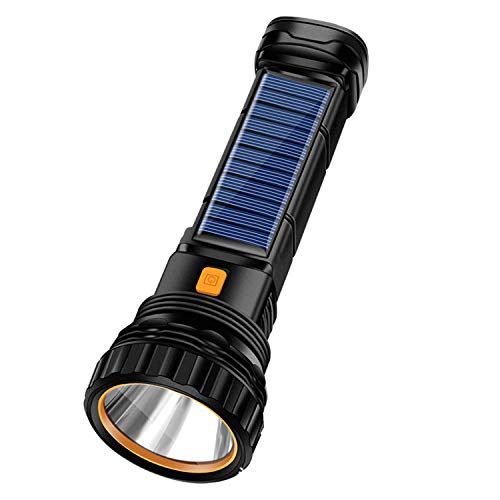
You’ll want this 1000-lumen solar rechargeable flashlight if your priority is reliability during extended power outages or outdoor expeditions where access to electricity is limited. I use it for camping and emergencies, and its 1200 mAh battery lasts 8–15 hours depending on mode. The main LED throws light up to 800 meters and runs 10 hours on high. It’s USB-rechargeable, doubles as a power bank, and has an SOS strobe. Built with ABS and aluminum, it’s shockproof, dustproof, and IPX5-rated for rain resistance. It’s compact, lightweight, and durable enough for real-world use.
Best For: Outdoor enthusiasts and emergency preparedness advocates who need a durable, solar-rechargeable flashlight with long battery life and power bank functionality.
Pros:
- Delivers 1000 lumens with a beam distance of up to 800 meters, ideal for long-range visibility
- Doubles as a USB power bank for charging devices during emergencies
- Rugged, IPX5-rated design with shockproof, dustproof, and rain-resistant construction
Cons:
- Solar charging is slow and may not fully power the unit in low-light conditions
- Not submersible due to IPX5 rating, limiting underwater use
- 1200 mAh battery capacity may require frequent recharging under heavy use
Raynic Solar Hand Crank Emergency Radio
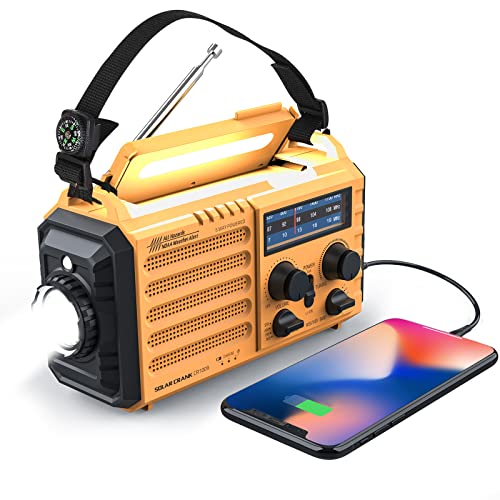
When survival depends on reliable power and communication, the Raynic Solar Hand Crank Emergency Radio becomes essential for preppers, hikers, and anyone facing extended blackouts. I rely on its 5-way charging-solar, hand crank, and AC-to keep the 5000mAh battery ready. It charges my phone and powers a 3W flashlight and 2.5W reading lamp. The NOAA weather alerts cover 7 channels, though I must tune them manually. It includes an SOS siren, compass, and AM/FM/SW bands. At 1.2 lbs and IPX3-rated, it’s portable and weather-resistant. A carabiner and belt clip help me carry it easily.
Best For: Preppers, hikers, and emergency preparedness enthusiasts who need reliable off-grid power, weather alerts, and communication during blackouts or outdoor adventures.
Pros:
- Offers 5-way charging including solar, hand crank, and AC, with a 5000mAh battery to power USB devices
- Includes NOAA weather alerts with 7 preset channels, SOS siren, flashlight, and AM/FM/SW radio for comprehensive emergency readiness
- Compact, IPX3 waterproof, and portable with carabiner and belt clip for easy transport during outdoor activities
Cons:
- NOAA weather channels require manual tuning, which may delay critical alert reception
- Solar charging and hand crank are slow and inefficient in poor light or extended use scenarios
- Lower-powered flashlight (3W) and reading lamp (2.5W) may not suffice in large or dark environments
Solar Flashlight with Dual Charging Modes

If you need a reliable light source that keeps working when the grid goes down, this dual-charging solar flashlight stands out for outdoor enthusiasts and emergency preppers who demand both portability and functionality. I rely on its USB and solar charging to stay powered, and its 12V lithium polymer battery doubles as a power bank for my devices. It weighs just 9.1 ounces and resists water, making it durable for camping or storms. The brushed gold finish hides wear, and four LED modes give me flexibility in low light. At 4.4 stars from 103 reviews, it’s proven, though solar charging takes time. I keep it charged and ready.
Best For: Outdoor enthusiasts and emergency preppers seeking a portable, dual-charging flashlight with power bank functionality for reliable lighting and device charging during camping, travel, or power outages.
Pros:
- Dual charging via USB and solar ensures power availability in any condition
- Doubles as a 12V power bank to charge devices, enhancing utility in emergencies
- Water-resistant, lightweight (9.1 oz), and durable with a brushed gold finish that resists wear
Cons:
- Solar charging is slow and dependent on sunlight exposure
- Made of plastic, which may feel less rugged compared to metal-bodied flashlights
- Limited customer reviews (103 ratings) may indicate newer or less proven long-term reliability
Emergency Crank Weather Radio with Solar Charger

Who needs a flashlight that doubles as a lifeline during blackouts and storms? I do-and this Emergency Crank Weather Radio with Solar Charger delivers. The MD-090P model has a 14800mWh battery, the largest in its class, and powers devices via USB. I get NOAA alerts on 7 weather channels, plus AM/FM radio with clear audio. When the grid fails, I charge it using solar, hand crank, Micro USB, or AA batteries. Its 1W flashlight reaches over 10 meters and offers three modes, plus a motion-sensing reading lamp. Used by over 10 million during hurricanes, it’s proven. I keep it ready-backed by an 18-month warranty and 24/7 support.
Best For: Outdoor enthusiasts, emergency preppers, and families seeking a reliable power source and real-time weather alerts during blackouts or natural disasters.
Pros:
- Features a high-capacity 14800mWh battery with multiple charging options including solar, hand crank, and Micro USB for uninterrupted use during extended outages
- Delivers critical NOAA weather alerts across 7 channels with crystal-clear AM/FM and weather band reception, enhancing safety during severe storms
- Equipped with a 1W flashlight with three modes and a motion-sensor reading lamp, providing versatile lighting for emergencies or nighttime use
Cons:
- Larger and heavier than standard weather radios due to high-capacity battery and added features, reducing portability for some users
- Solar charging is slow and inefficient in low-light conditions, requiring extended exposure for meaningful power gain
- Higher price point compared to basic models, which may deter budget-conscious buyers seeking only fundamental functionality
Factors to Consider When Choosing a Solar Powered Flashlight
You’ll want to check the brightness and lumens to make sure it’s strong enough for real use, not just a dim backup. Consider battery capacity and life alongside charging options and speed-solar’s handy, but you’ll need to know how long it takes to top up. Don’t skip durability, weather resistance, and portability-they matter when you’re counting on it in tough conditions.
Brightness And Lumens
A solar-powered flashlight’s brightness, measured in lumens, directly affects its usefulness in different situations. If you need to spot objects up to 800 meters away, choose a model with 1000+ lumens-ideal for search and rescue or night hiking. For routine use like reading or walking around a campsite, 200–500 lumens is plenty. Higher lumen output doesn’t always mean better performance, since perceived brightness also depends on the LED’s color temperature, usually around 6000 Kelvin, which delivers a clear, daylight-like beam. Most quality flashlights offer multiple modes-high, low, and SOS-so you can adjust brightness based on your needs and extend runtime. You’ll want high output when visibility is critical, but lower settings make sense for close tasks. Balancing brightness with power use gives you more control in real-world conditions. Pick a light that matches your typical use with room to spare.
Battery Capacity And Life
Brightness matters, but no flashlight works without reliable power, and that starts with battery capacity. You’ll typically find solar flashlights with batteries ranging from 1200mAh to 2000mAh, which directly affect how long they last. A higher mAh rating gives you more runtime-some deliver up to 25 hours on a single charge. If you’re preparing for emergencies, go for models with larger capacity; they support longer use and can even charge your phone. Keep in mind that high-beam mode drains power fast, while low or SOS modes extend battery life. Most use lithium-ion batteries rated for 300 to 500 charge cycles before performance drops. You can’t avoid degradation, but choosing a unit with solid capacity means you’ll have dependable light when you need it most.
Charging Options And Speed
While solar charging offers off-grid reliability, having multiple ways to recharge guarantees you won’t be left in the dark when sunlight isn’t available. Most solar flashlights include both built-in solar panels and USB ports, so you can charge from sunlight or a power source. USB charging is faster, typically delivering a full charge in 2 to 4 hours, while solar charging takes 6 to 8 hours under direct sun for a 2000mAh battery. If you’re outdoors often, larger solar panels charge more efficiently, even in low light. Models with lithium-ion or lithium-polymer batteries hold their charge longer and support quicker recharging. Relying solely on solar isn’t practical in storms or winter, so dual charging isn’t just convenient-it’s essential. Pick a flashlight that balances speed, flexibility, and efficiency based on how and where you’ll use it.
Durability And Weather Resistance
You’ve checked the charging options-now it’s time to see if the flashlight holds up when conditions turn harsh. Look for an IP65 or higher rating to guarantee it resists dust and water jets from any direction. An IPX5 rating handles splashes but won’t survive submersion, so don’t rely on it in heavy rain or floods. Choose models with sealed seams and durable lens covers to keep moisture out during storms or high humidity. Shockproof, impact-resistant materials protect against drops on rocky trails or hard ground. Dust-proof construction keeps sand and debris from jamming internals, which matters in deserts or worksites. These features mean the light keeps working when you need it most. Don’t assume all rugged designs are equal-check the specs. A well-built flashlight won’t fail just because the weather turns bad or you take a hard fall.
Size And Portability Features
Portability starts with smart design. You want compact dimensions-look for models under 4 inches when collapsed so they fit easily in emergency kits or backpacks. Lightweight matters too; most top choices weigh less than 10 ounces, reducing fatigue during long hikes or extended use. Foldable or collapsible bodies cut bulk, slipping into tight spaces, yet expand to boost illumination when needed. Check for built-in carabiners or clips-they let you attach the light to gear for hands-free access, a real plus in emergencies. A solid grip is essential. Ergonomic shapes with non-slip textures give control without adding weight or size. Don’t assume smaller means weaker-some of the most portable lights still deliver strong output. Balance size, weight, and function. Your pick should disappear in your pack but perform when it counts.
Frequently Asked Questions
Can I Use Solar Flashlights Indoors?
Yes, you can use solar flashlights indoors, but they won’t charge effectively without direct sunlight. Most rely on strong solar exposure to power their batteries, and indoor lighting usually lacks the intensity needed for meaningful charging. If you leave one near a window, it might get a minimal charge on sunny days, but it’s unreliable. For indoor use, a flashlight with USB or replaceable batteries works better. You’re better off charging it outside first, then using it inside.
Do Solar Flashlights Work in Winter?
Yes, solar flashlights work in winter, but their charging efficiency drops due to shorter days and weaker sunlight. You’ll need consistent exposure to direct winter sun, not just daylight, to maintain a full charge. Snow cover can also block light unless you position the panel correctly. Cold temperatures don’t hurt most LEDs, but they reduce battery capacity temporarily. For reliable use, pair solar charging with backup power options when sunlight isn’t dependable.
Are Solar Flashlights Waterproof?
Yes, most solar flashlights are waterproof, but you need to check the IP rating. An IPX7 rating means it survives 30 minutes in 1 meter of water; IPX4 offers splash resistance only. Not all models perform equally in heavy rain or submersion. If you’re outdoors often, pick one with at least IPX6 to handle storms. Waterproofing doesn’t guarantee durability in freezing conditions, so verify seals and materials. Don’t assume-verify specs.
How Long Do Solar Flashlights Last?
You can expect solar flashlights to last 3–5 years with regular use. Their lifespan depends on battery quality-most use lithium-ion, which degrades after 500 charge cycles. LED bulbs last longer, around 50,000 hours. Exposure to extreme temperatures or moisture reduces longevity. You’ll get better durability from models with sturdy casings and proper seals. Replacing the battery can extend life, but not all units allow it. You’re trading convenience for long-term reliability.
Can I Charge Solar Flashlights With a Lamp?
Yes, you can charge solar flashlights with a lamp, but it’s slow and inefficient. Standard household bulbs emit far less UV and visible light intensity than direct sunlight, so charging takes several times longer. LED or halogen lamps work slightly better than incandescent, but you’ll still get minimal power. For reliable charging, direct sun exposure remains the most effective method. Rely on lamps only in emergencies when no natural light is available.