Best Survival Bushcraft Knives for Outdoor Enthusiasts
You need a durable, full-tang knife with a blade between 4.1 and 5.3 inches for reliable performance in tough conditions. Models like the Gerber Ultimate and BeaverCraft BSH4F use carbon or stainless steel, balancing edge retention and rust resistance, while scandi or compound grinds support precise cutting or heavy tasks. Textured handles and secure sheaths with ferro rods add real utility in wet or cold environments. Weight ranges from 10 to 17 oz, affecting control and endurance. Trade-offs in steel, thickness, and maintenance matter most. Each model’s design reveals its true role in survival situations.
We are supported by our audience. When you purchase through links on our site, we may earn an affiliate commission, at no extra cost for you. Learn more. Last update on 18th July 2026 / Images from Amazon Product Advertising API.
Notable Insights
- Full tang construction with durable steel like 1066 carbon or Sandvik 12C27 ensures strength and longevity in survival conditions.
- Scandi or compound grind blades offer precise carving and easier field sharpening for bushcraft tasks.
- Ergonomic handles made of G10, rubber, or oiled wood provide secure, comfortable grip in wet or cold environments.
- Integrated fire starters and sharpening tools in sheaths enhance utility without adding significant weight.
- Blade lengths between 4.1 and 5.3 inches balance control, versatility, and durability for outdoor survival needs.
Gerber Ultimate Survival Knife with Fire Starter
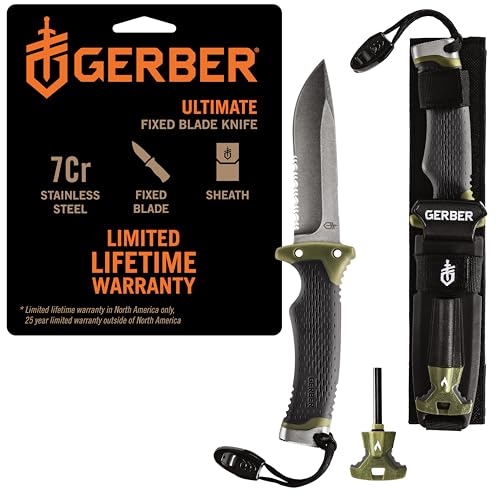
If you need a fixed-blade knife that handles both camp tasks and emergency scenarios without fuss, the Gerber Ultimate Survival Knife with Fire Starter fits the role. I use it for carving, skinning, and food prep, and its 4.8-inch stainless steel blade holds up well. The half-serrated edge cuts rope cleanly, while the textured grip stays secure even when wet. Its full tang and 11-ounce weight offer balance and durability. The sheath includes a sharpening stone and ferro rod, which I’ve used to start fires in wind. The pommel doubles as a hammer and whistle. It’s not the lightest, but the tools included save space. I pack it for every trip.
Best For: Outdoor enthusiasts and survivalists seeking a rugged, multi-functional fixed-blade knife for camping, hunting, and emergency preparedness.
Pros:
- Durable full tang construction with a 4.8-inch stainless steel blade excels in carving, skinning, and heavy-duty tasks
- Integrated survival tools including a ferrocerium rod fire starter, sharpening stone in the sheath, and emergency whistle in the pommel
- Textured rubber grip and ambidextrous design ensure secure handling in wet or challenging conditions
Cons:
- Weighs 11.02 oz, making it heavier than some comparable survival knives
- Half-serrated edge may not be ideal for users preferring a fully fine edge for precision work
- Sheath tools, while useful, add bulk and may not appeal to minimalist packers
BPSKNIVES Adventurer Bushcraft Knife with Leather Sheath

The BPSKNIVES Adventurer earns its place among the best survival bushcraft knives for outdoor enthusiasts who prioritize durability and function in a fixed-blade design. I’ve used it for carving, shelter building, and food prep, and its 5.3-inch 1066 carbon steel blade holds up well, though it needs regular drying to prevent rust. The full tang and scandi grind make it reliable for precise tasks, while the walnut handle feels solid and stays comfortable over long use. It comes with a leather sheath that includes a ferro rod, adding real value. At 10.2 oz with the sheath, it’s not the lightest, but the balance and build justify the weight.
Best For: Outdoor enthusiasts and bushcrafters seeking a durable, full-tang fixed-blade knife for carving, shelter building, and survival tasks.
Pros:
- Full tang 1066 carbon steel blade with scandi grind offers excellent edge retention and precision for detailed bushcraft work
- Walnut handle coated with Danish oil provides a secure, comfortable grip and resists moisture and dirt
- Includes a leather sheath with integrated ferro rod, adding functional value for fire-starting in survival situations
Cons:
- Carbon steel blade requires immediate drying after use to prevent rust, making maintenance more demanding
- At 10.2 oz with sheath, it’s heavier than some comparable bushcraft knives, which may deter ultralight backpackers
- Fixed design with right-hand orientation may not suit left-handed users or those preferring ambidextrous handling
BeaverCraft Bushcraft Knife with Fire Starter (BSH4F)

I rely on the BeaverCraft BSH4F when I need a full-tang bushcraft knife that handles heavy tasks without failing. Its 5-inch, 3.5 mm-thick 1066 carbon steel blade holds an edge well and resists corrosion thanks to a blued finish. At 11.3 ounces, it’s hefty enough for chopping but balanced for precise carving. The jimped spine improves control, and the flat grind slices cleanly through wood and bark. I’ve used it to strike the included ferro rod-works every time. The leather sheath secures the knife and carries comfortably on a belt. It’s simple, functional, and built for real use.
Best For: Outdoor enthusiasts and bushcrafters seeking a durable, full-tang survival knife with integrated fire-starting capability for heavy-duty tasks in the wild.
Pros:
- Full-tang 1066 carbon steel blade with blued finish offers excellent durability, edge retention, and corrosion resistance
- Includes a ferro rod fire starter and high-quality leather sheath with dual belt loops for secure, convenient carry
- Jimped spine and balanced design provide superior grip and control for both precision carving and aggressive chopping
Cons:
- Weight of 11.3 ounces may feel heavy for users preferring ultralight gear
- 3.5 mm blade thickness, while strong, may limit fine detail work compared to thinner bushcraft blades
- Blued finish requires proper maintenance to prevent rust if exposed to prolonged moisture
Mossy Oak Survival Hunting Knife with Sheath
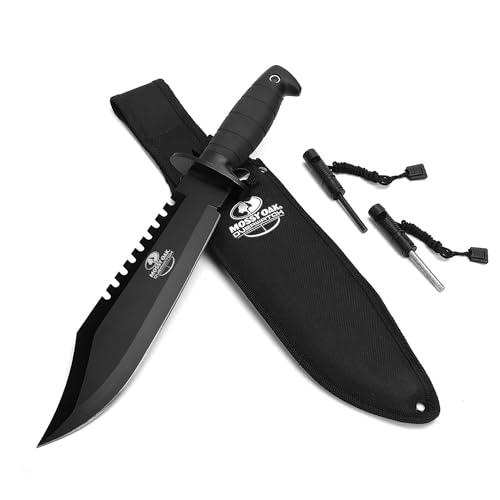
You’ll find this 15-inch fixed-blade knife works best if you need a durable, no-frills tool for heavy-duty outdoor tasks like batoning, fire prep, or game processing. I’ve used it in wet and dry conditions, and the stainless steel blade holds its edge well thanks to its compound bevel and 3.8 mm thickness. The rubber handle gives a secure grip, even with gloves, and it’s ambidextrous. The nylon sheath is rugged and carries easily on a belt. It includes a fire starter and sharpener, which I’ve found practical in the field. At 16.8 oz, it’s not the lightest, but it’s built for toughness.
Best For: Outdoor enthusiasts, hunters, and survivalists needing a tough, full-sized fixed-blade knife for heavy-duty tasks in rugged environments.
Pros:
- Durable 10-inch stainless steel blade with compound bevel edge stays sharp and resists rust
- Secure rubber handle offers a non-slip grip ideal for use with gloves or in wet conditions
- Includes practical field accessories: fire starter and sharpener, plus a rugged belt-compatible nylon sheath
Cons:
- At 16.8 oz, it’s on the heavier side for extended pack carry
- The 15-inch overall size may be cumbersome for fine, detailed tasks
- Limited blade versatility due to fixed clip-point design and lack of additional tools
Survival Knife with Fire Starter & Sheath

Though I prioritize simplicity in survival gear, the foyeni Survival Knife with Fire Starter & Sheath stands out for those needing a reliable, all-in-one tool for extended bushcraft trips or unpredictable conditions. I’ve used the 4.4-inch 5Cr15Mov blade-hardened to 58 HRC-and found it holds an edge well during wood carving and food prep. The full tang and G10 handle offer solid grip, even when wet. The included Kydex sheath secures the knife firmly and rotates for versatile carry. I keep the ferro rod handy because it sparks reliably in rain or cold. At 14 oz, it’s not the lightest, but the balance of function and durability makes it a practical pick for serious outdoor use.
Best For: Outdoor enthusiasts and survivalists seeking a durable, multi-functional knife with built-in fire-starting capability for bushcraft, camping, and emergency situations.
Pros:
- Full tang 5Cr15Mov steel blade offers excellent edge retention and durability for demanding outdoor tasks
- Ergonomic G10 handle and Kydex sheath provide secure grip and versatile, reliable carry options
- Integrated ferro rod fire starter ensures reliable ignition in wet or cold weather conditions
Cons:
- At 14 ounces, the knife is relatively heavy compared to lightweight survival tools
- Black titanium coating may show wear over time with aggressive use
- 58 HRC hardness, while strong, may be slightly less resistant to extreme impact than higher-rated steels
Morakniv Companion Fixed Blade Knife

The Morakniv Companion Fixed Blade Knife suits bushcrafters and outdoor enthusiasts who prioritize reliability and simplicity in a field tool. I’ve used it for carving, food prep, and cutting tinder, and it performs consistently. The 4.1-inch Sandvik 12C27 stainless blade resists rust but may develop a patina over time, especially in damp or acidic conditions. Its 2.0 mm thickness balances durability and cutting precision. The textured polymer handle stays grippy in wet or cold weather, and the built-in finger guard adds safety during extended use. It comes with a durable polymer sheath and belt clip for easy carry. I recommend hand washing, drying, and occasional oiling to maintain the blade.
Best For: Outdoor enthusiasts and bushcrafters seeking a reliable, low-maintenance fixed blade knife for everyday tasks in rugged environments.
Pros:
- Durable Sandvik 12C27 stainless steel blade offers excellent rust resistance and holds a good edge
- Ergonomic polymer handle with textured grip ensures secure, comfortable hold even when wet or cold
- Includes tough polymer sheath with belt clip for convenient, secure carry in the field
Cons:
- Blade may develop a patina over time, which could concern users who prefer a pristine appearance
- Limited blade thickness (2.0 mm) may not suit heavy-duty chopping tasks
- Sheath, while durable, lacks MOLLE compatibility or multi-position carry options
ODENWOLF W-SCANDI D2 Steel Survival Knife

A full tang fixed-blade knife like the ODENWOLF W-SCANDI suits outdoor users who prioritize durability and precision in demanding environments. I’ve used it for bushcraft tasks, and its 4.6-inch D2 steel blade holds a sharp edge well, thanks to its 60 HRC hardness and 20–25 degree grind. The full tang construction feels solid, and at 13.1 ounces, it’s balanced for extended use. The TPE handle offers grip in wet conditions, and the ambidextrous design works for most users. Its sheath is rugged, locking the knife securely for safe carry. While it’s heavier than some, the trade-off is strength and long-term reliability in harsh conditions.
Best For: Outdoor enthusiasts and bushcrafters seeking a durable, full-tang survival knife with excellent edge retention and reliable performance in rugged environments.
Pros:
- Full tang D2 steel construction offers exceptional strength and a long-lasting, razor-sharp edge
- TPE handle provides secure grip in wet or cold conditions and supports ambidextrous use
- Includes a rugged, locking polypropylene sheath for safe and convenient carry
Cons:
- Weighs 13.1 ounces, making it heavier than many comparable survival knives
- D2 steel, while hard and wear-resistant, is only moderately stainless and may require maintenance to prevent corrosion
- Limited blade length of 4.6 inches may not suit users preferring longer blades for heavy-duty tasks
Purple Dragon D2 Steel Survival Knife

You’ll want this Purple Dragon D2 Steel Survival Knife if you need a rugged, no-frills fixed blade that handles heavy bushcraft tasks without bending or chipping. I rely on its 5.5-inch tanto D2 steel blade because it holds an edge under abuse and resists corrosion. The full-tang build and textured G10 handle keep it stable during batoning or chopping, even when wet. It’s heavy at 1.12 pounds, but that adds durability. The Kydex sheath secures the knife firmly and allows fast draws, which matters in urgent scenarios. I’ve used it for shelter building, fire prep, and game processing-it performs across roles. This model’s straightforward design suits practical users who prioritize function over flair.
Best For: Survivalists, bushcrafters, and outdoor professionals who need a durable, full-tang fixed blade knife for heavy-duty tasks in rugged environments.
Pros:
- High-carbon D2 steel blade offers excellent edge retention and corrosion resistance
- Textured G10 handle and full-tang construction ensure a secure grip and superior strength
- Includes durable Kydex sheath with quick-release design for reliable carry and fast access
Cons:
- Weighs 1.12 pounds, which may be heavy for lightweight packers
- Fixed blade design lacks portability compared to folding knives
- Tanto blade style may not be ideal for fine precision tasks
ODENWOLF WOLF-I Survival Knife with Sheath

D2 steel defines the ODENWOLF WOLF-I’s edge-this knife suits outdoor enthusiasts who prioritize long-lasting sharpness and resilience in damp, rugged environments. I’ve used it in rain and humidity, and it resists rust well. The 4.6-inch drop point blade offers controlled piercing and slicing, while the full tang guarantees strength under stress. At 11.4 ounces, it’s not the lightest, but the balanced weight improves chopping stability. The TPE handle gives a secure grip, even with wet hands, and works for both left- and right-handed users. Its polypropylene sheath locks the knife firmly and attaches to a belt. I’ve carried it for days without accidental draws. Made to German standards, it’s durable, straightforward, and ready for bushcraft, camping, or survival use without fuss.
Best For: Outdoor enthusiasts who need a durable, rust-resistant survival knife for bushcraft, camping, and tactical use in harsh environments.
Pros:
- D2 steel blade offers excellent edge retention and above-average durability
- Full tang construction and TPE handle ensure strength and a secure, ambidextrous grip
- Rugged polypropylene sheath provides reliable belt carry and secure locking
Cons:
- Weighs 11.4 ounces, making it heavier than some comparable survival knives
- Limited blade edge options (only plain edge available)
- Grinding angle range for sharpening is broad (25–40 degrees), which may confuse beginners
Morakniv Carbon Steel Bushcraft Knife with Sheath

When rugged simplicity matters most, the Morakniv Carbon Steel Bushcraft Knife with Sheath stands out for hands-on users who prioritize reliability over frills. I’ve used it in rain and cold, and the ergonomic polymer handle stays grippy thanks to its soft rubber texture. The 4.3-inch carbon steel blade has a black DLC coating that resists rust and minimizes glare-useful in real survival scenarios. It’s not stainless, so I dry it after use, but that’s a fair trade for its edge retention. At 5.4 ounces, it’s light, and the sheath holds a fire starter and sharpener, which I’ve actually needed. The clip-point V-grind cuts cleanly, and the finger guard keeps me safe during batoning.
Best For: Outdoor enthusiasts and survivalists who value a lightweight, durable bushcraft knife with essential built-in tools for reliable performance in harsh conditions.
Pros:
- Durable 4.3-inch carbon steel blade with excellent edge retention and a rust-resistant black DLC coating
- Ergonomic polymer handle with soft rubber grip ensures secure, comfortable use in wet or cold conditions
- Sheath includes integrated fire starter and diamond sharpener, plus multiple carry options for practicality in the field
Cons:
- Blade is not stainless and requires prompt drying after use to prevent corrosion
- Plastic sheath, while functional, may lack the long-term durability of premium materials
- Limited customization or high-end features, making it less appealing to collectors or precision-oriented users
Factors to Consider When Choosing a Survival Bushcraft Knife
You’ll want a blade made from high-carbon steel since it holds an edge longer and resists chipping during heavy tasks. A comfortable, textured handle gives you control in wet conditions, while a sheath with built-in fire starter storage keeps essentials handy and secure. Look for models that balance edge retention with easy sharpening, so you’re not stuck with a dull knife when it matters most.
Blade Material Quality
Blade material plays a critical role in determining how well your knife performs in harsh conditions. You’ll want high carbon steel if you value sharpness and easy field sharpening-it’s typically 56–60 HRC and holds a good edge, though it rusts faster. For wet environments, stainless steel beats corrosion thanks to 10.5%+ chromium, but it’s slightly harder to sharpen. D2 steel gives you semi-stainless protection, hits about 60 HRC, and resists wear well, but it can chip under heavy impact. 5Cr15Mov offers balanced toughness, about 0.5% carbon, and added molybdenum-vanadium to resist rust and hold an edge. Harder blades above 58 HRC stay sharp longer, but they’re more brittle and tougher to fix in the wild. You’re trading edge life for resilience. Pick based on your environment and how much maintenance you can realistically do.
Handle Comfort Grip
A good grip keeps the knife where it belongs-in your hand, not in the dirt or, worse, your leg. You need a textured, non-slip handle made from rubber, G10, or TPE to maintain control in wet or cold conditions. These materials stay reliable in extreme temperatures and resist slippage when your hands sweat or freeze. Look for an ergonomic shape with finger guards and contours that fit your hand naturally-this reduces fatigue during extended use. The handle should be 4 to 5 inches long, letting you grip it fully with space between your fingertips and the guard for better leverage. Oiled wood or moisture-resistant coatings help prevent swelling or cracking in humid environments. A secure grip isn’t about comfort alone-it’s about safety and precision when processing wood, skinning game, or carving shelter supports. Pick a handle that stays stable in all conditions.
Sheath Utility Features
With survival situations demanding reliability, a sheath that does more than hold the blade becomes essential. You need features that actively support survival tasks. A sheath with an integrated ferro rod gives you immediate fire-starting capability, vital in wet or cold conditions. Built-in sharpening stones or diamond sharpeners let you maintain your edge in the field, keeping the blade effective over long use. Look for tactical models with 360° rotating clips or universal mounts-they let you carry the knife in multiple positions for faster access. Kydex or reinforced polymer sheaths offer durable protection and resist wear, even in rugged terrain. Dual belt loops or MOLLE compatibility guarantee secure attachment to your belt, pack, or tactical gear, improving both portability and reach when seconds count.
Edge Retention Performance
You’ll want a knife that holds its edge through extended use, and that starts with steel hardness measured on the Rockwell scale-look for 58 to 62 HRC, as this range balances longevity with resistance to chipping. High-carbon steel with alloys like chromium or vanadium sharpens the advantage, offering better wear resistance and finer grain structure for durable edges. The blade grind matters too-Scandi or V-grinds with thin, acute edges cut cleanly but may need more frequent maintenance in heavy tasks. Thicker edges last longer under impact but require more effort to resharpen. A well-executed heat treatment makes all the difference, locking in the steel’s ideal hardness and toughness. Don’t overlook coatings like black titanium or DLC-they reduce friction and shield the edge from moisture and corrosion, slowing degradation. You’re not just buying steel; you’re investing in how well it’s processed and shaped. Choose based on use: harder isn’t always better if it sacrifices resilience.
Fire Starter Integration
Though not essential, a knife with a built-in fire starter adds a critical advantage when matches fail or pockets run empty. You’ll find ferrocerium rods commonly mounted in the sheath or handle, delivering sparks over 3,000°F-enough to ignite damp tinder or char cloth even in wind and rain. Most sheath-mounted rods are 1.5 to 3 inches long, offering hundreds of strikes before needing replacement. Their placement often allows one-handed use, which saves time and effort when you’re cold or under pressure. While the added weight ranges from 0.5 to 1.5 ounces, the trade-off is minimal for the boost in fire-making reliability. You’re not buying a gadget-you’re adding a failsafe. In real-world survival scenarios, that small feature could mean staying warm when everything else goes wrong. Choose based on placement, spark strength, and rod length, not just convenience.
Frequently Asked Questions
Can I Use the Knife Underwater?
You can use the knife underwater, but it won’t stay sharp long if you do. Water accelerates blade corrosion, especially on carbon steel. Stainless holds up better but isn’t immune. Bearings and pivot points trap moisture, leading to early wear. You’ll cut effectively in short bursts-like freeing a snagged rope-but prolonged use risks rust and mechanism damage. Rinse and dry it immediately after. For reliable performance, avoid routine underwater use unless maintenance follows.
Is the Sheath MOLLE Compatible?
Yes, the sheath’s MOLLE-compatible, so you can attach it securely to tactical gear or backpacks using woven straps. It holds up under movement and rough terrain without loosening. Keep in mind, though, that added bulk might slow your draw compared to simpler sheaths. MOLLE offers versatility, but if you’re prioritizing speed or minimalism, it’s a trade-off. Works well if you need hands-free carry and rugged access in changing conditions.
Does the Blade Rust in Saltwater?
you’ll see some rust if you expose the blade to saltwater and don’t clean it soon after. high-carbon steel edges hold a sharp edge well but react with salt, so they need prompt rinsing and drying. stainless variants resist corrosion better but often sacrifice edge retention. in real use, no blade is fully rust-proof-maintenance matters most. wipe it down, apply light oil, and you’ll keep it in working order, especially in coastal or marine environments where salt exposure is constant.
Can I Carry This on a Plane?
you can’t carry this on a plane-blades with fixed blades or locking mechanisms aren’t allowed in carry-ons by tsa rules. you might check it as luggage if properly sheathed and secured, but airlines vary. pocket knives under 2.5 inches without locks sometimes get approved, but survival knives don’t meet that. always verify current tsa guidelines before traveling. failure to comply risks confiscation or fines, so plan accordingly.
Is the Fire Starter Replaceable?
Yes, you can replace the fire starter. It’s a standard ferrocerium rod, so you don’t need the manufacturer’s version. Just measure the diameter and length-most are 0.19″ by 1.5″. Swap it out with generic replacements available online or at outdoor stores. It’s a simple press-fit, no tools needed. That means you’re never stuck without a spark, even if the original wears down fast under heavy use.