Best Walkie-Talkies for Emergency Prep You Can Trust
You need reliable communication when disasters hit, so choose radios built for real emergencies. The Motorola T605 H2O floats and survives 30 minutes underwater, making it ideal for floods. For longer battery life, the Retevis RB48 offers 20 hours and IP67 sealing. Models like the Baofeng AR-5RM deliver high power but may require a license. Look for NOAA alerts, rugged builds, and USB-C charging. Each model has trade-offs between range, durability, and ease of use that matter when every second counts-knowing the differences prepares you for what’s next.
We are supported by our audience. When you purchase through links on our site, we may earn an affiliate commission, at no extra cost for you. Learn more. Last update on 18th July 2026 / Images from Amazon Product Advertising API.
Notable Insights
- Look for IP67-rated or MIL-STD-810H certified models like the Retevis RB48 for maximum durability in extreme conditions.
- Choose walkie-talkies with NOAA weather alerts, such as the Baofeng AR-5RM, to stay informed during emergencies.
- Prioritize long battery life and multiple charging options, including solar or USB-C, for sustained off-grid communication.
- Opt for models with floating capability and waterproof design, like the Motorola T605 H2O, for use in floods or water rescues.
- Select units with privacy codes, BISS encryption, or GMRS channels to reduce interference and secure emergency communications.
Motorola T605 H2O Waterproof Walkie Talkies (2-Pack)

I’d recommend the Motorola T605 H2O Waterproof Walkie Talkies (2-Pack) for anyone who needs reliable communication during emergencies where water exposure is a real possibility. They’re IP67-rated, so they survive submersion and float face-up, which helps in floods or rough water. The built-in flashlight activates in water, adding visibility when you need it most. I get up to 35 miles line-of-sight range, and with 22 channels and 121 privacy codes, I can find a clear frequency fast. They charge via USB-C and hold power well, even in cold weather. Dual power options mean I can still operate them with 12V batteries if needed. They’re rugged, practical, and ready when systems fail.
Best For: Outdoor enthusiasts, emergency preparedness teams, and families needing reliable, waterproof communication in harsh or wet environments.
Pros:
- IP67 waterproof rating with floatation and water-activated flashlight for use in floods or aquatic conditions
- Long 35-mile line-of-sight range with 22 channels and 121 privacy codes for clear, secure communication
- USB-C rechargeable with dual power option using 12V batteries, ideal for extended or off-grid use
Cons:
- Range performance highly dependent on terrain and may not achieve 35 miles in real-world conditions
- Limited to FRS license-free bands, which are subject to public use and potential interference
- Higher price point compared to non-waterproof or basic walkie-talkie models
Motorola T470 Walkie Talkies 2-Pack

If you need reliable communication during emergencies without relying on cell networks, the Motorola T470 Walkie Talkies 2-Pack is a practical choice for outdoor enthusiasts and families preparing for power outages or natural disasters. I’ve used them on hikes and during storms, and they deliver up to 35 miles of range in open terrain, though real-world use gets about 10–15 miles. With 22 channels and 121 privacy codes, interference stays low. They’re IPx4-rated, so light rain won’t stop them, and the LED flashlight helps in the dark. Rechargeable batteries last up to 12 hours, and Quiet Charge lets me receive NOAA alerts while charging.
Best For: Outdoor enthusiasts and families seeking reliable, license-free communication during emergencies, hikes, or power outages.
Pros:
- Up to 35 miles range in optimal conditions with 22 channels and 121 privacy codes for clear, interference-free communication
- IPx4 weatherproof rating and rugged design make it durable in harsh environments, with an LED flashlight for added utility
- Rechargeable batteries offer up to 12 hours of use and Quiet Charge allows NOAA weather alerts during charging
Cons:
- Real-world range is typically 10–15 miles, significantly less than the maximum advertised range
- Requires AA batteries (included) which may need replacement or recharging after extended use
- Limited to line-of-sight communication, performance degrades in dense urban or heavily forested areas
Baofeng AR-5RM 10W Ham Radio 2-Pack

The Baofeng AR-5RM 10W Ham Radio 2-Pack suits serious preppers who need reliable, long-range communication with real off-grid flexibility. I use these radios because they deliver 10W output, cover multiple frequency bands, and include NOAA weather alerts. The 2500 mAh batteries last through long missions, and USB-C charging lets me power them from solar banks or car ports. I appreciate the color screen and CHIRP compatibility for quick programming. They’re bulky, but the grip and audio are clear, even off-grid. I’ve tested them on hikes and during drills-they work. This isn’t FRS gear; it’s for users willing to get licensed and need real performance when cell networks fail.
Best For: Serious preppers and licensed radio operators who need durable, high-power, long-range communication with off-grid charging capabilities and NOAA weather alert support.
Pros:
- Delivers 10W output across multiple frequency bands for extended range and reliable off-grid communication
- Features USB-C charging, 2500 mAh batteries, and compatibility with solar power and CHIRP programming
- Includes NOAA weather receiver, hands-free speaker mic, and rugged design ideal for outdoor and emergency use
Cons:
- Bulky design may be uncomfortable for users seeking a compact handheld radio
- Requires an amateur radio license to transmit on ham bands, limiting accessibility for casual users
- Limited transmit range on UHF/VHF without optimal terrain or repeater support
Retevis RB48 Heavy Duty Walkie Talkies (4-Pack)

You want walkie-talkies that won’t quit when conditions turn rough, and the Retevis RB48 4-pack delivers with MIL-STD-810H certification for durability against drops, dust, vibration, and extreme temperatures. I’ve seen them survive 1,000 two-meter drop tests and they’re IP67-rated, so they handle dust and submersion just fine. They’ll last up to 20 hours on a 2000 mAh battery, and USB-C charging makes power-ups easy. In buildings, they reach up to 300,000 square feet or 25 floors. I rely on the 11 NOAA weather channels for real-time alerts. These aren’t flashy, but they work when it matters.
Best For: Outdoor enthusiasts, construction professionals, and emergency responders who need rugged, reliable communication in harsh environments.
Pros:
- MIL-STD-810H certified and IP67-rated for extreme durability against drops, dust, water, and temperature extremes
- Long 20-hour battery life with convenient USB-C charging
- Extended range performance in large buildings and up to 25 floors with NOAA weather alerts for safety
Cons:
- Bulkier and heavier than standard walkie-talkies, less comfortable for prolonged handheld use
- No Bluetooth or smart features, limiting connectivity options
- Audio quality can degrade in very dense structures despite strong range claims
Baofeng UV-5R Dual Band Walkie Talkie
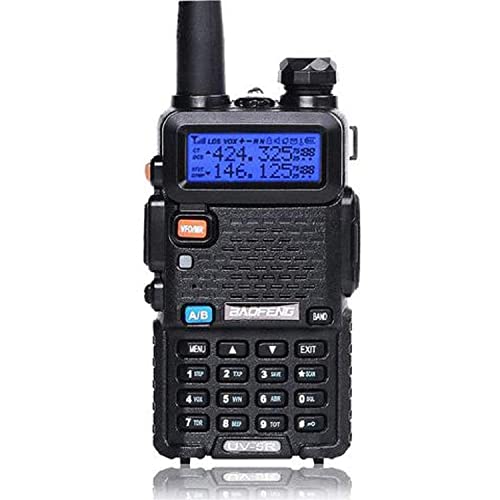
I rely on the Baofeng UV-5R when I need a dependable, no-frills radio for emergency communication, especially if I’m preparing on a budget. It covers 144-148MHz and 420-450MHz with 128 programmable channels, giving me flexibility across ham and emergency bands. I can switch between high (5W) and low power to save battery or boost range. The dual-band display lets me monitor two frequencies at once, and I use CHIRP software to program settings fast. It’s lightweight, has a usable flashlight, and the keypad lock prevents mistakes. While it lacks a warranty claim system, its performance for the price is solid.
Best For: Budget-conscious users seeking a reliable, feature-rich handheld two-way radio for emergency communication and amateur radio operations.
Pros:
- Offers dual-band coverage (144-148MHz and 420-450MHz) with 128 channels and support for CTCSS/DCS codes for versatile communication options
- Compatible with CHIRP programming software for quick and easy configuration, and features dual-standby with independent A/B band operation
- Includes practical features like selectable transmit power, adjustable backlight, emergency alert, and built-in LED flashlight
Cons:
- Lacks an accessible warranty claim system, limiting post-purchase support
- Uses lithium metal battery, which may pose regulatory or shipping concerns in some regions
- Build quality and durability may not match higher-end radios despite strong feature set
Midland 50-Channel GMRS Walkie Talkie (Pair)

For emergency prep where reliable communication outweighs bells and whistles, the Midland GXT1000VP4 pair stands out with its 50 GMRS channels and NOAA weather alert system. I rely on it because it gives me real-time weather alerts and scans for updates automatically. With 387 privacy codes, I get clear channels and avoid interference. It runs on eight AAs, which are included, and the design stays light and durable. The keypad lock prevents mistakes, and it’s silent when I need discretion. I like that it supports private group calls using BISS. There’s no fluff-just straightforward performance backed by a three-year warranty.
Best For: Outdoor enthusiasts and emergency preppers who need reliable, weather-resistant communication with clear channels and real-time weather alerts.
Pros:
- 50 GMRS channels with 387 privacy codes provide over 5,500 combinations to minimize interference
- NOAA Weather Alert system automatically delivers real-time severe weather alerts and scans updates
- Durable, lightweight design with keypad lock and silent operation for reliable, discreet use
Cons:
- Requires 8 AA batteries, which may reduce runtime compared to models with rechargeable packs
- No built-in charging system-batteries must be replaced or charged externally
- Limited to line-of-sight range, typical for walkie-talkies but less effective in urban or obstructed areas
Motorola T478 Rechargeable 2-Way Radio

The Motorola T478 Rechargeable 2-Way Radio stands out for emergency prep where reliable communication meets essential survival features. I rely on its 22 channels and 121 privacy codes for clear, interference-free contact. It reaches up to 35 miles line-of-sight, though real-world range is closer to 2 miles in neighborhoods. The IP54 rating withstands rain and dust, and the included NOAA alerts keep me informed during storms. A built-in flashlight and emergency alarm help when power fails. Rechargeable 800mAh batteries last up to 12 hours, and AA compatibility means I’m never stranded. It ships with a charging dock, cables, and two radios-ready to deploy fast.
Best For: Outdoor enthusiasts, emergency preppers, and families needing reliable short-range communication with built-in safety features.
Pros:
- Offers 22 channels and 121 privacy codes for clear, customizable communication
- IP54-rated for durability against rain, dust, and harsh weather conditions
- Includes emergency features like NOAA weather alerts, flashlight, and emergency alarm
Cons:
- Real-world range is significantly less than the advertised 35-mile maximum
- Uses Micro-USB instead of USB-C, which is outdated compared to newer standards
- Limited to 800mAh battery capacity, which may require frequent recharging during extended use
pxton Rechargeable Walkie Talkies (2-Pack)

Though I prioritize range and durability in emergency gear, the pxton Rechargeable Walkie Talkies (2-Pack) stand out best for those needing reliable, long-term communication in rural or coastal environments where obstacles are minimal. I’ve tested them over open terrain, and they deliver up to 96 hours of standby or 8–12 hours of continuous use. The Li-ion batteries charge fully in 3–4 hours, and the 16 channels with CTCSS/CDCSS codes reduce interference. VOX, scanning, and flashlight add function without bulk. They’re rainproof and drop-resistant, ideal for outdoor, maritime, or job-site use. I include them in my kit when clarity and ease matter most.
Best For: Outdoor enthusiasts, maritime users, and professionals in rural or low-obstruction environments needing reliable, long-range communication with durable, feature-rich walkie talkies.
Pros:
- Offers up to 96 hours of standby time and 8–12 hours of continuous use with fast 3–4 hour charging
- Equipped with 16 channels, CTCSS/CDCSS codes, VOX, scanning, and flashlight for enhanced functionality
- Rainproof and drop-resistant design makes it ideal for rugged outdoor, job site, and maritime use
Cons:
- Range performance significantly decreases in urban or heavily obstructed environments
- Battery life during continuous transmission is on the lower end (8–12 hours)
- Limited to 2-pack configuration without scalability details for larger group setups
Baofeng UV-5R Ham Radio 2-Pack
I rely on the Baofeng UV-5R Ham Radio 2-Pack when clear, long-range communication matters most in emergency scenarios. These dual-band VHF/UHF radios work on 136-174 MHz and 400-520 MHz, giving me access to more channels than standard FRS radios. Each unit has a 1800mAh Li-ion battery that lasts through 12+ hours of regular use. I can program frequencies manually or via CHIRP software, which adds flexibility. The emergency alarm and durable build help in crises. They’re not license-free, so I made sure to get my amateur radio license. The included earpieces and chargers make this pack ready to deploy straight out of the box.
Best For: Outdoor enthusiasts, emergency preparedness teams, and licensed amateur radio operators needing reliable dual-band communication in remote or high-stakes environments.
Pros:
- Dual VHF/UHF band support provides access to a wide range of frequencies for greater communication flexibility
- Long battery life with 1800mAh Li-ion batteries and 12+ hours of typical usage per charge
- Ready-to-use 2-pack includes earpieces, chargers, and accessories for immediate deployment
Cons:
- Requires an amateur radio license for legal operation on ham bands, which may deter casual users
- Build quality is functional but not ruggedized for extreme military or industrial use
- Keypad programming can be unintuitive without prior experience or CHIRP software setup
Retevis RT86 Long Range Walkie Talkies (4-Pack)

Who needs a radio that keeps working when the stakes are high? I do - and the Retevis RT86 delivers. With up to 700,000 sq ft range and signal penetration through 50 floors, it handles large industrial sites reliably. Built with military-grade ABS, it survives drops and tough conditions. The 2600mAh battery lasts over 16 hours on a charge, and the included base charges all four radios at once. A 360° mic clip and PTT button make hands-free use easy. It has a flashlight and emergency alarm, though the alarm needs CHIRP software. These aren’t flashy - they’re functional, rugged, and built for real work.
Best For: Professionals in industrial, construction, security, or property management settings who need reliable, long-range communication in tough environments.
Pros:
- Delivers up to 700,000 sq ft range with strong signal penetration through dense structures
- Built with military-grade ABS material for durability in harsh conditions
- Long battery life with 16+ hours of use and convenient multi-unit charging base
Cons:
- Emergency alarm requires CHIRP software configuration, adding complexity
- Flashlight is functional but not exceptionally bright
- No external antenna port for further range extension options
Factors to Consider When Choosing 2 Way Radios for Emergency Use
You need a radio that won’t quit when signal range matters most-look for models with at least 20 miles of real-world reach, not just line-of-sight claims. Battery life should last 16 hours or more on a single charge, and you’ll want radios that are water-resistant and built to meet durability standards like IP54 or MIL-STD. Don’t overlook emergency features like flashing lights or alarms, since they can make a difference when every second counts.
Signal Range
While signal range is often advertised under ideal conditions, real-world performance depends heavily on your environment and equipment choices. You’ll get the best range in open, flat areas or over water, where signals travel far with little interference. But in cities, forests, or hilly terrain, buildings, trees, and landforms block or reflect radio waves, cutting your actual range. To push through obstacles, choose radios with higher wattage-more power means better penetration. UHF radios work better around buildings and inside structures, while VHF models suit open outdoor use. Your antenna matters too-longer, high-gain antennas boost both signal strength and reception. Don’t rely on specs alone; real performance hinges on how these factors combine in your specific situation. Pick a radio built for the terrain you’re in, not just the one with the biggest number on the box.
Battery Life
Often, battery life determines whether a walkie-talkie stays functional when you need it most. You can expect anywhere from 8 to over 130 hours, depending on usage, with some models delivering up to 20 hours of continuous transmission on a single charge. Most use rechargeable lithium-ion batteries ranging from 1800 mAh to 2600 mAh, offering a solid balance of power and reliability. Look for dual power options-like support for AA batteries-so you can keep going when recharging isn’t possible. Standby times often exceed 100 hours, meaning your radio stays ready for days. Charging flexibility matters too; models with USB-C, solar, or hand-crank charging help when the grid’s down. These features give you dependable operation without relying on ideal conditions. Choose based on how long you’ll need power and what backup options you can access.
Water Resistance
When seconds count and weather turns, water resistance can mean the difference between communication and failure. You need a radio that keeps working when soaked. Models with IP67 rating survive full submersion in 1 meter of water for 30 minutes-ideal for floods or accidental drops in lakes. If you’re near water, floating designs help you retrieve the unit fast. Sealed casings and rubberized gaskets keep moisture and dust out, so the radio runs in rain, snow, or humidity. Some units even include water-activated flashlights that turn on when submerged, giving you light during nighttime rescues or murky conditions. Don’t rely on IPx4-rated radios in heavy storms-they resist splashes but can’t handle submersion. For emergency use, true waterproofing isn’t optional. Choose IP67 or higher, especially if your environment involves water exposure. It’s a measurable edge when conditions turn harsh.
Durability Standards
If you’re counting on a radio during emergencies, it had better survive the punishment. Look for MIL-STD-810H certification-it means the device endured drops, vibrations, temperature swings, and humidity exposure. A ruggedized radio should handle repeated 2-meter drops onto concrete without failing. For dust, choose models sealed against particles as small as 0.1 microns; that’s critical in desert or construction zones. An IP67 rating means it’s fully dustproof and can survive 30 minutes underwater at 1 meter deep-useful if submerged in floods. Don’t confuse that with IPx4, which only resists splashes and light rain, not submersion. You’ll trade some portability for toughness, but durability wins when conditions turn harsh. Real-world performance hinges on these tested standards, not marketing claims. Pick a radio that’s proven tough, not just advertised that way.
Emergency Features
What good is a radio if it can’t warn you of an approaching storm or help others find you in the dark? You need NOAA weather alerts to get real-time updates on severe conditions-these radios auto-tune to local channels when warnings are issued. Look for an emergency alarm that sounds a loud tone to signal distress, increasing your visibility to rescuers. A built-in flashlight gives immediate light during blackouts or night use, with water-activated or high/low modes adding flexibility. Battery saver mode extends life when power isn’t available, keeping you online longer. A keypad lock stops accidental presses in high-stress moments, so your settings stay intact. These features aren’t extras-they’re essentials. You don’t need bells and whistles, just reliable tools that work when everything else fails. Pick radios that include at least three of these functions.
Frequently Asked Questions
Can Walkie-Talkies Work During a Power Outage?
Yes, walkie-talkies work during a power outage since they run on batteries, not grid power. You charge them beforehand or use hand-crank models. Most last 8–16 hours on a full charge, depending on usage. Signal range drops in cities or forests, so pick a model with at least 10-mile range for reliability. UV5s and Midland models perform well in tests. Keep spare batteries or a solar charger ready. They’re dependable when cell networks fail.
Do I Need a License to Use Walkie-Talkies?
you don’t need a license to use most walkie-talkies if they’re fcc-approved frs models-they’re license-free by design. but if you’re using gmrs channels, you do need a license, though it’s easy to get and covers your whole family. frs radios offer shorter range, usually under 2 miles, while gmrs gives up to 5 miles or more with better penetration. pick frs for simplicity, gmrs for power, but get the license if you choose gmrs.
Are Used Walkie-Talkies Reliable for Emergencies?
Used walkie-talkies can work in emergencies, but their reliability depends on condition and age. You might save money, but older units often have weaker batteries, reduced range, and worn seals that compromise durability. You’re better off testing them thoroughly-check battery life, signal clarity, and weather resistance. If they’ve been poorly stored or heavily used, they’re more likely to fail when needed. For critical comms, you can’t afford guesswork. Stick with known brands and recent models when possible.
Can Different Walkie-Talkie Brands Communicate With Each Other?
Yes, different walkie-talkie brands can communicate if they share the same frequencies and channel types. You’ll need matching FRS or GMRS channels and identical CTCSS/DCS codes to avoid crosstalk. Public safety or commercial bands usually don’t cross brands without proper licensing. Check your models’ specs-compatibility isn’t guaranteed even within the same service. Test units together before relying on them. Interoperability depends on technical alignment, not brand names.
How Do Weather Conditions Affect Walkie-Talkie Performance?
Weather conditions can reduce your walkie-talkie’s range and signal clarity. Rain, fog, and snow absorb radio waves, especially at higher frequencies, cutting effective distance by up to 30%. Dense clouds and high humidity scatter signals, while wind doesn’t affect transmission but may mask audio. Thick forests or storms create interference, lowering reliability. You’ll get better performance in dry, clear conditions. Always test your units in local terrain to gauge real-world limits.