The Role of BioSand Filters in Sustainable Water Treatment Systems for Communities
You rely on BioSand filters for clean water without electricity or replaceable parts. They use sand, gravel, and a living microbial layer to remove up to 98% of bacteria and 99% of protozoa from turbid water. Built with local materials, they last over 10 years with minimal maintenance. Flow is slow-about 0.5 liters per minute-but consistent if used daily. Disturbing the top layer or letting it dry out reduces effectiveness. Their design guarantees resilience during crises and independence from supply chains. Practical examples show how maintenance routines directly impact performance over time, and you’ll see how scaling them can meet broader community needs.
Notable Insights
- BioSand filters provide gravity-driven water treatment without electricity or complex components.
- They use locally sourced sand, gravel, and concrete for low-cost, sustainable construction.
- A biological layer forms at the top, removing up to 98% of bacteria and protozoa.
- Minimal maintenance, such as monthly diffuser cleaning, ensures long-term functionality.
- Ideal for communities, they offer climate-resilient, infrastructure-independent access to safe water.
How BioSand Filters Work
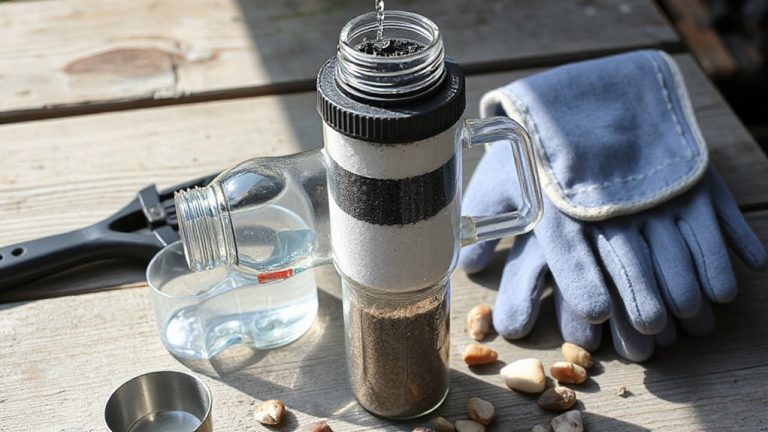
While it might sound complex, a BioSand filter works through a simple, natural process you can rely on. You pour water through the top, and gravity pulls it down slowly. The filter mechanics rely on layers: sand traps larger particles near the surface, while finer grains below catch smaller contaminants. After a few days of use, a microbial layer forms at the top-this isn’t harmful, it’s essential. That layer consumes bacteria and pathogens as water passes through. It doesn’t need electricity or replaceable parts. In field tests, well-maintained units reduce turbidity by over 90% and remove up to 98% of bacteria. You must let the filter rest between uses so the microbial layer stays active. Performance drops if flow rates are too fast or if you disturb the top layer. It won’t remove viruses completely, but it markedly improves water safety with minimal effort.
How to Build a Biosand Filter With Local Materials
You can build an effective BioSand filter using locally available materials without sacrificing performance. Filter construction starts with a concrete or plastic container, both of which are durable and widely accessible. Use fine sand, gravel, and a diffuser plate-components easily sourced from nearby markets or riverbeds. Layer the sand and gravel to create a natural filtration matrix that removes pathogens over time. Local sourcing reduces costs and supports community independence. A 60–90 cm sand depth is ideal for biological layer development. The outlet tube should sit above the gravel to prevent disturbing the base. You don’t need imported parts-standard dimensions work reliably. This approach keeps filter construction simple and replicable. With basic tools and planning, you can assemble a unit in a day. Performance stays consistent when layers are properly maintained. Practicality and availability guide every material choice. Top-performing water systems often include layers similar to those found in best water filters for enhanced contaminant removal.
How to Keep Your BioSand Filter Working for Years
Regularly maintaining your BioSand filter keeps it effective for years. Proper filter maintenance guarantees consistent water flow and pathogen removal. You should inspect the diffuser plate monthly to confirm it’s not clogged and clean it as needed. If water drains too slowly, it’s time for sand cleaning. Swirl the top 5 cm of sand gently with a stick to disrupt clogging layers, but don’t remove the sand. Full sand replacement is rarely needed and can disrupt the biofilm. Run at least 10 liters daily to keep the biological layer active. Letting the filter dry out kills beneficial microbes, so never let the water level drop below the sand. With consistent use and basic care, your filter will reliably treat water for years. Neglect leads to poor performance, but simple upkeep avoids most issues.
How BioSand Filters Enable Sustainable Water Access
Because they rely on natural processes and locally available materials, BioSand filters offer a long-term solution for clean water in off-grid or low-resource settings. You don’t need electricity or replaceable parts-just consistent use and basic maintenance. The slow sand filtration process removes up to 98% of bacteria, protozoa, and suspended solids, giving you reliable protection against common waterborne pathogens. Since construction materials like concrete or plastic can be sourced locally, costs stay low, and repairs are manageable. This supports water equity by making safe water accessible regardless of infrastructure or income. The system builds long term resilience, functioning for years with minimal oversight. Unlike chemical treatments or complex systems, BioSand filters work passively, day after day. You’re not dependent on external supplies, which reduces vulnerability during crises. For communities without centralized treatment, these filters are a measurable, scalable way to secure clean water-practical, durable, and effective when consistent access matters most.
How Underserved Communities Use BioSand Filters
While infrastructure gaps limit clean water access, underserved communities rely on BioSand filters as a low-cost, no-power solution that delivers consistent results. You install them at the household level, using locally available materials, which cuts costs and simplifies maintenance. Each filter removes up to 98% of bacteria and protozoa from water, improving water security over time without chemicals or electricity. You don’t need technical training to operate it-just routine pouring and occasional cleaning. This hands-on use fosters community empowerment, as families manage their own water treatment. Filters last 10+ years with basic care, offering long-term reliability. While flow rate is slow-about 0.5 liters per minute-it’s a fair trade for dependability. In areas with intermittent supply or contaminated sources, you get a practical, field-tested option. It won’t replace large-scale systems, but it fills critical gaps where alternatives are unavailable or unaffordable.
Expanding BioSand Filters in Climate-Exposed Communities
What happens when climate shocks hit and your water source turns murky or vanishes? You need a solution that’s reliable, low-cost, and easy to maintain-BioSand Filters fit that need. These units remove up to 98.5% of bacteria and 99% of protozoa from turbid water, critical when storms or droughts compromise supply. They require no electricity, last decades with basic care, and function continuously, unlike batch-style alternatives. For community resilience, deploying multiple units guarantees redundancy when single points of failure aren’t an option. Their simple design allows local fabrication, reducing supply chain risks. In climate adaptation planning, they’re a measurable, scalable intervention-especially in flood-prone or arid zones where infrastructure is fragile. You don’t need engineers to operate them, just basic training. When systems fail under stress, BioSand Filters keep delivering clean water. That’s practical stability where it’s needed most. Top Picks & Buying Guide can help identify complementary filtration technologies for integrated water treatment solutions.
On a final note
You get clean water with minimal upkeep when you use a biosand filter. It removes up to 98% of bacteria and protozoa, works without electricity, and lasts years with basic maintenance. While flow rate slows over time and occasional cleaning is needed, its durability and low cost make it reliable. Communities in remote or climate-stressed areas depend on it because it uses local materials and requires no technical skills to maintain.