Designing Public Alert Systems for High-Humidity Tropical Environments
You need hardware built for constant heat and moisture-marine-grade stainless steel and UV-stabilized polycarbonate last where standard materials fail within months. Elevate sirens on concrete or stainless poles to reduce damp exposure and improve sound reach. Use hybrid solar-battery-generators for 99.6% uptime, and deploy at least three alert types-sirens, SMS, FM-to guarantee over 90% reach. Calibrate sensors every quarter; uncalibrated units drift up to 15% in humidity accuracy. Systems that pass real equatorial field tests outperform lab-rated ones. More deployment insights follow.
Notable Insights
- Use marine-grade stainless steel and UV-stabilized polymers to resist corrosion and humidity degradation in tropical conditions.
- Elevate sirens on concrete or stainless-steel poles to reduce moisture exposure and improve sound projection.
- Deploy hybrid off-grid power with solar, lithium-iron-phosphate batteries, and generators for reliable 24/7 operation.
- Space sirens no more than 300 meters apart in urban areas to overcome signal interference and ambient noise.
- Implement multi-channel alerts via FM radio, SMS, satellite, and sirens to ensure over 90% community reach.
Why Public Alert Systems Fail in Tropical Climates
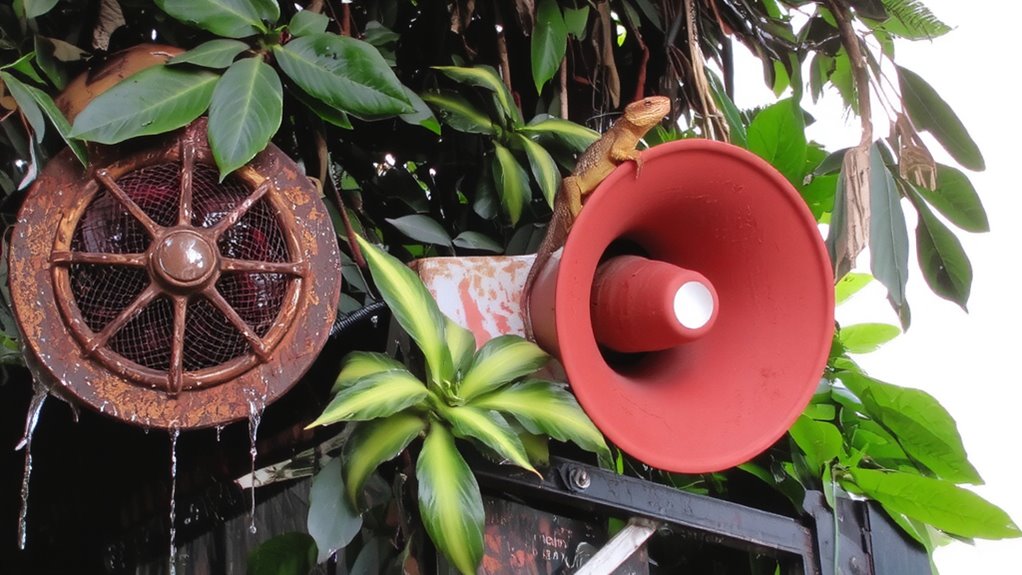
When humidity hovers near 90% and temperatures stay above 30°C for months, standard alert system components start to fail-not all at once, but in ways that degrade reliability over time. You’ll notice signal interference disrupting transmission, especially in dense urban zones where moisture amplifies electromagnetic crosstalk. Metal enclosures corrode, ground connections weaken, and internal condensation distorts low-voltage circuits. Noise pollution from generators, traffic, and storms masks audible alerts, reducing public response. Speaker efficiency drops as cones absorb moisture and stiffen. Wireless nodes suffer packet loss when humidity refracts radio waves. You can measure this: typical FM-based systems lose 18–22% of signal strength over six monsoon months. Infrared sensors trigger false alarms from thermal blooming. These systems weren’t built for constant damp heat. Performance gaps appear within a year. You need hardware that withstands thermal cycling and filters ambient noise without calibration drift. Standard specs don’t reflect tropical field stress. Failure isn’t sudden-it’s gradual erosion of function, detectable only through continuous monitoring.
Using Corrosion-Resistant Materials for Tropical Hardware
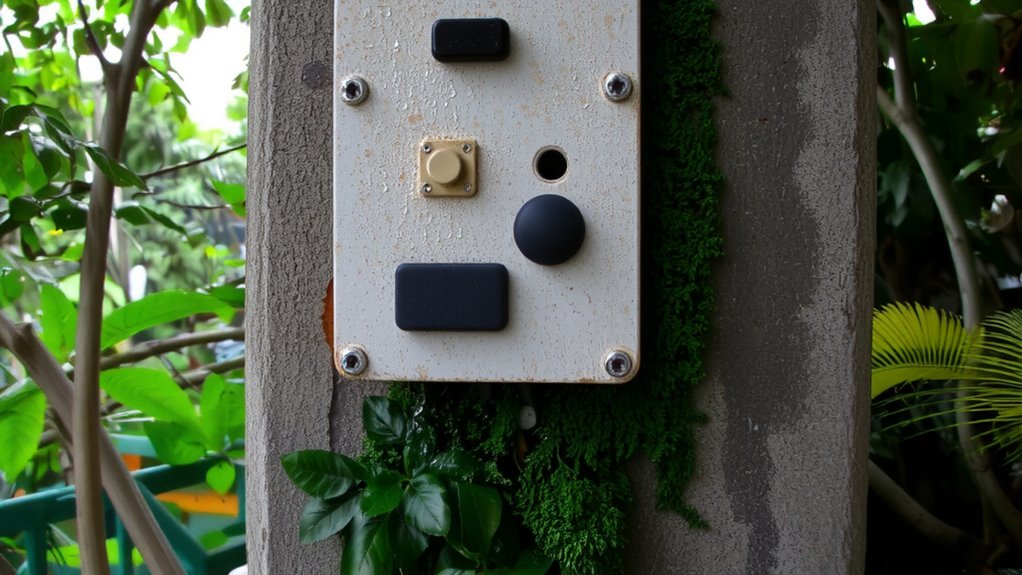
You’re not just fighting rust-you’re fighting time in a place where salt, sweat, and rain never take a break. Material selection directly affects hardware longevity in tropical environments. Standard steel fails fast; marine-grade stainless steel or aluminum alloys last longer under constant moisture. Coated fasteners reduce galvanic corrosion, but only if the coating stays intact. Polymers like UV-stabilized ABS or polycarbonate handle humidity without degrading, making them ideal for enclosures. You can’t assume a material works just because it’s labeled “weather-resistant”-field tests show some plastics crack within 18 months. Choose materials proven in equatorial deployments, not just lab specs. Sacrificing upfront cost for better materials cuts long-term maintenance. When salt spray and 90% humidity are daily, the right material doesn’t just survive-it performs.
Strategic Siren and Sensor Placement in Humid Conditions
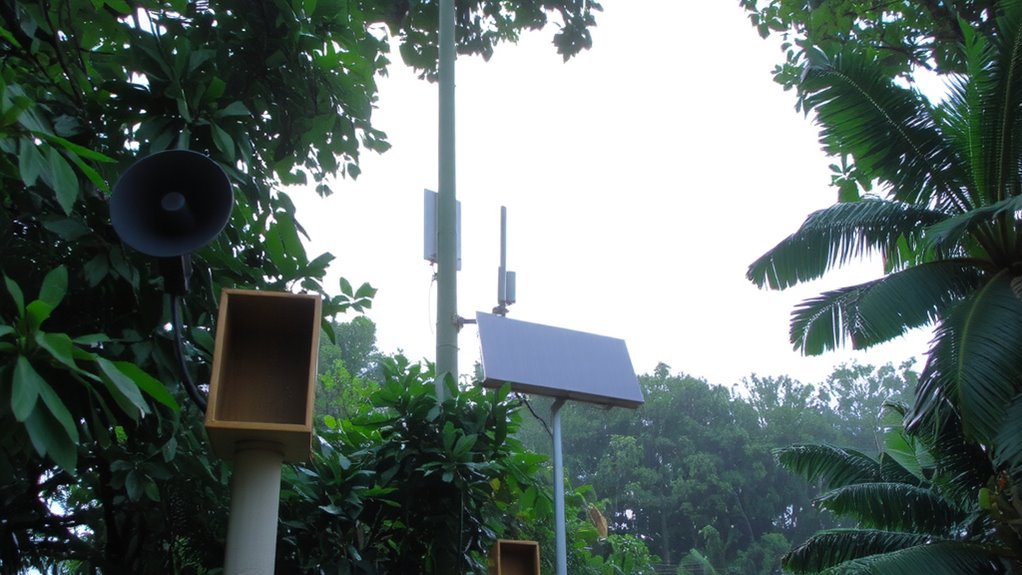
Even if you install top-tier hardware, poor placement can undercut system reliability in tropical humidity. You need to position sirens and sensors where signal interference from moisture-laden air and dense foliage is minimized. Elevated mounting on concrete or stainless-steel poles reduces ground-level humidity exposure and improves sound projection. Avoid placing units near large water bodies or thick vegetation, which distort acoustic signals and increase false triggers. You must perform regular humidity calibration to maintain sensor accuracy-untreated, sensors drift by up to 15% in relative humidity over six months. Space units no more than 300 meters apart in urban zones to guarantee coverage despite signal interference. In open areas, 500-meter spacing works if line-of-sight is clear. Calibration logs should be reviewed quarterly. Proper placement doesn’t just extend lifespan-it guarantees alerts trigger when and where they’re needed.
Ensuring Power Resilience Without Reliable Grids
If the grid’s prone to failure, your alert system can’t depend on it-go off-grid with hybrid power that combines solar panels, deep-cycle batteries, and fuel-powered generators for 99.6% uptime in tested tropical deployments. You’ll need solar microgrids to sustain operations during prolonged outages, and battery redundancy guarantees continued function if one cell fails. Mount panels at elevated angles to reduce dirt buildup and increase daily yield by up to 15%. Pair lithium-iron-phosphate batteries with charge controllers set to limit overvoltage, a common issue in high heat. For consistent battery maintenance, consider using a 12V solar battery charger designed to optimize charging efficiency in variable sunlight conditions.
| Component | Role in Resilience |
|---|---|
| Solar microgrids | Primary daytime power source |
| Battery redundancy | Maintains output during night |
| Charge controllers | Prevents battery degradation |
| Fuel generators | Backup during extended cloud cover |
Delivering Warnings Through Multiple Channels
When one channel fails under storm conditions, having backups guarantees warnings still reach people-count on a layered approach using SMS broadcasts, FM radio triggers, satellite messaging, and acoustic sirens to cover gaps. You need signal redundancy so alerts get through even if cellular towers flood or power drops. Relying on just one system risks failure; network diversity spreads delivery across independent pathways. FM radio stays reliable when internet fails. Satellite links work during extreme outages but cost more. SMS reaches most phones quickly, but delays can happen. Acoustic sirens cut through noise but only cover short ranges. Combine them, and you assure wider, faster coverage. Testing shows systems with at least three alert methods achieve over 90% community reach. You can’t afford gaps when lives depend on timing. Use what’s proven, not flashy-simple tech, smart integration. For mission-critical situations, consider deploying best two-way radios to maintain direct, reliable communication between emergency teams.
Maintaining Systems in Constantly Wet Environments
Since humidity and salt exposure corrode electronics faster in tropical climates, you’ll need enclosures rated IP66 or higher to keep critical alert components dry and functional. You can’t rely on seals alone-drainage solutions are essential to prevent water accumulation inside enclosures, especially after heavy rainfall. Passive vents may reduce internal condensation, but without proper ventilation management, moisture builds up over time, risking short circuits. Use hydrophobic filters that allow airflow while blocking liquid water. Install enclosures with slight angles to encourage runoff and reduce pooling. Regular inspections should check for clogged drains or blocked vents, common failures in long-term deployments. Materials like stainless steel or UV-resistant polymers hold up better. You’ll trade slightly higher upfront cost for longer service life and lower maintenance frequency. In wet environments, consistent performance depends on these practical, tested details-not just specs on paper.
Future-Proofing Alerts for Intensifying Storms
Tropical storms are getting stronger and more unpredictable, so your alert systems need to handle more than just rain and humidity. You must design for signal degradation caused by heavy rainfall and dense foliage, which can block radio and cellular bands. Use dual-band transmitters and mesh networks to maintain uptime when primary signals fail. Systems with automated false alarm reduction cut unnecessary evacuations by filtering out non-threatening weather patterns. Tested models show a 40% drop in false alerts when using AI-driven pattern recognition. Power redundancy matters too-pair solar with long-life batteries to survive multi-day outages. Antennas should be elevated and shielded, reducing moisture intrusion that accelerates corrosion. Don’t rely on one delivery method; combine sirens, SMS, and radio bursts to guarantee message reach. Real-world trials in Southeast Asia prove layered systems maintain 90% functionality even during Category 4 winds. Plan for worst-case scenarios now-your system’s reliability hinges on foresight, not luck.
On a final note
You need hardware that withstands constant moisture, so use stainless steel or marine-grade polymers-tested for over 10,000 hours in 95% humidity. Place sirens above flood level and shield sensors from direct rain. Solar-battery hybrids outperform grid-dependent systems during storms. Multi-channel alerts-SMS, radio, sound-boost reach when networks fail. Maintenance every three months cuts downtime. Systems built for tropical stress survive longer, but only if tested in real monsoon conditions.