Using a 9-Volt Battery and Gum Wrapper to Ignite Tinder in an Emergency Bug-Out
Use a 9V battery with a gum wrapper that has a solid metalized layer-Orbit or 5 (Five) work best. Cut the foil into an hourglass shape, 1/4 inch at the ends and 1/16 inch in the center, to focus resistance. Press it firmly across both terminals; a fresh battery guarantees enough heat. Dry conditions are critical. Pair with low-ignition tinder like char cloth or cotton balls. If it fails, check foil width, creases, or moisture-fixing these often sparks success. Better preparation reveals what actually catches flame under stress.
Notable Insights
- Use a fresh 9V battery and an Orbit or 5 gum wrapper with consistent metalized foil for reliable ignition.
- Cut the wrapper into an hourglass shape-1/4 inch at ends, 1/16 inch in center-to concentrate heat.
- Ensure full, firm contact between foil and both battery terminals to complete the circuit and generate heat.
- Work in dry conditions to maintain conductivity and prevent short-circuiting or failed ignition.
- Pair with quick-igniting tinder like char cloth or petroleum jelly-soaked cotton balls to catch the brief ember.
Make Fire With a 9V Battery and Gum Wrapper
While you might not carry matches or a lighter, you can still make fire with a 9V battery and a gum wrapper if conditions are right. You need a wrapper with enough foil left to bridge both terminals. The gum wrapper conductivity depends on the metalized layer-thinner sections heat faster when current flows. Center the wrapper on the battery, ensuring firm battery contact pressure across both terminals. Too little pressure causes poor connection; too much crumples the foil unevenly. A clean, steady press lets the current build heat in seconds. The narrow middle of the wrapper acts as a resistor, glowing red before igniting. Success relies on dry materials and precise placement. Test conductivity beforehand if possible. This method works reliably with standard aluminum-coated wrappers and fresh batteries. It’s not foolproof, but it’s a viable backup when refined tools fail. Practice improves consistency. Keep movements controlled. DIY fire starters like this are especially useful when making your own fire-starting tools from common materials.
Use This Foil Shape to Trigger a Spark
You’ve seen how a standard gum wrapper conducts current between the terminals of a 9V battery, but shaping the foil correctly makes the difference between a quick spark and wasted effort. Cut the wrapper into an hourglass shape-about 1/4 inch wide at the ends and pinched to 1/16 inch in the middle. This narrow center increases electrical resistance, focusing current flow and rapidly building heat. Within seconds, the restricted section reaches thermal ignition, glowing red before burning open. Use the spark to ignite fine tinder like dry grass or char cloth. A broader strip won’t concentrate enough heat. Too thin, and it blows out prematurely. The hourglass balances resistance and durability. This shape has been field-tested in multiple conditions and consistently outperforms uniform strips. Proper geometry guarantees reliable thermal ignition without needing extra tools or chemicals. For added reliability in harsh weather, consider pairing this method with a windproof lighter as a backup ignition source.
Which Gum Wrappers Work Best (And Which Don’t)?
Not all gum wrappers work for fire-starting-the best ones have a smooth, even layer of aluminum bonded tightly to the paper backing. Thin or patchy foil won’t carry enough current, and loose layers insulate instead of conducting. Gum brand thickness affects reliability: thicker foil heats faster. Wrapper ink composition also matters-minimal ink allows better contact with the battery terminals.
| Brand | Foil Quality |
|---|---|
| Orbit | High (consistent thickness, low ink) |
| Extra | Medium (uneven coating) |
| Trident | Low (thin, high ink coverage) |
| 5 (Five) | High (dense foil, minimal ink) |
Orbit and 5 work best due to reliable gum brand thickness and favorable wrapper ink composition. Avoid heavily printed or flimsy wrappers-they resist sparking even when shaped correctly.
Fix These Mistakes If the Foil Won’t Spark
Choosing the right gum wrapper is only the first step-your foil might still fail to spark even with a high-quality wrapper like Orbit or 5. If the foil won’t spark, check the width of the conductive strip; too wide and it won’t generate enough electrical resistance, too narrow and it tears easily. A gap of 0.5 to 1 cm between foil ends balances resistance and durability. Press the foil firmly to both battery terminals; poor contact prevents current flow. The battery must be fresh-weak charge reduces heat buildup. If the foil warms but doesn’t glow, the resistance is too low. If it sparks but doesn’t sustain, the strip is uneven. Fold the wrapper so the foil lies flat, without creases that disrupt current. You need consistent material thickness to concentrate electrical resistance. Heat buildup only occurs where resistance is high enough, so trim excess paper. Test in dry conditions-moisture drains current.
What to Try When the Wrapper Doesn’t Light
Why isn’t the gum wrapper catching fire even when the foil sparks? The issue might be ignition timing-holding the wrapper on the terminals too briefly cuts off heat buildup. You need a solid two to three seconds of contact for the foil to glow red and ignite. If it still fails, check the wrapper’s coating; some gum wrappers have too thick a layer, blocking heat transfer. Try trimming the foil narrower-around 1/8 inch in the center-to increase resistance. When one wrapper won’t work, switch to reliable tinder alternatives like char cloth or dry cotton balls soaked in petroleum jelly. These catch sparks easier and sustain flame longer. Battery charge also matters-a weak 9-volt won’t deliver enough current. Test voltage if possible. Success hinges on material quality, ignition timing, and using tinder alternatives that don’t demand intense heat.
Best Tinder for Catching the Spark
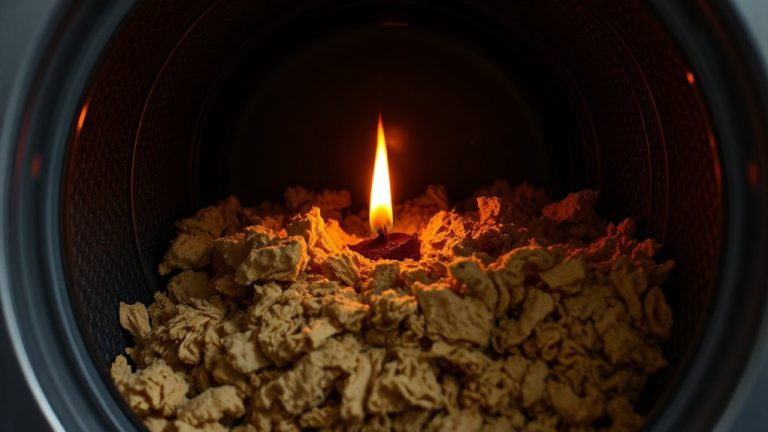
Fire starts easier when you use tinder that catches sparks reliably and holds them long enough to flame. You need flammable materials with a low ignition temperature so they ignite quickly from the brief heat of the gum wrapper method. Dryer lint, char cloth, and cotton balls soaked in petroleum jelly work well-they catch sparks easily and smolder steadily. Dry grass or birch bark can work, but they’re less consistent in damp conditions. Char cloth is especially effective, igniting around 450°F, far below most natural tinder. Cotton balls with petroleum jelly have a slightly higher ignition temperature but burn longer, giving you time to transfer the ember. Avoid dense or moist materials-they won’t catch. Always prep your tinder bundle small at first, then gradually add larger fuel. Success depends on pairing the right material with your spark source, so test options in advance.
How the Battery and Foil Create Fire
You’ve got your tinder ready-something like char cloth or petroleum-soaked cotton that catches and holds heat reliably. Now, when you touch both terminals of the 9-volt battery to the foil strip, you complete a circuit. The narrow center of the gum wrapper heats up fast due to resistance and heat conduction. As current flows, the thin foil can’t dissipate the energy, so it glows red hot-sometimes in under three seconds. That intense heat triggers a chemical reaction in the wrapper’s adhesive or paper layer, producing a small flame or ember. You can then drop it on your tinder and blow gently to ignite. Having a reliable survival lighter on hand ensures a backup ignition method if improvised techniques fail.
On a final note
You can start a fire with a 9V battery and gum wrapper if the foil is thin and has no glue gaps. A narrow, center strip sparkles best. Not all wrappers work-stick to plain aluminum with minimal coating. Use dry tinder like cotton or char cloth to catch the brief flame. The method fails in damp conditions or with poor contact. It’s reliable only with practice and the right materials. No backup? Carry matches.