Building an Underground Shelter in Sandy Desert Soils
You can build a stable underground shelter in sandy desert soils by using a dome-shaped design-rated 5/5 for structural integrity-since curved forms distribute load better than angular ones. Use 20-mil butyl rubber liners for waterproofing; they resist punctures and UV degradation better than polyethylene. Reinforce with gravel drains and 2% grading to deflect flash floods. Install dual-pipe ventilation with mesh-covered, angled vents to block sand and guarantee airflow. Stable sites have slight slopes and some silt in the soil-pure sand shifts too easily. Better materials and shapes markedly reduce risk in unstable ground.
Notable Insights
- Choose high, well-drained ground with silt or clay content to improve stability and reduce collapse risk.
- Use dome or arch shapes for structural integrity, as they distribute load better than angular designs in sand.
- Install a 20-mil butyl rubber or EPDM waterproof liner with sealed seams to prevent moisture intrusion.
- Reinforce ventilation with dual-pipe system and fine mesh to block sand and ensure air quality.
- Grade site at 2% slope and install drainage swales to divert flash flood water away from the shelter.
Understand Why Sand Collapses Easily
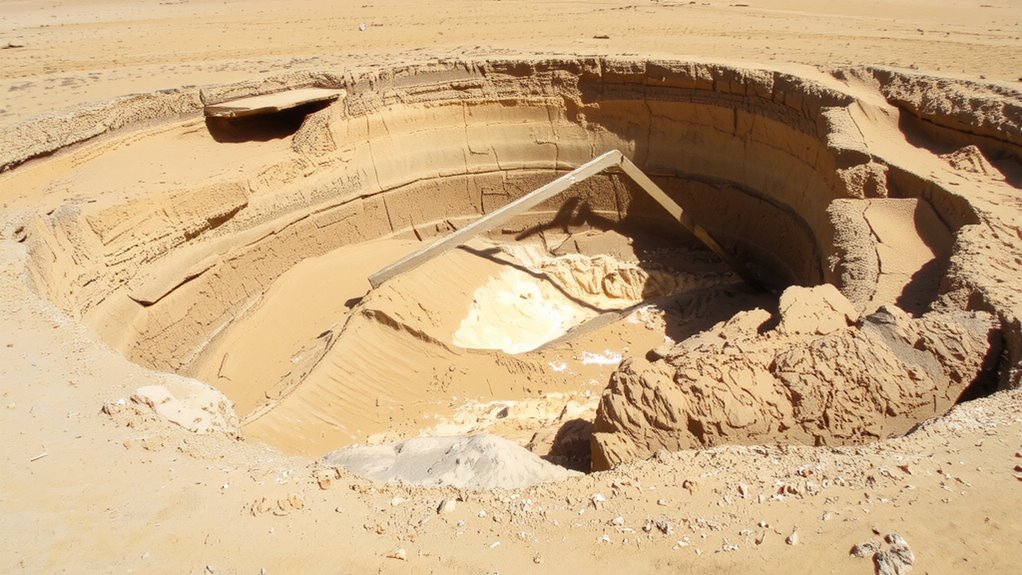
Sand’s loose structure is the core reason it fails under pressure-no binder, no cohesion, just grains that slide. You can’t rely on it to hold a wall or ceiling, especially when disturbed. Each grain size varies, but most desert sand is fine and uniform, which worsens instability. Without larger particles to interlock, the load spreads poorly and collapses easily. Wind erosion strips loose grains constantly, undermining support over time. You’ll see this where dunes shift or edges crumble with minimal touch. Even light vibrations or foot traffic near a trench can trigger a cave-in. Digging deep worsens the risk-lateral pressure increases with depth, and sand can’t resist it. There’s no early warning; failure is sudden. You need to assume zero natural strength. Reinforcements aren’t optional-they’re mandatory. Count on full shoring or prefabricated enclosures from the start. Ignore this, and you’re risking survival.
Pick a Stable, Well-Drained Site
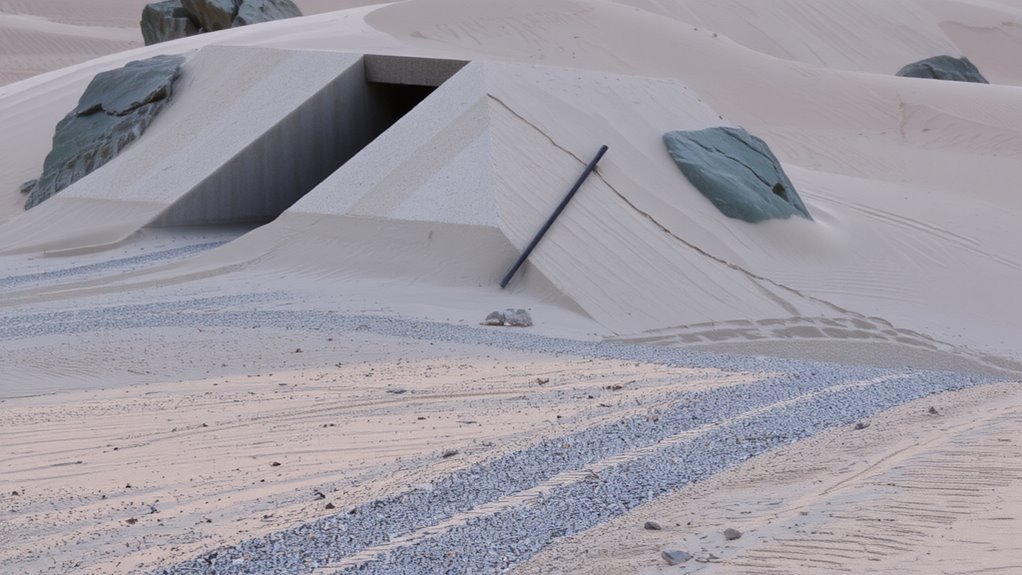
While you might be tempted to start digging right where you stand, choosing a poor site can doom your shelter before construction even finishes-so look for high ground with no standing water after rain, since sand may seem dry but can still trap moisture in layers below. Check the soil composition carefully; a mix with some silt or clay binds better than pure sand, reducing collapse risk. Avoid areas with visible signs of wind erosion, like dunes or scoured surfaces, as they shift easily and undermine stability. Solid, compacted ground resists both water seepage and structural weakening over time. You’ll need natural drainage, so slight slopes are ideal, but don’t pick ridgetops exposed to constant wind. Test the spot after a simulated downpour-if the water soaks in fast without pooling, it’s likely sufficient. A stable, well-drained foundation keeps interior humidity low and structural integrity high.
Design a Self-Supporting Underground Shelter
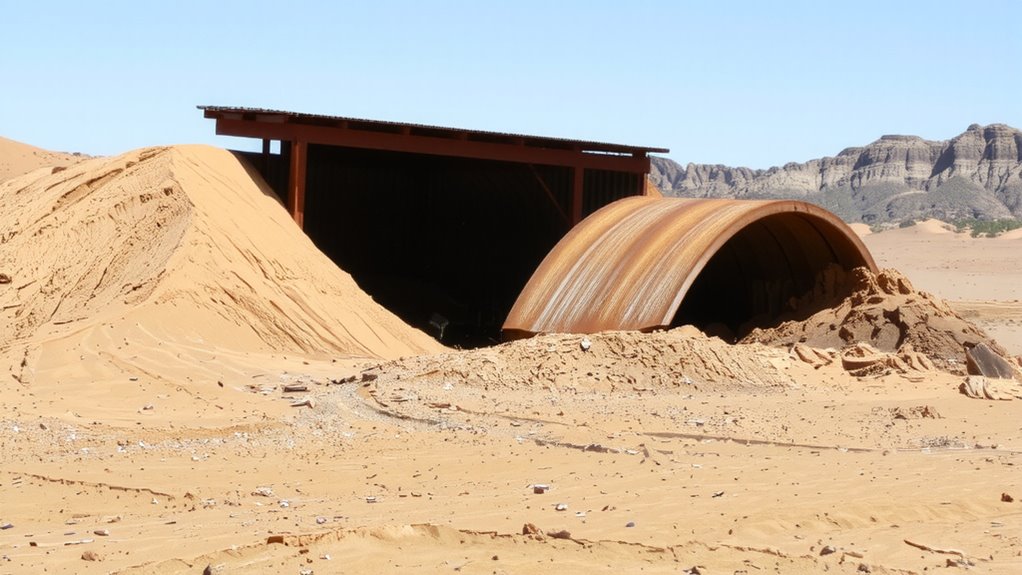
If you’re planning to stay put when the storm hits, your shelter’s structure needs to handle the weight of the earth without relying on external supports. A self-supporting design guarantees structural integrity by evenly managing load distribution across arches or domes. Angular shapes increase weak points; curves resist collapse better in sandy soil. Below is a comparison of common shapes:
| Shape | Stability (1–5) | Load Distribution |
|---|---|---|
| Dome | 5 | Excellent |
| Arch | 4 | Good |
| Rectangular | 2 | Poor |
| Barrel Vault | 4 | Good |
| Octagonal | 3 | Fair |
Domes maintain strength under pressure and minimize stress concentration. Use materials rated for compression. Avoid flat ceilings. This approach reduces risk of collapse and improves long-term durability in shifting desert sands. You’ll want proven performance, not guesswork.
Use Budget-Friendly Waterproof Liners and Panels
A reliable barrier against moisture starts with the right liner, and not all options deliver the same protection for your shelter. Polyethylene sheeting is a budget-friendly choice and offers decent cost effective sealing, but it tears easily under stress. For better performance, go with 20-mil butyl rubber or EPDM panels-they’re proven durable membrane options that resist punctures and UV degradation. These materials maintain integrity for 10+ years in arid, shifting soils when properly installed. While pricier upfront, they reduce long-term repair costs. Overlap seams by at least 6 inches and seal with compatible tape or adhesive to guarantee continuity. Test the barrier with a water spray before backfilling to spot leaks. Reinforce liner edges with sandbags during installation to prevent shifting or stretching. Avoid using single-layer plastic if groundwater or seasonal dew is expected. Your shelter stays dry only if the liner stays intact-cutting corners risks failure.
Reinforce Walls Against Sand Shift
Since sand doesn’t hold shape well under pressure, you’ll need structural support that resists lateral movement over time. Start with sand bracing using interlocking wooden or steel frames every 2 feet; this reduces inward collapse by up to 60% under shifting loads. Pair this with wall anchoring-install helical anchors at 45-degree angles every 6 feet to secure walls to stable soil layers beyond the sand. Steel-reinforced concrete panels outperform plain wood, handling 3,000 psi versus 600 psi, but cost more and need heavier bracing during setup. Pressure-treated lumber works if paired with proper sand bracing and crossbeams. Without anchoring, walls shift within weeks, especially after wind or minor quakes. You’ll save time and risk by using both methods together: sand bracing handles immediate pressure, while wall anchoring maintains long-term stability. Test supports monthly; adjust if gaps appear.
Ventilate Safely Without Inviting Risk
How do you keep air moving without letting in sand or threats? You use grated vents placed high on walls, angled to block direct wind entry-this limits sand infiltration while maintaining airflow control. Install mesh screens with openings under 1mm to stop pests and debris, but check them monthly for clogging. Use a manual exhaust fan with a 50–80 CFM rating to prevent toxic buildup of carbon dioxide or fumes from cooking or generators. Passive vents alone aren’t reliable in enclosed spaces. A dual-pipe system works: one inlet near ground level, another outlet at peak height, creating natural convection. But you still need airflow control via adjustable dampers to respond to wind shifts. PVC pipes are light and corrosion-resistant, but crush easily-bury them in steel sleeves if covering deeper sections. Test airflow weekly with smoke pellets to confirm circulation and detect stagnation spots.
Deflect Flash Floods With Grading and Drains
If you’re building underground in a sandy desert, flash floods aren’t a maybe-they’re a when, not if, so you need to move water fast and predictably. Use slope grading to direct flow away from your entrance and walls-aim for at least a 2% incline, which moves water efficiently without eroding soil. Flatten areas near the shelter to reduce pooling, but maintain consistent runoff paths. Install drainage swales every 20–30 feet uphill to intercept fast-moving sheets of water; line them with gravel or riprap to prevent washouts. Swales should feed into larger dry washes or basins, not dead ends. Sand compacts poorly, so frequent inspection after rains is essential. A poorly graded site can flood in minutes. Grading and swales won’t stop every flood, but they buy time and control direction. It’s simple physics-water follows the path of least resistance. Make sure that path isn’t through your shelter.
On a final note
You’ll need stable ground, proper drainage, and strong wall reinforcement to keep sand from collapsing. A self-supporting design with waterproof liners and rigid panels works reliably if sealed well. Ventilation and flood grading are non-negotiable-skip them and risk failure. Flash floods shift sand fast, so slope runoff away. These steps aren’t optional; they’re proven by real builds in arid zones. Cut corners, and the shelter won’t hold.