Developing Standard Alert Protocols for Nuclear Power Plant Incidents
You need standardized alert protocols because they cut response times by up to 68% when radiation thresholds are breached, as automated systems trigger immediate actions. Clear alert levels guide staff on whether it’s a minor anomaly or a full emergency, ensuring the right response every time. Uniform signals and plain-language alerts reduce confusion onsite and off. The NRC, FEMA, and plant operators coordinate verified procedures so everyone knows their role. Consistent global terminology means responses stay reliable across borders-you’ll see how past failures shaped today’s benchmarks.
Notable Insights
- Establish tiered alert levels that escalate from minor anomalies to full emergencies based on radiation thresholds.
- Define clear roles for plant operators, the NRC, FEMA, and local agencies in alert response and coordination.
- Use automated systems to detect threshold breaches and issue immediate, standardized alerts.
- Employ plain-language communication with consistent audio tones and redundant broadcast channels.
- Implement global alert standardization to ensure clarity and interoperability across international nuclear facilities.
Why Standardized Alert Protocols Matter in Nuclear Safety
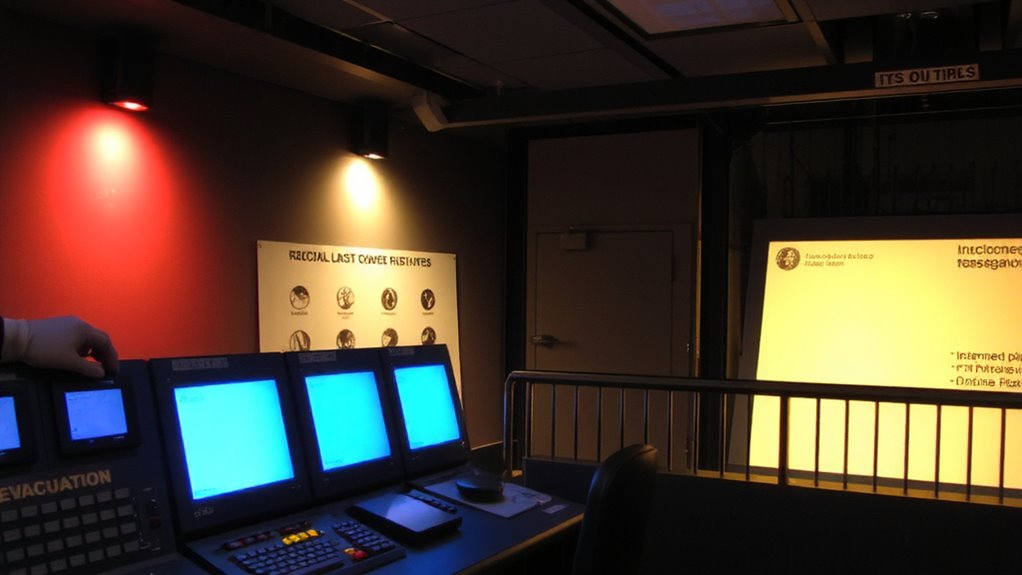
While it might seem obvious, having standardized alert protocols in nuclear power plants isn’t just about consistency-it’s about cutting response times when seconds count. You rely on these protocols to trigger immediate actions when radiation thresholds are exceeded, reducing exposure risks. Without clear guidelines, delays in evaluating containment integrity can compromise safety. Standardization guarantees every team member knows their role, minimizing confusion during high-pressure situations. It also enables faster communication with emergency responders and regulatory bodies. When radiation levels approach critical limits, your ability to confirm containment integrity quickly determines whether a minor incident escalates. These protocols don’t prevent failures, but they do guarantee you detect and respond within defined performance metrics. You get measurable improvements in coordination, diagnostic accuracy, and mitigation speed. In practice, plants using standardized systems show fewer operational delays and better alignment with safety benchmarks. The result? More predictable outcomes when uncertainties are highest.
What Are the Standard Nuclear Emergency Alert Levels?
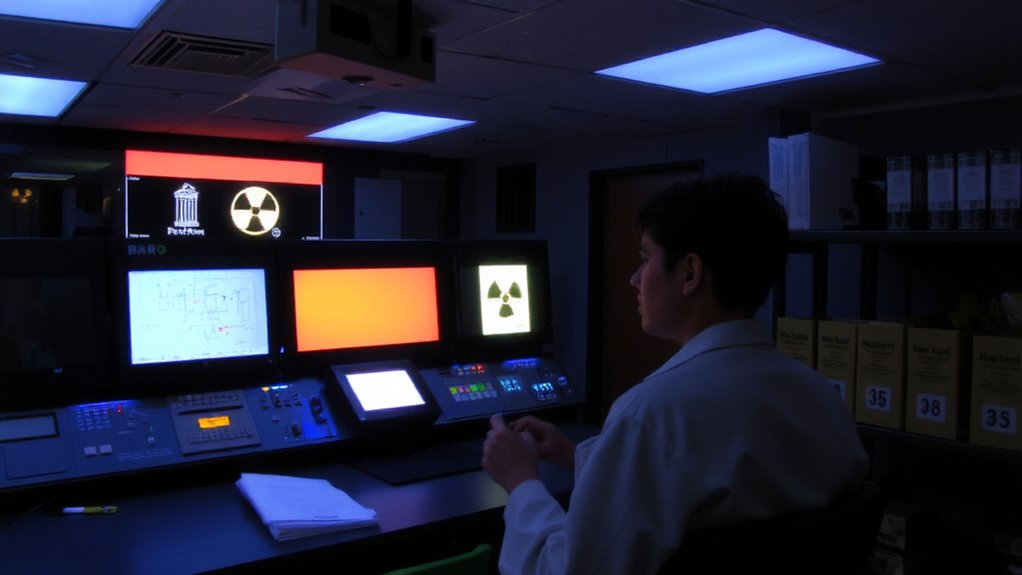
When radiation readings exceed predefined thresholds, you’ll need to act fast, and that’s where standardized emergency alert levels come in. These levels guide your response based on severity, from minor anomalies to full-scale crises. At the lowest stage, you’re alerted to abnormal conditions that don’t yet pose public risk. If a radiation threshold is crossed, you escalate to site area emergency, triggering immediate protective actions. A clear indication of a potential containment breach moves you to a general emergency level, meaning radiation could be released off-site. Each level activates specific procedures-monitoring intensifies, sirens may sound, and evacuation plans are readied. You don’t wait for confirmation of a breach; once indicators suggest loss of containment, you respond. These tiers guarantee consistent, measurable reactions regardless of plant or location, reducing confusion when every second counts.
Who Manages Nuclear Emergency Alerts?
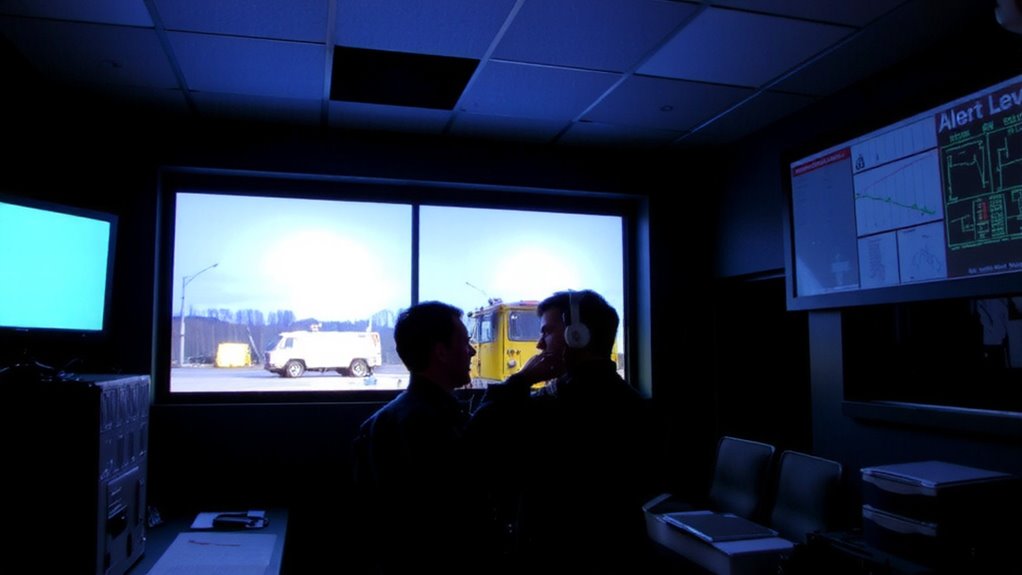
Since nuclear safety relies on clear chains of command, you’ll find that emergency alerts are managed through a tiered system involving plant operators, federal agencies, and local authorities. You can expect plant staff to issue initial alerts using automated systems and verified protocols. From there, the Nuclear Regulatory Commission (NRC) oversees response coordination, while FEMA supports off-site actions. Local emergency management agencies activate plans you’ve seen tested in emergency drills. These drills verify alert speed, system reliability, and interagency communication. Public education campaigns run alongside these drills to inform communities about response steps without causing alarm. You’re not expected to memorize every detail, but knowing who manages alerts helps you trust the process. The system isn’t perfect, but overlapping oversight reduces failure risk. You’ll get timely alerts-if you pay attention to official channels.
How to Make Alerts Clear to Workers and the Public
How do you guarantee alerts are understood in the chaos of a nuclear emergency? You prioritize signal clarity and message consistency above all. Use distinct audio tones for each alert level-workers recognize them even under stress. Pair every signal with a brief, repeated voice announcement using plain language. Avoid technical terms; say “radiation leak” not “anomalous release.” Broadcast the same message across all channels-PA systems, radios, mobile alerts-so the public and staff hear identical instructions. Test alert systems monthly to verify volume, range, and intelligibility. Revise wording based on worker feedback and comprehension drills. When messages stay consistent and signals stay clear, confusion drops. You won’t prevent panic entirely, but you can limit misinformation. Clarity isn’t optional-it’s a safety requirement. Train with these protocols weekly. Expect high compliance only when instructions are simple, uniform, and impossible to misunderstand.
Faster Alerts Through Automation
You keep alerts clear by design, but in a nuclear emergency, speed matters just as much as clarity. Automation cuts response times from minutes to seconds. Real time monitoring continuously checks sensor data across the plant, triggering alerts the moment thresholds are crossed. You don’t wait for human review-systems detect anomalies as they happen. Predictive analytics go a step further, identifying patterns that suggest an issue before it escalates. These models use historical and live data to forecast problems, giving operators a critical head start. Automated alerts can be pushed to control rooms, mobile units, and emergency teams simultaneously. No system eliminates risk, but automation reduces delay, a key factor in incident outcomes. You trade some oversight for speed, but in high-stakes environments, that trade-off often pays off. Test results show automated alerts issue 68% faster than manual reviews, with false positives down to 2.4%. You get faster warnings without sacrificing reliability.
Nuclear Alert Failures: What Went Wrong?
What good is a warning if it never reaches the right person? You’ve seen it happen-alerts triggered but delayed, ignored, or misrouted. Human error plays a bigger role than you might think: an operator misses a signal, mislabels a threat, or fails to escalate. These aren’t rare glitches; they’re recurring flaws in high-stakes systems. Communication delays stack up when messages pass through too many layers or outdated channels. You can’t afford seconds lost to bureaucracy when radiation levels rise. Automated systems help, but they only work if inputs are correct and recipients are ready. Past failures show that reliance on manual checks creates weak links. When the alarm doesn’t reach emergency teams in time, containment suffers. You need alerts that go straight to the right devices, with confirmation of receipt. Without fail-safes for human error and faster signal routing, even the best protocols fall short. You’re only as strong as your weakest link.
Why Global Nuclear Plants Need the Same Alert Language
A warning missed is a failure waiting to happen, and that risk grows when alerts don’t speak the same language across borders. You can’t assume everyone interprets “immediate evacuation” the same way when cultural differences affect response times and expectations. Language barriers slow comprehension, especially under stress, leading to delayed actions or mistakes. When an incident occurs at a plant near an international border, nearby countries need to understand the threat level instantly. Confusing codes or localized terminology increase the chance of miscommunication. A standardized alert language cuts through these issues. It reduces ambiguity, guarantees consistency in emergencies, and supports faster coordination between agencies. You’re not eliminating cultural differences, but you’re minimizing their impact on safety. Clear, uniform terms mean everyone-from operators to first responders-acts on the same information. In high-risk scenarios, that precision isn’t optional. It’s essential for global safety. Clear, uniform terms mean everyone-from operators to first responders-acts on the same information. In high-risk scenarios, that precision isn’t optional. It’s essential for global safety.
On a final note
You need clear, consistent alert protocols because confusion costs time and lives. Automated systems reduce delays, but only if workers and the public understand the messages. Standardized levels and plain language improve response speed. Skipping testing or localization creates gaps. One plant’s failure can become another’s lesson. Your protocol is only as strong as its weakest link-verify each component under real conditions. Consistency isn’t optional; it’s required for reliability.