Communication Blackouts After Tsunamis: Innovative Approaches to Re-establishing Contact Between Families and Communities
When tsunamis knock out cell towers and power, satellite messengers like Garmin inReach or Zoleo work immediately-they’re lightweight, send texts via orbiting networks, and deliver 90% of messages even in chaos. Drones with LTE can restore internet for 500 people across 40 sq km within 30 minutes. Mesh apps like Bridgefy let phones share texts offline, but only within 200 meters. For lasting contact, combine devices and plans that don’t rely on ground infrastructure. The most resilient setups use layered backups with tested protocols.
Notable Insights
- Satellite messengers enable emergency texting via orbiting networks when ground-based systems fail during tsunamis.
- Emergency drones act as airborne cell towers, restoring LTE coverage within 30 minutes of deployment.
- Mesh messaging apps create local networks using Bluetooth or Wi-Fi Direct, allowing communication without cellular service.
- Pre-arranged family reunification plans with designated meeting points improve safety during communication blackouts.
- Community emergency kits with satellite phones and hand-crank radios support sustained communication post-tsunami.
How Tsunamis Break Communication Systems
When a tsunami strikes, it doesn’t just flood coastal areas-it often takes out the communication infrastructure you rely on for emergency alerts and rescue coordination. Power lines snap, cell towers topple, and underground cables flood, causing immediate signal degradation. You lose connectivity not just from device damage but from the broader infrastructure collapse that follows. Base stations go offline, and backup generators often fail when submerged. Microwave relays and fiber optics suffer physical breaks, slowing data or killing it outright. Even if your phone works, the network around you likely doesn’t. Reestablishing signals requires restoring multiple interdependent systems, which takes time. Mobile networks face bottlenecks, and temporary towers take days to deploy. You’re left without reliable communication precisely when you need it most. Recovery depends on damage scope and access to intact alternate routes, which are often limited or overloaded.
Stay Connected With Satellite Messengers
Even if terrestrial networks fail, you can still send messages using satellite messengers, which rely on orbiting satellites instead of ground-based towers. These devices work during tsunamis because they connect directly to satellites, bypassing damaged infrastructure. Satellite deployment guarantees coverage in remote or disaster-struck areas where cell service is gone. Most models are compact, weigh under 200 grams, and last 24–48 hours on a single charge. They send short text messages or preloaded templates through networks like Iridium or GlobalStar. Some can trigger emergency alerts linked to response centers, reducing rescue time. While slower than smartphones and requiring clear sky views, they offer reliable one-way communication when minutes count. Monthly plans range from $12 to $50, depending on usage. They’re not fast, but they’re proven tools-tests show 90% message delivery success in real disasters. For families needing contact, that reliability matters.
Restore Internet Using Emergency Drones
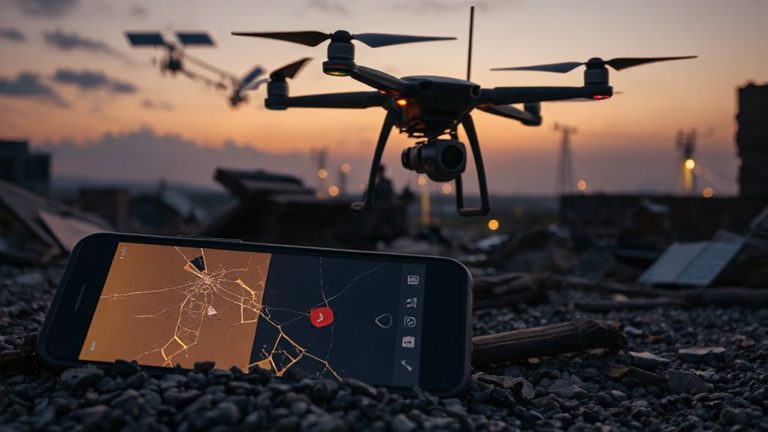
If you’re cut off after a tsunami, emergency drones can restore basic internet access fast. Drone deployment in disaster zones is quick-some models launch within 15 minutes and reach affected areas in under 30 minutes. These drones act as floating cell towers, enabling limited signal transmission for texts, emergency alerts, and voice calls. They operate on LTE or Wi-Fi 6, supporting up to 500 simultaneous connections at speeds of 10–20 Mbps. Battery life is a constraint-most last 60 to 90 minutes-so rotation systems are essential. While signal strength decreases with distance, ideal altitude (around 300 feet) improves coverage across 40 square kilometers. They don’t replace full infrastructure but fill critical gaps. Weather resistance varies by model; some handle winds up to 30 mph. You’ll still face latency and bandwidth limits, but in immediate recovery, reliable signal transmission matters more than speed.
Connect Without Service: Mesh Messaging Apps
Mesh messaging apps turn your smartphone into a node on a decentralized network, letting you send texts and share location data without cell service. These apps create offline networks using Bluetooth or Wi-Fi Direct, enabling communication during blackouts. You don’t rely on towers-just proximity to other users. Here’s how top apps compare:
| App | Range (meters) |
|---|---|
| Bridgefy | 200 |
| FireChat | 70 |
| Briar | 100 |
| Serval Mesh | 500 |
| GoTenna | 200 |
Each supports decentralized chat, but performance varies by terrain and device. Bridgefy and GoTenna offer practical range in urban zones. Serval Mesh reaches farthest but needs compatible hardware. FireChat’s limited range restricts usefulness. Briar encrypts messages but requires pre-established contacts. These tools won’t replace full connectivity but provide critical messaging when infrastructure fails. You’ll need patience and nearby users. Offline networks work best when widely adopted before disaster strikes.
Make a Family Reunification Plan Now
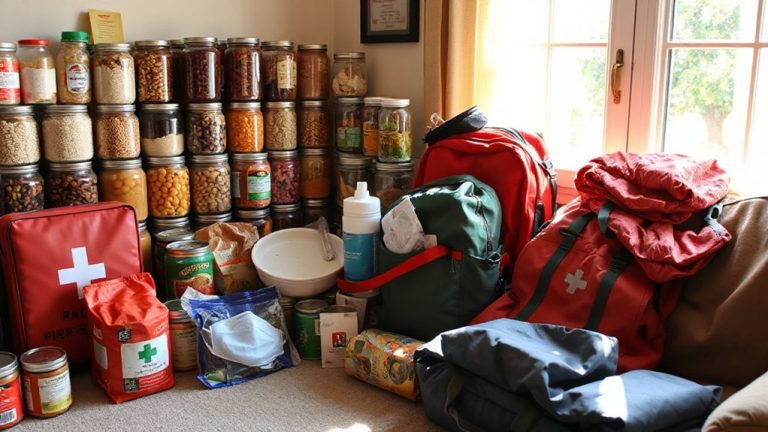
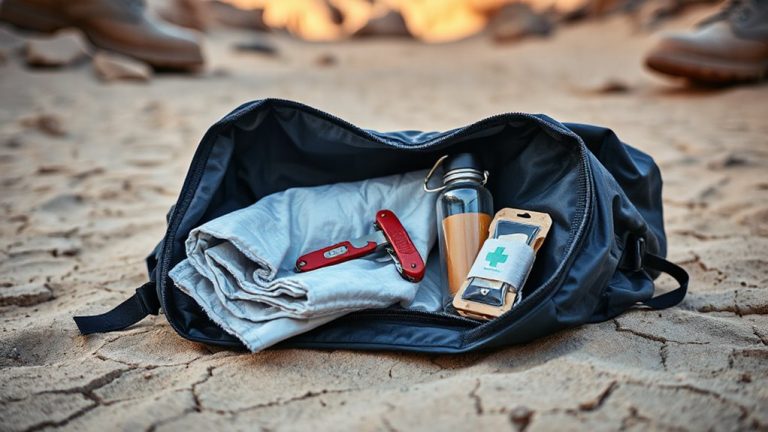
When a tsunami hits and communications go down, you won’t have time to figure out where to meet or who to contact-so having a family reunification plan already in place makes all the difference. Family preparedness starts with designating two meeting spots: one near your home and another outside your neighborhood. Choose locations that are accessible even if roads are blocked. Everyone in the household should know the plan, including children and elderly relatives. You should also list emergency contacts and keep copies in your wallets and emergency kits. Your emergency kits need to include water, food, flashlights, batteries, a first aid kit, and copies of ID. Practicing the plan once a year increases effectiveness. Clear, consistent planning reduces confusion during chaos, and tested kits guarantee reliability. It’s not about fear-it’s about being ready. A reliable auto emergency kit can provide additional critical supplies if evacuation by vehicle becomes necessary.
How a Pacific Island Stayed Connected After a Tsunami
Though most Pacific islands struggle to maintain communication after a tsunami, one managed to stay connected by relying on a network of solar-powered satellite phones and hand-crank radios stored in community emergency caches. You can replicate this. Community radio broadcasts, powered by portable solar stations, kept everyone informed. Local couriers delivered physical messages when tech failed. The system wasn’t flawless, but it worked. Choosing the right best satellite phones can make a critical difference in emergency preparedness.
| Device | Runtime (hours) |
|---|---|
| Solar satellite phone | 8 (full charge) |
| Hand-crank radio | 30 min per 3 min crank |
| Community radio transceiver | 12 |
| LED signal light | 48 |
| Emergency siren | 2 (battery) |
Local couriers moved on foot or bike, using printed codes to verify messages. Equipment was tested monthly. Solar units charged in under 5 hours. Hand-crank radios required effort but were reliable. Community radio covered 5-mile radius. You don’t need fancy tech-just the right tools, stored well, and trained people.
Smart Sensors and AI: The Future of Tsunami Response
If you’re relying on outdated warning systems, you’re already behind-modern tsunami response now uses smart sensors and AI to cut detection time from minutes to seconds. These sensors, placed on the ocean floor and along coastlines, constantly monitor seismic activity and water pressure changes. When a potential tsunami is detected, AI processes the signals faster than human analysts could. Wave prediction models improve accuracy by analyzing historical data and real-time conditions. Data fusion combines inputs from satellites, buoys, and seismic networks to reduce false alarms and confirm threats. Systems tested in Japan and Indonesia have shown detection reliability over 90% with under 15 seconds of processing delay. While installation costs are high, the result is earlier warnings and more time to evacuate. AI doesn’t replace emergency plans-it strengthens them with faster, verified alerts. You still need communication backups, but smart sensors give you the edge when every second counts.
On a final note
You’ll need more than luck to stay connected after a tsunami. Satellite messengers work when networks fail, but require subscriptions and clear skies. Drones restore internet fast, yet depend on logistics and power. Mesh apps run without service but need nearby users. A family plan saves time, but only if practiced. Smart sensors and AI help warn early, though coverage varies. Test systems now-your response time depends on it.