Designing a Water Storage System That Resists Earthquake-Induced Cracking
You need a tank that won’t crack when the ground shakes. Use base isolation to reduce structural strain by up to 70% and flexible liners to maintain watertight seals during movement. Steel-reinforced concrete with fiber mesh controls cracks, while expansion joints every 30 to 50 feet handle stress without leaking. Avoid rigid connections-they fail. Neoprene or EPDM seals rebound after compression. These systems stay online post-quake, and there’s more to how they’re tested and proven.
Notable Insights
- Use base isolation systems to decouple the tank from seismic ground motion and reduce structural strain by up to 70%.
- Install flexible liners to absorb deformation and maintain watertight integrity during seismic joint movement.
- Construct tanks with steel-reinforced, high-performance concrete to resist cracking and limit permeability under stress.
- Incorporate expansion joints with durable rubber seals every 30 to 50 feet to allow movement and prevent cracking.
- Design joints with flexible connections instead of rigid ones to withstand hydrodynamic pressure and reduce failure risk.
Why Earthquake-Resistant Water Tanks Are Critical
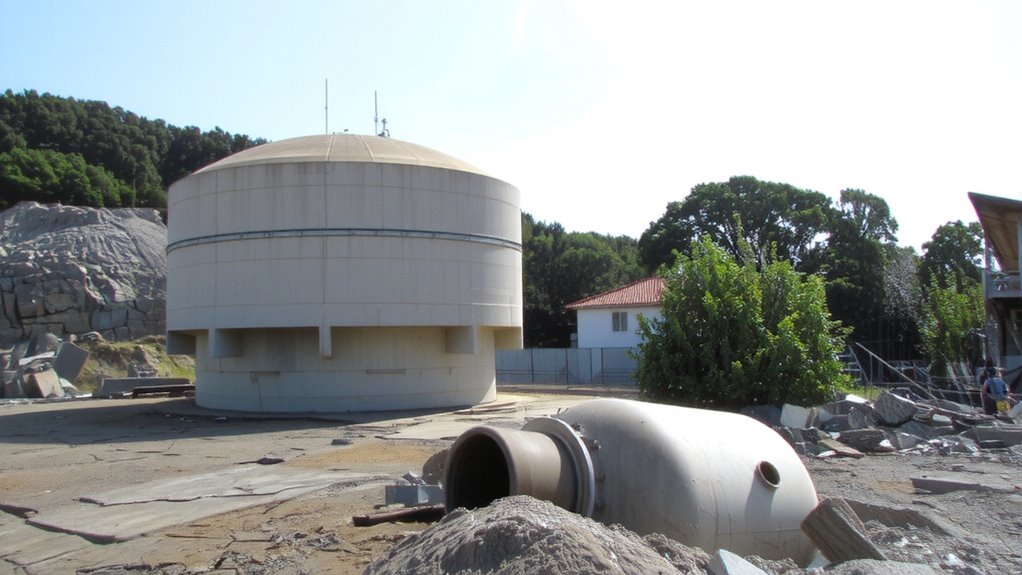
Water storage during quakes isn’t just about capacity-it’s about survival. You need water for drinking, sanitation, and medical use when systems fail. If your tank cracks, you lose that lifeline when it’s needed most. Earthquake-resistant tanks maintain integrity under seismic stress, ensuring water remains available post-quake. This directly supports effective emergency response-you won’t be dependent on delayed aid or compromised infrastructure. First responders rely on accessible water, too. Without it, firefighting and field operations suffer. Resilient tanks also boost public awareness. When communities see robust systems in place, they take preparedness seriously. It signals that planning matters. These tanks are tested to performance standards, simulating real quake conditions. Sure, they may cost more upfront, but the trade-off is reliability. You’re not buying a container-you’re investing in continuity. For any region at seismic risk, that’s a practical necessity, not a luxury. Homes using high-quality best water storage tanks experience far fewer failures during seismic events.
How Seismic Shaking Causes Tank Cracks
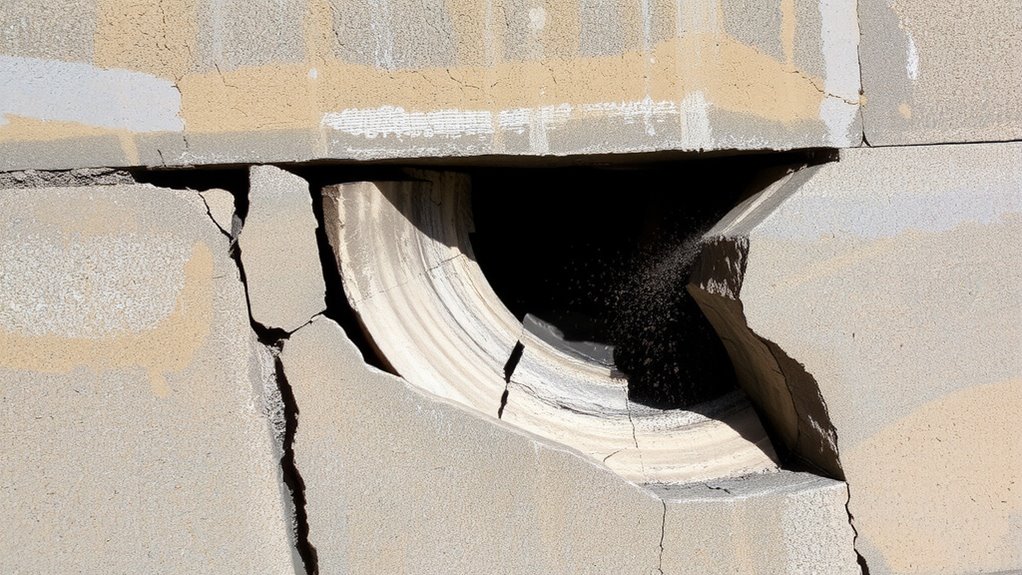
You’re not just building a tank-you’re anchoring a system that has to withstand violent, unpredictable shaking. During an earthquake, lateral ground motion pushes your tank back and forth, generating hydrodynamic pressure as the water inside surges. That pressure stresses walls and joints, often leading to cracks, especially near the base. If the supporting soil is loose or saturated, soil liquefaction can occur-turning firm ground into a fluid-like mess. When that happens, the tank may tilt or sink unevenly, adding strain. This combination of shifting earth and internal sloshing overwhelms rigid structures. Even minor settlement can open cracks that compromise integrity. You can’t prevent shaking, but you must anticipate how hydrodynamic pressure and soil liquefaction interact with your design. Real-world tests show tanks on stabilized foundations with proper anchoring resist damage better. The data is clear: unanchored or poorly founded systems fail under these dual forces.
Flexible Designs That Survive Ground Motion
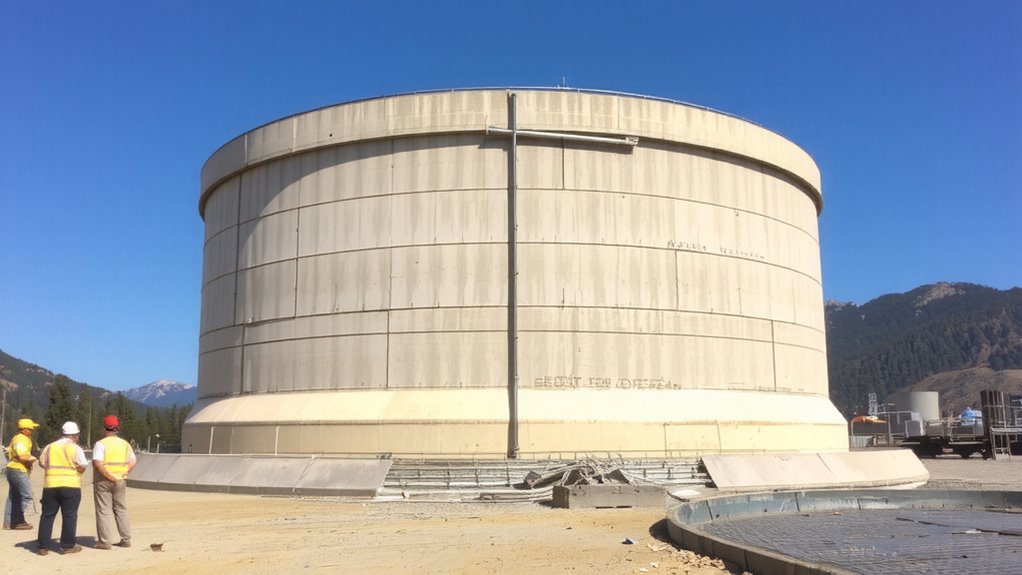
While rigid tanks often fail under seismic stress, flexible designs absorb and redistribute energy through controlled movement, reducing crack risk. You can achieve this with base isolation, which decouples the tank from ground motion, letting it shift without transferring full force. Base-isolated tanks show up to 70% less structural strain in shake tests. Flexible liners inside concrete or steel tanks also help, moving with the structure and sealing against leaks even when joints shift. These liners tolerate deformation that would rupture traditional coatings. In real-world quakes, tanks with both features survived with minimal damage, while rigid counterparts cracked. You’ll pay more upfront-base isolation adds cost and complexity-but the reduction in downtime and repair makes it practical for critical infrastructure. Flexibility isn’t about being soft; it’s about surviving motion by giving the system controlled ways to respond.
Stronger Materials for Seismic Zones
Base isolation and flexible liners help manage movement, but even the smartest design can’t compensate for weak materials when the ground shakes hard. You need materials that survive intense stress without cracking. Concrete reinforcement with fiber mesh or rebar boosts strength and controls crack propagation. Material durability matters just as much-chloride-resistant steel and low-permeability concrete resist corrosion and water loss over decades.
| Material | Performance Benefit |
|---|---|
| Steel-reinforced concrete | Handles high seismic loads |
| Fiber-reinforced polymer (FRP) | Lightweight, resists degradation |
| High-performance concrete (HPC) | Low permeability, superior durability |
Choose systems tested under real seismic simulations. Material durability paired with proper concrete reinforcement guarantees your tank won’t fail when it’s needed most. No design works if the material gives out.
Joints That Bend Without Breaking
Even when materials hold up, joints often become the weakest link during seismic events, so designing connections that flex without failing is critical. You need expansion joints that allow controlled movement while maintaining structural integrity. Rigid connections crack under stress, but well-placed expansion joints absorb shifting without leakage. Pair them with durable rubber seals that compress and rebound reliably, even after repeated deformation. These seals must resist tearing and maintain watertight performance under dynamic loads. Standard neoprene or EPDM rubber works well, offering proven resilience in temperature extremes and prolonged use. You’ll also want to anchor the joint hardware securely so movement stays within design limits. Over-engineering here adds cost, but under-sizing risks failure. Expansion joints spaced every 30 to 50 feet typically balance flexibility and strength in large tanks. Properly installed, with high-quality rubber seals, they deliver dependable performance when the ground moves. You’re not preventing motion-you’re managing it.
How Engineers Test Tanks for Earthquakes
When you’re verifying how well a water tank withstands seismic forces, laboratory and field tests give you the data you need to trust its design. You subject scale models to simulated earthquakes on shake tables, monitoring stress points and deformation. Full-scale tanks undergo controlled excitation to measure real-world responses. Effective tank anchoring prevents overturning and excessive displacement, but over-rigid connections can increase crack risk. Base isolation systems reduce force transfer by allowing controlled movement, though they require more space and maintenance. You compare failure modes across designs, noting how anchoring and isolation affect cracking and fluid sloshing. Test results inform adjustments in materials, joint flexibility, and foundation design. You don’t assume performance-you measure it. Data from repeated trials validates reliability. These methods guarantee the tank survives not just the shaking, but decades of service without degradation.
On a final note
You need water tanks that won’t crack when the ground shakes. Flexible designs and reinforced materials reduce failure risk, tested under real seismic loads. Joints that bend, not break, maintain integrity. Rigid concrete may resist pressure but often fails under movement. Steel and fiber-reinforced polymers perform better in high-risk zones. Your choice depends on location, cost, and durability trade-offs-test results prove it.