Penetrating Foggy Conditions Using Infrared Illuminators Paired With NVGs
You can see farther in fog with infrared illuminators and NVGs because IR light scatters less than visible light and penetrates moisture more effectively. Shorter visible wavelengths reflect off fog droplets, but longer IR wavelengths maintain direction and range. NVGs amplify this IR light into a usable image, letting you navigate in low visibility. In heavy fog, IR extends your effective vision to around 80 meters, double that of standard headlights. Go further, and you’ll find how wavelength choice impacts performance.
Notable Insights
- Infrared light penetrates fog better than visible light due to longer wavelengths reducing scattering and absorption by water droplets.
- IR illuminators in the 3–5 μm range are most effective for fog penetration, outperforming shorter 0.7–0.9 μm bands.
- Night vision goggles (NVGs) amplify IR light into visible images, enabling clear vision in fog when paired with IR illuminators.
- In heavy fog, IR-NVG systems can achieve up to 80m visibility, significantly surpassing the 20m limit of standard headlights.
- 850nm IR provides strong illumination with minor visible glow, while 940nm offers covert operation with slightly reduced range.
Why Fog Blinds Headlights: But Not IR
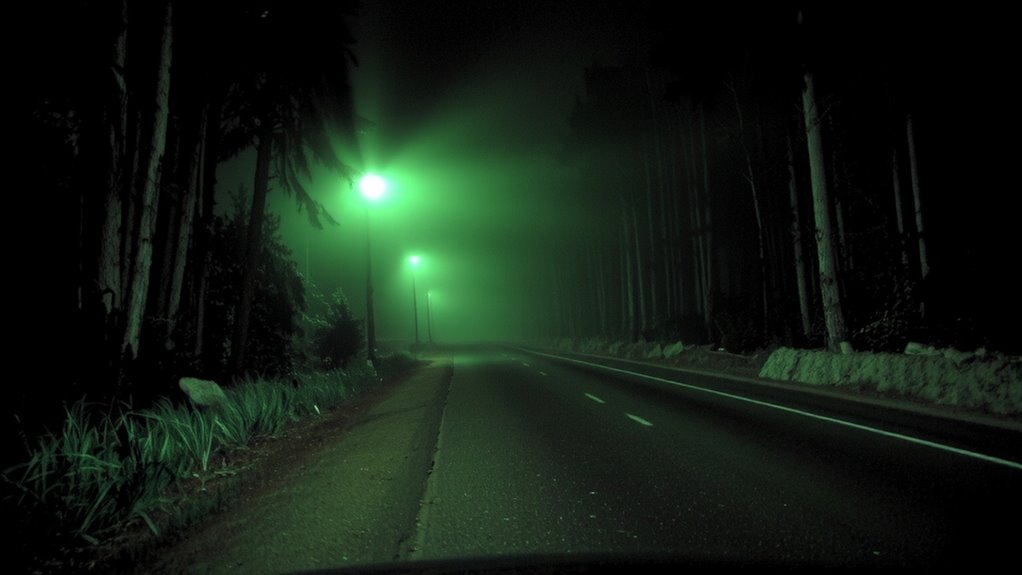
Why do your headlights turn fog into a glowing wall? Because visible light scatters heavily off water droplets, creating glare. This light scattering blocks your view by reflecting photons back at your eyes instead of letting them travel forward. Shorter wavelengths, like blue and white light, scatter the most, worsening visibility. Fog also absorbs some wavelengths through wavelength absorption, further reducing effective illumination. Your headlights simply can’t punch through. But infrared (IR) light behaves differently. With longer wavelengths, it’s less prone to scattering and not as affected by absorption in fog. That means IR beams travel farther with less diffusion. When paired with night vision goggles (NVGs), this lets you see beyond the fog’s glare. It’s not magic-just physics. IR avoids the scattering trap visible light falls into, giving you a clearer, longer-range view when conditions turn bad. That’s a measurable advantage in low-visibility navigation.
How IR Light Penetrates Fog Better Than Visible Light
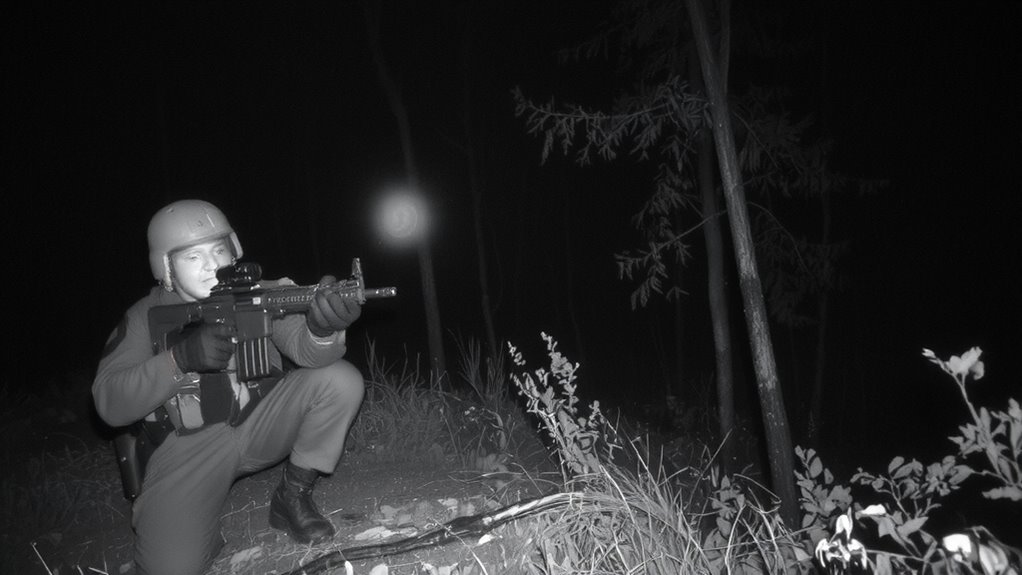
While visible light gets scattered and absorbed by fog, IR light pushes through more effectively because its longer wavelengths interact less with water droplets. You’ll notice less wavelength scattering and reduced beam diffusion, meaning your IR illuminator maintains a tighter, more usable beam in dense conditions. Unlike visible headlights that bloom and blur, IR light travels farther with directional integrity.
| Condition | Visible Light Range (m) | IR Light Range (m) |
|---|---|---|
| Clear Night | 150 | 200 |
| Light Fog | 90 | 160 |
| Moderate Fog | 45 | 120 |
| Heavy Fog | 20 | 80 |
| Dense Fog | 10 | 50 |
This table shows how IR consistently outperforms in range. The longer wavelength minimizes interaction with fog particles, giving you usable reach when visibility drops. It’s not magic-just physics working in your favor.
How NVGs Turn IR Light Into Clear Night Vision
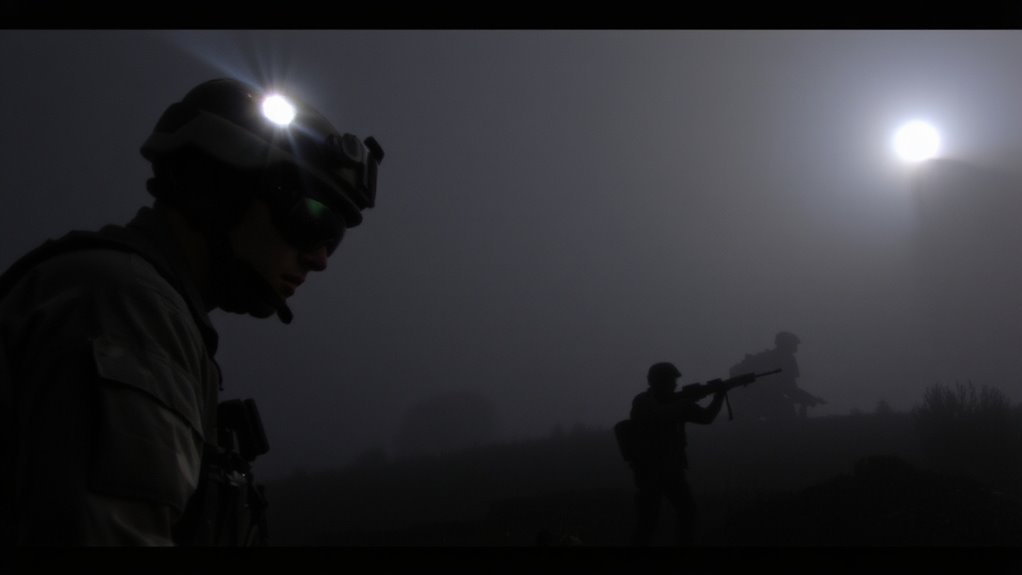
You’ve seen how IR light cuts through fog better than visible light, giving you more usable range in poor conditions. Now, your NVGs take that IR light and convert it into a visible image through signal amplification. Photons enter the objective lens, strike a photocathode, and release electrons that multiply through a microchannel plate. This amplified signal hits a phosphor screen, creating the green-hued image you see. It’s not thermal imaging-NVGs rely on ambient or IR light, not heat signatures. That means they need some light to work, even if it’s invisible to your eyes. While IR illumination extends their function in total darkness, performance depends on tube generation and lens quality. You get clarity and depth perception, but limited detection range compared to thermal. Signal amplification boosts usability, but contrast drops in heavy fog. It’s a practical balance: NVGs deliver detailed vision where thermal might lack resolution, especially near vehicles or terrain with subtle detail. Top-performing models on Amazon offer enhanced low-light sensitivity and durable designs ideal for challenging environments, making best night vision goggles a key consideration for reliable performance.
IR + NVG in Action: Aviation, Emergency, and Defense
How do pilots, first responders, and special operations teams maintain visual clarity in total darkness? You rely on IR illuminators paired with NVGs to see what’s invisible to the naked eye. In aviation, this combo guarantees safe landings and obstacle avoidance, even in zero ambient light. Emergency crews use it to navigate smoke-filled buildings or locate victims at night, improving response speed and accuracy. For defense units, it’s critical for stealth movement and target acquisition without revealing position. The right IR-NVG setup directly impacts mission readiness-consistent performance reduces hesitation and errors. Wavelengths around 850nm offer better visibility but carry a slight glow; 940nm stays covert but needs higher gain. Units operate longer with efficient emitters and battery-matched goggles. Real-world testing shows these systems cut disorientation and boost situational awareness. When seconds count, you need gear that performs-every time.
Choosing the Right IR and NVG Setup for Fog
When visibility drops due to fog, your IR illuminator and NVG setup can make the difference between progress and peril. Fog scatters visible and near-IR light, so spectrum selection matters-use mid-wave IR (3–5 μm) if available, as it penetrates moisture better. Short-wave IR (0.9–1.7 μm) works with most NVGs but struggles in dense fog. Device compatibility guarantees your illuminator’s wavelength matches your goggles’ sensitivity range. Below is a quick reference:
| Spectrum Band | Best For Fog? |
|---|---|
| 0.7–0.9 μm | No |
| 0.9–1.7 μm | Limited |
| 3–5 μm | Yes |
| 8–12 μm | Moderate |
| Broadband IR | Varies |
Choose mid-wave systems where possible. Test illuminator-NVG pairs in real fog. Compatibility cuts guesswork.
On a final note
You’ll see better in fog with IR illuminators and NVGs than with headlights. IR light scatters less than visible light, giving you usable contrast at 50–150 meters, depending on fog density. Paired NVGs with Gen 2+ tubes perform reliably, but expect reduced range in heavy fog. Power draw is higher, and setup adds weight. It’s not perfect, but it’s proven in aviation and search operations. For low-visibility mobility, this combo works-just know its limits.