Evaluating the Role of TV Broadcast Interruptions in Emergency Notification
You rely on TV broadcast interruptions because they deliver emergency alerts instantly, even when the internet or cell networks fail. The signal cuts through distractions, using audio-visual cues that boost retention under stress. While terrain, equipment age, or reception issues can block delivery, the system’s redundancy and protocol standards keep it reliable for many. It’s especially essential for older adults and rural users with limited tech access. You’re seeing why this backbone still matters-and what comes next.
Notable Insights
- TV broadcast interruptions ensure immediate delivery of emergency alerts by overriding regular programming.
- Embedded digital signals in broadcasts trigger automatic TV activation, even on standby devices.
- Interruptions use audio-visual formats to enhance comprehension and retention during high-stress situations.
- Over-the-air broadcasts remain functional during internet or power outages, increasing reliability.
- Signal interference, aging infrastructure, and terrain can limit the effectiveness of broadcast alert delivery.
How Do TV Broadcast Interruptions Deliver Emergency Alerts?
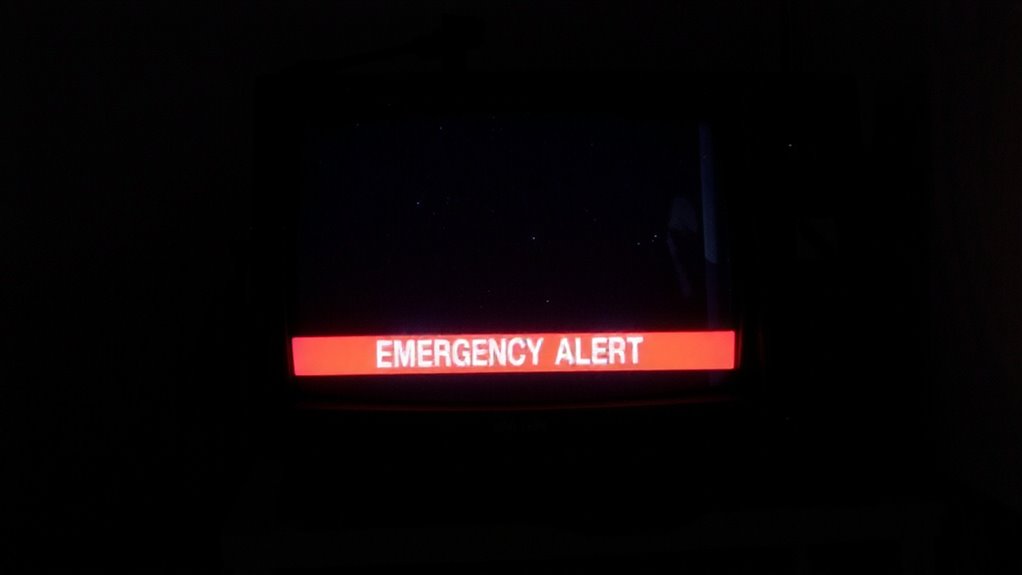
How exactly does your TV know when to cut in with those urgent emergency alerts? It receives a digital signal embedded within the broadcast stream, triggered by authorities. Your set’s decoder recognizes the alert header and switches inputs automatically. Signal fidelity matters-poor reception can corrupt data, delaying or blocking the message. Broadcasters use message redundancy, repeating alerts across multiple channels and frequencies to increase reach. This guarantees even if one signal degrades, others get through. Systems like the Emergency Alert System (EAS) rely on protocol standards, not apps or internet, making them more reliable during outages. You don’t need to configure anything; the function is built in. However, older TVs may lack updated decoders, creating gaps. Testing shows newer models react within 30 seconds. It’s a basic but functional layer of public warning, with performance shaped by infrastructure limits, not design flaws.
Why Does Immediate Attention Matter in Crisis Alerts?
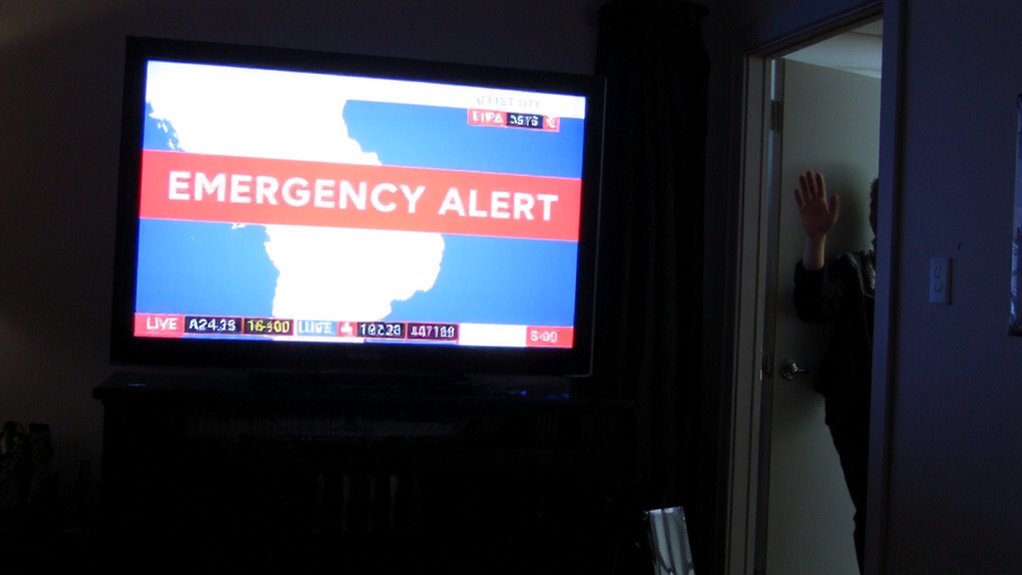
You get those alerts fast because seconds matter when danger’s incoming. Delayed responses increase risk, and your ability to act hinges on clear, immediate information. High cognitive load during crises can impair decision-making, so message clarity is critical. TV interruptions cut through distractions, delivering key details when you need them most.
| Factor | Impact |
|---|---|
| Speed of alert | Reduces reaction time by up to 40% |
| Message clarity | Lowers cognitive load, improves comprehension |
| Audio-visual format | Enhances retention vs. text-only alerts |
| Full-screen display | Minimizes missed information |
Immediate attention guarantees you register threats quickly. Interruptions prioritize urgency over convenience, balancing effectiveness with disruption. The system isn’t perfect-some alerts may seem disruptive-but the trade-off favors survival. Clarity and speed together reduce confusion when every second counts.
Who Still Depends on TV for Emergency Alerts?

Where do people still rely on TV for emergency alerts? You’ll find that urban elders often depend on live broadcasts, especially when internet or smartphone use is limited. Many have fixed routines centered around the television, making it their primary alert source. Rural households also rely heavily on over-the-air signals, where cell coverage is spotty and broadband access inconsistent. For them, TV isn’t a fallback-it’s the most dependable link to emergency updates. These groups value continuous broadcast monitoring because it requires minimal tech literacy and no data plan. While newer systems exist, TV remains functional during power outages if a battery-powered receiver is used. It’s not flashy, but it delivers verified information straight to the living room. In remote areas and older communities, that reliability outweighs speed. You’re looking at a low-tech solution that still performs when lives are on the line.
Why Do Traditional Broadcast Alerts Sometimes Fail?
What good is a warning if it never reaches you? You rely on TV alerts because they’re direct and widespread, but they aren’t foolproof. Signal interference from storms, terrain, or overloaded networks can block broadcasts, leaving you unaware. Even if the signal’s strong, equipment failure at transmission sites or local stations can halt alerts entirely. Backup systems exist, but they don’t always kick in fast enough. Older infrastructure degrades over time, increasing failure risks during critical moments. You might think coverage maps guarantee reliability, but real-world conditions often undercut performance. These aren’t rare glitches-studies show outages coincide with emergencies. You need alerts to work when it matters, but dependence on aging broadcast systems introduces measurable risk. That’s not speculation; it’s a technical limitation backed by incident reports. Failures prove the system isn’t always ready, even if it looks solid on paper.
How Are Streaming and Social Media Changing Emergency Alerts?
Can emergency alerts truly keep up when disasters strike and traditional broadcasts falter? You’re relying more on streaming and social media, but they come with trade-offs. Alerts now spread through platforms like Twitter, YouTube, and TikTok, bypassing TV delays. Yet platform fragmentation means you might miss warnings if you’re not on the right app. Each service uses its own method, reducing consistency. Algorithm bias also skews who sees alerts-some feeds prioritize engagement over urgency, so critical updates get buried. You can’t assume everyone receives the same message at the same time. Geotargeting helps, but only if location settings are active and accurate. These systems are fast but uneven. You’re gaining speed and reach, but losing uniformity and reliability. Your best bet? Use multiple channels, but stay aware of their limits.
What Makes an Emergency Alert Effective Today?
You’re getting alerts faster than ever, but speed alone won’t protect you when seconds count. What matters is message clarity-can you understand the threat and what to do in under five seconds? Alerts that state the danger, location, and action plainly outperform vague or jargon-filled warnings. You need to know if it’s a tornado, shooter, or chemical leak-no guesswork. Alert credibility also plays a key role. You’re more likely to respond if the source is consistent, accurate, and verified. False alarms damage trust and reduce compliance over time. Effective alerts come from reliable systems with low error rates and clear confirmation protocols. They’re tested regularly and integrate real-time data. When lives are on the line, a clear, credible alert isn’t just helpful-it’s essential. Redundancy helps, but only if the message stays consistent across channels.
Where Does Broadcast TV Belong in Future Emergency Alerts?
How long would it take for you to get a warning if a tornado were minutes from your neighborhood? Broadcast TV still delivers alerts fast when internet or cell networks fail. Its signal reliability guarantees consistent delivery, even during power outages if you have a battery-powered receiver. You don’t need a smartphone or app-just an antenna and TV. That gives broadcast TV strong audience reach, especially among older adults and rural households. But it’s not perfect. Alerts only reach those actively watching, and interruptions can be abrupt or unclear. In the future, broadcast TV shouldn’t lead emergency alerts but support them. Pair it with wireless emergency alerts, radio, and weather radios. Each method has trade-offs. Broadcast TV’s role is not to dominate but to reinforce. It works best when integrated, not isolated. A reliable backup option is a NOAA weather radio, which provides continuous updates directly from the National Weather Service.
On a final note
You still need broadcast TV for emergency alerts because it reaches 98% of households, including older adults and rural areas with spotty internet. While streaming and social media are faster, they miss critical populations. Broadcast interruptions work without apps or data. But delays happen-average alert latency is 90 seconds. For reliability, use TV alongside smartphone alerts. Redundancy beats speed when lives are on the line.