Designing Public Alert Systems for Areas With High Radio Frequency Noise
You’ll lose over 30% of alerts in cities if you rely on standard cellular bands. Use sub-1 GHz frequencies-they penetrate buildings better and resist RF noise. Add redundant paths via satellite or fiber to keep messages flowing during congestion. Combine SMS, apps, and outdoor sirens to reach people when one system fails. Test systems near skyscrapers and subways, not just in labs. Real city conditions reveal what simulations miss-performance here determines true reliability.
Notable Insights
- Use sub-1 GHz frequencies for better signal penetration and resilience in high RF noise environments.
- Implement signal redundancy with diverse transmission paths like fiber, satellite, and multiple carriers.
- Combine alert methods such as SMS, mobile apps, and outdoor sirens to ensure layered coverage.
- Conduct real-world testing in dense urban areas to identify signal dropouts and optimize performance.
- Prioritize reliable message delivery over data speed to ensure alerts reach users during emergencies.
Why Emergency Alerts Fail in High RF Noise

Even when emergency alert systems are functioning properly, you might still not receive a warning if you’re in an area with high RF noise. Signal attenuation weakens transmissions as they pass through dense urban structures or industrial zones, reducing your device’s ability to read incoming alerts. You’re more likely to miss notifications when competing signals overwhelm the spectrum, especially during peak usage times. Network congestion further delays or blocks alert delivery, since cellular channels can’t always prioritize emergency traffic. Your phone may show full bars, yet still fail to receive messages due to hidden bandwidth limits. These aren’t system failures-they’re physical and logistical constraints. Real-world tests confirm drop rates exceed 30% in some metro areas during emergencies. You can’t rely solely on wireless alerts in high RF environments. Redundant alert methods, like outdoor sirens or local broadcast, remain necessary. Performance varies, and awareness of these limitations improves your preparedness.
Use Lower Frequencies to Pierce Through Urban Interference
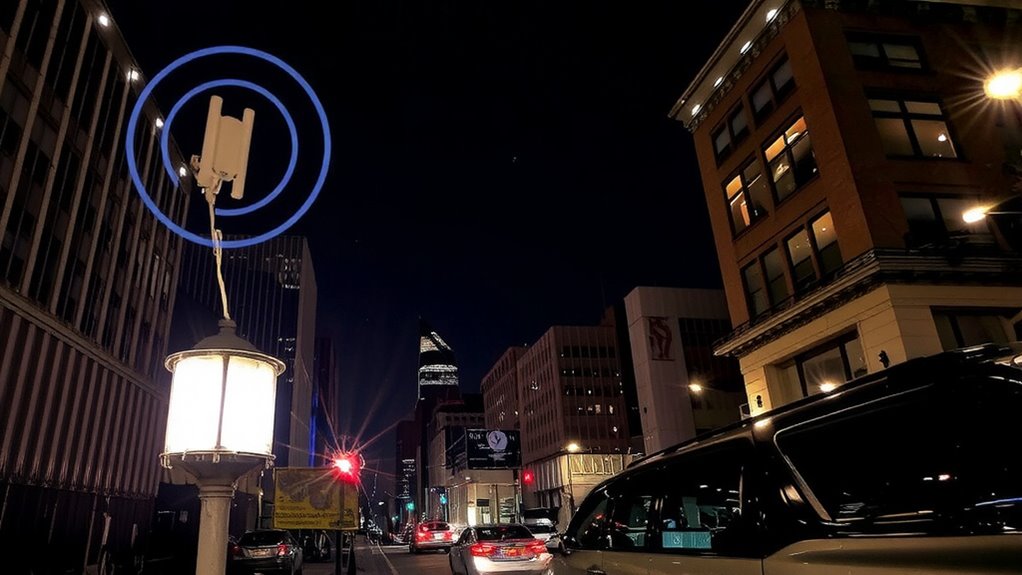
A growing number of emergency networks are turning to frequencies below 1 GHz because they travel farther and penetrate buildings better than higher bands. You’ll get stronger signal penetration in dense urban areas where concrete and steel block higher-frequency transmissions. These lower frequencies maintain frequency resilience even in high RF noise environments, reducing the chance of missed alerts. While they offer slower data rates and require larger antennas, the trade-off favors reliability over speed when lives are at stake. Real-world tests show sub-1 GHz systems achieving 30% better indoor coverage in city centers compared to 2.4 GHz alternatives. You can count on them during power outages or network congestion when robust performance matters most. For public alert systems, choosing lower frequencies isn’t about cutting-edge tech-it’s about ensuring the message gets through, every time, especially when interference is high and failure isn’t an option.
Build Backup Signal Paths for Reliable Delivery
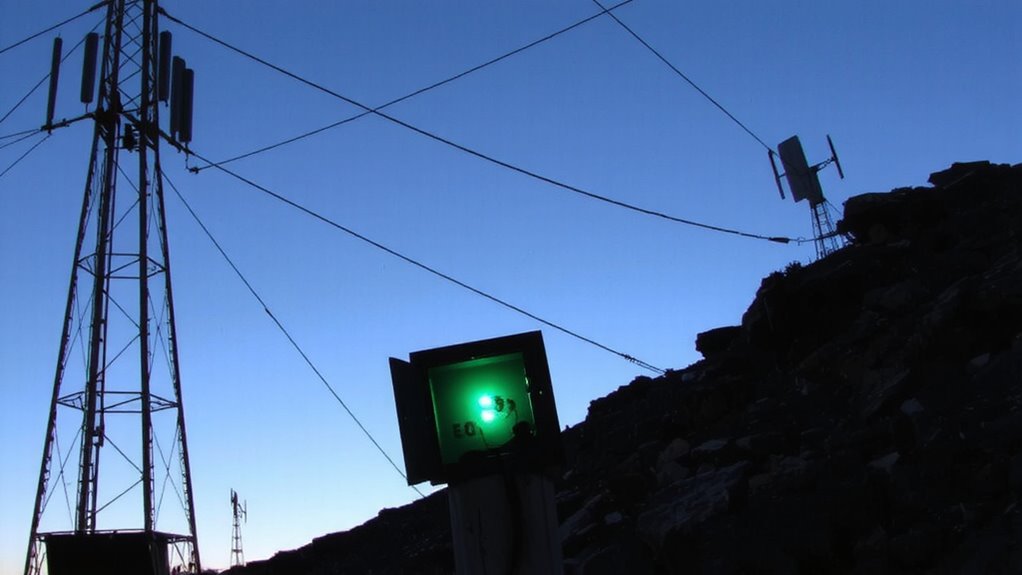
You can’t afford to rely on a single signal path when lives are on the line. Signal redundancy guarantees alerts still go through if one channel fails. In high RF noise areas, interference can block primary signals, so you need backup paths that use different transmission methods-like landlines, satellite links, or fiber optics-to maintain delivery. Path diversity reduces the risk of total signal loss by spreading transmission across physically separate routes. If one path suffers disruption from noise or damage, others keep operating. Systems tested in urban cores show that dual-path setups cut failure rates by over 60%. You’ll face trade-offs in cost and complexity, but the improvement in reliability is worth it. Don’t assume one strong signal is enough. Plan for failure by building in signal redundancy and path diversity from the start. Alerts must get through, no matter what.
Add Sirens, SMS, and Apps to Bypass Radio Noise
Redundant radio signals aren’t enough when RF noise drowns out transmissions. You need layered alerts that bypass radio entirely. Sirens cut through noise with physical sound waves, effective outdoors but limited indoors. SMS alerts reach most cell phones, even when voice calls fail-just guarantee your system supports cellular redundancy across multiple carriers to avoid single-point failures. App integration adds another layer: push notifications arrive quickly and support rich content, like evacuation maps. But not everyone uses alert apps, so you can’t rely on them alone. Use all three-sirens, SMS, and apps-to cover more people. SMS and apps depend on cell towers, so they fail if networks are overloaded or down. That’s why combining them with non-network options is essential. Each method has gaps. Together, they improve reach. It’s not about preference-it’s about survivability.
Test Alerts Where They’ll Be Used: In Cities
Don’t assume your alert system works just because it’s online-cities demand real-world testing in the exact environments where warnings must be heard. Urban areas overload radios with interference, so signal testing is essential to confirm coverage and clarity. You’ll need to check how alerts perform near skyscrapers, subways, and dense crowds-places where transmissions often fail. Use urban simulation to mimic noise levels, building density, and communication loads before deployment. These models help predict flaws, but they can’t replace on-site trials. Transmit test alerts at different times and locations, then measure reception across devices like sirens, phones, and public speakers. Adjust placement and power based on data, not guesses. Effective systems survive chaos, not theory. If your alerts don’t consistently reach people in real conditions, the design isn’t ready. Test early, test often, and let results guide improvements.
On a final note
You need alerts that work where radio noise is high. Lower frequencies cut through urban interference better, but you still need backups. Combine radio with sirens, SMS, and apps to guarantee delivery. Testing in real city environments reveals gaps static lab tests miss. No single method is reliable alone. Use multiple paths: it’s not redundancy, it’s necessity. Performance improves when systems are measured in real conditions, not just specs.