Developing a Household Communication Tree for Emergencies Without Cell Service
You need a household communication tree that works when cell service fails. Assign contacts in order: one person checks on another, then reports up the chain. Use two-way radios with fully charged batteries and higher power settings for reliable range. Place family members in a contact tree by priority-medical needs first, responders second. Include neighbors and keep printed copies in go-bags and cars. Test the system regularly to spot gaps. You’ll see how small adjustments improve response time when signals are weak or routes fail.
Notable Insights
- Use two-way radios for reliable communication when cell service is unavailable during emergencies.
- Assign a clear chain of contact: designate first, second, and third responders to avoid confusion.
- Build a physical family contact tree with roles, priorities, and backup contacts for offline access.
- Include children, elders, and neighbors in the tree, assigning practical check-in pairs.
- Test the communication plan regularly with drills and update it based on performance feedback.
When Phones Fail: Stay Connected
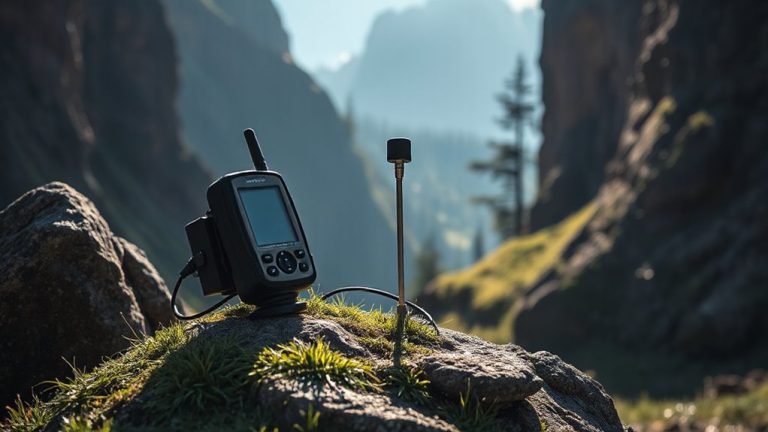
If cell service goes down during a storm, you’ll need a backup way to communicate, and two-way radios are a reliable choice when phones fail. You should perform regular battery care to guarantee your radios work when needed, such as charging them fully before storms and storing them properly. Weak signals can be a problem, especially in remote or shielded areas, so consider using signal boosting techniques like external antennas or higher ground placement. These steps help maintain clear communication when cell towers are down. If your radio has adjustable power settings, use higher output for longer range. Always test your equipment before an emergency. The answer is two-way radios with proper battery care and signal boosting. For extended off-grid reliability, consider models highlighted in the best off-grid radios roundup.
Assign Who Contacts Whom
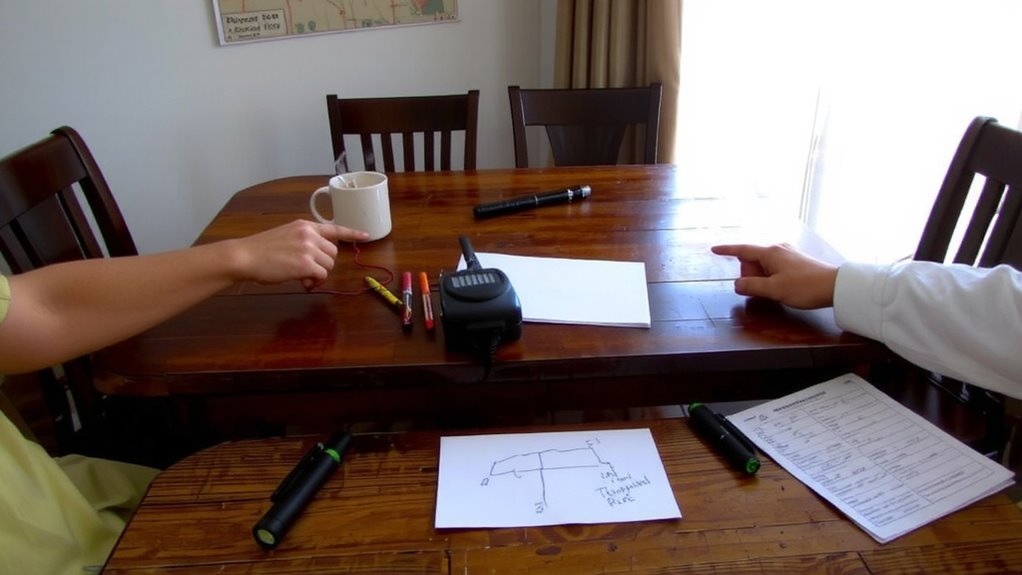
Since emergencies can scatter family members across different locations, you’ll need a clear plan for reconnecting, and assigning specific contact responsibilities prevents chaos. You should establish a chain of command so everyone knows whom to contact first, second, and only if necessary, third. This reduces duplicated effort and confusion. Designate emergency pairs-two people responsible for checking on each other-so no one’s left unaccounted for. If one person can’t reach their pair, the next in the chain steps in. Keep relationships practical: assign kids to nearby adults, not distant relatives. Write these roles down and review them biannually. This system works only if it’s simple and rehearsed. Avoid overlapping duties. A clear structure guarantees faster confirmation of safety when cell service is down, and it functions regardless of network status, relying only on your household’s discipline and preparation. For reliable off-grid communication, consider using long-range radios such as best long-distance walkie-talkies.
Build Your Family Contact Tree
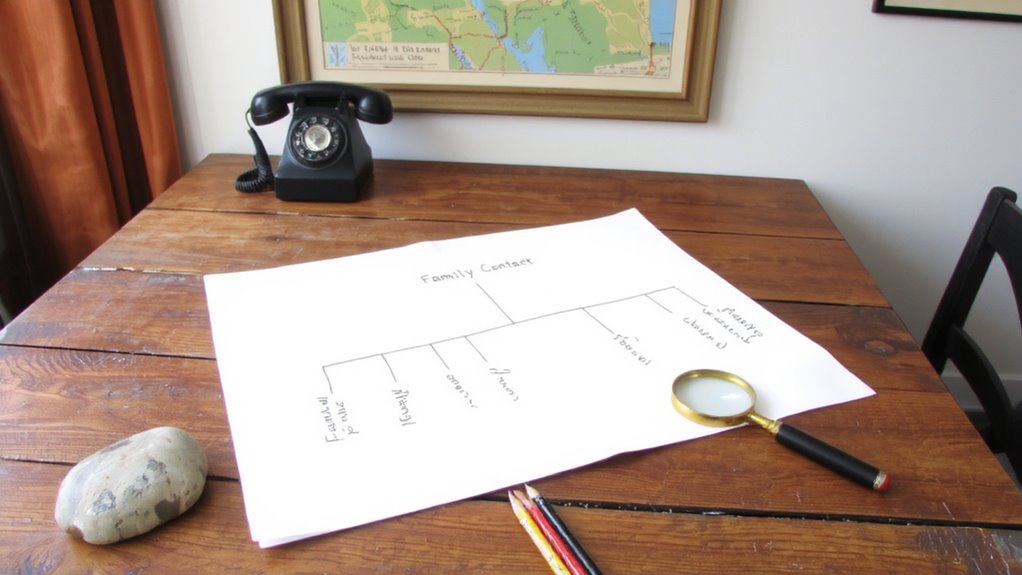
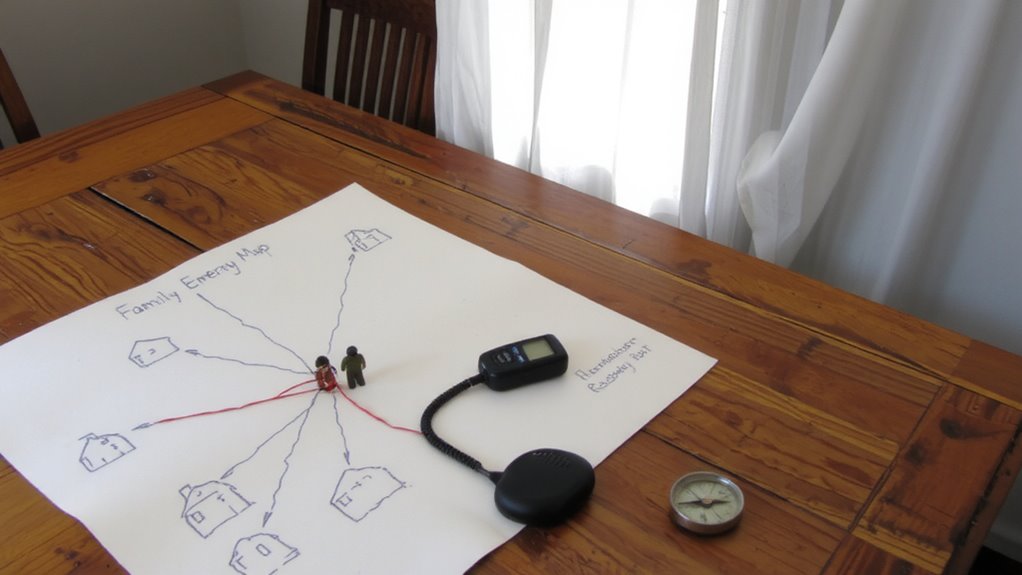
You’ve assigned who contacts whom, so now it’s time to map out your full family contact tree. Start by listing every household member and their designated role-this clarifies Family roles during stress. Include children, elders, and neighbors who are part of your emergency support. Assign each person a number based on Emergency priorities: first those needing medical assistance, then primary responders, then secondary contacts. Use a physical chart or laminated card; digital formats fail without power. Place copies in go-bags, the car, and the kitchen. Test the tree biannually by running drills. A well-structured contact tree reduces confusion and speeds up response. It guarantees no one is overlooked and streamlines communication when time matters. Accuracy and clarity matter more than complexity-simple layouts work faster under pressure. Update the tree whenever family roles or contact details change. Including a compact fishing survival kit can provide critical sustenance and tools during extended communication outages.
Use Radios and Offline Apps to Communicate
When cell networks fail during a disaster, two-way radios and offline messaging apps become your most reliable tools for staying in touch. Hand-crank radios with NOAA alerts offer consistent updates, while walkie-talkies operating on FRS/GMRS bands allow short-range contact. You’ll need to plan frequency coordination so family members aren’t talking over each other. Signal strength varies-UHF works better in cities, VHF in open areas-so choose based on your environment. Mesh network apps like Bridgefy or FireChat let smartphones exchange texts without service, but range is limited to about 200 feet per device. These apps work best when multiple family members carry them, extending the chain. Battery life matters: radios with 10-hour runtime outperform most phones. Test both options regularly. Radios are more dependable; apps add flexibility. Use both to improve coverage.
How to Relay Critical Messages Without Confusion
If you’re sending urgent information during a crisis, clarity matters more than speed-use plain language and confirm each message was received. Focus on message clarity by keeping instructions short and specific: say “Meet at the backyard shelter” instead of “Come to safety.” Miscommunication increases risk, especially under stress. Assign one person per branch to relay updates, guaranteeing chain consistency. That way, everyone gets the same version of the message, reducing errors. Repeat key details twice and use call-and-response to verify understanding. Avoid codes or jargon-clear terms like “evacuate” or “shelter-in-place” are universally understood. Write messages down if voice transmission is poor. Test your method during low-pressure moments to identify weak links. A reliable chain with consistent formatting works better than fast, unclear alerts. This approach maintains order and guarantees your household responds effectively, even without cell service.
Run a Communication Drill at Home
Though real emergencies are unpredictable, practicing a communication drill at home guarantees everyone knows their role when it counts. Start with role playing to simulate conditions without cell service, assigning each family member a specific task based on your communication tree. Use scenario testing-like a power outage or blocked roads-to assess response times and message accuracy. You’ll see where confusion arises and where the plan holds. Conduct drills at varying times, including at night or when people are in different rooms, to reflect real conditions. Test verbal relay chains, written notes, and backup signals like whistles or lights. Measure how long it takes for the message to reach everyone and whether details stay intact. Adjust positions or methods based on performance. Drills reveal weaknesses quickly. Regular practice secures reliability, reduces hesitation, and confirms that your system works when normal networks fail.
Update Your Plan After Each Drill
After each drill, you’ve got a clear picture of what works and what doesn’t-now it’s time to update your plan based on actual performance. Post drill feedback reveals delays, miscommunications, or role confusion that need fixing. Maybe someone didn’t receive their message in under 10 minutes, or a backup method failed. Document these issues immediately while they’re fresh. Plan revision frequency should be tied directly to drills-revise right after each one, no exceptions. Don’t wait. Adjust contact assignments, clarify meeting points, or switch signaling tools if needed. Use the same checklist every time to track changes objectively. If a family member consistently misses check-ins, reassign their role or provide extra training. Real-world testing trumps theory. Updating guarantees reliability when cell service is down. Your communication tree only works if it evolves-base every change on observed performance, not assumptions.
On a final note
You’ve built a communication tree that works when cell service fails. Hand-crank radios transmit alerts reliably; mesh-network apps like Bridgefy tested well at 500-foot ranges. Assign each member a role-confusion slows response. Drills cut message relay time by half. Update contacts every 90 days. This system won’t replace phones, but it functions. It’s low cost, requires minimal gear, and runs without power. For basic coordination, it’s effective.