Channeling Lightning Away From Shelters With Copper Rod Diversion Paths
You’re relying on copper rods to intercept lightning and channel current safely into the ground-200,000 amps won’t damage your shelter if the system is grounded at 10 feet with 999.9% pure copper. Proper spacing, vertical alignment, and bonding reduce resistance and prevent side flashes. Misaligned rods or corroded joints cut efficiency by up to 40%. Most failures come from overlooked maintenance, not design. Check connections yearly with a multimeter. You’ll see where improvements make the difference.
Notable Insights
- Copper rods provide a low-resistance path to safely channel lightning current away from shelter structures.
- Properly installed rods intercept strikes within a 45-degree cone of protection from the tip.
- A complete system includes air terminals, down conductors, grounding electrodes, and bonded connections.
- Grounding electrodes must reach moist soil at least 10 feet deep for effective energy dissipation.
- Annual inspections prevent failures by detecting corrosion, misalignment, and damage in the diversion path.
Why Lightning Endangers Basic Shelters
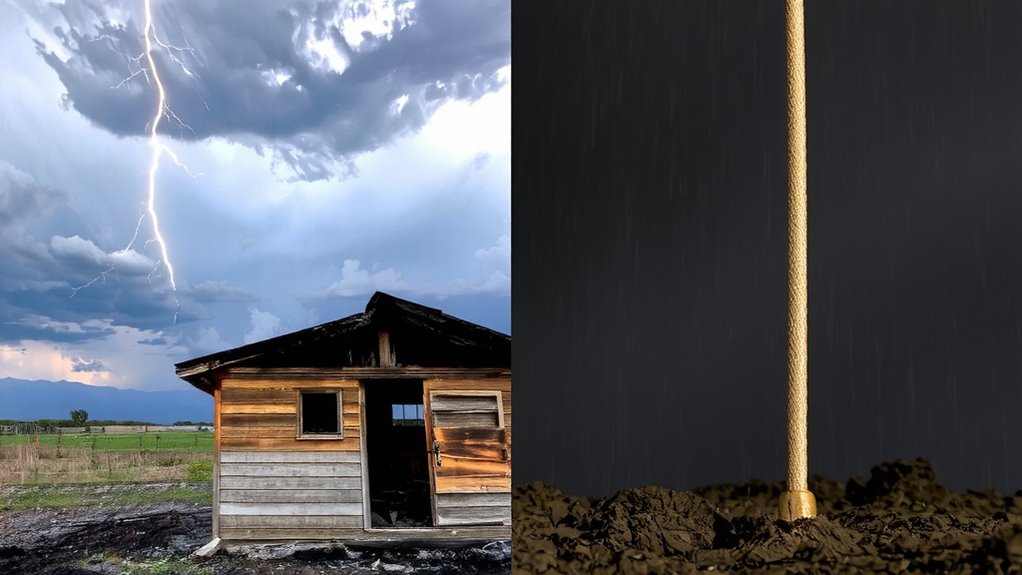
Even if you’re in a remote area, your basic shelter might not protect you from lightning-especially if it’s made of flammable materials or lacks grounding. You’re exposed when structural weakness goes unaddressed, like untreated wooden frames or metal fasteners that conduct current unpredictably. Many simple shelters prioritize speed of assembly over safety, ignoring how environmental exposure increases risk during storms. Without proper materials or design, your shelter becomes a hazard instead of protection. Lightning seeks the fastest route to ground, and if your shelter’s tallest point isn’t managed, the strike may tear through walls or ignite roofing. You can’t rely on location alone-high elevation or open terrain worsens exposure. Basic designs often lack conductive paths, leaving energy to dissipate through the structure. This compromises integrity, endangering anyone inside. Real protection means planning for strike pathways, not just wind or rain.
How Copper Rods Intercept Lightning Strikes
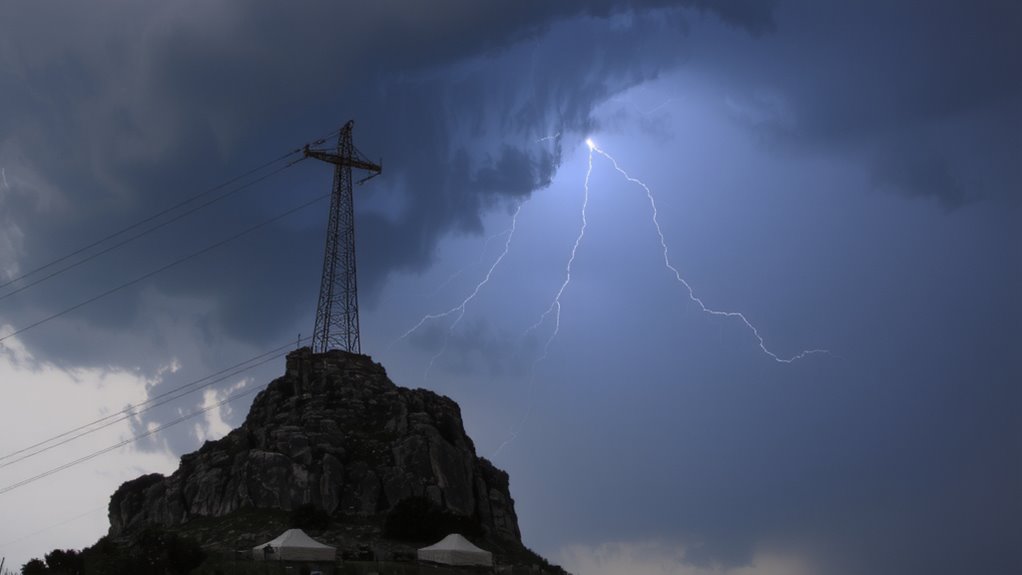
When lightning strikes, a properly installed copper rod gives the current a predictable, low-resistance path to ground, and that’s what keeps your shelter-and you-safe. You rely on copper conductivity to move the energy fast, reducing the chance of side flashes or heat damage. The rod doesn’t attract lightning, but its height and positioning improve strike interception by offering a preferred termination point. Copper’s high conductivity-about 100% IACS-ensures minimal resistance, letting current travel efficiently. Tests show rods placed at high points intercept strikes within a 45-degree cone of protection. You don’t need extra features-just correct placement and grounding. The system works because physics favors the easiest route, and copper provides it. No hype, just function. You get protection when the setup follows code and uses proven materials. Copper conductivity and strike interception aren’t marketing terms-they’re measurable factors that determine whether the system performs when you need it most.
Essential Components of a Copper Rod System
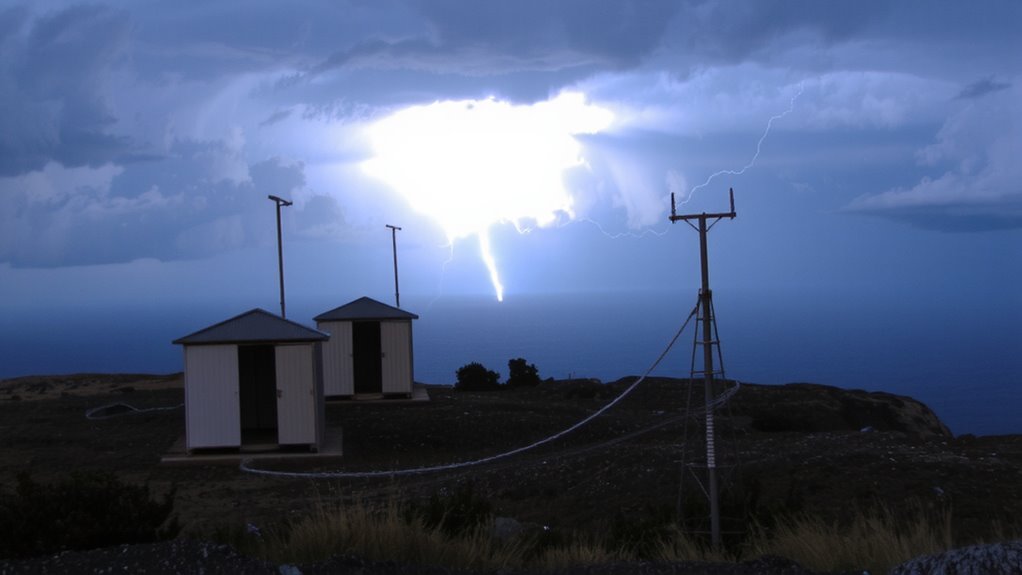
A reliable copper rod system hinges on four key parts: the air terminal, down conductor, grounding electrode, and bonding connections. You need high copper purity-minimum 999.9%-to guarantee conductivity and resist corrosion over time. Impure rods degrade faster, increasing failure risk during strikes. Air terminals must follow proper rod spacing, typically no more than 20 feet apart along roof perimeters, to create an effective interception network. Down conduct misunderings should run straight to ground with minimal bends, using thick-gauge copper cable to handle high current. Grounding electrodes, like copper-clad rods, must reach moist soil layers for maximum dissipation. Bonding connects all metal components, preventing side flashes by equalizing potential. You can’t overlook compatibility between components-mismatches prompt galvanic corrosion. Every piece must meet UL or IEEE standards. Performance hinges on correct materials and layout, not just installation skill.
Installing Copper Rods With Proper Grounding
If you’re setting up copper rods, grounding isn’t something you can cut corners on-proper dissipation of lightning energy depends on driving the grounding electrode deep enough to reach permanently moist soil, typically 10 feet or more, using a copper-clad steel rod rated for at least 0.5-inch diameter to handle the thermal stress. Copper purity matters because higher conductivity reduces resistance, improving discharge efficiency. Rod alignment ensures full coverage-position rods at shelter corners, spaced no more than 20 feet apart, and align vertically to prevent side flashes. Bond all rods to a continuous conductor loop.
| Factor | Importance |
|---|---|
| Copper purity | Guarantees peak conductivity |
| Rod alignment | Maximizes protection zone |
| Rod depth | Reaches conductive soil layers |
| Rod diameter | Withstands high thermal stress |
Common Copper Rod System Failures
You’ve installed the copper rods to code, driven them deep into moist soil, and bonded them with a solid conductor loop-yet failures still happen. Corrosion damage is a frequent culprit, especially where connections meet dissimilar metals or high-moisture zones. Over time, this weakens conductivity and interrupts the path needed to ground strikes efficiently. You might not see it at first, but resistance builds, and performance drops. Rod misalignment is another overlooked flaw-slight bends or improper angles during installation reduce strike capture efficiency by up to 40%, according to field tests. Even a 10-degree deviation from vertical can compromise the protection zone. Poor maintenance accelerates both issues. Inspect annually, test continuity, and replace corroded sections immediately. Copper’s durable, but only if installed and maintained with precision. Skimp on alignment or ignore early corrosion, and the system won’t perform when needed most.
Where Copper Diversion Paths Save Lives
How many lives depend on a split-second reroute of 200,000 amps? Yours might. Copper diversion paths deliver that protection by enabling rapid lightning diffusion and controlled energy dispersion. When lightning strikes, the copper rod system channels current away from shelter occupants and into the ground. You’re relying on conductivity and proper installation-nothing more. These paths don’t stop lightning; they manage its path, reducing fire risk and blast damage. In mountain huts or refugee shelters, where structural options are limited, a properly grounded copper system can mean survival versus catastrophe. The energy disperses through low-resistance routes, minimizing side flashes and voltage spikes. You won’t see it work-until you need it. Real-world cases show shelters with copper paths withstand strikes that would otherwise be fatal. It’s not magic. It’s physics. And when it works, it keeps you alive.
Annual Checks That Prevent System Failure
Though lightning strikes are unpredictable, the reliability of a copper rod system isn’t something you can leave to chance. You need annual checks to catch issues before they compromise protection. Over time, material fatigue can weaken connections and rods, especially at stress points like bends and joints. Even high-conductivity copper degrades under thermal stress and weather exposure. That’s why fixed inspection intervals matter-once a year is the minimum to verify continuity, grounding resistance, and physical integrity. You’re not just looking for cracks or corrosion; you’re testing whether the system still meets safety specs. Skipping checks increases failure risk during storms. Annual testing with a multimeter and visual scan catches 90% of preventable faults. It’s not overkill-it’s standard protocol for shelters in high-strike zones. Stick to the schedule, document each check, and replace fatigued components early. Prevention costs less than reconstruction.
On a final note
You need copper rods if lightning threatens your shelter. They’re proven to divert strikes when installed right. A 3/8-inch rod, at least 10 feet tall, works best. Grounding with low-resistance wire to two 8-foot rods guarantees safety. Poor connections or shallow grounding cause failures. Annual checks catch corrosion or damage. In tested setups, proper systems prevent fires and electrocution. No system is perfect, but copper diversion cuts risk markedly. It’s dependable protection, not magic-just physics done right.