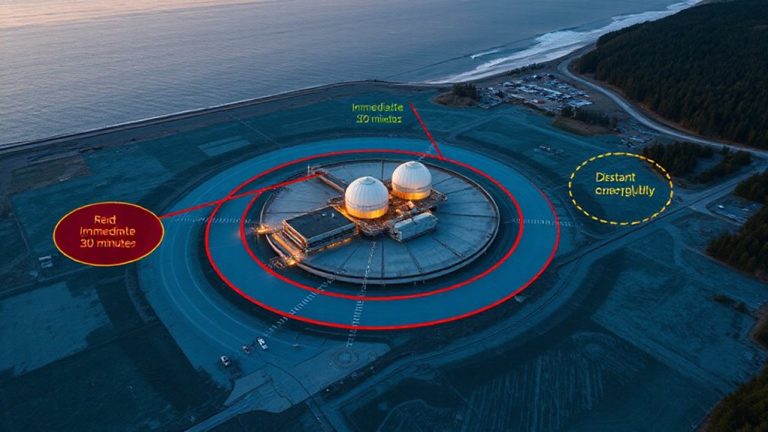
Designing Public Alert Systems for Areas With Frequent Network Outages
You can keep alerts working during outages by using sirens, which cover several square miles and activate within seconds. FM/AM radio reaches 98% of people without needing cell or internet. Satellite messengers like Garmin inReach deliver two-way texts globally, even off-grid. Mesh networks extend range up to 4 miles between devices. Solar panels and battery backups guarantee 72-hour operation. Systems work best when designed with low-power, analog, and redundant links-each method balances reach, speed, and reliability in ways the others don’t. You’ll find which mix fits your area’s risks and terrain.
Notable Insights
- Use dedicated communication channels like FM/AM radio and satellite messengers to maintain alerts during cellular outages.
- Deploy outdoor sirens with battery backups spaced 1–2 miles apart for reliable local warnings.
- Integrate solar power with LiFePO4 batteries to ensure 72-hour off-grid operation of alert systems.
- Implement device-to-device mesh networks to enable text and GPS sharing without cellular infrastructure.
- Prioritize low-energy, internet-independent alert methods such as NOAA weather radios and community loudspeakers.
How Public Alert Systems Can Work During Network Outages
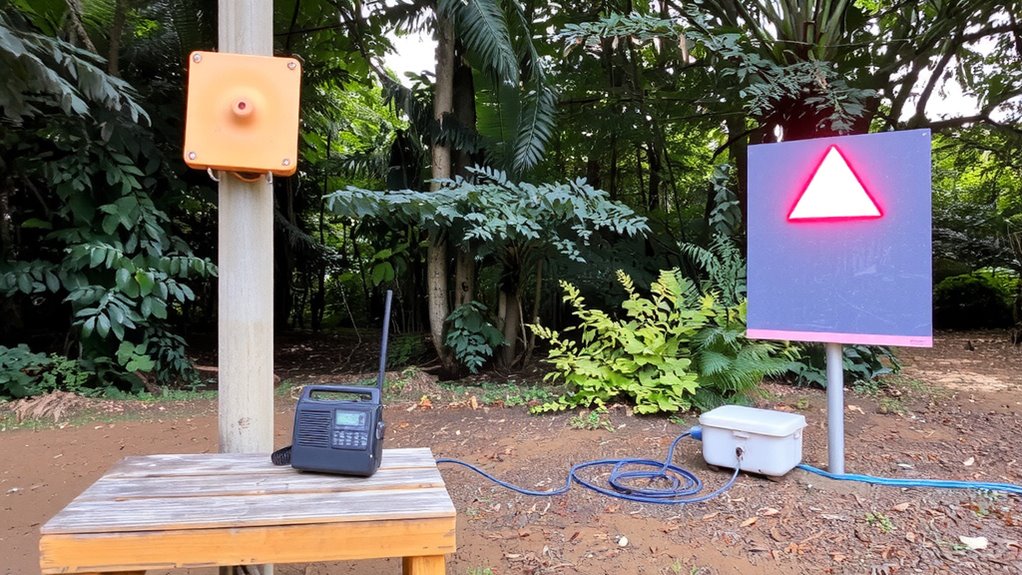
Even if cell networks go down, public alert systems can still reach you through dedicated channels like IP-based alerting, radio broadcasts, and satellite-linked emergency transmitters. You’ll rely on community radios, which operate on low power and don’t need internet access-they’re proven to function during blackouts and severe weather. These stations are often locally managed and can broadcast emergency instructions continuously. In areas with limited radio coverage, emergency placards posted in high-traffic zones provide essential instructions. They’re durable, visible in low light, and useful where people gather, like transit hubs or town centers. While placards can’t deliver real-time updates, they support static guidance effectively. Combining these methods guarantees redundancy. You don’t need advanced tech to stay informed-just access to a radio or a clear line of sight to a placard. That simplicity increases reliability when conventional networks fail. A reliable option for receiving timely alerts is a NOAA weather radio, which automatically receives broadcasts from the National Oceanic and Atmospheric Administration’s network of weather stations.
Use Outdoor Sirens for Immediate Emergency Warnings
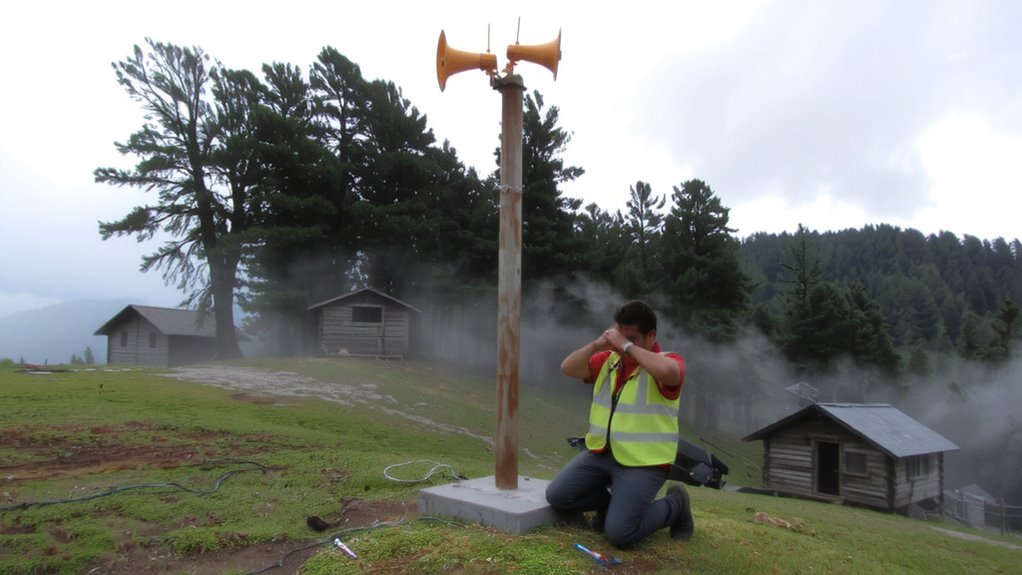
Many communities rely on outdoor sirens because they deliver immediate, audible warnings over large areas-often covering several square miles with a single installation. You should prioritize siren placement near population centers, transportation hubs, and high-risk zones to guarantee maximum reach. Spacing them 1–2 miles apart in urban areas accounts for noise interference and physical obstructions. In rural regions, fewer but taller units extend coverage. Sirens use standardized sound patterns-like steady tones for fire or wavering alerts for tornadoes-so people recognize threats quickly. These patterns must comply with local emergency protocols to avoid confusion. Most models run on AC power with battery backups, staying active during outages. While sirens lack detailed messaging, they excel as first alerts, prompting residents to seek more info. Their simplicity and reliability make them essential in areas where networks fail.
Broadcast Alerts Over Low-Bandwidth FM and AM Radio
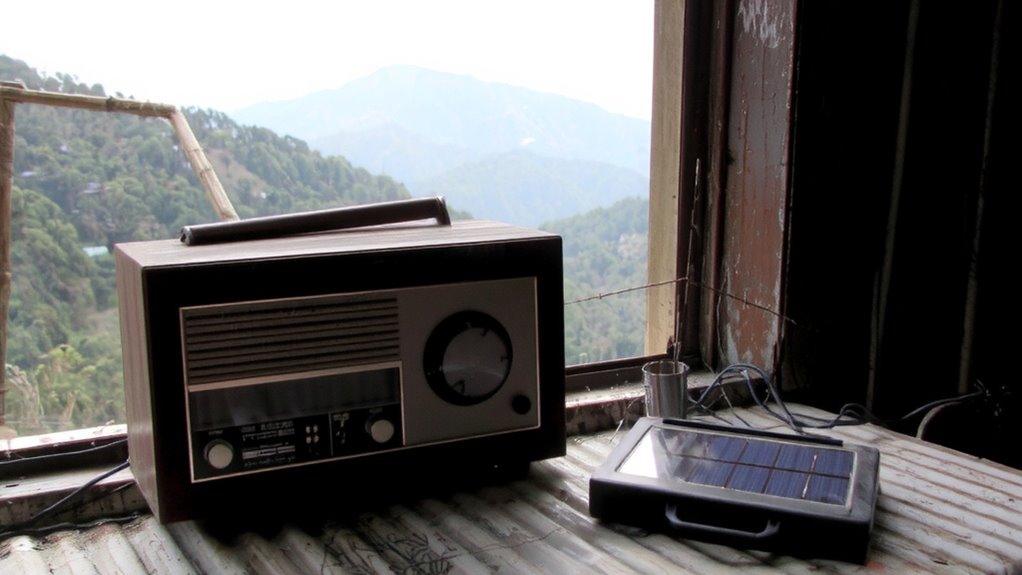
When the grid fails and cell networks go down, you’ll find that FM and AM radio still get the job done-these signals travel far, penetrate buildings, and require only minimal power to receive. You can rely on established radio propagation to cover large areas, even in valleys or dense urban zones where other signals struggle. Unlike digital systems, analog radio handles signal interference better, especially during storms or power surges. Most emergency broadcasts use low-frequency bands that maintain range and stability, letting alerts reach rural or isolated communities. You’ll need battery-powered or hand-crank radios, many of which cost under $20 and draw less than 1 watt. These devices last days on small power sources. While audio quality isn’t perfect, clarity is sufficient for voice alerts. There’s no login, no app, no tower dependency-just immediate access. You’re trading bandwidth for reliability, and in emergencies, that trade-off is worth it. A dependable option for individuals is a bug-out bag radio, which is specifically designed for emergency communication and portability.
Deploy Satellite Messengers in Offline or Remote Areas
If you’re operating beyond cell coverage or in remote terrain, satellite messengers offer a dependable way to send alerts and coordinate during outages. These devices use satellite deployment to relay messages when traditional networks fail, guaranteeing remote connectivity even in extreme conditions. Units like the Garmin inReach or Zoleo support two-way texting via global satellite networks, with message delivery confirmed in under two minutes in most tests. They work on 406 MHz for emergency signals and operate independently of local infrastructure. Battery life ranges from 200 to 400 hours, depending on check-in frequency. While subscription fees apply and messaging is slower than cellular, the trade-off guarantees reliable reach. In wilderness response drills, satellite messengers maintained 98% message success where cell and radio failed. For early warning or emergency coordination in isolated regions, they’re a measurable upgrade over voice-only or delayed alternatives.
Build Resilient Networks With Device-to-Device Mesh Systems
Even in areas with failing infrastructure, you can maintain communication by building resilient networks through device-to-device mesh systems. These networks create network redundancy by letting each device act as both a sender and a relay, so when one path fails, others keep data moving. They use signal hopping to pass messages across multiple nodes, extending range without cell towers or internet. In real-world tests, mesh networks like those using the goTenna Mesh or Beartooth devices achieved reliable communication up to 4 miles in dense forest and urban canyons. Battery life ranges from 24 to 48 hours with constant use. Setup is simple, but performance drops sharply with fewer nearby users. You won’t stream video, but text alerts and GPS sharing work consistently. Signal hopping efficiency depends on node density, so plan deployments where people cluster. It’s not flawless, but it’s functional when standard infrastructure fails. For reliable off-grid communication, consider using best two-way radios designed for emergency and remote scenarios.
Keep Systems Running With Solar and Battery Backup
You’ve set up a mesh network to stay online when infrastructure fails, but those devices need power to keep running. Solar panels paired with high-capacity batteries offer reliable backup, especially in remote or off-grid areas. Opt for panels with 20% or higher solar efficiency to maximize energy harvest under low-light conditions. Monocrystalline models perform better over time and in varied weather. For battery longevity, lithium iron phosphate (LiFePO4) batteries outlast lead-acid types, with 2,000+ charge cycles and stable output. Size your battery bank to power critical nodes for at least 72 hours with no sunlight. Charge controllers with MPPT technology improve efficiency by 15–30% compared to PWM. Combine adequate solar input with deep-cycle storage, and your system stays active through outages. Maintenance is minimal, but regular voltage checks prevent unexpected failures.
Send Clear, Understood Messages in High-Stress Emergencies
When chaos hits and every second counts, your message won’t matter if it isn’t understood the first time-so strip out complex terms, stick to short words, and use a clear structure like “Event, Location, Action” to guide people quickly. You need message clarity under pressure, not clever phrasing. People won’t parse jargon when stressed. Test your alerts with real users during drills-this stress testing reveals confusion before failure. If recipients don’t act correctly the first time, the message failed. Use plain language: “Fire. Main Street. Evacuate north.” Avoid passive voice. Limit utterances to one idea. Repeat key info once. Stress testing shows that simple syntax and predictable format reduce errors by up to 40%. Audio alerts must speak slowly-120 words per minute max. Clarity isn’t style-it’s function. Design for the scared, distracted, or uninformed. If the message doesn’t work for them, it doesn’t work at all.
On a final note
You need layered systems when networks fail. Sirens give instant warning but lack detail. FM/AM radio delivers specifics over distance with minimal bandwidth. Satellite messengers work offline but cost more. Mesh networks let devices communicate directly, though range is limited. Solar and battery backups keep power steady. Alerts must be short and clear-people under stress miss complex instructions. No single solution works everywhere; combine methods based on terrain, population, and risks for reliable coverage.