How to Use a Hand Drill With Softwood to Start a Friction Fire in Tropical Climates
Use dry, low-density softwood like cedrela or balsa for your spindle and drill board-straight, fine grain guarantees clean fiber breakdown. In humidity, rely on seasoned wood from dead falls under canopy cover and sand contact points to reduce resistance. Maintain a 30–45 degree angle with firm, steady pressure and a rolling palm motion to build heat fast. If dampness causes clumping, replace components immediately. Success hinges on alignment, dryness, and rhythm-get these right, and embers form in under a minute. You’ll see why softwoods outperform in wet climates with consistent results.
Notable Insights
- Choose low-density softwoods like cedrela or balsa with straight, fine grain for efficient ember production in humid conditions.
- Use only dry, seasoned wood from dead branches under canopy cover to ensure moisture content is below 12%.
- Sand the spindle tip and drill board notch to reduce friction resistance and prevent dust clumping during rotation.
- Maintain a 30 to 45-degree drill angle with firm, steady pressure and a rhythmic palm roll for consistent spindle speed.
- Transfer the ember gently on a leaf tray to dry tinder like coconut husk pith, then apply controlled breaths to ignite.
Choose the Best Softwood for a Hand Drill Fire
Softwoods matter-your success depends on picking the right one. For hand drill friction fires in tropical climates, wood selection is critical. You need softwoods with low density and straight grain structure, like cedrela or balsa, which allow easier fiber breakdown under friction. Dense or resinous woods resist spindle rotation and generate insufficient powder. Look for dry, seasoned wood-moisture above 12% hinders ignition. The ideal grain structure is uniform and fine, producing consistent, powdery embers without clumping. Test by scratching the surface; it should leave a soft mark with minimal resistance. Avoid warped or twisted pieces-straight grain safeguards stable contact with the hearth board. Poor wood selection leads to fatigue and failure, especially in humid conditions. Choose wisely: the right softwood ignites faster, requires less effort, and increases your chances of a sustained ember.
Prepare Your Drill Board and Spindle in Humid Weather
A solid fire starts with properly prepared components, especially when humidity’s working against you. You need a drill board and spindle from dry, seasoned softwood-even in wet conditions, look for dead branches under canopy cover. Sand the spindle tip and the drill board’s notch to reduce resistance. Your drill angle matters: aim for 30 to 45 degrees to maintain spindle pressure without breaking the spindle or slipping out. Too steep, and you lose control; too shallow, and friction drops. Apply steady, firm spindle pressure, but don’t press so hard you stall rotation. Humidity softens wood, so a sharper drill angle helps maintain efficiency. Check for fine, powdery dust-if it’s clumping, the wood’s too damp. Replace components if needed. Proper prep compensates for moisture, improving your odds when conditions aren’t ideal.
Use the Hand Drill to Create a Fire Ember
Success hinges on technique, not just effort. You must maintain proper spindle alignment to concentrate friction exactly where needed. If the spindle wobbles or shifts, heat disperses, and ember formation slows or fails. Keep your hands steady, guiding the spindle straight down into the hearth board’s socket. Pressure control is equally critical-apply firm downward force without crushing the softwood fibers. Too much pressure stalls rotation; too little won’t generate enough heat. Use a rhythmic, rolling motion between your palms, sustaining speed and consistency. In tropical humidity, softwood fibers compress more easily, so adjust pressure slightly to prevent premature grooving. A well-aligned spindle with balanced pressure produces fine, powdery dust that darkens, then smolders. Watch for smoke and a concentrated coal pile. That’s your ember forming-don’t rush it. Stop only when the coal is fully developed.
Turn Your Ember Into Flame With Dry Tinder
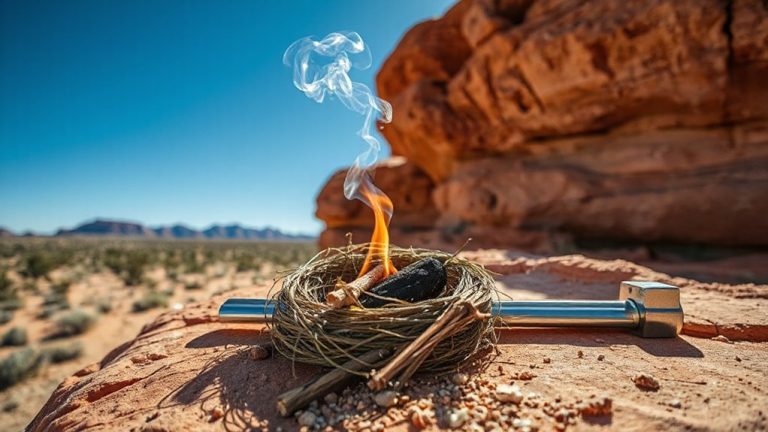
One well-prepared ember is all you need, but only if you transfer it correctly to your tinder bundle. For successful fire lighting in humid tropical conditions, your tinder must be bone-dry and finely shred-think dry palm fiber or coconut husk pith. Cradle the ember gently from the hearth using a leaf or bark tray to avoid breakage during the ember transfer. Place it center-mass in your tinder bundle, then slowly blow with controlled breaths to increase airflow. Don’t rush; premature aggression can cool the ember. Once you see wisps of smoke grow steady, gently lift and cradle the bundle in cupped hands, continuing light airflow. The glow will spread through the tinder until flame appears. A proper ember transfer guarantees heat retention, critical when ambient moisture saps thermal momentum. Test tinder readiness by trying to ignite a small piece with a spark-delay means it’s still too damp.
Fix the 3 Most Common Hand Drill Failures
If you’re struggling to get a coal despite steady effort, it’s usually due to one of three faults: poor spindle alignment, inadequate hand pressure, or damp wood. Fixing poor hand positioning is critical-your hands should form a straight column over the spindle, reducing lateral wobble. Misalignment kills efficiency, wasting energy and generating little heat. Drill pressure must be firm and consistent; light pressure won’t compress fibers enough to ignite, while too much can stall rotation. Adjust hand positioning frequently to maintain control and balance. Damp wood absorbs friction instead of converting it to heat, so use only dry, seasoned softwood. Correct alignment, solid drill pressure, and proper hand positioning work together-each affects the others. Test your setup early: if smoke doesn’t appear within 30 seconds of rapid spinning, recheck these three points. Small adjustments make the difference between failure and success.
Why Softwoods Work Better in the Humid Tropics
You’ve checked your alignment, adjusted your pressure, and confirmed your wood isn’t damp-yet your spindle still isn’t smoking up. Hardwoods aren’t your best bet here. In humid tropics, softwoods outperform because of lower wood porosity, which limits moisture absorption. Even when air humidity hits 90%, properly seasoned softwoods like cedar or cypress retain less water. That means less energy wasted evaporating internal moisture. Hardwoods, with higher wood porosity, soak up ambient humidity like a sponge, making ignition harder despite dry surfaces. Soft fibers also generate finer, drier ember-ready dust faster under friction. You’ll get ignition quicker, usually within 90 seconds of steady spinning. Yes, softwoods wear faster-spindles may last one or two attempts-but in tropical damp, reliability matters more than longevity. You need fire, not durability. Choose softwood. It’s not ideal everywhere, but here, in heat and humidity, it just works.
On a final note
You’ll get best results in tropical humidity by using dry softwood like cypress or bamboo for your drill board and spindle. Friction generates embers faster when materials stay low in moisture, even if the air’s wet. A properly aligned hand drill setup reduces failure from slippage or overheating. Success depends on consistent speed and pressure. Tinder must catch the ember fast-fine, bone-dry fibers work. This method works, but demands practice.