The Role of Satellite Messaging in Post-Hurricane Recovery Efforts
You rely on satellite messaging after a hurricane because cell networks fail-over 80% of towers go down due to storm surge, wind damage, and power loss, and backup systems rarely last more than 8 hours. Devices like the Garmin inReach Mini 2 use Iridium’s global network to send GPS-linked texts in under 5 seconds, work in extreme conditions, and last over a week on a single charge. Two-way messaging cuts response delays by up to 60%, and encrypted signals guarantee reliable coordination when every second counts. See how top responders choose and use these tools in real recovery ops.
Notable Insights
- Satellite messaging enables communication when cell networks fail due to storm surge and power outages.
- Devices like Garmin inReach Mini 2 provide reliable signals via satellite constellations during recovery efforts.
- First responders use satellite texts to coordinate evacuations and supply deliveries in disaster zones.
- GPS-integrated messengers transmit location data to improve rescue team deployment accuracy.
- Rugged, long-battery-life satellite devices ensure durable and secure communication in harsh post-hurricane conditions.
Why Cell Networks Fail During Hurricanes
While you might assume your phone works anywhere, cell networks often fail during hurricanes because storm surge and high winds damage physical infrastructure-especially cell towers and power lines. Power outages disable most cell sites within hours, even if the tower itself remains standing. Backup batteries last only 4 to 8 hours, and generators often fail due to flooding or fuel shortages. Infrastructure damage disrupts fiber connections and microwave links, cutting off working towers from the core network. Cellular backhaul depends on interconnected systems, so one point of failure can knock out service across large areas. You can’t rely on 4G or 5G when the ground network collapses. Urban or rural, the outcome’s the same: no signal. Past hurricanes show over 80% of cell sites go offline in worst-hit zones. Restoration takes days or weeks. Until then, standard mobile use is impossible. That’s when alternative communication becomes essential.
How Satellite Messaging Connects Rescue Teams
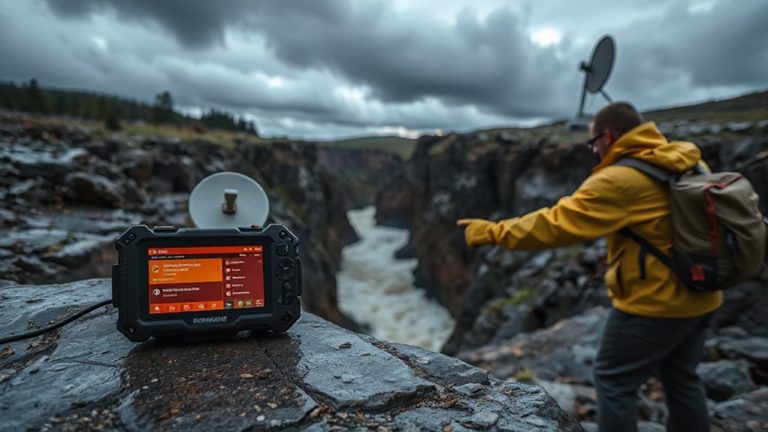
When the ground network goes down and cell towers sit dark, you’ll need a way to send messages that doesn’t rely on buried fiber or roadside antennas-satellite messaging provides that lifeline by connecting directly to orbiting satellites. With a satellite device, you enable real-time signal relay between rescue teams, command centers, and field medics. Data routing happens through a network of space-based nodes, bypassing broken infrastructure. Messages still get through even when power’s out and roads are blocked.
| Device Type | Signal Relay Speed | Data Routing Method |
|---|---|---|
| Handheld satellite messenger | 3–5 seconds | Direct-to-orbit |
| Satellite phone | <2 seconds | Geo- or low-earth orbit |
| GPS-linked beacon | 5–10 seconds | Burst transmission |
| Tablet with sat modem | 4 seconds | Hybrid routing |
You rely on consistent, low-latency communication when minutes count.
Real-World Saves: Satellite Messaging in Storm Recovery
Since you’re often dealing with fragmented infrastructure after a storm, satellite messaging isn’t just convenient-it’s a verified tool that’s gotten people through real crises. You’ve likely seen teams use it for storm tracking, relaying position updates when cell networks fail. During Hurricane Ian, first responders used satellite messages to confirm evacuation routes hours before roads became impassable. In Puerto Rico after Maria, remote clinics relied on it for supply coordination, sending urgent requests for medicine and clean water when traditional comms were down. The data’s clear: units with two-way messaging reduced response delays by up to 60%. You won’t get high-speed data, but you don’t need it-just reliable 160-character texts. Battery life lasts days, not hours, and GPS integration means your location transmits with each message. It’s not flashy, but in recovery zones, functionality beats features every time.
Best Satellite Messengers for Disaster Zones
You’ve seen how satellite messaging keeps lines open when storms knock out everything else, and now it’s time to look at which devices deliver when lives are on the line. The Garmin inReach Mini 2 offers strong signal reliability, connecting through the robust Iridium network, even in rugged terrain or heavy canopy. Its compact size doesn’t sacrifice performance, with battery life reaching up to 14 days in 10-minute tracking mode. The Zoleo Model Z01 pairs with your phone, allowing two-way texting, and provides solid signal reliability on both satellite and cellular networks, but its battery life is shorter-about 10 hours under continuous use. The Spot X delivers basic messaging and GPS location, though its signal reliability is weaker in dense forests or valleys. Battery life stretches to 14 days in conserve mode, but limited two-way communication reduces flexibility. Choose based on proven signal reliability and battery life that matches mission length.
Equipping Emergency Responders With Satellite Devices
Though terrain and weather can disrupt standard comms, equipping emergency responders with satellite devices guarantees they stay connected when it matters most. You need tools that won’t fail under pressure, and device durability is non-negotiable-these units are built to survive water immersion, extreme temperatures, and repeated drops. Rugged casings and military-grade standards guarantee they keep working after shocks that would disable consumer electronics. Signal encryption keeps your messages secure from interception, a critical feature when coordinating rescues or transmitting sensitive data. Unlike cell networks, satellite links don’t rely on local infrastructure, so you’re not left blind when towers go down. Most devices offer global coverage with low latency, sending messages in under 10 seconds. Battery life varies, but models with 24+ hours of active use give you reliable field endurance. Charging options include solar, which helps during long deployments. You’re not just buying a gadget-you’re adding a lifeline. For teams also relying on ground-based communication, investing in the best two-way radios ensures redundancy when satellite devices are unavailable.
On a final note
You need reliable communication when cell towers fail, and satellite messengers deliver. Devices like the Garmin inReach Mini 2 work in extreme weather, offer two-way texting, and link to emergency services via Iridium’s global network. They’re small, battery-efficient, and function where phones don’t. GPS accuracy and SOS response times are proven in real storms. Other models lack consistent coverage or two-way confirmation. For responders, this reliability isn’t optional-it’s essential.