Safe Procedures for Smoking Wild Foraged Fish to Prevent Parasite Survival
You must freeze wild foraged fish at -20°C for seven days to kill parasites like nematodes and tapeworms-shorter times or warmer temps won’t work. Then hot smoke it to an internal 145°F, using a thermometer in the thickest part. Cold smoking won’t reach that temp, so it’s unsafe. After smoking, chill fish below 40°F within two hours. Store in airtight containers, refrigerated or vacuum-sealed and frozen. Things get clearer from here.
Notable Insights
- Visually inspect wild fish for parasites by checking the gut and muscle tissue for worms, specks, or nodules.
- Freeze fish at -20°C for 7 days to kill parasites before smoking.
- Use hot smoking only, maintaining temperatures between 160°F and 200°F.
- Ensure fish reaches an internal temperature of 145°F to destroy parasites and pathogens.
- Cool smoked fish below 40°F within two hours and store refrigerated or frozen.
Spot the Parasites in Wild Fish That Can Make You Sick
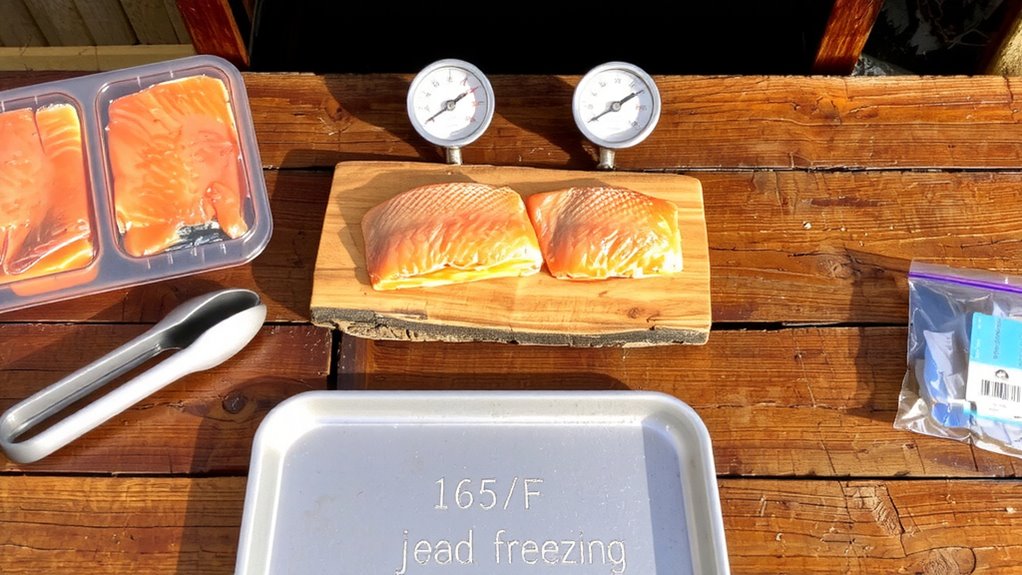
While you’re cleaning your catch, take a close look inside the flesh-especially around the gut and muscle tissue-because parasites like nematodes and tapeworms are common in wild fish and can be dangerous if not properly handled. You need parasite identification as part of your routine. These worms often appear as thin, coiled threads or cysts in the muscle. Visual inspection is your first and most accessible defense. Check for white or translucent specks, unusual discolorations, or small nodules under the skin and along fillets. Some parasites are visible to the naked eye, while others require close scrutiny. If you’re unsure, trim suspicious areas-better safe than sorry. Reliable detection doesn’t require tools, just sharp eyes and attention. This step isn’t optional if you plan to eat the fish. Accurate visual inspection reduces risk markedly. Ignoring it puts your health at unnecessary risk.
Freeze Fish at -20°C for 7 Days to Kill Parasites
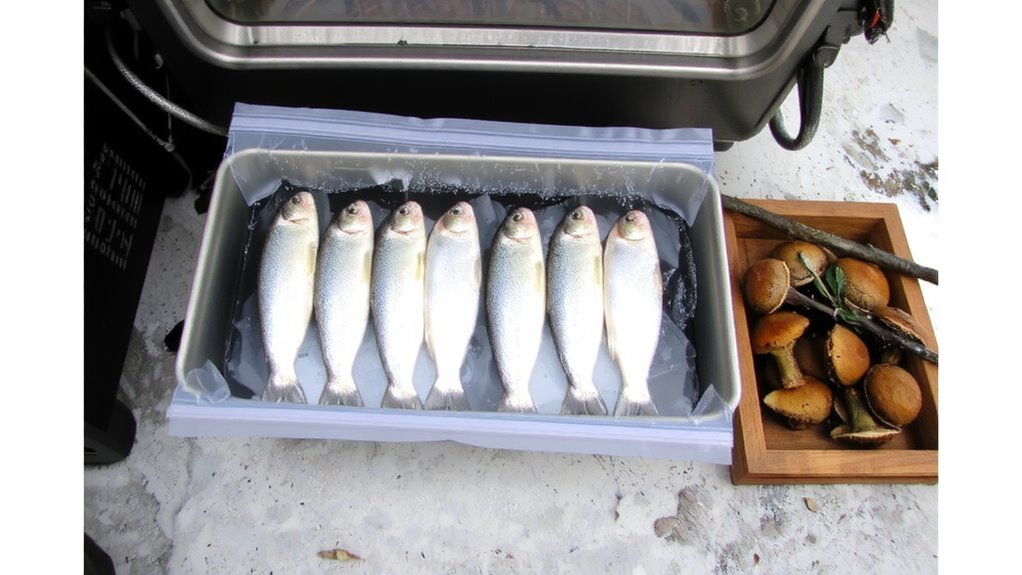
One reliable method to eliminate parasites in foraged fish is freezing at -20°C for at least 7 days. This freezing duration halts the parasite lifecycle, effectively killing common pathogens like nematodes and tapeworms. You can’t rely on visual inspection alone-some parasites embed deep in the flesh. Freezing works by forming ice crystals that disrupt cellular structures in parasites, guaranteeing they don’t survive. Below is a comparison of freezing conditions and their impact:
| Temperature | Duration | Effectiveness |
|---|---|---|
| -20°C | 7 days | High |
| -20°C | 5 days | Moderate |
| -15°C | 7 days | Low |
| -20°C | 14 days | High (overkill) |
| -30°C | 4 days | High |
You don’t need special equipment-most home freezers reach -20°C. Guarantee consistent temperature and don’t interrupt the cycle. This step is essential before any smoking.
Use Hot Smoking: Never Cold Smoke Wild Fish

You’ve already frozen the fish to knock out parasites, so now it’s time to cook it through with heat. Hot smoking is your only safe option for wild foraged fish-never cold smoke. Cold smoking doesn’t raise the internal temperature enough to kill pathogens, leaving you at risk. Hot smoking, done right, guarantees complete parasite destruction. Keep your smoker between 160°F and 200°F and maintain consistent smoking duration of 4 to 8 hours, depending on fish thickness. This range delivers safety without drying the flesh excessively. Use clean, food-safe hardwoods like oak, maple, or alder-avoid softwoods, as they introduce harmful resins. Proper wood selection improves flavor and combustion stability. The combination of sufficient heat, correct smoking duration, and appropriate wood selection guarantees a safe, palatable result. Stick to these standards every time.
Monitor to 145°F: The Safe Internal Temp for Smoked Fish
Don’t guess when it comes to doneness-your fish needs to hit 145°F internal temperature to be safe. That number isn’t arbitrary; it’s the minimum heat required to kill parasites commonly found in wild foraged fish. Use a reliable instant-read thermometer to check the thickest part of the fillet, avoiding bone or skin for accuracy. Once it reaches 145°F, you’ve met a critical food safety threshold. Undercooking risks illness, while overcooking dries out the flesh-145°F balances safety and texture. This internal temperature guarantees proteins coagulate and pathogens are neutralized, making the fish safe to eat. Cold smoking won’t achieve this, which is why hot smoking is non-negotiable. Monitoring internal temperature isn’t optional if you prioritize food safety. Every batch, every time, verify with a thermometer. It’s the only way to confirm your smoked fish is both safe and properly cooked.
Store Smoked Fish Safely to Avoid Recontamination
Your smoked fish’s safety depends on proper storage the moment it comes off the heat. Cool it quickly, within two hours, to below 40°F to halt bacterial growth. Use clean, airtight containers to maintain storage hygiene and block airborne contaminants. Place the fish in the coldest part of your refrigerator, ideally at 32–38°F, where it can last up to two weeks. For longer storage, vacuum-seal and freeze it-good for up to three months with minimal quality loss. Avoid using damp or reused containers, as they compromise contamination prevention. Never leave smoked fish at room temperature for more than two hours. Cross-contamination risks rise when tools or hands touch other foods then fish. Use separate utensils and wash hands before handling. Label packages with dates so you track shelf life. Proper methods guarantee what’s safe stays safe.
On a final note
You need to kill parasites in wild-caught fish, so freeze it at -20°C for seven days before smoking. Always use hot smoking, never cold smoking, to reach a safe internal temperature of 145°F. That heat level destroys pathogens effectively. After smoking, store the fish at or below 40°F and consume within five days to prevent bacterial growth. These steps aren’t optional-they’re essential for safe, edible smoked fish from wild sources.