Using Charcoal Remnants From Old Campfires as Cultural Landmarks
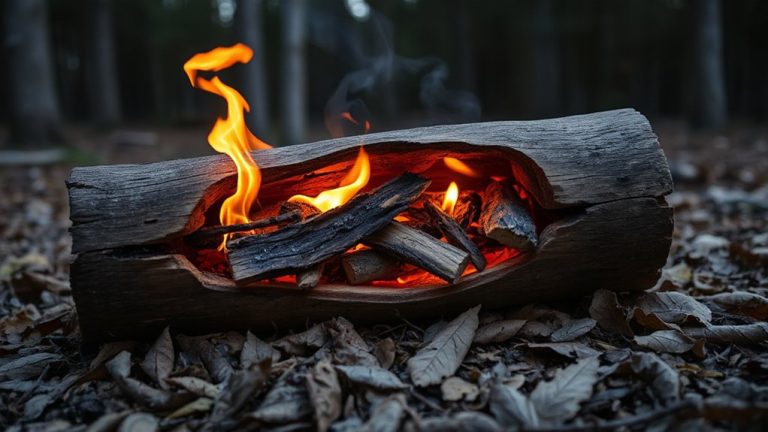
You’ve stepped into ancient footprints if you’re near old campfire charcoal-it lasts thousands of years because carbon resists decay better than bone or wood. Archaeologists use it to date human activity accurately, especially when undisturbed. Fire pit layouts reveal travel routes or temporary camps, while non-local charcoal hints at early trade. Each layer marks a distinct event, helping build timelines of settlement and land use. What lies beneath could tell you when and how people lived right where you’re standing.
Notable Insights
- Charcoal remnants resist decay, preserving evidence of ancient human fire use in campfires and hearths.
- Radiocarbon dating of undisturbed charcoal provides accurate timelines for human occupation and activity.
- Fire pit patterns with charcoal reveal settlement duration, movement routes, and behavioral practices.
- Non-local wood charcoal types indicate trade networks and cultural exchange between distant groups.
- Stratified charcoal layers help reconstruct historical land use and environmental changes over time.
Why Charcoal Outlasts Other Campfire Remains
Even though most campfire materials break down quickly, charcoal sticks around because it’s mostly carbon, which resists decomposition. You’ll find it intact while wood, cloth, and food scraps decay within years or decades. That chemical stability means charcoal doesn’t react easily with water, oxygen, or microbes-common causes of breakdown in organic materials. Because of this, it serves as a durable marker where other signs of human activity vanish. Its resistance supports long-term organic preservation, especially in buried or sheltered sites. Unlike ash, which washes away, or bone, which dissolves in acidic soils, charcoal holds its structure for centuries. You can rely on it to mark old fire pits, cooking zones, or land-clearing events. It’s not flashy, but its persistence gives you a clear, measurable record. When evaluating site longevity, charcoal outperforms nearly all other campfire byproducts due to simple chemistry and low solubility.
How Archaeologists Date Human Activity Using Charcoal
You can use charcoal to pin down when people were active at a site because it’s one of the few organic materials that survives long enough to be reliably dated. When wood burns in a low-oxygen environment, it turns into charcoal, locking in carbon from the atmosphere at that time. Scientists measure radiocarbon decay to estimate its age-after an organism dies, carbon-14 decays at a known rate, giving a clear time range. Charcoal resists chemical weathering better than bone or plant matter, making it more stable over centuries. You’ll get accurate dates as long as the sample hasn’t been contaminated by younger carbon or moved from its original context. It’s not perfect-context matters, and dating only applies to when the tree died, not necessarily the human activity-but combined with stratigraphy, it’s a reliable method. For fieldwork planning, prioritize undisturbed charcoal from hearths.
What Fire Pit Patterns Reveal About Past Human Movement
Why do fire pits appear where they do? Their placement isn’t random-it reflects how people moved and settled. You can trace travel routes by mapping fire pit locations along ridges, water sources, or sheltered areas. Fire pit symmetry often indicates intended use: circular, evenly spaced stones suggest temporary camps; asymmetrical or irregular layouts point to short-term, utilitarian stops. The spatial arrangement across a site reveals patterns-clusters imply group activity or repeated occupation, while isolated pits suggest transit points. Linear arrangements may align with known migration paths. You’re not just seeing charcoal; you’re seeing movement logic. Consistent pit size and orientation imply planned use, while scattered, uneven pits suggest opportunistic stops. Fire pit symmetry and spatial arrangement, combined with terrain analysis, let you reconstruct travel behavior without speculation. It’s practical evidence-measurable, visible, repeatable.
Charcoal Evidence of Trade, Migration, and Cultural Exchange
How far did those ancient travelers really go? You can trace their steps through charcoal remnants that reveal movement far beyond local foraging. Exotic wood types in fire pits signal long-distance trade routes, linking distant communities. These findings aren’t random-they align with known paths of cultural diffusion, where goods and ideas moved hand to hand across landscapes.
| Wood Type | Source Region |
|---|---|
| Juniper | Mountain zones |
| Mangrove | Coastal areas |
| Cedar | Distant forests |
Finding mangrove charcoal deep inland means someone carried it, proving trade routes functioned earlier than written records suggest. Cultural diffusion didn’t rely on empires-it happened campfire by campfire. Each non-local charcoal fragment confirms that ancient people weren’t isolated. They exchanged materials, and through them, language, tools, and beliefs-quietly shaping societies long before history was recorded.
Campfire Remnants and Seasonal Habitation
When did people first return to the same places year after year? You can trace seasonal habitation patterns through repeated campfire remains at favored sites. Charcoal deposits reveal consistent firewood selection habits-hardwoods like oak or pine-based on availability and burn efficiency. These choices reflect adaptation to local resources and intended use. Repeated use of specific spots suggests planned returns, likely tied to resource cycles. Seasonal cooking practices appear in residue analysis: plant remains, charred bones, and hearth structures indicate food processing routines aligned with migration or harvest times. The density and layering of charcoal show occupation frequency and duration. Patterns in fuel choice and food remains help you distinguish summer foraging stops from winter shelters. Site fidelity isn’t random; it’s practical. The evidence is measurable: stacked fire layers, tool debris, and species-specific charcoal. You rely on these markers to map human movement without speculation.
Why Preserving Charcoal Sites Matters for Cultural Research
Though it might seem unremarkable at first glance, preserving charcoal sites gives you direct access to measurable evidence of long-term human behavior. You can analyze combustion patterns and fuel choices, which reveal practical decisions and environmental knowledge. Beyond daily survival, these sites often held spiritual significance-fires weren’t always just for warmth or cooking. You’ll find remains associated with ritual practices, like controlled burns or offerings, indicating structured belief systems. When you protect these locations, you maintain context: the spatial layout, artifact proximity, and soil layers that link fire use to cultural meaning. Without preservation, you lose the ability to distinguish routine fires from those tied to ceremonies. You also risk erasing indirect evidence, such as charred plant remains used in rites. Preserving charcoal sites guarantees you retain physical links to both ordinary and sacred acts, allowing accurate, grounded interpretations of past societies through practical, testable data.
Using Charcoal Layers to Build Historical Timelines
What can a thin black line in the soil really tell you? More than you think. These charcoal layers help build historical timelines by revealing fire frequency and charcoal composition over time. Each layer marks a past fire event, and its depth indicates age. By analyzing multiple strata, you can track human activity or climate shifts. The composition tells you what burned-hardwood, softwood, or grass-giving clues about local vegetation and fuel use. Fire frequency shows how often people used fire, which relates to settlement patterns or land management.
| Depth (cm) | Estimated Age (BP) | Charcoal Type |
|---|---|---|
| 15 | 200 | Oak |
| 42 | 850 | Pine |
| 78 | 1,600 | Grass and shrubs |
You rely on consistent sampling and lab analysis. It’s not flashy, but it works.
On a final note
You can rely on charcoal remnants to map ancient human activity because they resist decay better than organic materials. Radiocarbon dating gives accurate timelines, often within decades. Fire pit patterns show settlement range and movement. Charcoal layers reveal seasonal use or trade routes. Preserving these sites lets you compare cultural shifts over centuries. It’s a durable, datable record-no flash, just facts useful for building precise historical models.