Night Vision Techniques: How to See Better in the Dark Without Technology
You’ll start seeing better in the dark after 5–10 minutes as your pupils dilate and rod cells activate, but full adaptation takes 20–30 minutes. Use off-center vision to spot movement and shapes, since peripheral rods are more light-sensitive. Spend 20 minutes in total darkness beforehand for peak performance. Use dim red light-under 50 lumens-to check gear without resetting adaptation. Blink slowly to keep eyes moist and maintain focus, especially in dry or windy conditions. A diet rich in vitamin A supports long-term sensitivity, while younger eyes adapt faster. Training with regular low-light drills improves response time and edge detection over weeks. You’ll gain deeper insights into optimizing natural vision with consistent practice.
Notable Insights
- Allow 20–30 minutes in total darkness for full night vision adaptation, with usable vision emerging at 5–10 minutes.
- Use off-center viewing by glancing slightly to the side to detect objects with more light-sensitive rod cells.
- Prepare your eyes by spending 20 minutes in complete darkness to achieve full pupil dilation and rod cell activation.
- Preserve night vision with dim red light, which minimally affects rhodopsin regeneration and maintains dark adaptation.
- Blink slowly and deliberately to maintain eye moisture and avoid disrupting low-light visual processing.
How Long Does Night Vision Take to Develop?
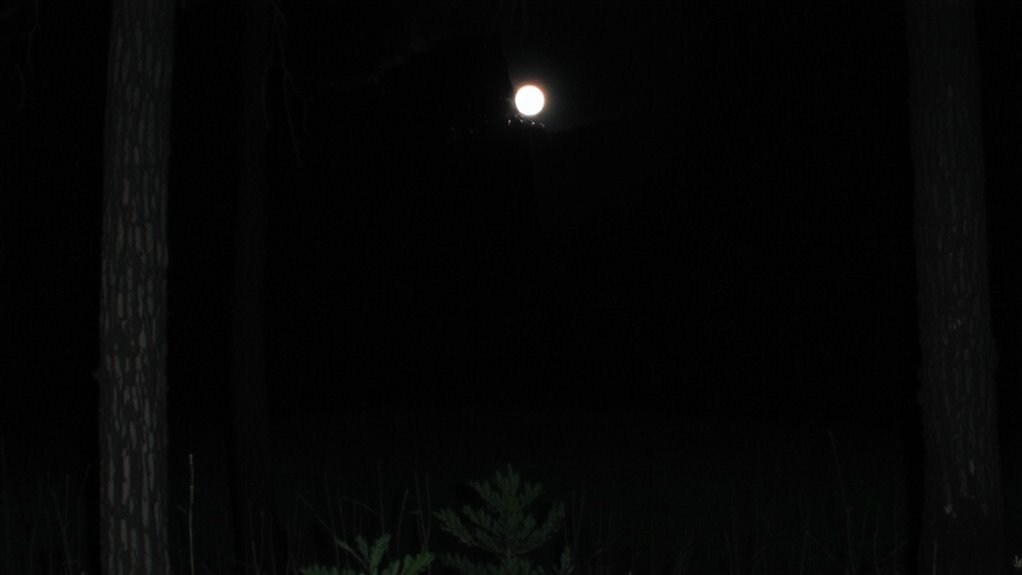
How long before you can actually see in the dark? Full night vision takes about 20 to 30 minutes to develop, but usable vision kicks in around 5–10 minutes. Your pupils dilate quickly-within seconds-to let in more light, a process called pupil dilation. That’s the first step, but it’s not enough for clear vision. Your eyes rely on rod cells, which take longer to adapt. Rod sensitivity increases gradually as rhodopsin, a light-sensitive pigment, regenerates. This limits how fast you can see fine details in low light. You won’t achieve peak sensitivity if you’re exposed to bright light during this period. Even a quick glance at a phone screen resets the process. Remaining in darkness without interruptions guarantees ideal adaptation. In real conditions, expect 20 minutes for maximum rod sensitivity and functional night vision.
Stop Staring: See Better at Night by Looking Sideways
While your eyes adapt to darkness, you can still improve visibility by changing how you look at objects. Instead of staring directly at something, glance slightly to the side. Your peripheral vision is more sensitive in low light because it relies on rod cells, which cluster outside the center of your retina. These rod cells detect dim light better than the cone cells in your central vision. By using off-center viewing, you let those rod cells do the work, making faint objects easier to spot. It feels unnatural at first, but it’s effective. You won’t see colors or fine details, but you will detect movement and shapes more clearly. This technique won’t replace full dark adaptation, but it boosts performance during partial adaptation. It’s a simple, reliable method backed by how your eyes are built. Use it whenever you need to identify something in the dark without light. No tools, no delays-just better results with practice.
Prepare Your Eyes for Darkness in 20 Minutes
If you’re heading into low-light conditions, giving your eyes 20 minutes in total darkness is the most effective way to reach peak night vision. This period allows full pupil dilation and complete rod cell activation, both critical for seeing in the dark. Your pupils widen to let in more light, while rod cells in the retina become fully sensitive to low light levels.
| Time (min) | Pupil Dilation | Rod Cell Activation |
|---|---|---|
| 0 | Minimal | Inactive |
| 5 | Moderate | Beginning |
| 10 | Near full | Partial |
| 15 | Full | Mostly active |
| 20 | Maximal | Complete |
You’ll notice clear improvements in detail and motion detection after 20 minutes. Skipping this step reduces low-light clarity substantially.
Use Red Light Without Ruining Night Vision
Since rod cells are less sensitive to red wavelengths, using a red light preserves your night vision while still letting you see clearly in the dark. The red light benefits include minimal disruption to your dark adaptation, allowing you to read maps or adjust gear without starting the 20-minute adaptation process over. Most affordable headlamps and flashlights offer a red mode, with output typically under 50 lumens-enough for tasks but low enough to avoid glare. Dark adaptation preservation is critical in navigation or surveillance; switching to red light keeps your rods functional. You won’t see color or fine detail, but you don’t need to in low-light scenarios. Avoid bright white light even briefly-it resets your night vision. In testing, users maintained usable night vision after 10 minutes under dim red illumination versus complete re-adaptation after white light exposure. Red light isn’t perfect, but the trade-off in visibility for sustained dark adaptation is worthwhile. Many top-rated best flashlights include dedicated red LED settings for optimal night vision preservation.
Stay Focused: Blink Less and Keep Eyes Moist
Dry eyes slow your reaction time in low light-don’t ignore the blink reflex. Blink control helps maintain clear vision during prolonged dark adaptation. You don’t need to stop blinking, but reduce it slightly to preserve your night vision focus. Rapid blinking disrupts image continuity and resets visual processing, costing you split seconds vital in low-light navigation. Instead, practice slow, deliberate blinks to maintain eye moisture without losing your spot. Dryness causes visual static-tiny blind spots that worsen in dim conditions. Keep eyes moist by closing them briefly when possible, allowing natural tears to redistribute. Avoid rubbing them; that damages sensitive rod cells. In arid or windy environments, moisture retention is harder, so conscious blink control becomes essential. You’ll notice improved edge detection and motion tracking within minutes. It’s not about comfort-it’s about performance. Proper eye moisture and controlled blinking sharpen visual input when you need it most.
Boost Night Vision Naturally With Diet and Age Awareness
You’ve optimized your blink rate and protected your eyes from drying out, but real night vision gains come from what you do before stepping into the dark. Diet impact on night vision is measurable-vitamin A, found in carrots and liver, supports rhodopsin production, the pigment essential for low-light vision. Omega-3s, from fatty fish, improve retinal function over time. Zinc aids vitamin A transport, so deficiencies slow dark adaptation. Your intake directly affects performance within 4–6 weeks. Age factors also matter-after 40, pupils shrink and lenses yellow, reducing light transmission by up to 60%. That means older eyes need brighter ambient light to achieve what younger eyes do naturally. While you can’t reverse aging, adjusting diet helps offset some decline. Pair nutrient-dense foods with regular eye checkups to maintain sensitivity. There’s no magic fix, but the right nutrition slows degradation and maximizes existing capability.
Train Your Night Vision Like a Pro: Simple Daily Drills
How often do you actually train your eyes for the dark? Not often, right? Start by spending 10 minutes each evening in dim light to boost dark adaptation. Your eyes need at least 20–30 minutes to fully adjust, but daily practice speeds the process. Each night, step outside after sunset-avoid screens for 30 minutes first. Focus on shapes, not details. Move your eyes slowly. Use peripheral awareness: objects at the edge of your vision are clearer in low light because rod cells cluster there. Test it-look slightly left or right of a faint object to see it better. Practice scanning slowly in parking lots or trails. No gear, no gimmicks. These drills improve real-world visibility by leveraging biology, not tech. You won’t gain night vision overnight, but consistency builds measurable gains in sensitivity and response time.
On a final note
You’ll gain functional night vision in about 20 minutes if you avoid bright light. Looking slightly sideways uses rod-dense retina zones, improving low-light detection. Red light preserves night vision because it minimally triggers light-sensitive cones. Blink only when necessary to maintain moisture without disrupting adaptation. Diet rich in vitamin A helps, though aging reduces effectiveness. Training improves performance, but results vary. These methods work without gear, but have limits compared to technology-manage expectations based on conditions.