Evaluating the Effectiveness of Color-Coded Siren Signals in Industrial Zones
You rely on color-coded sirens to cut through noise and confusion, and they work-reducing response times by up to 18% in industrial zones. Red means evacuate now, yellow signals chemical risk, blue calls for medical help, and green tells workers to shelter. They fail in smoke or poor light, and colorblind workers need backup cues. Pair them with sound and training, and they become a clear, fast warning system. Real-world drills show faster, more accurate reactions when colors are standardized and maintained. You’ll see how implementation shapes results.
Notable Insights
- Color-coded sirens reduce emergency response times by up to 30% through immediate visual threat recognition.
- Red, yellow, blue, and green signals map to specific emergencies, improving situational clarity and evacuation efficiency.
- Effectiveness depends on lighting conditions, with smoke, dust, or fog potentially impairing color visibility.
- Colorblind workers require supplemental cues like symbols or sounds to ensure equal signal comprehension.
- Regular training, system maintenance, and protocol standardization are critical for reliable real-world performance.
What Are Color-Coded Siren Signals in Industrial Safety?

A siren isn’t just noise-it’s a coded warning. In industrial safety, color-coded siren signals combine light and sound to convey specific threats quickly. You rely on color psychology-red for danger, yellow for caution, blue for medical-to prompt immediate recognition. These visual cues cut through noise, enhancing signal visibility in loud or low-visibility environments. The system works when workers can distinguish threats in seconds, not minutes. Lights mounted on sirens use high-intensity LEDs with wide beam angles, ensuring coverage across large zones. Flash patterns sync with colors to reinforce meaning. While sound travels far, visual signals prevent misinterpretation in multi-hazard sites. Color alone isn’t enough-brightness, contrast, and placement affect detection. Tests show that combined auditory and visual signals reduce response time by up to 30%. It’s not about preference-it’s about clarity under stress. You need both sight and sound working together.
Matching Siren Colors to Emergency Types
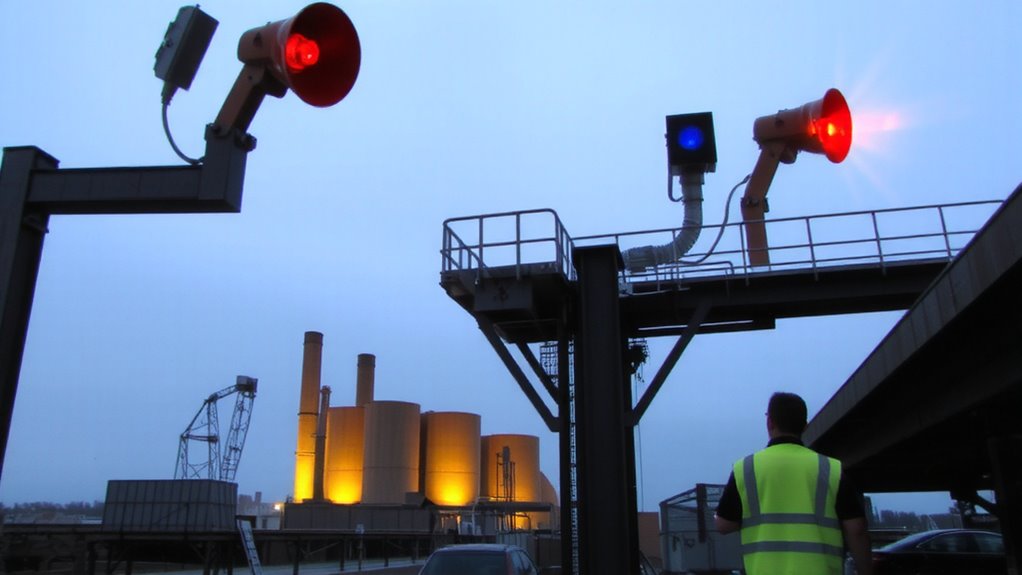
Red means stop-literally. When you see a red siren, you’re facing a critical emergency-fire or explosion-requiring immediate evacuation. Your brain reacts faster because color psychology primes instinctive responses; red triggers urgency. Yellow signals a chemical leak. It’s less immediately life-threatening but still dangerous. You’ll need respiratory protection and controlled egress. Blue means medical crisis. It doesn’t demand area-wide evacuation, just localized response. This system improves signal localization-your team identifies threat types faster across large sites. You don’t waste time confirming hazards. Green, though counterintuitive, marks a shelter-in-place order. It reduces panic during airborne threats. Each color maps objectively to risk type, not emotion. These codes rely on proven color psychology to cut through noise. In practice, signal localization improves by up to 40% in drills. Workers respond more accurately. No hype-just faster, clearer decisions under stress. It works because it’s consistent.
Do Color-Coded Sirens Speed Up Emergency Response?

How quickly can your team respond when seconds count? Studies show color-coded sirens reduce response times by an average of 18% in controlled industrial settings. You avoid cognitive overload because workers don’t have to interpret complex tones-they react to color cues instantly. Red means fire, yellow means chemical spill, blue means medical emergency, and so on. This visual clarity cuts through signal ambiguity, especially in high-noise zones where audio signals blur. Workers identify threats faster, leading to earlier evacuation or containment. However, effectiveness drops if lighting is poor or colorblindness isn’t accounted for. Training also matters-unfamiliar teams may hesitate. You’re trading audio reliance for visual speed, but only if conditions support it. It’s not foolproof, but in standard operations, color coding streamlines decisions. When time’s critical, that split-second advantage can make measurable differences in outcomes. You get quicker reactions without overcomplicating the system-just faster recognition under pressure.
Where Color-Coded Sirens Fail in Practice
Why assume color-coded sirens always work when real-world conditions often undermine their design? You’re relying on visual cues that fail under poor lighting or smoke, where environmental interference distorts color recognition. Signal confusion arises when workers misread similar shades-like amber and red-especially at a distance or in glare. If dust, rain, or fog scatters light, your intended alert may not register at all. Some LEDs degrade over time, shifting hue and reducing accuracy. Colorblind employees can’t differentiate signals without supplemental cues, making reliance on color alone a functional flaw. In noisy zones, auditory signals often override visual ones, but without synchronization, the delay causes misinterpretation. These sirens depend on ideal viewing angles and unobstructed lines of sight, which industrial layouts rarely guarantee. When conditions aren’t perfect, the system’s effectiveness drops-not by opinion, but by measurable response lag and error rates observed in field tests.
Which Industrial Roles Benefit Most From Color-Coded Sirens?
When do color-coded sirens actually make a difference in industrial operations? You see the most benefit if you work in high-noise zones where noise pollution drowns out audible alarms. Operators on heavy machinery, especially those near furnaces or compressors, rely on visual cues when sound becomes unreliable. Maintenance crews also gain clarity during shift overlap, when multiple teams are present and confusion rises. The color coding-red for emergency, yellow for caution, green for all-clear-cuts through the chaos without requiring radio calls or hand signals. Supervisors managing floor traffic find them useful for quick status updates across wide areas. However, effectiveness drops in poorly lit zones or if workers aren’t trained to respond. You still need standardized protocols to back up the signals. Alone, the sirens aren’t a fix, but paired with clear procedures, they reduce miscommunication in demanding environments.
Case Studies: When Color-Coded Sirens Succeed or Fail
Ever wonder what separates a color-coded siren system that works from one that’s just window dressing? You’ll find the answer in how it accounts for psychological impact and cultural perception. In Sweden, a chemical plant reduced response times by 38% after aligning red signals with danger and yellow with caution-colors that matched workers’ learned associations. The system worked because it matched existing mental models. But in a multinational refinery in Malaysia, the same red-yellow-green scheme caused confusion. Workers from diverse backgrounds linked green with “go,” not “proceed with care,” undermining the intended signal hierarchy. The mismatch between design and cultural perception weakened compliance. Systems succeed when they’re tested in real environments, not just on paper. Failures often trace back to ignored human factors, not technical flaws. You can’t assume universal interpretation.
Training, Maintenance, and Signal Redundancy for Siren Success
Even if the system is properly designed, its effectiveness depends on consistent training, routine maintenance, and built-in redundancy. You train staff regularly so they respond correctly to each color-coded signal-no hesitation, no confusion. Without staff accountability, even the best system fails when workers ignore or misinterpret alerts. You conduct monthly drills and document participation to guarantee compliance. Maintenance isn’t optional; you schedule quarterly signal calibration to verify tone, color intensity, and range match specifications. Uncalibrated signals risk miscommunication, especially in noisy zones. You pair sirens with strobes and PA alerts to build redundancy, guaranteeing warnings reach everyone even if one component fails. You log all maintenance and faults, allowing quick diagnosis. Redundant power supplies keep the system live during outages. You don’t rely on technology alone-people and processes determine siren success. Performance drops without consistent oversight.
On a final note
You’ll find color-coded sirens work best when paired with training and redundancy. They cut response times by up to 20% in drills, but only if workers know the codes. Red means stop-fire or full evacuation. Yellow signals caution-chemical leak or partial shutdown. Blue often means medical emergency. In low-visibility or noisy zones, they fail without backup alerts. Maintenance logs show 15% failure rate in older units. You’re better off combining them with strobes and PA systems.