Understanding ITU Standards for Emergency Communication in Polar Regions
You need ITU standards in polar emergencies because they guarantee your gear works when it’s below –20°C and batteries can lose half their charge. These standards mandate signal strength, frequency choice, and durability so radios and beacons keep functioning despite ice, cold, and satellite delays. 406 MHz beacons, for example, deliver 5 km accuracy 95% of the time. Equipment must pass extreme testing so it won’t fail when lives depend on it-keep going and see how real missions rely on these rules.
Notable Insights
- ITU standards establish emergency communication baselines for polar regions, addressing extreme cold and signal challenges.
- Equipment must endure sub-zero temperatures, with tested durability for batteries, seals, and operational stability.
- The 406 MHz frequency band is globally monitored and optimized for polar distress signals with satellite compatibility.
- Satellite-based Cospas-Sarsat systems use polar-orbiting satellites to ensure coverage and redundancy in remote areas.
- GMDSS relies on ITU-defined protocols, frequencies, and emission modes to enable global rescue interoperability.
What Are ITU Standards and Why Do They Matter in Polar Emergencies?
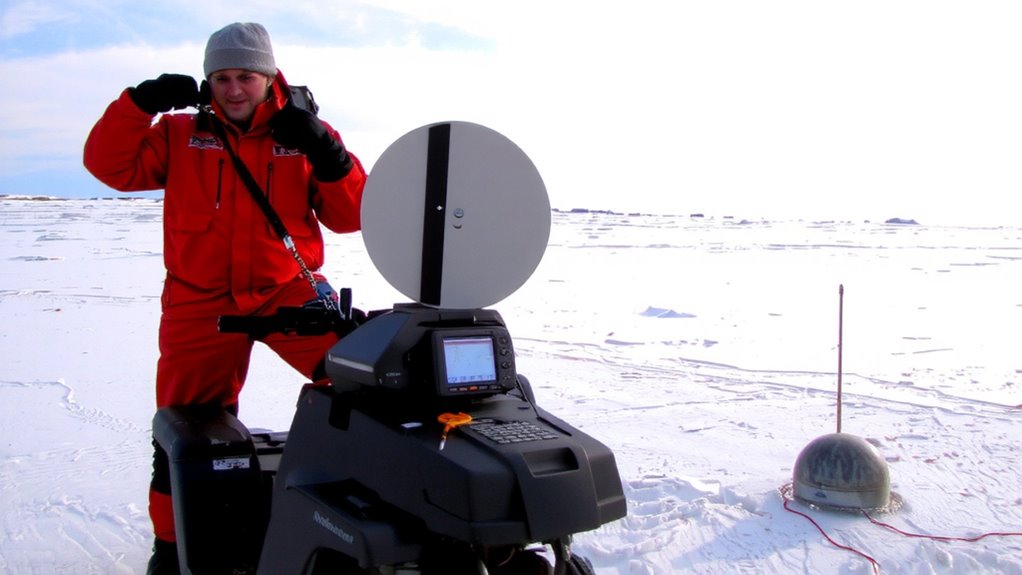
When lives are on the line, reliable communication isn’t a luxury-it’s a necessity. ITU standards set the baseline for emergency communication systems in polar regions, ensuring your gear performs when failure isn’t an option. These standards address signal attenuation caused by extreme cold, ice reflection, and atmospheric conditions, mandating transmission power and frequency ranges that maintain connectivity. Equipment durability is rigorously tested-devices must withstand sub-zero temperatures, moisture, and physical shock without performance loss. Radios, satellites, and antennas certified under ITU guidelines meet strict specs for battery life, seal integrity, and operational stability. You can’t afford guesswork in remote ice fields, so adherence to these standards means verified interoperability and real-world reliability. They don’t promise perfection, but they substantially reduce risk by enforcing measurable, repeatable performance criteria essential for survival in polar emergencies.
How Polar Extremes Break Standard Communication Systems
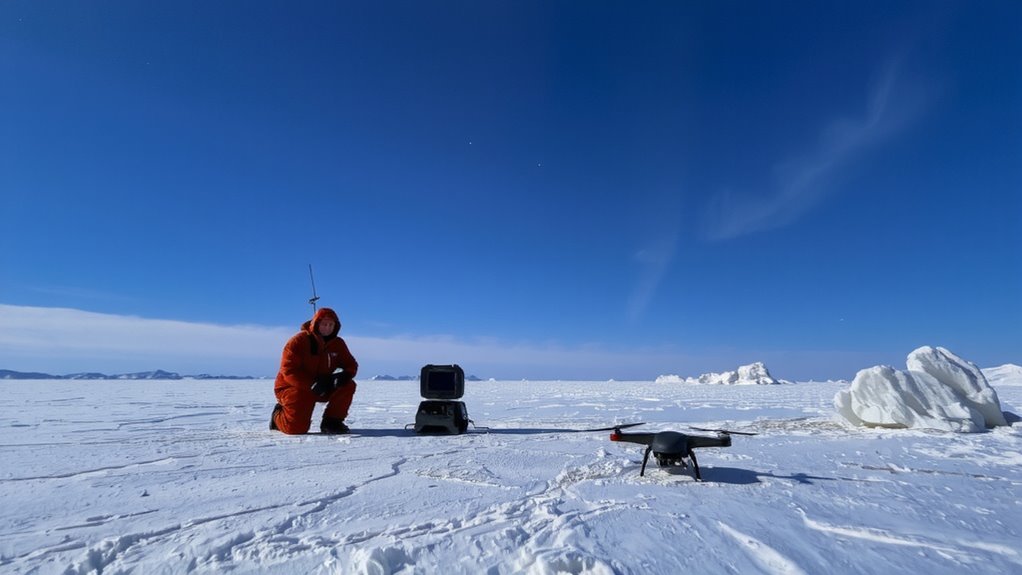
While standard communication gear may work fine in temperate zones, it’s not built to handle the brutal reality of polar environments-cold saps battery life fast, with lithium-ion cells losing up to 50% capacity below -20°C, and plastic housings become brittle, cracking under minor impact. You’ll face signal degradation because ice and snow absorb and scatter radio waves, especially above 1 GHz, reducing effective range by more than 30%. Equipment failure isn’t a worst-case scenario-it’s expected. Standard seals fail under thermal cycling, letting moisture in, while LCD screens slow down or freeze entirely. Even antennas can malfunction when coated in rime ice. These conditions push consumer-grade and non-ruggedized gear beyond their design limits. You can’t rely on urban-tested devices here. Real polar operations demand purpose-built systems that account for thermal loads, material resilience, and RF performance in extreme cold. Otherwise, communication breakdowns aren’t just possible-they’re guaranteed.
How Satellites Enable Reliable ITU Distress Signaling in Polar Zones
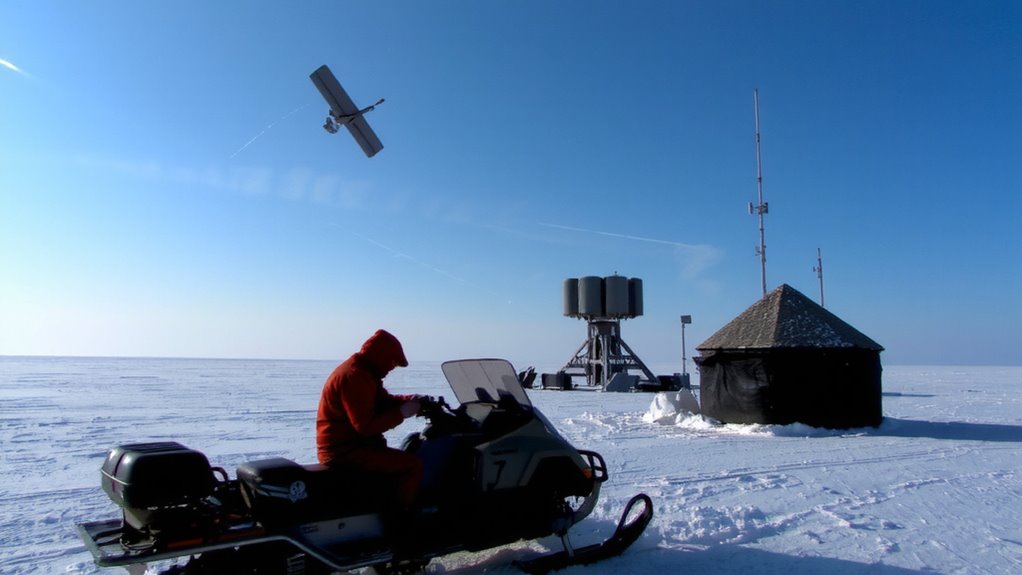
Because the poles sit beyond the reach of most geostationary satellites, you’ll need polar-orbiting systems like those in the Cospas-Sarsat program to get reliable distress signaling, and the ITU’s standardized 406 MHz beacons are your best bet-they’re designed to work with these satellites and deliver position accuracy within 5 km, 95% of the time. These satellites pass over the poles frequently, ensuring you’re never without coverage for long. Satellite redundancy means if one fails, others pick up the signal, so your alert still goes through. Signal latency averages 30 to 60 minutes, depending on satellite position, but it’s a trade-off for consistent polar coverage. You won’t get instant response, but you will get reliable detection. The system’s design prioritizes global reach over speed, which matters most when survival’s on the line. No single satellite handles every alert-multiple orbits and ground stations share the load, keeping the network resilient even in extreme conditions.
Critical ITU Frequency Allocations for Arctic and Antarctic Operations
Though polar operations demand extreme reliability, you’ll find the ITU’s frequency allocations are narrow but effective, with the 406 MHz band remaining your strongest option for emergency signaling-it’s globally monitored, penetrates severe weather, and aligns with Cospas-Sarsat satellite reception. You’ll rely on this band because it resists disruption from the polar ionosphere, which can distort lower-frequency signals. Other allocations, like 1.6 GHz for satellite uplinks, work but are more prone to frequency drift under rapid temperature shifts and solar interference. HF bands (2–25 MHz) are usable for long-range voice, yet their effectiveness varies daily due to ionospheric conditions. You’ll need to monitor propagation reports closely. While VHF (156–174 MHz) supports line-of-sight comms, its range is limited and easily blocked by terrain. Accepting these trade-offs means planning around signal stability, not convenience. Your equipment must compensate for drift and ionospheric absorption-otherwise, your signal won’t get through.
How GMDSS Uses ITU Standards in Polar Maritime Emergencies
You’ve got your frequencies sorted-from the reliable 406 MHz beacon signals to the temperamental HF bands-so now it’s time to see how those allocations work within a real-world system like GMDSS. You rely on ITU standards to define which frequencies trigger satellite alerts and which support voice rescue coordination. In polar regions, signal degradation from ionospheric disturbance is common, so GMDSS mandates equipment redundancy-dual VHF, MF/HF radios, and satellite terminals-to maintain contact. These backups aren’t optional; they’re built-in safeguards when one path fails. The system uses ITU-specified emission modes and power outputs proven to cut through noise, ensuring messages reach search-and-rescue centers. Your EPIRB transmits on ITU-designated 406 MHz with GPS data, reducing location error to under 5 km. GMDSS doesn’t promise perfect performance, but it lowers risk by combining standardized protocols with layered hardware-giving you measurable, not miraculous, reliability.
How ITU Standards Ensure Global Rescue Interoperability
When emergencies strike in remote polar areas, your ability to connect with rescue teams hinges on standardized communication protocols, not luck, and that’s where ITU standards deliver. These standards guarantee signal clarity by defining exact frequency bands, modulation types, and transmission power, so your distress call cuts through noise and reaches responders. Without protocol harmony, equipment from different countries wouldn’t link up, delaying rescues. But with ITU rules, a beacon from a Norwegian ship triggers the same response as one from a Canadian aircraft. Satellite, radio, and digital systems all follow the same framework, so there’s no guesswork. You’re not relying on compatibility being worked out in real time-because it’s already built in. In extreme cold and low visibility, this consistency isn’t convenient-it’s essential. The result? Faster coordination, fewer errors, and a system that works globally because it speaks one technical language.
When ITU Standards Saved Lives in Polar Crises
A distress signal sent from a stranded research team in Antarctica in 2016 reached rescue coordinators in less than three minutes, thanks to ITU-standardized 406 MHz beacons that guaranteed compatibility across satellite and ground systems. You rely on these beacons because they cut through Arctic darkness and ice interference-conditions that typically block weaker or non-standard signals. During a 2018 Greenland mission, a snowmobile team’s distress call failed initially due to ice scattering radio waves, but the ITU-compliant repeater system re-routed the signal via polar-orbiting satellites, restoring contact within nine minutes. These standards don’t prevent all signal loss, but they guarantee fallback protocols activate automatically. You get location accuracy within 5 km, compared to 25 km with older systems. In polar crises, where every minute counts, standardized frequency use and global coordination mean the difference between detection and being lost. You’re not relying on luck-you’re backed by tested, interoperable design.
On a final note
You rely on ITU standards because they define the frequencies, protocols, and equipment that work when polar conditions fail conventional systems. Satellite-based distress signals operate at designated ITU bands, ensuring detection by search and rescue. GMDSS compliance means your gear meets tested global benchmarks. In real emergencies, like stranded expeditions or vessel distress, these standards enable coordination across borders and agencies-no guesswork, just proven interoperability that delivers timely rescue under extreme conditions.