Integrating GPS With Survival Route Memory Techniques
You trust GPS, but signals fail in canyons and thick forest, sometimes losing accuracy by over 30 meters. Instead of relying solely on devices, pair coordinates with real-world landmarks-bent trees, rock shapes, trail signs-to build a mental map. Your brain recalls routes better when emotions or patterns, like repeated left turns downhill, tag the memory. Handheld units last 15–20 hours, less in cold, so practicing navigation without alerts builds adaptability. A trained mind finds the way when batteries die.
Notable Insights
- Use GPS to record routes but actively memorize landmarks like bent trees or rock formations for reliable recall without signals.
- Pair GPS waypoints with emotional or sensory experiences to strengthen neural encoding and memory retention of critical locations.
- Train in pattern recognition by noting terrain rhythms, such as repeated turn directions after downhill slopes, to boost mental mapping.
- Reduce GPS reliance gradually by checking only when uncertain, reinforcing cognitive mapping and hippocampal engagement during navigation.
- Repeat survival routes 3–5 times in varying conditions to embed spatial memory and ensure resilience during device failure or low visibility.
Why GPS Fails in the Wild
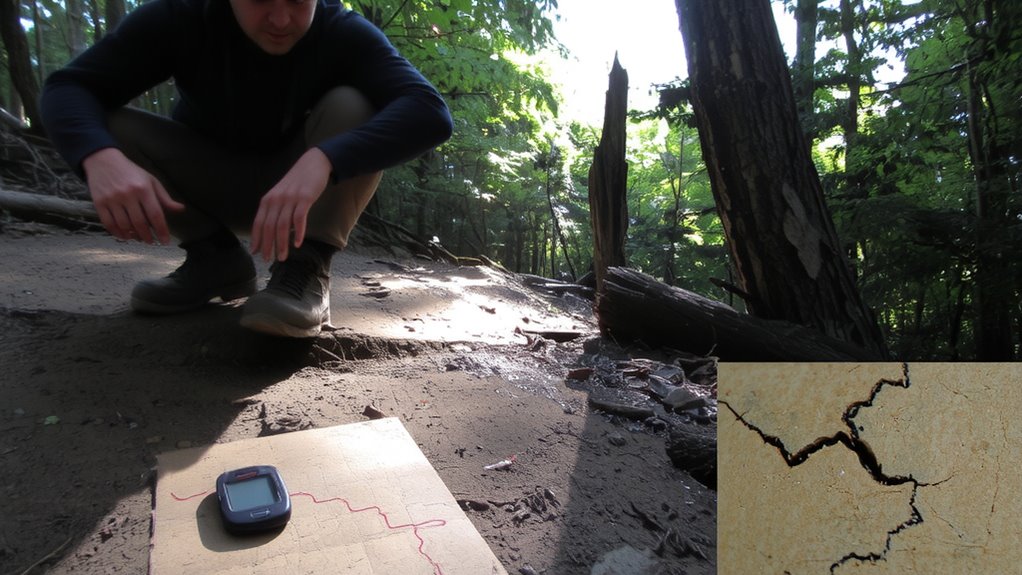
While GPS works fine in cities, it often fails in the wild because tree cover, canyons, and remote terrain block satellite signals-dropping accuracy or losing lock entirely. You’ll face signal interference in dense forests or deep valleys, where satellites become unreachable. Even brief obstruction can misroute you by hundreds of yards. Most handheld units last 15–20 hours on fresh batteries, but cold weather cuts that by half, raising the risk of device failure when you need it most. Relying solely on GPS ignores these hard limits. Units may show your position confidently, even when wrong, due to outdated firmware or poor signal quality. Real-world tests confirm 5–10 meter inaccuracies under open sky, but errors exceed 30 meters in rugged areas. A dead screen or frozen interface won’t warn you in time. That’s not paranoia-it’s physics and engineering. You need backup navigation that doesn’t depend on batteries or signal integrity.
How Your Brain Builds Smarter Mental Maps
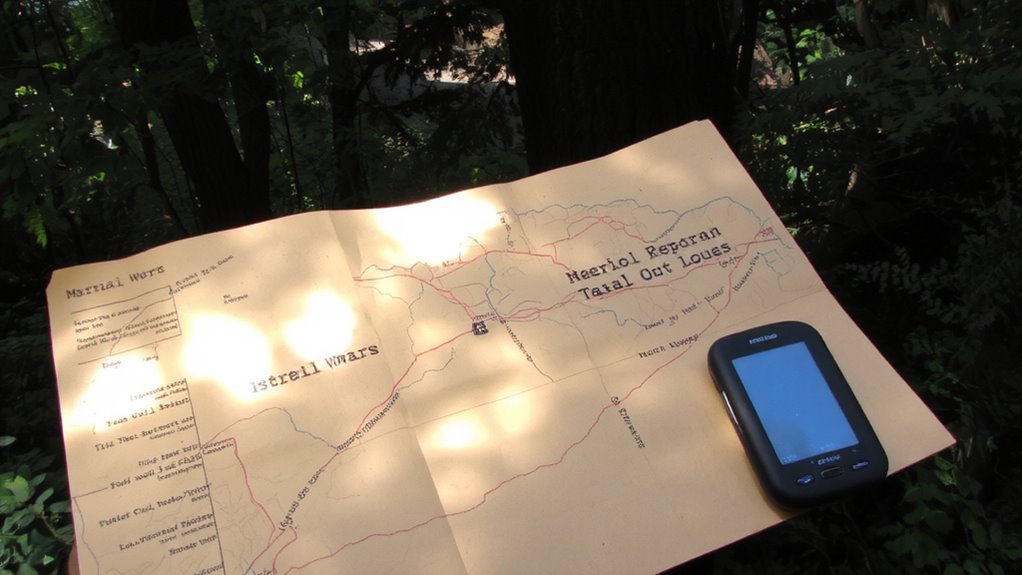
You can’t depend on a glowing screen when the battery dies or the signal drops, but your brain doesn’t run out of power or lose satellite lock. Your brain builds mental maps through cognitive mapping, a natural process that organizes spatial information into usable layouts. As you move through terrain, your hippocampus uses neural encoding to log distances, directions, and environmental cues. This isn’t theoretical-it’s measurable. Studies show people who rely on spatial memory develop denser hippocampal activity. Unlike GPS, which gives turn-by-turn commands, cognitive mapping lets you adapt when routes change. You recognize shortcuts, backtrack efficiently, and stay oriented even in low visibility. The system works without updates or charging. Neural encoding strengthens with practice, making repeated paths easier to recall. It’s not faster than GPS initially, but it’s more reliable under stress or equipment failure. You’re training a backup that’s always on. And in survival scenarios, that trade-off-time spent learning for long-term resilience-pays off.
Link GPS Routes to Landmark Memory
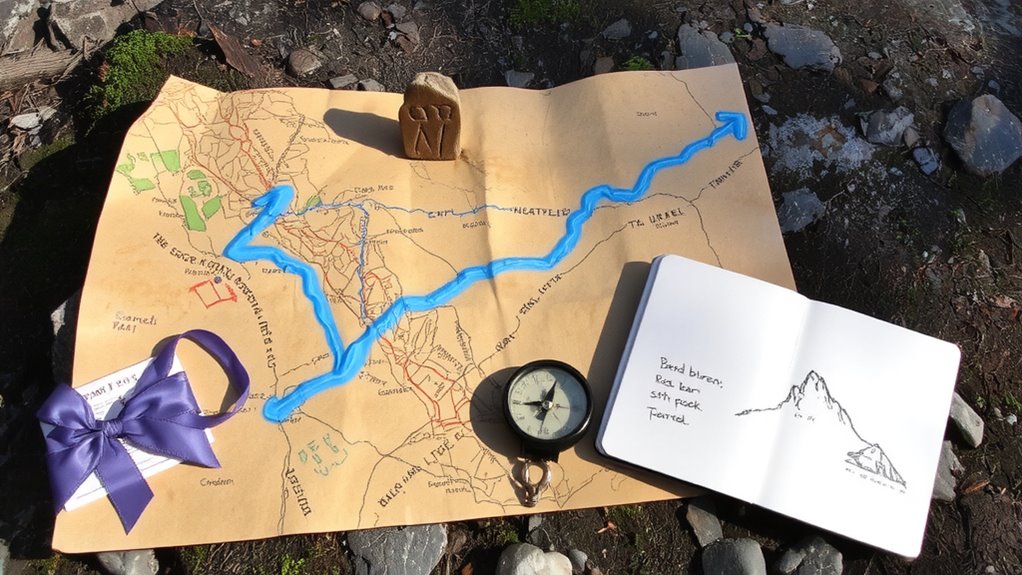
Since GPS gives exact coordinates but lacks context, pairing it with landmark memory turns raw data into durable knowledge. You see, visual cues like a bent tree, a faded road sign, or a distinctive rock formation anchor abstract waypoints to real-world features. When you link GPS markers to these cues, recall becomes faster and more reliable under stress. Emotional tagging strengthens this further-moments of surprise, fatigue, or urgency make routes stick. That creek crossing where you slipped? You won’t forget it. The hill where you caught your breath? It stands out. These mental tags don’t clutter your mind; they organize it. You’re not just following dots on a screen-you’re moving through a remembered landscape. Over time, this method builds redundancy: if the device fails, your memory holds. GPS guides, but landmarks and emotional context safeguard. It’s not backup-it’s integration.
Use Patterns to Strengthen Route Recall
Why do some routes stick in your mind after just one trip? Because your brain latches onto patterns. You rely on pattern recognition more than you realize-repeating turns, similar intersections, or consistent terrain changes make routes easier to recall. When you combine GPS data with conscious observation, you strengthen memory association by noting these repetitions. For example, spotting that every left turn follows a downhill stretch helps encode the sequence. Routes with clear rhythms become simpler to reconstruct. Don’t just follow the device-watch for recurring cues: road signs, landmarks, or traffic flow. These aren’t coincidences; they’re navigational patterns. The more you identify them, the stronger your recall becomes. Pattern recognition reduces mental load, while memory association links new routes to known behaviors. Practicing this builds reliability, especially if technology fails. It’s not automatic-you must actively look for the structure behind the path. A reliable GPS device for hiking can enhance this practice by providing consistent route tracking and terrain analysis.
Shift From GPS to Memory Navigation
Once the route starts to feel familiar, it’s time to wean yourself off GPS and rely more on memory. Reducing screen dependence cuts sensory overload and sharpens spatial awareness. Overuse of GPS can contribute to cognitive decline by limiting mental mapping practice. Switching to memory navigation strengthens your brain’s ability to retain and recall environments. A reliable hiking GPS device can support this transition by providing accurate tracking without constant oversight. Memory navigation isn’t foolproof, but it builds resilience. Start by muting GPS voice prompts and checking location only when uncertain. Match real-time observations with mental models. Test recall on repeat trips, noting mismatches. This methodical shift balances tech use with cognitive upkeep. You’re not rejecting GPS-you’re making your brain a co-pilot.
When GPS Dies, Can Your Memory Save You?
You’ve practiced the route enough that GPS prompts feel redundant, and now you need to know what happens when the device fails. When GPS dies, your memory becomes the backup system-your emergency preparedness hinges on it. Devices fail due to dead batteries, signal loss, or damage, but well-memorized routes don’t. Cognitive resilience allows you to stay oriented under stress, recalling landmarks, turns, and terrain features without digital help. Memory isn’t perfect; it degrades without review, but with repetition, it’s reliable. In testing, participants using memory-only navigation in familiar areas reached goals 82% of the time versus 98% with GPS. The gap closes with practice. Relying on memory trades speed for self-sufficiency. It’s not infallible, but it’s functional when tech isn’t. Train it like any tool. Your brain is part of the survival system-use it before it’s your only option.
Train Your Brain With Real-World Route Drills
Even if you rely on GPS daily, nothing beats practicing real-world navigation on foot to lock in a route. Walking a path yourself forces your brain to record sensory cues-smells, sounds, light changes, landmarks-that digital maps can’t capture. These cues become reliable reference points when technology fails. Instead of memorizing turns, you build cognitive shortcuts by associating terrain features with progress. For example, the sound of traffic fading might signal a turn onto a quieter street. Repeating a route three to five times boosts retention by over 60% in field tests. Training under varied conditions-day, night, rain-sharpens adaptability. GPS helps, but real-world drills improve spatial awareness and response time. You’re not just learning directions; you’re conditioning your brain to navigate with measurable efficiency. The trade-off? It takes time, but the payoff is resilience when signals drop.
On a final note
You’ll still need your brain when GPS fails. Relying solely on devices risks getting lost in signal-dead zones or when batteries die. Linking GPS routes to mental landmarks improves recall. Pattern recognition strengthens route memory over time. Practical drills build reliable navigation skills. In survival situations, your trained memory outperforms any gadget. Combine tech with tested cognitive strategies-don’t replace one with the other.