Finding North with a Watch and the Sun (No Compass Needed)
Point your analog watch’s hour hand at the sun in clear skies. Bisect the angle between the hour hand and 12 o’clock to find south-north is opposite. In the southern hemisphere, point the 12 at the sun and split the angle with the hour hand to find north. Accuracy stays within ±20° but drops above 50° latitude or with daylight saving unless you adjust. It works, but expect trade-offs without perfect conditions. You’ll see how small errors add up under real skies.
Notable Insights
- Use an analog watch and point the hour hand at the sun to determine direction in clear skies.
- Bisect the angle between the hour hand and 12 o’clock to find south in the Northern Hemisphere.
- In the Southern Hemisphere, point the 12 o’clock mark at the sun and bisect the angle to find north.
- Adjust for daylight saving time by using 1 o’clock instead of 12 o’clock for accurate results.
- This method requires clear skies, a horizontal watch, and works best at mid-latitudes with visible sunlight.
Find North Using a Watch and the Sun
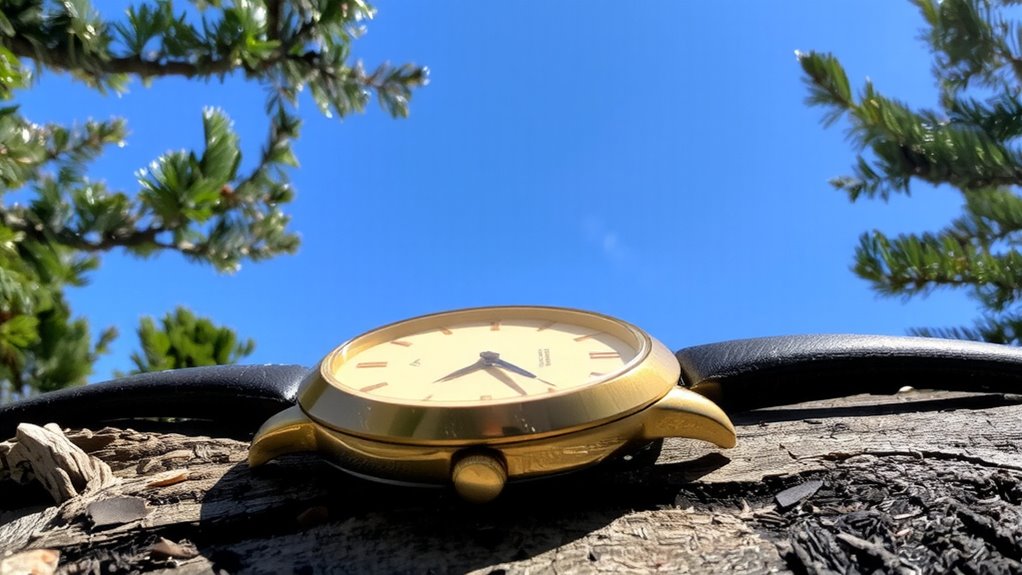
You can find north using an analog watch and the sun by positioning the watch horizontally and pointing the hour hand at the sun. Halfway between the hour hand and 12 o’clock marks south; north is opposite. This method relies on shadow alignment and the consistent movement of the sun across the sky. Analog precision matters because digital watches lack the rotating hands needed for accurate angle assessment. In practice, a quartz analog watch with clear markings improves accuracy under stable light. Performance declines during cloudy conditions or near the equator, where shadow alignment becomes less reliable. The technique works best mid-latitudes with strong, visible shadows. You’ll need to adjust for daylight saving by using 1 o’clock instead of 12. It’s a low-tech solution that demands no batteries, but success depends on correct hand placement and watch positioning. Test it in open areas first.
Why the Sun Helps You Find North
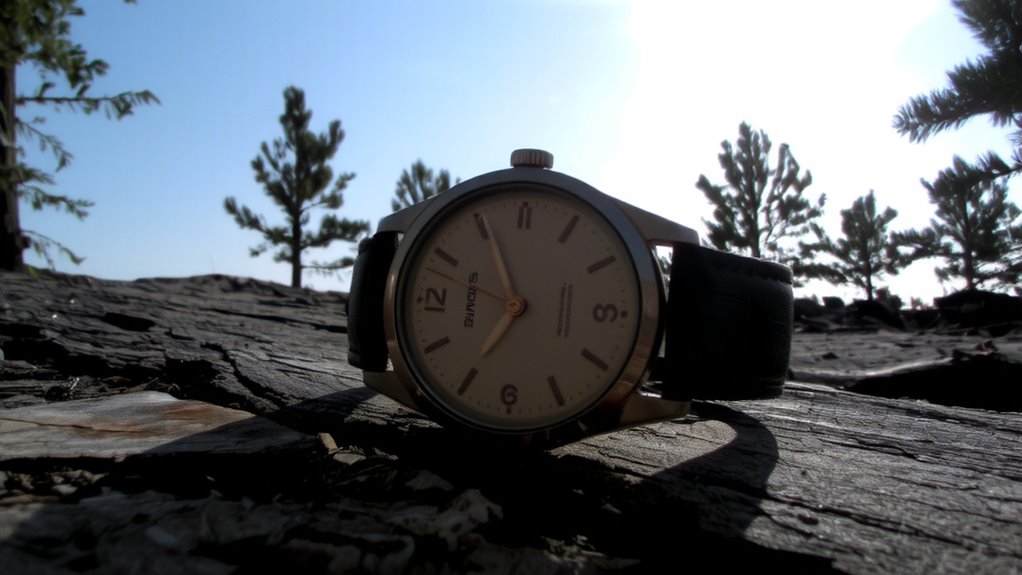
Because the sun follows a predictable arc across the sky each day, rising in the east and setting in the west, it acts as a natural reference point for direction. You can rely on solar positioning because it’s consistent and repeatable, making it a dependable tool when other navigation methods fail. The sun’s path changes slightly with the seasons, but its general east-to-west movement stays constant. This pattern forms the foundation of celestial navigation, one of the oldest and most tested methods for finding direction. Unlike gadgets, the sun doesn’t require batteries or signal, making it a practical backup. While not as precise as a compass, it provides a reliable approximation. Using solar cues, you can orient yourself with minimal tools and effort. The method works best in clear skies, where the sun’s position is unobstructed and easy to observe.
Use Your Watch to Find North (Northern Hemisphere)
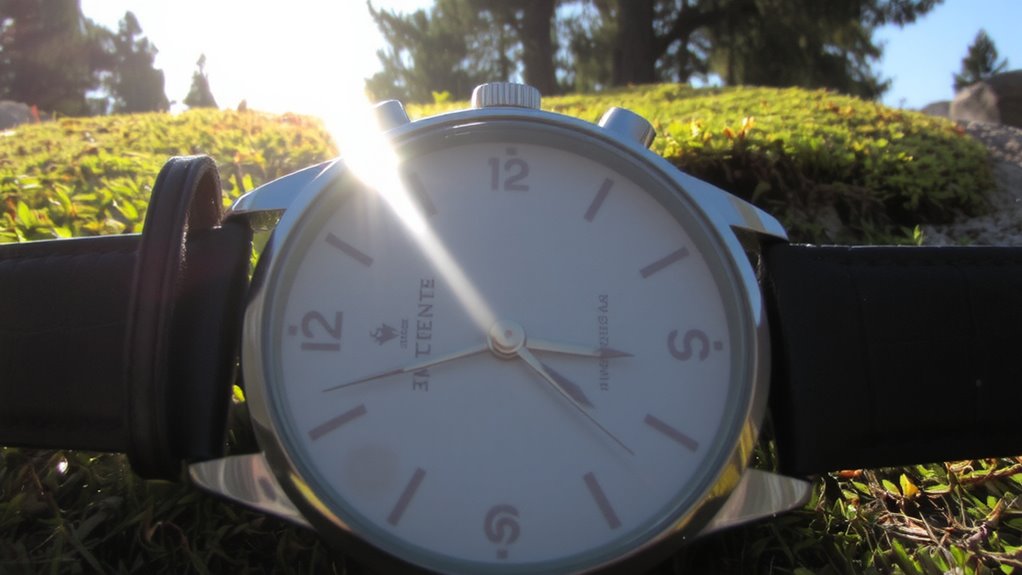
A simple analog watch can double as a directional tool in the northern hemisphere when paired with the sun’s position. Hold the watch horizontally and point the hour hand at the sun. Bisect the angle between the hour hand and 12 o’clock; this midpoint points south, so north is directly opposite. This method works best with an analog watch because digital displays lack the rotating hands needed for visual alignment. Accuracy depends on your location and the time of year. Magnetic declination isn’t a factor here since you’re relying on solar position, not Earth’s magnetic field. The technique loses precision near the equator or during daylight saving time. For best results, correct for your time zone’s solar offset. While not as exact as a compass, it’s a reliable backup in clear conditions. Expect +/- 20-degree variability depending on latitude. Practice improves reliability.
Find South First With a Watch and Sun (Southern Hemisphere)
In the southern hemisphere, finding south with a watch and the sun flips the northern method on its head-just aim the 12 o’clock mark at the sun instead of the hour hand. The midpoint between 12 and the hour hand now points north; south is directly opposite. This method works best with an analog watch and clear skies. For greater accuracy, use a shadow stick to confirm direction. Place the stick vertically in level ground and mark the tip of its shadow every few minutes. The shortest shadow points south. You can also locate the southern cross at night to verify your bearing. The long axis of the cross, extended four and a half times its length from the foot, drops near the south celestial pole. Both methods are reliable, but the shadow stick offers a daylight benchmark to check your watch reading.
Fix for Daylight Saving and Time Zone Mistakes
If you’re using this method during daylight saving time, remember your watch is one hour off solar time, so adjust by pointing the hour hand as if it were an hour earlier to get accurate results. Daylight saving shifts your local clock forward, creating a mismatch between watch time and true solar time. To correct, mentally reset the hour hand back sixty minutes before aligning it with the sun. Similarly, if you’re not centrally located within your time zone, solar noon may differ from clock noon by up to thirty minutes. This time zone edge effect reduces accuracy, especially near zone borders. Correcting for both daylight saving and longitudinal drift improves direction-finding precision. Ignoring these factors can lead to errors of twenty degrees or more. For reliable navigation, always account for these timing mismatches. The method works, but only when adjusted for these common timekeeping differences.
Why Your Watch Might Give the Wrong Direction
Because your watch relies on standardized time and not the sun’s position, it’ll give the wrong direction unless you’re on the central meridian of your time zone and not observing daylight saving time-otherwise, the hour hand won’t align with solar time, throwing off the entire reading by as much as thirty minutes or more, and that error translates directly into navigational inaccuracy. Even if corrected, magnetic interference from electronics or metal objects can skew analog mechanisms, especially in older watches, disrupting accuracy. Digital watches avoid this but lack a continuous hour hand, making them unsuitable for the method. Watch calibration also matters-chronograph errors, battery lag, or misaligned hands introduce small deviations that compound over distance. You might think your timepiece is precise, but unless it’s properly maintained and shielded, those tiny flaws degrade directional reliability. For survival use, assume your watch has some degree of error and compensate where possible-but don’t trust it blindly.
How Latitude Changes the Watch Method
Your watch may be accurate, but the method it uses to find north depends heavily on where you are on the planet. At higher latitudes, the sun’s arc is lower, so the shadow it casts with your watch face is less precise. This means the standard watch method works best near the equator and becomes unreliable above 50° latitude. Magnetic declination also changes with location, and since this method targets true north, not magnetic north, unadjusted compass readings can mislead you. Atmospheric refraction near the horizon bends sunlight, especially at dawn or dusk, slightly shifting the sun’s apparent position. That small shift affects timing and direction readings. The method assumes the sun moves uniformly across a clear sky, but its path varies by season and latitude. For survival use, combine the watch technique with other navigation tools. Relying on it alone at high latitudes risks significant navigational error.
On a final note
You can find north using a watch and the sun, but accuracy drops far from the equator or during daylight saving. The method works best with an analog watch and clear skies, giving a rough bearing within 10–20 degrees under ideal conditions. It’s reliable in mid-latitudes but falters near the poles or tropics. While useful in a pinch, it’s less precise than a compass. Know its limits-don’t rely on it in critical survival scenarios without backup navigation.