Why You Should Never Strip Bark From Trees During Survival Foraging Expeditions
You shouldn’t strip bark because it kills trees by exposing the phloem and cambium, disrupting nutrient flow and inviting disease. Dead trees reduce forest cover, weaken ecosystem stability, and increase erosion. Stripped areas stand out, attract animals, and can reveal your location. Birch, maple, and beech rarely survive. Use downed wood or plant fibers instead-they’re reliable and sustainable. Destroying trees for short-term gain backfires; there’s always a better way if you know where to look.
Notable Insights
- Stripping bark kills trees by disrupting nutrient flow and exposing vital inner layers to disease and dehydration.
- Damaged trees weaken forest stability, increasing erosion and harming surrounding plant and soil health.
- Bark wounds create long-lasting visible and olfactory cues that attract animals and reveal human presence.
- Vulnerable species like birch, maple, and beech often die quickly after bark removal, even in small amounts.
- Sustainable alternatives like downed wood, moss, and plant fibers provide effective resources without harming living trees.
Why Stripping Bark Often Kills Trees
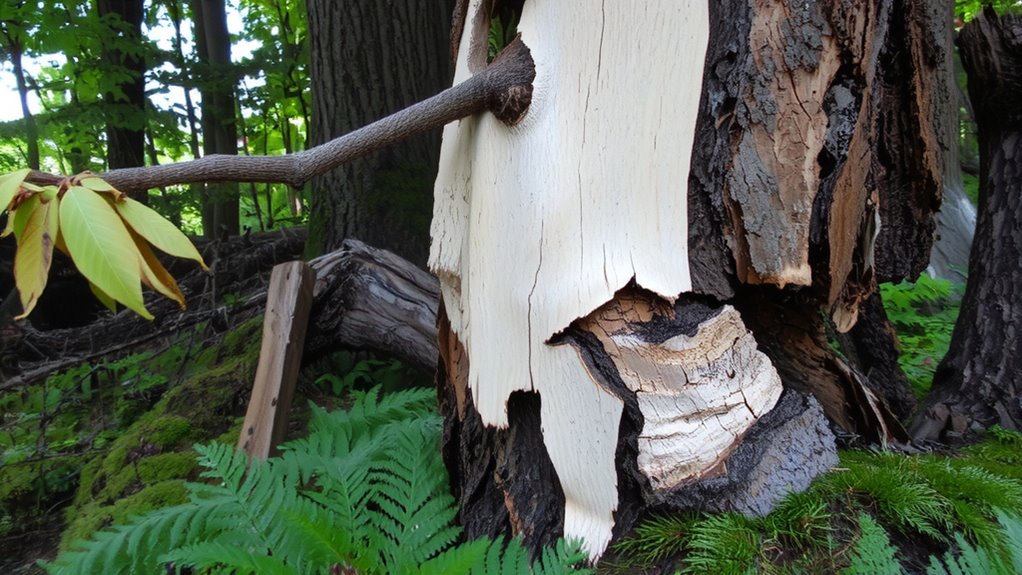
That bark’s doing more than just sitting there looking tough-it’s your tree’s frontline defense. When you strip it, you expose the inner layers to sunlight, pests, and diseases. This damage disrupts the phlo academic, which carries nutrients, leading to nutrient loss. Without this essential transport, the tree can’t sustain growth or repair. You also compromise the cambium, responsible for new tissue. Once exposed, moisture evaporates quickly, accelerating tree dehydration. Even brief exposure in dry or hot conditions worsens water loss, weakening the tree fast. Young trees die quicker because their systems are less resilient. Deep or wide stripping is rarely survivable. Partial rings might slow the process, but survival rates drop sharply above 50% circumference damage. You’re not just harming one tree-you’re reducing future resources. In survival scenarios, this short-term gain risks long-term failure. Keep the bark intact to preserve tree function and your own sustainability.
How Bark Damage Collapses Forest Health
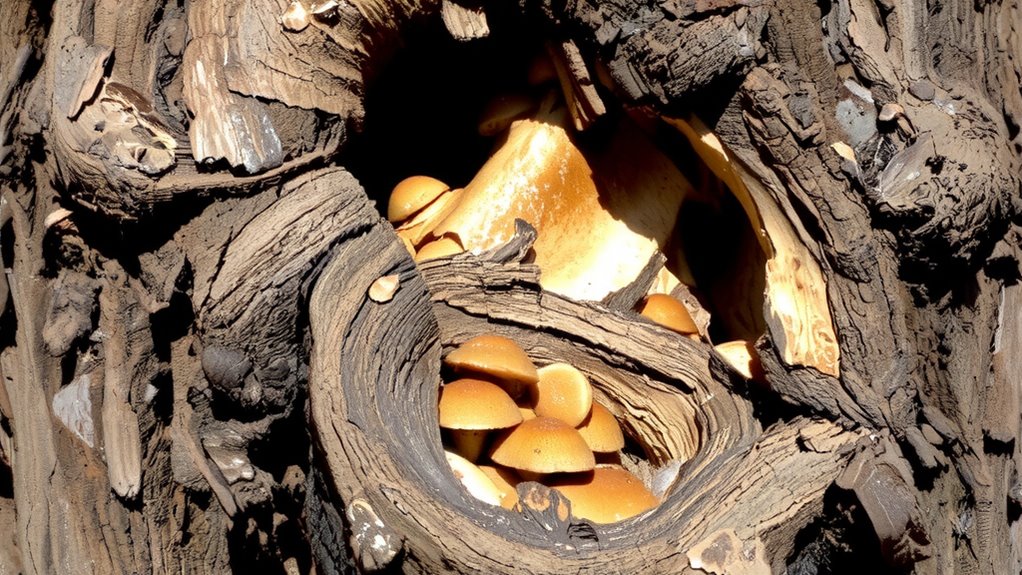
While one stripped tree might seem like a minor issue, the cumulative effect of bark damage across a forest disrupts the entire ecosystem’s resilience. You compromise tree stability, leading to root exposure as weakened trunks shift or fall. Exposed roots dry out, reducing water uptake and increasing erosion. Damaged trees can’t efficiently transport nutrients, causing nutrient disruption that affects soil quality and nearby plant life. Insects and pathogens invade stripped areas, spreading to healthy trees. Canopy gaps open, altering microclimates and sunlight patterns on the forest floor. This cascades into reduced reproduction for shade-dependent species. Over time, regeneration slows, and biodiversity drops. What you may see as a quick resource grab undermines decades of ecological balance. Every layer of damage adds up-visible now, worse later. The forest doesn’t just lose trees. It loses structure, function, and the ability to recover.
Why Stripped Trees Can Betray Your Location
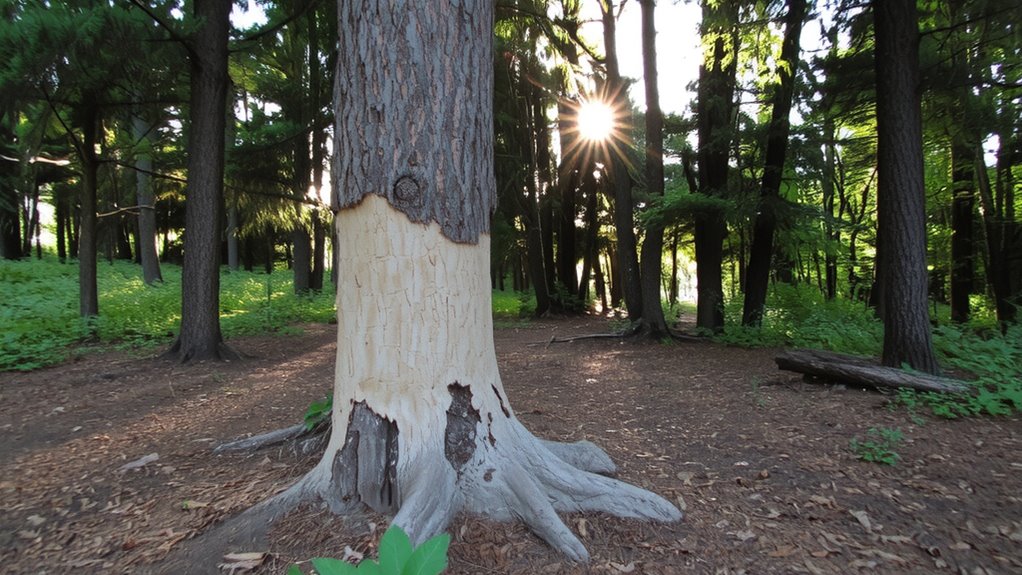
How far do you think you can vanish when your trail leaves behind unmistakable scars on the landscape? Stripped trees create visual signals that stand out in natural settings, especially in dense forests where bark disruption breaks uniformity. These exposed patches reflect light differently, making them visible from a distance, even in low light. You might think you’re hidden, but searchers or predators can spot these signs easily. The damage also triggers animal attraction-curious or scavenging species like birds, raccoons, or insects gather at the site, drawn by scent or texture changes. Their activity adds movement and sound, further revealing your path. Unlike subtle footprints, stripped bark won’t wash away with rain or fade quickly. It persists for weeks, sometimes months. Each stripped tree becomes a signpost. You’re not just damaging the tree-you’re broadcasting your presence through both visual signals and increased animal attraction.
Survival-Proof Alternatives to Bark Use
Forget bark-there are better, smarter options that won’t mark the land or hurt trees. You can use downed wood for cordage and shelter instead of stripping live trees. Inner bark substitutes, like cattail fibers or hemp dogbane, work well for string and bindings when properly dried. Pine resin, collected from naturally damaged areas, seals seams without girdling. For food, focus on abundant, fast-renewing plants like dandelion or clover-reliable and ethically gathered. Moss and leaf litter insulate shelters effectively, reducing direct impact. These methods support sustainable harvesting, letting ecosystems recover. Choosing fallen or renewable materials aligns with ecological preservation, minimizing trace. You don’t need bark when alternatives are functional and accessible. Real survival isn’t about taking-it’s about using what’s already available. Make practical choices. They last longer and leave less behind. Your actions shape the wild spaces you depend on.
Tree Species That Can’t Survive Bark Stripping
You’ll kill some trees just by removing their bark, and you need to know which ones. Species like birch, maple, and beech can’t survive bark stripping due to immediate sap flow disruption and cambium layer exposure. These trees rely on a continuous vascular system just beneath the bark; once disrupted, nutrient transport stops. Birch bark is particularly vulnerable-peeling it opens large surface areas, accelerating moisture loss and inviting pathogens. Maples suffer rapid decline when their thin cambium is exposed, impairing sugar transport. Beech trees respond poorly to wounds, often succumbing to fungal infections after damage. Removing even vertical strips can girdle the tree, cutting off resources completely. Unlike resilient oaks or pines, these species lack protective mechanisms to seal large injuries. There’s no recovery once the inner layers are compromised. In survival scenarios, targeting these trees risks long-term ecosystem harm with little gain. The structural and physiological trade-offs aren’t worth the minimal return. Choose alternatives instead.
When Bark Stripping Is (Rarely) Acceptable?
While most situations don’t justify removing bark, there are rare cases where it’s a viable last resort-specifically when you’re in a true survival emergency and no other options exist. If you’re severely injured, lost in harsh conditions, and lack food or shelter materials, stripping bark from a non-critical tree might provide lifesaving fiber or insulation. Even then, take only what’s necessary and choose a tree that can tolerate damage. Some indigenous groups have used bark sustainably for centuries, guided by deep cultural significance and respect for the tree’s role in their environment. These historical practices emphasize minimal impact and gratitude, not reckless harvesting. You’re not in that context, but you can still apply the principle: act with restraint. This isn’t about foraging efficiency-it’s about survival ethics. The tree’s health matters even in crisis, because your long-term survival may depend on the ecosystem remaining intact.
Foraging Without Harming Trees
If you’re gathering food in the wild, you can meet your needs without stripping bark by focusing on renewable plant parts like leaves, berries, and fallen twigs. These choices support tree regeneration and sustain nutrient cycling. Harvesting non-lethal portions guarantees long-term forest health and reliable future yields. Below are practical alternatives and their ecological impact:
| Forage Type | Renewable? | Supports Nutrient Cycling? |
|---|---|---|
| Leaves | Yes | Yes |
| Berries | Yes | Yes |
| Fallen twigs | Yes | Yes |
| Inner bark | No | No |
| Roots | Rarely | Disrupts |
Prioritize species that resprout quickly after pruning. Avoid girdling or deep cuts that impair tree regeneration. Fallen debris already contributes to soil fertility-use it. Your survival strategy should align with ecosystem resilience, not degrade it. Sustainable foraging means taking only what can be replaced.
On a final note
You strip bark at the tree’s peril and your own. Damaged trees die, weakening the forest and exposing your position. Most species won’t survive the loss. Use fallen wood, inner bark from willow or birch in small amounts, or fibrous plants like dogbane instead. Only strip when starving and no alternatives exist. Prioritize minimal impact-your survival depends on the ecosystem staying intact. Leave no trace; it’s safer and sustainable.