Assessing Scene Safety in a Remote Area With Active Mudslides
You’re in danger if the soil’s soaked, cracking, or bulging-these mean a mudslide’s likely. Get to higher ground fast, moving perpendicular to the slope on solid rock or ridges. Avoid gullies and damaged roads. Watch for leaning trees or pavement splits; two or more signs confirm high risk. Signal rescuers with three smoky fires, mirror flashes, or a 10-foot SOS in open ground. Safe zones are at least 100 feet back-stay alert, even after evacuating. Details matter when seconds count.
Notable Insights
- Observe soil saturation, cracking sounds, and muddy runoff as immediate signs of active mudslide risk.
- Evacuate quickly to higher ground, prioritizing stable terrain over distance from the slide zone.
- Ascend perpendicular to the slope fall line using ridges or solid rock paths for safer evacuation.
- Monitor for widening cracks, leaning trees, and bulging ground, which indicate escalating slope instability.
- Maintain distance from slope edges and use binoculars to observe movement without approaching hazard zones.
Spot Early Mudslide Warning Signs
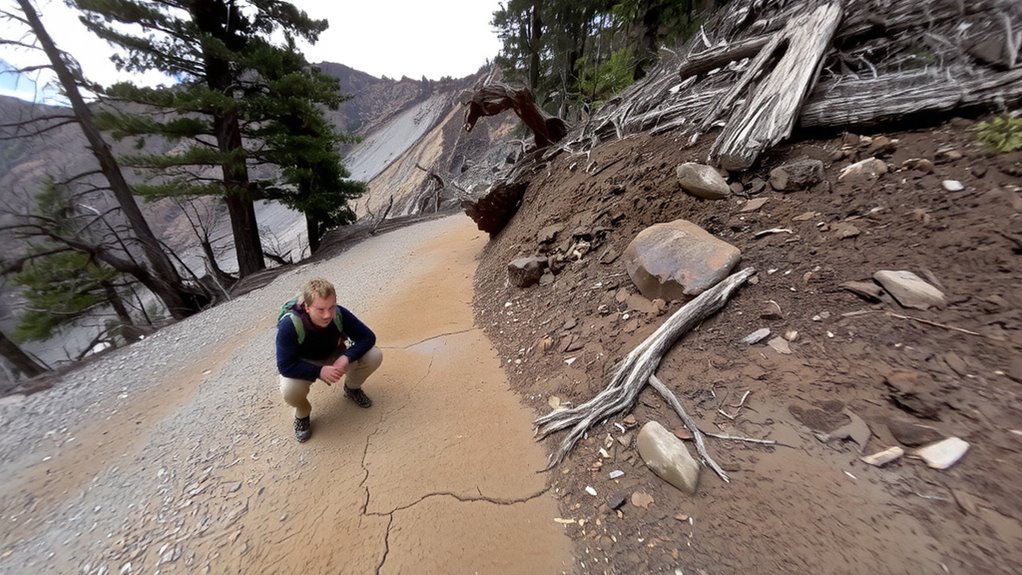
While you can’t predict a mudslide with certainty, recognizing early warning signs improves your odds of getting clear before debris moves. You should watch for soil saturation, especially after prolonged rain-soggy ground can’t absorb more water, making it unstable. If the soil feels soft or pools form quickly, that’s a red flag. Vegetation loss is another key indicator; plants anchor the soil, so when roots decay or plants die off, slopes weaken. Bare patches on hillsides, uprooted trees, or tilted trunks suggest recent movement. You’ll often hear cracking sounds or notice sudden changes in water flow. These aren’t subtle hints-they’re direct signals the land is shifting. Muddy runoff or bulging ground at a slope’s base confirms active risk. Acting early gives you time to reassess safety without rushing. Monitoring these signs objectively helps you make measured decisions, not panicked ones.
Move To Higher, Stable Ground Immediately
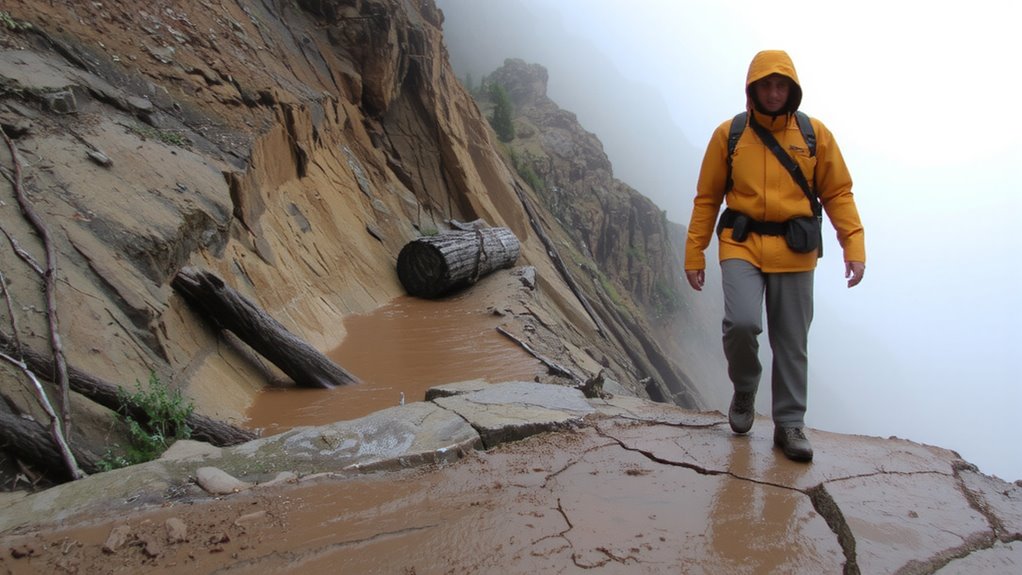
If you see the warning signs of a mudslide, you need to move to higher, stable ground right away-every second counts when the ground starts to shift. Conducting a quick risk assessment can save your life; don’t wait for confirmation. Prioritize terrain stability over distance-slopes with vegetation are less likely to fail than bare soil. Move quickly but deliberately, avoiding routes that cut across potential flow paths.
| Factor | Action |
|---|---|
| Slope angle | Climb perpendicular to the fall line |
| Surface type | Choose consolidated soil or rock |
| Erosion signs | Avoid gullies or cracked ground |
| Vegetation cover | Use rooted plants as stability indicators |
| Distance to flow | Gain elevation, not just horizontal distance |
Immediate relocation to high, stable ground reduces exposure. Your survival hinges on terrain stability and timely risk assessment-not speed alone.
Watch For Shifting Ground: From A Safe Spot
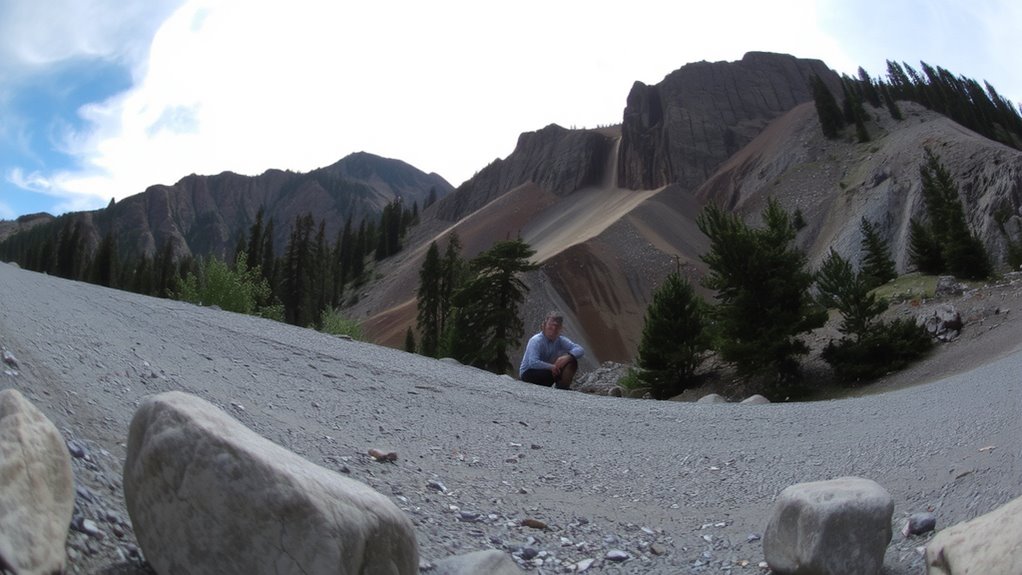
You’ve reached higher, stable ground-now stay alert. Watch for shifting ground from your safe spot, as soil saturation can weaken terrain even where it looks firm. Saturated soil loses cohesion, increasing slide risk without warning. Don’t assume stability just because you’re uphill. Observe subtle cues: ground that trembles underfoot or makes soft cracking sounds is compromised. Wildlife behavior offers clues-sudden animal movement or distressed calls often precede ground shifts. Animals detect vibrations and changes in soil saturation faster than humans. Stay at least 100 feet from any slope edge, as lateral spread is common. Use binoculars to scan, minimizing movement near questionable zones. Avoid low areas where water and debris accumulate. Your safety depends on ongoing observation, not just initial relocation. Stay patient, stay back, and let the land reveal its weaknesses.
Look For Cracks, Leaning Trees, And Road Damage
As you scan the landscape, keep your eyes peeled for cracks in the soil, because they’re one of the clearest signs that the ground is giving way. These fissures often signal soil saturation and the start of rock displacement. You’ll also want to check for trees leaning at odd angles-this isn’t normal settling; it means the ground beneath has shifted. Their roots can’t hold when water has soaked deep into the soil. Roads may appear buckled, sunken, or split, which indicates subsurface movement. Don’t ignore even small gaps in pavement or dirt banks; they can widen rapidly. Together, cracks, tilted trees, and damaged roads show the area is unstable. Soil saturation weakens structure, and rock displacement increases the risk of sudden slides. These clues are measurable and observable-use them as objective indicators. If you see two or more of these signs, the zone is unsafe. Move to higher, stable ground immediately.
Map Your Escape Route Before Danger Spreads
Where will you go when the hillside starts to slip? You need an escape plan before danger spreads. Start with a risk assessment and terrain analysis to identify safe paths. Move to higher ground quickly-avoid valleys and saturated soil. Below is a comparison of common escape route features:
| Feature | Risk Level | Best Use Case |
|---|---|---|
| Ridge lines | Low | Fast, stable evacuation |
| Riverbeds | High | Avoid-flash floods likely |
| Logging roads | Medium | Check for debris buildup |
| Forest trails | Medium | Use if dry and uphill |
Pick routes with minimal exposure and multiple exit options. Terrain analysis helps you anticipate movement patterns of mudflows. A solid risk assessment reduces hesitation when seconds count. Always pre-map two escape paths-if one’s blocked, you’ve still got options. Don’t wait until movement starts.
Signal For Help Using Mirrors, Smoke, Or Ground Markings
How do you make sure rescuers see you when visibility is limited? Use mirror reflections during daylight-aim the beam at aircraft or distant patrol points. A small signaling mirror, even with minor scratches, can flash visibility up to 10 miles under clear conditions. At night or in low light, rely on smoke signals. Build three smoky fires in a triangle; contrasting light and dark smoke increases detection. Wet leaves or green wood help generate thick smoke. Ground markings like SOS, made from debris or cleared soil, should be at least 10 feet wide and visible from above. Choose open areas for maximum exposure. Mirror reflections work faster in direct sun, while smoke signals perform better in overcast conditions but require constant fuel. Each method has trade-offs: mirrors need line-of-sight and sun, smoke needs materials and wind consideration. Use combinations for redundancy when possible. A loud, sharp whistle can also attract attention and requires less energy than shouting, making it a reliable backup; consider carrying a best emergency whistle for improved audibility and durability in harsh conditions.
On a final note
You can’t control a mudslide, but you can act fast. Move uphill now-every second counts. If the ground cracks or trees lean, you’re already in the path. A mirror or smoke signal works better than shouting. GPS or markings help rescuers find you. Sturdy boots and a loaded pack beat lightweight ease when running. Know the terrain, because once it shifts, your only option is reaction.