Safe Methods for Canning Wild Raspberry Coulis for Dessert Use
You must acidify wild raspberry coulis before canning because even naturally acidic berries can vary above pH 4.6, risking botulism in sealed jars. Use fresh, firm berries and add 1 tablespoon of lemon juice per 2 cups of puree for safety. Process pints in a boiling water bath for 10 minutes (longer at high elevations). Check seals after cooling-no flex means it’s secure. Store sealed jars in a cool, dark place. Unsealed jars go straight to the fridge. Once opened, use within a week. Safety hinges on consistent acidity and proper processing. More details follow on troubleshooting failed seals and optimizing texture.
Notable Insights
- Ensure wild raspberries are ripe, mold-free, and harvested in dry conditions to maintain quality and safety.
- Heat raspberries gently to preserve pectin, then strain thoroughly to create a smooth coulis free of seeds.
- Add 1 tablespoon of lemon juice per 2 cups of puree to achieve a safe pH below 4.6.
- Process pint jars in a boiling water bath for 10 minutes, adjusting time for elevation above 1,000 feet.
- Verify jar seals after cooling, store sealed jars in a cool dark place, and refrigerate after opening.
Why Botulism Risk Makes Acidification Essential
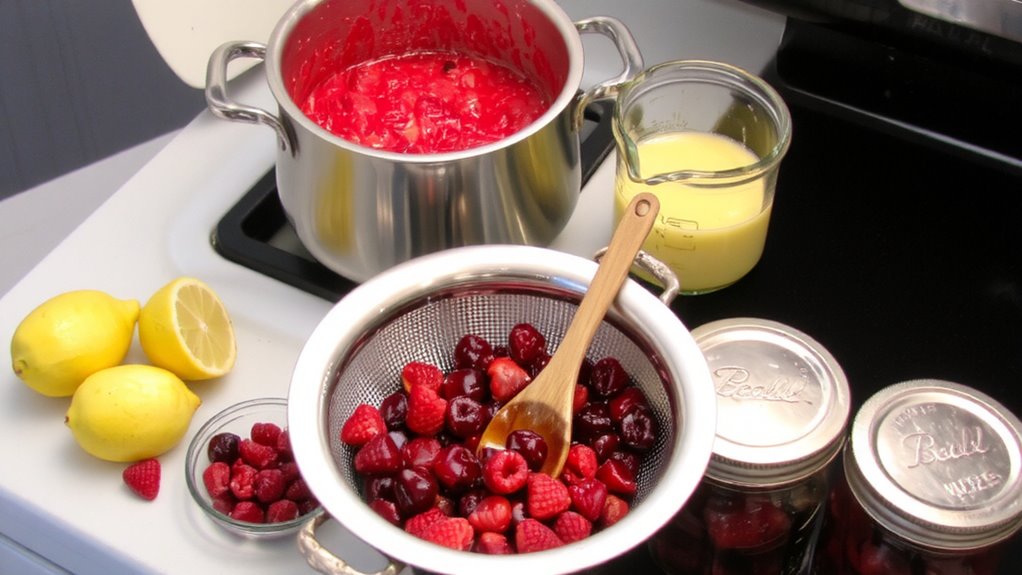
While canning wild raspberry coulis might seem straightforward, skipping acidification puts you at real risk because botulism spores thrive in low-acid, anaerobic environments like improperly preserved jars. You must lower the pH levels below 4.6 to create an inhospitable environment for microbial growth. Wild raspberries typically range between pH 3.2 and 3.9, but natural variation means you can’t assume safety without testing. Adding lemon juice or citric acid guarantees consistency. Failure to verify pH levels after acidification risks survival of Clostridium botulinum spores. Boiling water bath canning destroys active bacteria but not spores, making correct acidity non-negotiable. For safety, always use a calibrated pH meter or test strips accurate to 0.1 units. Relying on recipes without pH verification assumes risk. Proper acidification is a measurable, necessary step-not optional. Your safety depends on it.
Pick Fresh Wild Raspberries for Canning
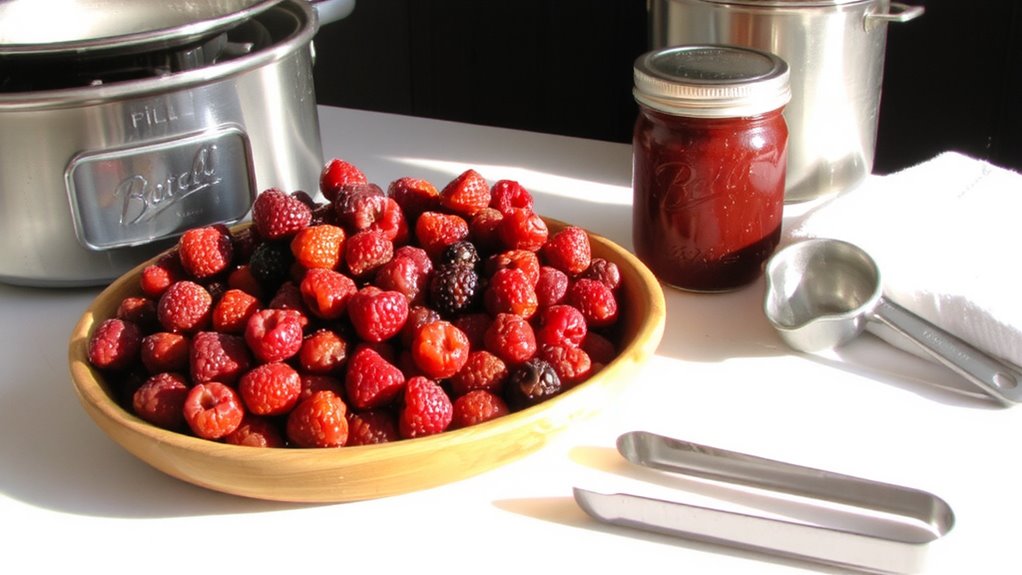
Your success starts with choosing peak-ripened wild raspberries-firm, deep-colored, and free of mold or crushing. Berry selection directly impacts yield and flavor concentration, so pass over any berries that feel soft or show signs of damp decay. A proper ripeness check means using sight and gentle touch: mature berries snap easily from the stem with a full, rich hue, while underripe ones resist removal and appear pale. Avoid overly large clusters, as they may indicate water absorption or overripening. Pick in cool, dry weather to minimize field heat and condensation in containers. Use shallow baskets to prevent crushing. Contaminants and damaged fruit introduce spoilage risks, even after processing. Selecting clean, uniform berries guarantees consistent texture and safe acidity in the final coulis. This step isn’t about perfection-it’s about eliminating variables that compromise shelf stability. Your canning outcome hinges on what you gather first.
Make Raspberry Coulis and Add Lemon Juice
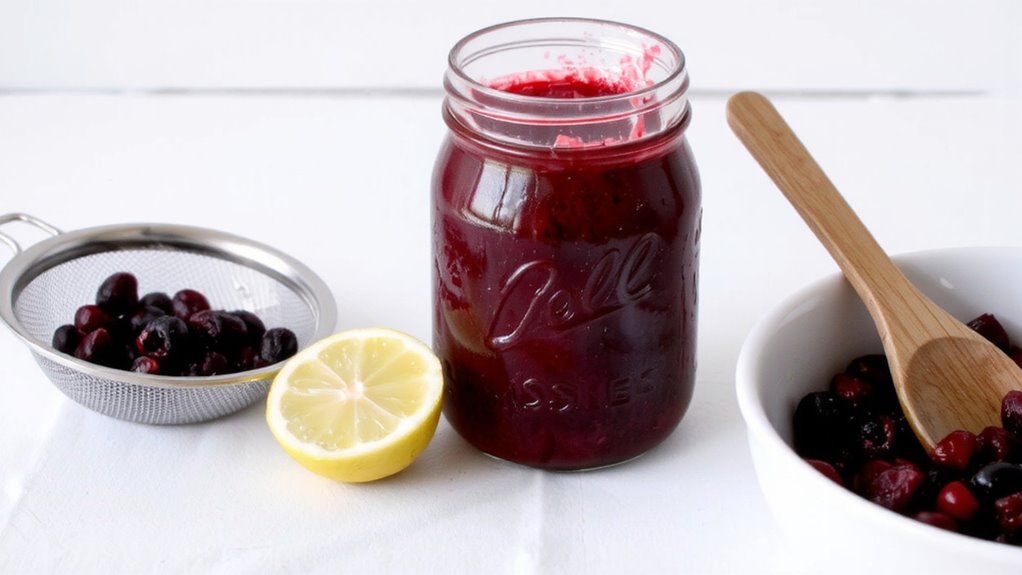
Once you’ve got your berries, it’s time to turn them into coulis by gently heating them in a saucepan over low heat. Your raspberry selection matters-use only firm, fully ripe berries to guarantee good flavor and texture. Mash them lightly as they warm to release juices. This cooking technique prevents scorching and preserves natural pectin. Bring the mixture just to a simmer, stirring occasionally. Then strain through a fine mesh sieve to remove seeds. For every 2 cups of puree, mix in 1 tablespoon of lemon juice. This boosts acidity, critical for safe canning and flavor balance.
| Factor | Recommendation |
|---|---|
| Heat level | Low to prevent burning |
| Stirring frequency | Every 2–3 minutes |
| Ideal berry state | Fully ripe, not overripe |
| Straining method | Fine mesh sieve, press gently |
Process Jars Using Water Bath Canning
A proper water bath canner or a large stockpot with a rack on the bottom is essential for processing your raspberry coulis jars safely. You need at least 1 to 2 inches of water above the jar lids during processing, so jar elevation matters-never let jars sit directly on the pot’s base. This prevents cracking and guarantees even heat distribution. Use the rack to keep jars separated and upright. Once the water reaches a rolling boil, start your water bath timing: process pints for 10 minutes at sea level. Adjust for altitude if you’re above 1,000 feet-add 5 minutes for every additional 1,000 feet. Maintain a steady boil throughout. Don’t let the water level drop too low; add boiling water if needed. Proper jar elevation and accurate water bath timing are non-negotiable for safe, shelf-stable results.
Test Seals and Store Properly
After the jars have cooled completely, check each seal by pressing the center of the lid-if it doesn’t flex up or down, the vacuum seal formed properly. If it pops, the jar didn’t seal and you’ve got a risk of canning failures. Label and refrigerate those immediately for short-term use. Properly sealed jars should be stored in a cool, dark place to maximize storage duration-ideally up to one year. Avoid areas with temperature swings or direct light, as they degrade quality over time. Inspect seals again after 24 hours; if any fail later, treat them the same as unsealed jars. Never assume a jar is safe just because it looks fine-improper seals invite spoilage. Use dated labels so you track age accurately. Rotation matters: use older jars first. Proper storage prevents waste and maintains flavor and texture. This method minimizes risk and delivers reliable results without guesswork.
How to Use Canned Raspberry Coulis Safely
While inspecting each jar before use won’t take long, it’s a critical step-always check for a proper seal, bulging lids, or off-odors, since even a correctly canned coulis can spoil if storage fails. Storage safety depends on consistent refrigeration after opening; keep the jar at or below 40°F to limit bacterial growth. Once opened, use within seven days. Never leave it at room temperature for more than two hours. If you’re using it in desserts, consider the final serving temperature: serve chilled or reheat to at least 165°F if combining with warm elements. This guarantees safety without compromising texture. Do not taste suspicious batches-discard immediately if signs of spoilage appear. Your judgment matters, but verified conditions matter more. Safe handling and attention to storage safety and serving temperature protect against risk.
Troubleshoot Common Canning Problems
Why do some jars fail to seal even when you follow the steps exactly? Small debris on the rim or a warped jar can break the vacuum. Always inspect each jar before filling. If you spot jar leakage after processing, it’s likely due to overfilling or trapped air bubbles. Leave the recommended headspace to avoid this. Lid rust can compromise seals, so check lids before use and discard any with corrosion or dents. You shouldn’t reuse lids, even if they look fine-threads weaken after one use. If a jar doesn’t seal within 24 hours, refrigerate and use it within two weeks. Re-process only if caught early. Cloudy liquid or spurting during opening often signals contamination. Store jars in a cool, dark place, and rotate stock yearly. Proper prep reduces failures more than any tool or brand. Your consistency matters most.
On a final note
You’ve preserved wild raspberry coulis safely by acidifying with lemon juice and using water bath processing. This method prevents botulism and guarantees shelf stability. Test seals, store in a cool dark place, and use within a year for best quality. Discard any unsealed or bulging jars. The coulis works well in desserts, adding bright flavor without additives. It’s a reliable, low-risk preserve if you follow tested guidelines.