Understanding the Role of NWS in Activating Wireless Emergency Alerts
You get a Wireless Emergency Alert because the National Weather Service (NWS) confirmed dangerous weather meets strict criteria, like 58 mph winds or radar-verified tornadoes. They trigger these alerts using cell broadcast technology over a dedicated spectrum, so your phone receives them without needing data or Wi-Fi. Unlike apps or news, WEAs work during network congestion and target your location via cell towers, not apps. Delays are rare, usually under 30 seconds. Knowing how they’re sent helps you trust the alert-and act fast.
Notable Insights
- The National Weather Service (NWS) issues Wireless Emergency Alerts (WEAs) when hazardous weather meets strict, measurable criteria.
- NWS forecasters verify threats like tornadoes or flash floods using radar, spotter reports, and real-time environmental data.
- Alerts are sent via the Commercial Mobile Alert System to cell towers in affected geographic areas.
- WEAs are broadcast over dedicated spectrum, ensuring delivery without relying on internet or data connections.
- The NWS ensures timely warnings by leveraging cell broadcast technology that reaches all compatible devices within range.
When the NWS Sends a Wireless Emergency Alert
Why would you get an alert from the National Weather Service (NWS) on your phone? Because severe weather threatens your location, and the system uses cell broadcast technology to reach you. You’re alerted only when signal propagation allows the message to reach nearby towers. It’s not instant-network latency means delays of seconds to minutes, depending on carrier systems. The alert doesn’t rely on data or apps; it uses dedicated spectrum, so even basic phones can receive it. Coverage gaps exist in rural or topographically blocked areas where signal propagation is weak. Network latency also varies by provider but generally stays under 30 seconds. You get the alert based on your phone’s connection to local towers, not GPS, so location accuracy depends on tower range. This isn’t perfect, but it’s fast and wide-reaching. When every second counts, this system delivers actionable warnings to most people in harm’s way, despite technical limits.
How NWS Decides to Issue a Weather Warning
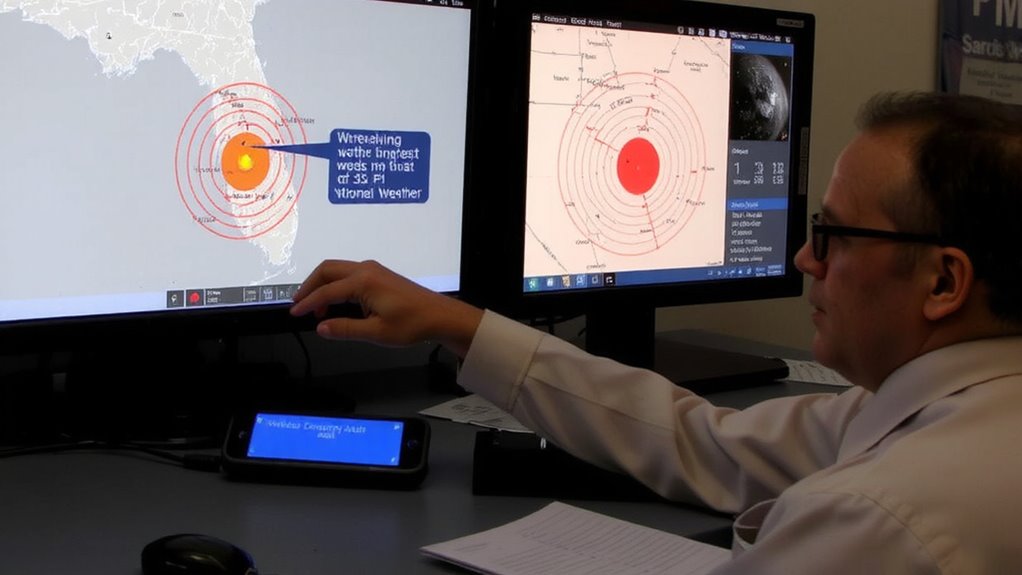
When a storm system shows signs of turning dangerous, the National Weather Service (NWS) starts evaluating hard data-not guesses or trends, but measurable thresholds like wind speed, barometric pressure, and radar signatures. You won’t get a warning unless specific criteria are met. For severe storms, that means winds hitting at least 58 mph or hail one inch in diameter. Tornadoes trigger warnings when radar confirms rotation or spotters see funnel clouds. Flash floods are judged by rainfall rates, terrain, and river levels-typically when rapid flooding is imminent or occurring. Each alert relies on objective benchmarks, not predictions. This strict approach cuts down false alarms. You’re alerted only when the threat is clear and meets defined thresholds. It’s a system built on consistency, so you know the warning isn’t arbitrary. Real-time monitoring guarantees accuracy, and human forecasters review all signals before issuing alerts.
How WEAs Reach Your Phone Instantly
Even if you’re not actively checking the news, a Wireless Emergency Alert can reach your phone in seconds because it piggybacks on cellular broadcast technology, not standard data or text messaging. This means the alert bypasses network congestion and sends the same message to every compatible device in a target area simultaneously. Your phone receives it based on signal strength and location, not app activity. Unlike regular texts, WEAs don’t clog networks during crises. Here’s how it compares:
| Feature | Standard Text | WEA |
|---|---|---|
| Delivery Speed | Slower during high use | Instant, even with congestion |
| Network Load | Adds to congestion | Minimal impact |
| Signal Dependence | Requires strong signal | Works with moderate signal strength |
You’ll get the alert as long as your phone is on and within range.
Why NWS Alerts Are More Reliable Than Apps or News
If you’re relying on weather alerts to make quick decisions during emergencies, you’ll find NWS-sourced WEAs more dependable than third-party apps or news outlets because they come directly from a nationwide, standardized system with guaranteed uptime. Unlike apps, which depend on background updates and data connections, WEAs use cellular broadcast technology that doesn’t rely on internet access. This means they still deliver during network congestion, when regular data traffic slows or fails. Apps can lag or miss alerts if servers are overloaded or if your signal strength weakens. WEAs, however, have priority delivery through the Commercial Mobile Alert System, ensuring they reach your phone even on low signal strength. News outlets may delay reporting or lack real-time geolocation targeting. With NWS alerts, you get timely, location-specific warnings without depending on app accuracy or streaming stability.
What to Do When Your Phone Alerts You
What happens the moment your phone sounds off with a Wireless Emergency Alert? You should act immediately, not panic. These alerts bypass regular notifications, signaling a verified threat. Your immediate response starts with reading the message fully-don’t assume. Check the event type: tornado warning, flash flood, or AMBER Alert-each demands different actions. Follow your emergency preparedness plan, such as sheltering in place or evacuating. Move to a basement or interior room if it’s severe weather. Confirm alerts with official sources like NOAA Weather Radio if possible, but don’t delay your initial response. Keep your phone charged and volume on to guarantee you receive future alerts. Emergency preparedness means knowing protocols in advance. Practice them with household members so your immediate response becomes routine, reducing hesitation when seconds count. A reliable NOAA weather radio can provide continuous, real-time updates directly from the National Weather Service, complementing your phone’s alerts.
On a final note
You get Wireless Emergency Alerts because the NWS meets strict criteria for severity, urgency, and likelihood. These alerts use dedicated cellular channels, so they arrive even when networks are slow. Unlike apps or news, they’re free, automatic, and don’t rely on internet or settings. You can’t customize them, but that guarantees everyone in the threat area gets the warning. Turn off only if risks are low where you live.