Understanding the Risk of Power Outages From Lightning Strikes
Lightning can hit near power lines and send surges through the grid, even without a direct strike. Your system may experience outages from tripped controls or damaged transformers, not just broken lines. Older grids with overhead wires and poor grounding fail more often. Surge protectors with 1,000+ joules help, but they wear out over time. Utilities use hardened equipment and fast-acting reclosers to reduce downtime-knowing what’s next could make all the difference.
Notable Insights
- Lightning strikes near power lines can cause outages by disrupting control systems, even without direct contact.
- Surges from ground currents create voltage differences that damage equipment and trigger protective shutdowns.
- Power line and transformer damage often results from extreme voltages exceeding system insulation limits.
- Older grid infrastructure with poor grounding and overhead lines increases vulnerability to lightning-induced outages.
- Surge protectors help mitigate indirect surges but cannot stop outages from direct or extremely powerful strikes.
How Lightning Causes Power Outages
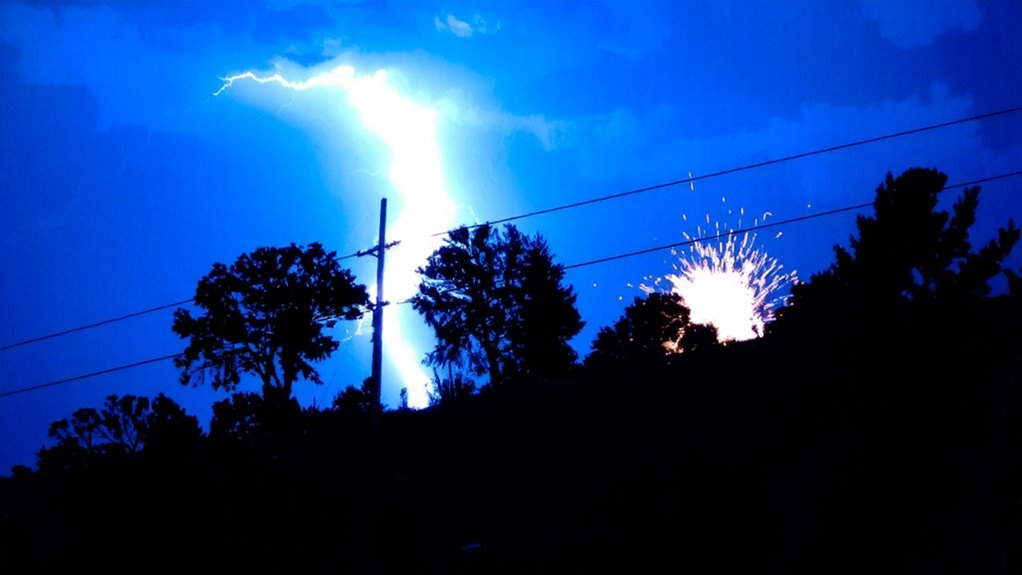
When lightning strikes near a power line, it doesn’t take much for your electricity to go out-just a single surge. That surge introduces electromagnetic interference, disrupting the signal and control systems managing power flow. You’re not just dealing with a spike in voltage; the ground current spreads outward from the strike point, creating uneven potentials across equipment. This current can enter your electrical system through grounded components, overwhelming circuits even if the line wasn’t directly hit. Most protection devices react in microseconds, but not all surges are stopped completely. Ground current can bypass filters, and electromagnetic interference can degrade data signals in smart meters or relays. You’ll lose power not because the line is destroyed, but because sensors trip or controls fail. Surge protectors help, but their response speed and clamping voltage determine effectiveness. A 40,000-amp surge may overwhelm even well-rated devices.
What Lightning Does to Power Lines and Transformers
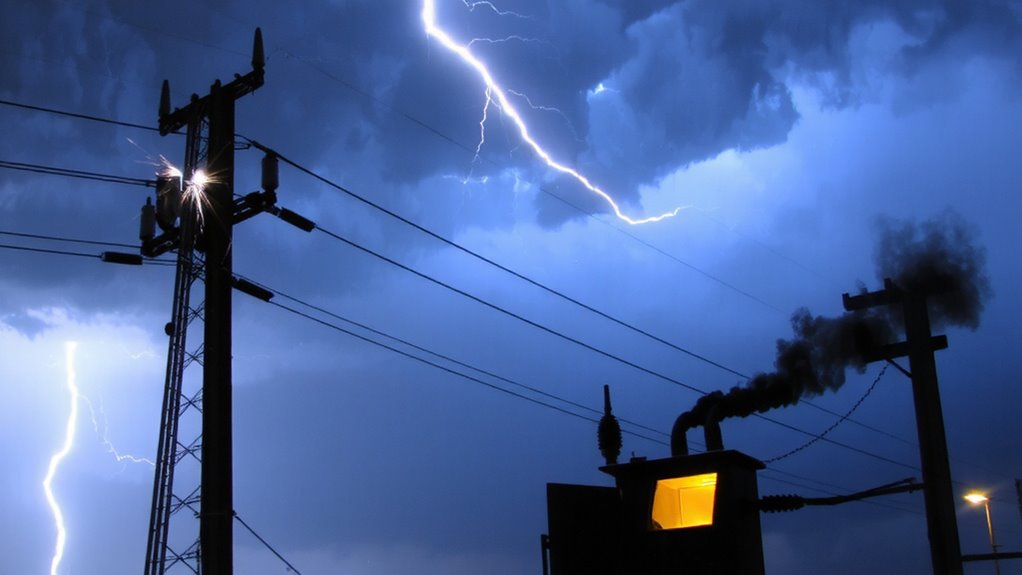
A single lightning strike can deliver over 100 million volts, and your power lines aren’t built to handle that kind of surge. When lightning hits a line or nearby ground, it sends a massive voltage fluctuation through the system, overwhelming transformers and protective components. These surges can melt conductors, crack insulators, or fry transformer windings, leading to immediate outages. Even if equipment survives, electromagnetic interference from the strike can disrupt control signals, causing misoperations in automated grid systems. Voltage fluctuation stresses connections and degrades materials over time, increasing failure risk. Transformers, especially older units, often lack sufficient surge protection and fail when exposed to such extreme spikes. Damage isn’t always visible, so some issues only surface later under load. While arresters divert some energy, they can’t catch everything. You’re left with compromised equipment that may fail days or weeks after the strike, making maintenance inspections essential-yet often overlooked-after thunderstorms.
Why Some Grids Are More Vulnerable to Lightning
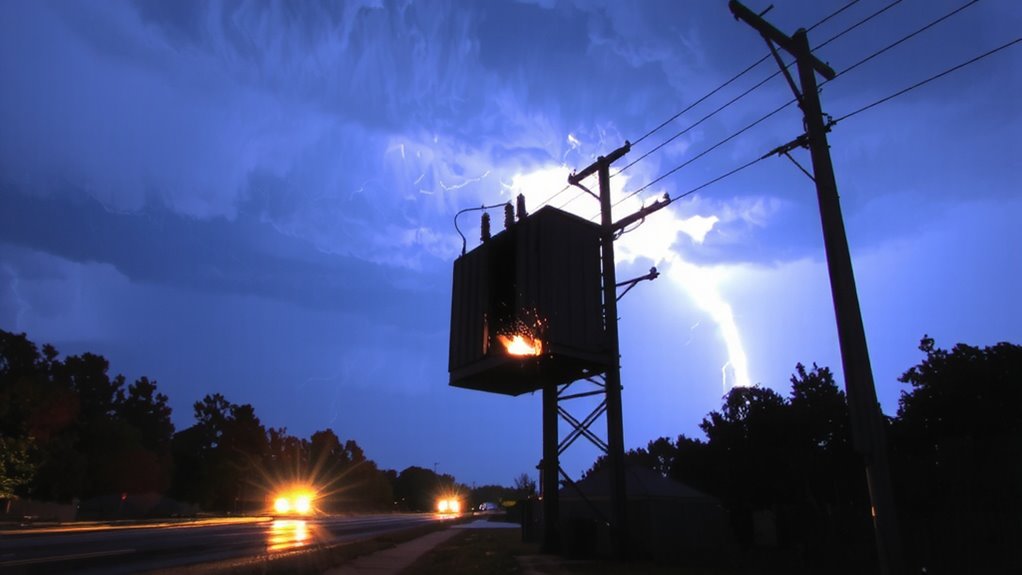
Your grid’s exposure to lightning damage depends heavily on design, location, and age. Grid design plays a key role-older systems often lack modern shielding, proper grounding, or redundancy, making them more likely to fail when struck. If poles are spaced too far apart or lines are overhead without adequate insulation, surges travel easily. Geographic location matters just as much. Regions with frequent thunderstorms, like the southeastern U.S. or mountainous areas, see more strikes, increasing risk. Coastal areas face added challenges from salt corrosion, weakening components over time. You can’t change where you are, but grid design can be upgraded. Systems built with lightning-resistant materials, shorter spans, and buried lines fare better. Some utilities install metal oxide arresters at weak points. Still, even well-designed grids in high-risk zones face higher failure rates. No system is immune, but smart design reduces outage frequency and duration.
How Surge Protectors Prevent Lightning Damage
Though lightning strikes bring extreme voltage in microseconds, surge protectors won’t stop a direct hit-they’re designed to divert excess energy from indirect surges that travel through power lines. You rely on them for surge absorption, where metal oxide varistors (MOVs) inside clamp down on voltage spikes. When excess voltage hits, the MOVs absorb the energy and redirect it to the ground, shielding connected devices. Good models handle up to 4,000 volts, but their protection degrades with repeated surges. Voltage regulation is limited-most units don’t stabilize ongoing line voltage but respond only to sudden spikes. You’ll want one with an indicator light to show protection is active. Joule ratings matter: higher values, like 1,000 or more, mean greater surge absorption capacity. They’re not foolproof, but used correctly, they reduce damage risks from nearby strikes. Replace them every few years or after major surges.
How Utilities Prevent Lightning-Caused Outages
Most lightning-related outages aren’t from direct strikes to power lines but from induced surges or flashovers caused by nearby strikes, and utilities use several proven methods to reduce the impact. You’ll see grid hardening used widely-this means installing stronger poles, covered conductors, and more durable transformers that resist damage. Automated reclosers quickly restore power after a momentary surge, minimizing downtime. Utilities also apply predictive monitoring, using weather data and lightning detection networks to anticipate strikes and isolate vulnerable sections before failure occurs. Sensors across the system detect abnormal current spikes, triggering immediate responses. While no system is failure-proof, these layers reduce outage frequency and duration. Grid hardening costs more upfront but lowers long-term repair needs. Predictive monitoring works best when integrated with real-time grid analytics. Together, they offer a practical defense-not perfect, but effective under most storm conditions.
How to Prepare for Lightning Blackouts
When a storm rolls in, having a plan beats scrambling in the dark-literally. You should keep emergency kits stocked with flashlights, batteries, water, non-perishable food, and a first-aid kit-enough to last 72 hours. These kits are only useful if you check supplies every six months; expired items reduce effectiveness. A reliable 72-hour emergency kit can make all the difference during extended power outages caused by lightning strikes. If you rely on medical devices or need continuous power, consider backup generators. Portable models typically run 8–12 hours on 1 gallon of fuel, but they require outdoor use to prevent carbon monoxide buildup. Inverter generators are quieter and more fuel-efficient, though they cost more upfront. Transfer switches are essential for safe generator use-backfeeding through outlets kills. Surge protectors won’t prevent outages, but they reduce equipment damage. You can’t stop lightning, but preparation reduces risk. Practice your plan so everyone knows where supplies and flashlights are.
On a final note
You can’t stop lightning, but you can reduce its impact. Surge protectors with at least 1,000-joule ratings help shield electronics. Hardened transformers and properly grounded lines lower outage risks. Utilities use reclosers and lightning arresters, cutting outage times by up to 50%. Still, rural grids fail more often-fewer redundancies. Keep a battery-powered radio, 72 hours of water, and a flashlight. These measures aren’t foolproof, but they’re proven.